I'm Aaron Flam and you're watching Deconstructive Criticism. The Shiite terror organisation has been born in Lebanon, joined in the Hanass attack on Israel the 7th of October on the 8th, the day after. Before Israel had entered Gaza and Israelis, we're still defending themselves in their own territory. In 2010, up to 250,000 Israelis are internally displaced in their own country.
I meet with Sarit Sahavi in her offices, less than 20 kilometres from Israel's border with Lebanon. Sarit is the founder and president of Almas Center and specialises in Israel's security challenges on its northern border. She has written numerous position papers and updates focusing on Lebanon, Syria and Israel's national security challenges. She served for 15 years in the Israeli army, specialising in military intelligence and as a reservist, her rank is Lieutenant Colonel.
Her unique achievements led her to be selected by the Jerusalem's post as one of the top 50 most influential global Jewish personalities of 2021. Enjoy. Mr. Sarit Sahavi, welcome to Deconstructive Criticism.
Thank you for having me. I usually start with a very simple but extremely complicated question to all my guests. Who are you? I'm the founder and president of Almas Research and Education Centre.
Yes, and before that. I'm retired Lieutenant Colonel from the Israel Defence Forces. I was an intelligence officer. And your family is originally from?
I was born here in Israel. My father was born in Damascus. His mother was born in Beirut. My mother was born here.
My grandmother from my mother's side was born here in Fevon. And my grandfather from my mother's side was born in Hispan, in Iran. Okay. And your expert on his bola?
His bola, Syria, Lebanon, the Iranian involvement in the region. Yes, many of the northern challenges of security to Israel. How did you become an expert in that particular area? I served in the northern command since I was assigned to the northern command since 2007 and came to live up north.
And when I ended my service about a decade ago, I decided that I wanted to continue to talk about it and to research these issues that I did the same thing in the army. So it was a process. I also have an email list in study. So practically all my life, I knew that I wanted to be an expert for the Middle East and what is happening here in the past 20 years, I focused more on the north.
And you speak Arabic? I understand. I can't say I speak because I never studied the spoken language. I studied the literature language.
So I understand I can read. And Farsi? No. No.
So tell me about his bola. Where did they come from? As well as founded in the 80s, the beginning of the 80s, there is a disagreement between the researchers of who founded the Hezbollah, whether it's an original Lebanese initiative, whether the Syrians had done that, whether the Iranians had done that. But what I can say is that from the very beginning, the Iranians identified an opportunity here.
And when Hezbollah was founded, it was founded under the title of the Islamic Revolution in Lebanon, meaning Islamic Revolution of Iran in 1992, Hezbollah changed its name when it wanted to become part of the Lebanese political system to the Islamic resistance in Lebanon. And that's how the campaign against Israel became first priority for Hezbollah officially. I must say officially because under the surface, eventually what Hezbollah wants is to distribute the Islamic Revolution's values to take over Lebanon and to have an Islamic state in Lebanon. To fight Israel, it's part of this ideology.
And it's also a tool to take over Lebanon. But Hezbollah is Iran's primary proxy. Yes. And they have lots of proxies.
Right. This is the most senior big and professional proxy. And the last day, the leader of Hezbollah has a very high position among the Ayatollahs of Iran and the Supreme Leader of Iran. But at the end of the day, it's a relationship of a boss and an employee.
And he's the boss, Hezbollah is the employee, even though it's the most senior manager of the organization, if you like. You told me earlier that your thinking on Hezbollah changed after October 7 and the atrocities that are mascommitted in Israel. How so? My thinking of my security change.
I always knew what is Hezbollah. I think that today I don't only understand the danger, I feel the danger. I personally feel the danger. And this change is huge because when you feel the danger, just at your doorstep, you are no longer willing to comply with the presence of such a brutal, cruel organization and terrorist army as it is today, South Lebanon and Lebanon.
I used to see things but every day on the border, I was meters away from them. They took photos of me, they were spying on me with the big binoculars. I took photos of them as well. And I was never afraid, I never carried a gun.
And today, after what happened in the South, I know that Hezbollah has the same intentions, it has the same operational plan and it has the same capabilities. So this is existential fear. I actually fear for my life and my family's life. And I am not willing to have any compromise on my life, on my very personal security.
And I think that what I'm saying now, represent not only myself, represent around 300,000 Israelis that are given in all cities. You said that they have the same capabilities as Hamas. That's not. They have more.
So can you tell me a bit about the So if you compare this to the Nughba of Hamas, they are much more experienced. The Nughba were already trained. But now we're also very, very experienced and successful in Syria. That's one thing.
Second, in numbers, the Almon al-Nghamas. And third, if you look at the arsenal of rockets and drones and missiles, this arsenal is very different from Hamas. It is much more accurate. It is high quality and most important, it is 10 times more than the arsenal of Hamas.
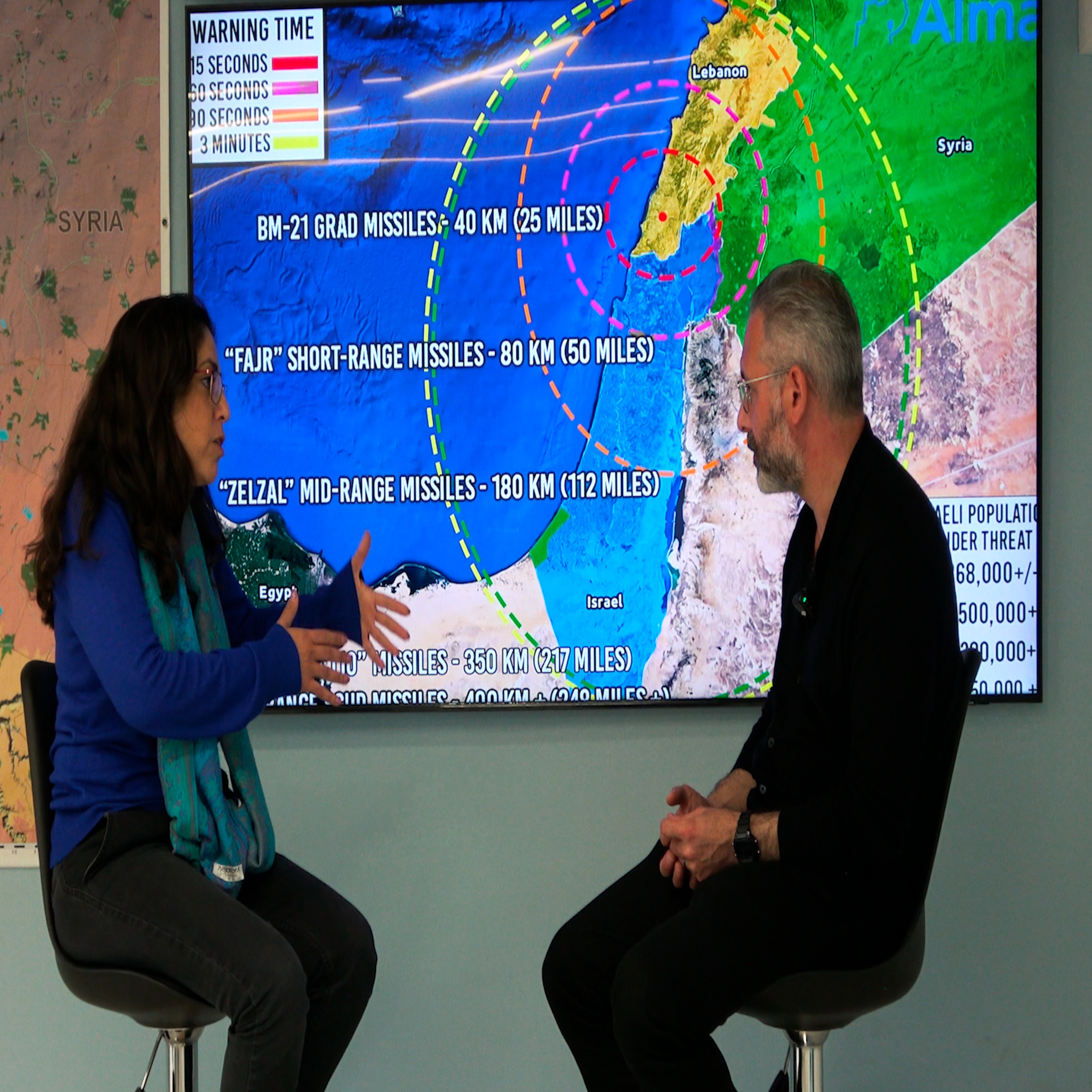
10 times more. Hezbollah has around 200,000 missiles, rockets, more tiles, all different types and around 2000 UAVs. Al-Ngh is stored just like you saw in Gaza inside the homes, under civilian infrastructure of the Lebanese, whether it's in South Lebanon, Beirut or in the Bakavali. So tell me a bit about this graphic that we see on the screen here.
What is this? These are the ranges of the Al-Nghamas. And the red circle is actually the area which is around the borderline. The main diminution that can get to this range is the anti-tanks which we don't know how many they have, but they already launched.
I think at least a few hundreds of them may be more CCC-4 started because it's every day, every day a few. These are accurate missiles that aren't done, cannot intercept and there are no alerts. It's a wreck shooting and very accurate. Up to 10 kilometers, around 140,000 motors which are not that accurate can be intercept by aren't done, but not always.
It depends on the distances, how high up they were launched, etc. But it's a huge amount of motors and even if you say that, okay, many of them are for to face IDF, if it will invade, even if 10% are to face Israel, that's a lot. To face Israeli sign. All these immunization is meant for a campaign against Israel, okay?
Not anyone else, that's the area. The pink circle that you see is representing 65,000 rockets that can get to ranges of 30, 40, 45 kilometers and some of them are accurate. A small amount, probably a few hundreds. We don't know exactly, okay, it's evaluations.
But we understand today that this battle made a project. It also made these rockets of a few tens of kilometers to make them accurate. GPS guided. Yes, in a way.
But it's not again, it's not direct shooting. You set it and it flies, that's it. It lands when you set it. The orange circle is for rockets, which the range is around 200 kilometers and it's a bit less.
Something of the sword, this is Jerusalem. If you want it from the borderline, it can get to Jerusalem. Israel is very small. And the last two circles represent the missiles that can get to 300 kilometers, maybe more.
There are various types here, okay, and this will, from each type you have, I don't know, a few hundreds or a few thousands, it depends on the type. Again, very few are accurate, very few meaning, maybe a few tens are accurate. And also in the circles you have 2000 UAVs that were used in the current war against us. Actually, now the oldest reservist told you that was killed in this war was killed in the northern front from a direct hit of UAV.
It was 53 years old. Just suicide drone. Just suicide drone. They used mostly suicide drone and a little bit they used also drones for intelligence control.
And here you can see how much time we have to run for shelter. So practically if we hear the silence here, we have 15 seconds to run for shelter. I can tell you that it doesn't feel like 15 seconds. I had an argument with my mayor.
I told him, no way it's 15 seconds. You're just promising stuff. It doesn't have, because I never made it on time in my home. I never made it on time.
In your home? In my home. I never made it on time. I was in my home.
I heard others. I had to get the family into the shelter. It never happened. And then he made an exercise and he proved me that it's 15 seconds, but it's really a short time.
It's not enough. Where is Tel Aviv on this map? I'll somewhere over here. Okay.
So there are arsenal can almost reach Tel Aviv. I mean, I can say more so, the arsenal, but a few thousands can get to Tel Aviv and maybe more. And the only safe space in Israel is basically from its own life. The drones can get to a lot.
We have drones that are coming from the hoodies that you're trying to get to a lot. That's what covers all of Israel. So in your opinion, what should be done about this dollar? If you were the Prime Minister, every solution comes with the tag price.
Okay. We need to understand. The world is talking about the diplomatic solution. Okay.
It could be it could work if it's if it is a solution. If it is just an arrangement for a ceasefire, it's not a solution. It's a ceasefire and ceasefire means that Hezbollah will be capable of preserving its military capability. And as I've said, this is unacceptable.
This is not going to happen. We cannot live with the military threat of invasion and massacre and missiles anymore. Now, what do I mean? The suggestion that was published by the French is that Hezbollah will be drove a few kilometers from the Israeli border.
The enforcement will be on the UN and the Lebanese army and there nobody talked about the deadline. So first, I think that it should be a deadline. Second, withdrawal is a fiction. We should talk about this.
Because Hezbollah military operatives live in South Lebanon because if they withdrawal, it's a few kilometers, they can drive back. And if they reserve all their military capabilities and they head waters and they miss out on the weapons, they drive back. They take everything that is already there and they continue to Israel. But there is a UN resolution that the South Lebanon is to be demilitarized.
No, the UN resolution says that South Lebanon in depth of around 25 kilometers from Israel and border should be empty of any illegal weapon, meaning that it's legitimate for the Lebanese army to be there. It's okay. UN field with 10,000 soldiers, UN forces, with a lot of European forces on the way, is there as well. It is an armed force, UN armed force.
But it never happened. This arrangement never happened. It's been more than 17 years since this UN security constitution that didn't create an effective enforcement mechanism. They didn't have a deadline.
And Hezbollah never respected the resolution. Never from day one. The only thing Hezbollah had done was to hide and conceal its military presence in South Lebanon until, you know, we say Hebrew, the same bride, until they got to the point that they didn't have even to conceal. They were openly marching and observing on the borderline and deploying with guns, uniforms, with cameras, whatever.
But what is UN field doing? Nothing. And the Lebanese army collaborating with Hezbollah. Okay.
I myself witnessed that. When I was one of these times that I was filmed by Hezbollah on the border, he was accompanied by Lebanese army soldiers. They were together. So in your mind, a strike on Hezbollah is unavoidable.
The cost of war, I said that every option comes with attack press. The cost of war or the risk of war is huge for both sides. Okay. And since Hezbollah has accurate missiles, if these missiles will not be taken off before their launch to Israel, they can cause a lot of damage.
Even though we have Iran, though, Iran is not 100%. That's it. Okay. Since Hezbollah has disamount of missiles, we are talking of amount of fire that we have never met before, including not in the current war.
I think that what Israeli government is trying to do now, the policy, is to try to gain a sufficient military achievement without deteriorating into a full-scale war. It's an option. But how? Is this option is going to succeed?
I'm not sure. Because first, when you're doing that, you're taking the risk of war every day, again and again. And second, you don't know whether eventually you will get a sufficient military achievement. What is a sufficient military achievement?
You tell me, you're the intelligence expert. I think that a sufficient military achievement would be first to attack all the assets of other one brigades. How many are they? We are.
You don't know? When I'm saying assets, I mean all these headquarters and weapons and commanders, Israel is doing that. Is this going to be sufficient? I don't know.
For how long it's going to be sufficient? I don't know. But I think that the Israeli government is very careful from deteriorating into war. And on the other hand, it understands that if 60,000 Israelis were evacuated from 43 communities, how can we provide them security and enable them to go back to their houses?
Because as I've said, Israelis are no longer willing to live next to the master. It's not going to happen. So there is no ideal solution here. Okay?
There is no ideal solution for us. But you're going to have to face it sooner or later. I mean, because you said yourself, you're not willing to put up with the risk of living next door to his bowl anymore. So something has to be done.
I portrayed the three options. We haven't talked about attacking Iran. Ah, I don't think this is an option. Why?
For Israel by itself. And second, I don't think this is an option. You're going to do the nuclear issue. This will have to be taken in consideration.
If there will be an attack against Iran, any attack like that, doesn't matter whether it's Israel or any other player, this attack should include first and foremost nuclear facilities in Iran, which is another goal, a military goal to meet another security challenge that we are facing here in Israel. But wouldn't that be so strange? I mean, Israel has attacked nuclear installations in Iran countries. This is completely different.
Also. Because in Iraq and in Syria, it was one plant, one location. Iran has much more. I can't remember the number, but it's much, much more.
So you need to carry on an attack that is in a bigger scale than what we had done in the past. But I'm guessing you don't think it's an option for Israel to wait until Iran gets it. No, of course. Because that would be true.
But I also don't think it's an option that Israel would do it by itself. I think that the world should join us because nuclear weapon in the ends of Iran means the risk to Sweden, to Belgium, to Poland, to all these countries that are very close to Ukraine because of the alliance that is, you know, prospering now between Iran and Russia, which we want to have both of them nuclear? No, personally, if I got to choose, I would say no. I don't get to choose.
I think that what should be created is a world wild coalition to stop Iran from becoming nuclear. This is very important. But do you see any sign of that in the Western immunity? Unfortunately, no.
Unfortunately, no. And it's a huge risk. I don't think Iran being nuclear is a threat to only to Israel. It's not just a problem for Israel.
It's a problem for everybody. So we're screwed, basically. I don't know. I'm trying to change the whole thing that I do.
Now I'm trying to make this world spread and to give the information to people to understand what's happening here and to make them understand that it's not Israel, Hamas war, it sounds much greater than that. And so all of us that believe in democracy, that believe in human rights, that share these values of the cherish life, you know, even before democracy, that's just a cherish love. We should join together to fight against this radical ideology. And if it will not do that, it will endanger all of us, not only the state of Israel.
It's not about the state of Israel. So you mentioned Russia's friendship with Iran, but they also have other friends like China. Yeah. Where do you see China's role in all of this?
China is putting a lot of effort in the past few years to take advantage of its economic involvement in the Middle East, to make it more political involvement. This is a very interesting process. We are kind of in between the beginning to the middle of it. We just started.
And so we started explicitly when we saw the normalization agreement between Saudi Arabia and Iran. The China was the mediator and it surprised everybody. Yes. But as it seems now that Saudi Arabia are still willing to become more friends with West and with the Iranians.
I wouldn't say more. I think they don't see a contradiction. I think Saudi Arabia in its point of view, and we see the same with the UAE, by the way, they have no problem having relationship with it this way, okay? It's different relationship.
But having relationship with Israel in the United States at the same time with Iran, on the contrary, they believe that this is the best way to defend themselves, okay? But isn't Saudi Arabia and Iran competing for the leadership of the Islamic world? Of course they are. But again, in the Middle East, if we are competing upon something, the best way to solve it is to try to do the okay for that we can fight, no problem.
But if we can talk, we can create open channels of dialogue. Let's create open channels of dialogue. And if needed in other places, we can fight. And you see this that in some of the places they were fighting.
In other fields, there was a normalization process that ended with actually sacrificing Yemen. You have the Houthis of Yemen, and there is no, I don't know, if there is not a Yemen, probably hardly, of a different way. Iran won in this. This normalization of the end end up in the disarmament of the Houthi rebels.
Saudi Arabia lost in this campaign. Nobody is talking about it actually. And the Houthis are another Iranian proxy? Yes.
So how many proxies does Iran have? Wow. It's the same as in the Islamic Jihad, in Syria, in Yemen. It's the Houthis of Yemen.
In Syria, you have so many proximulicians, like I stopped counting, but many militias in Syria. You have Islamic resistance in Iraq. You have groups, terrorist groups in West Bank as well, which are encouraged in getting more weapons from Iran. And you have a lot of civilian organizations that are working in various places around the world to become later on a platform for a military or terrorist activity.
Yes. When we talked earlier, you said something about Hezbollah in Sweden and Norway. They are right now, social organizations or what? In Sweden and Norway, I think it was proved that there was a terrorist activity as well, and the police was involved in this.
The Dutch and the Sages were involved in someone who arrested not only Hezbollah, but also Iranian and involvement there. We made another report about France, and there we saw civilian infrastructure that was connected to associations that had terrorist affiliations. So the connections are not direct. And this is how the net is being built.
It's fantastic to create a civilian platform on top of that, this enables you to mobilize terrorists, but nothing is direct. Everything is kind of a net that eventually ends up in Tehran and they have the connections to Tehran. And for us, we actually prove connections between civilian organizations to the Supreme Leader of Iran, to a specific association in Iran that its mission is to mobilize these military operatives, and we also found connections to leaders in Hezbollah. So what is the most important thing that you think a Western audience should hear?
That it's not in the small Hamas world, that it's the world of Western values, again radical ideologies, that if we will not work together against these radical ideologies, they will come at your doorstep and they are already there. They are already presence everywhere we look. And each the world should understand if the world is truly worried about the future of the Palestinians, Hamas should be defeated because Hamas sacrificed the Palestinians. Hamas built an underground Gaza to protect its military operatives rather than to protect civilians.
And the idea, the all tactic of Hamas was to sacrifice the civilians for the military operatives, for the military activity and for the existence of this radical ideology. That's why they are preventing the Syrian aid from these people right now as we speak. We have to fight this fight together and if we will not do that, it will come at your doorstep. It will be a physical risk for you just as it is for me today.
Thank you so much, Mrs. Darvi. Thank you. Thank you for watching or listening to Deconstructive Criticism.
This episode's guest was Sarid Sahavi and you can find more information on their webpage which you will find linked in the description below. And an extra thank you for supporting Deconstructive Criticism. A special thanks to you who have made a larger donation for this trip to Israel to become a reality. But also to you who are a Patreon at patreon.com or donate per episode if you live in Sweden via SWISH on 0768 94737 0768 947 37.
I am Aaron Flamm. Until next, have a good unit of time.