
EPISODE · Sep 14, 2024 · 1H 2M
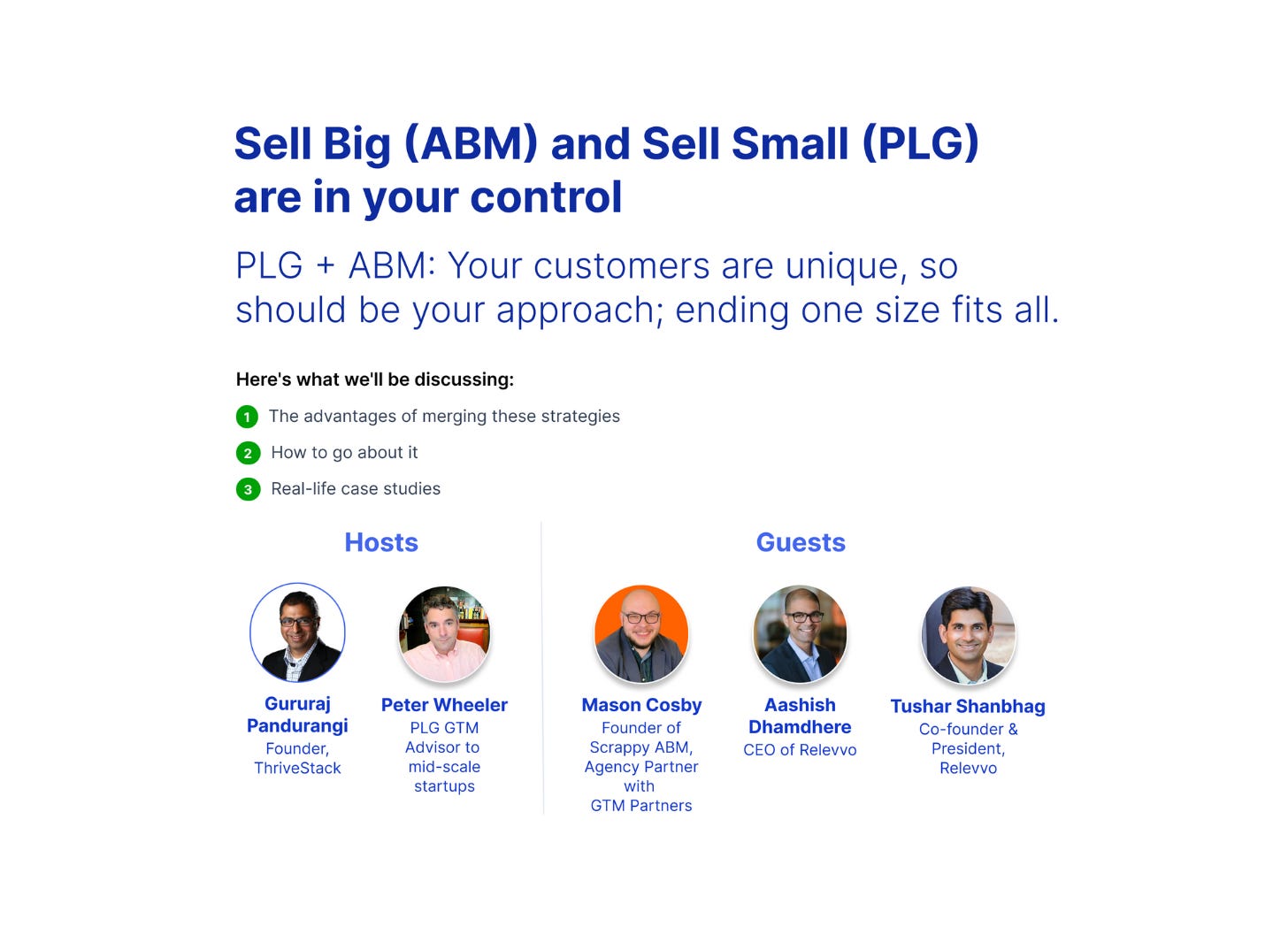
Sell Big (ABM) and Sell Small (PLG) are in your control
from Thrivecast · host Anushka Karmakar
tl;dr:* Product-Led Growth (PLG) allows users to discover, engage, and convert independently, making it ideal for scalable, low-touch products.* Account-Based Marketing (ABM) focuses on personalized, relationship-driven campaigns targeting high-value accounts with longer sales cycles.* Combining PLG and ABM enables companies to scale quickly while nurturing key accounts for larger, more complex deals.* AI-driven ABM helps by automating account identification, personalized outreach, and real-time adjustments, ensuring efficiency without losing personalization.* PLG is best for user-driven, self-service models, while ABM works for complex, high-ticket sales involving multiple decision-makers.Available on Apple, Spotify, Castbox, Google and YouTube.PLG vs. ABM: Key Differences and DefinitionsProduct-Led Growth (PLG) revolves around the idea that the product itself drives acquisition and conversion. Users explore the product independently, find value, and ultimately make a buying decision. This approach is ideal for companies where a smooth user experience leads to natural adoption, like Canva or Dropbox.In contrast, Account-Based Marketing (ABM) targets high-value accounts through personalized campaigns that focus on building long-term relationships. This strategy works best for companies with complex products or large deal sizes, where engaging key decision-makers is crucial.The key takeaway: PLG works well for user-driven, lower-touch products, while ABM is better suited for larger, more complex deals where personalization and relationship-building are essential.Should You Combine PLG and ABM?The takeaway here is clear: PLG helps you scale quickly with minimal overhead, while ABM allows you to focus on larger, more complex deals. The trick is knowing when to apply each strategy—or a combination of both—for maximum impact.Challenges in Choosing PLG or ABMEach approach presents unique challenges that companies need to consider:* PLG Challenges:* Requires a seamless product experience that allows users to discover, engage, and convert without human interaction.* Demands continuous investment in self-service features, onboarding, and product improvements to retain users and drive conversions.* Can struggle to convert free users to paying customers, especially for more complex products.* ABM Challenges:* Resource-intensive, involving personalized outreach, long sales cycles, and collaboration between marketing, sales, and customer success teams.* Needs a clearly defined and highly-targeted account list, requiring significant research and refinement.* Longer time-to-close compared to PLG, making it harder to scale rapidly.* Combining PLG and ABM:* Balancing the efficiency of PLG with the personalization of ABM requires coordination across teams.* Requires careful timing to know when to switch from PLG-driven growth to ABM-focused nurturing.* Can be resource-heavy if not managed effectively, especially for smaller teams.By weighing these challenges, companies can decide which strategy—or combination—is best suited to their growth stage and goals.When PLG Works BestPLG shines in situations where users can easily adopt and explore the product without much intervention. Companies offering intuitive tools that provide immediate user value—such as developer tools, SaaS platforms with freemium models, or products targeting tech-savvy customers—often find success with this model.* Low-touch products: PLG works well for software that doesn't require complex onboarding or customer support. Users can dive in and experience the value independently.* Developer-focused tools: Developers prefer hands-on product testing. PLG enables them to explore and adopt solutions without the pressure of a sales team.* Freemium and self-service models: Products that offer free versions or trials can benefit from PLG by letting users test before committing.However, for larger deals or more complex products, PLG might only be part of the journey, requiring a more targeted approach as deals progress.When ABM Is the Right StrategyABM is particularly effective for companies targeting high-value accounts with longer, more complex sales cycles. In these situations, a highly personalized approach is crucial to build strong relationships with decision-makers across multiple stakeholders.* Complex products: When the product requires more explanation or customization, ABM ensures the right people understand the value and are engaged throughout the buying process.* High-ticket deals: ABM is the go-to strategy for landing larger contracts, where the decision-making process involves multiple teams and stakeholders.* Nurturing relationships: With ABM, personalized communication and targeted campaigns are key to building trust and ensuring long-term success.By focusing on a select number of high-value accounts, ABM enables companies to maximize their resources and tailor their approach for each potential client.The Role of AI in ABMSmarter Account IdentificationAI helps narrow down the highest potential accounts by analyzing extensive data. It looks for buying signals, industry trends, and behavior patterns to ensure your team focuses on the right targets.Personalized Outreach at ScaleUsing AI-driven insights, companies can send highly personalized messages that resonate with each account's unique needs and challenges. AI helps craft communication that feels personal while reaching more accounts than traditional methods.Real-Time AdjustmentsAI continuously learns from customer interactions, enabling teams to adjust targeting and messaging strategies dynamically. This helps companies stay ahead of market shifts and evolving customer priorities.Increased EfficiencyBy automating much of the research and messaging process, AI allows marketing and sales teams to handle a larger volume of accounts without sacrificing quality. This leads to greater efficiency and better results.By the way, we’ll be discussing how PLG and Sales can work together at our upcoming webinar on September 24th at 10 am PST. Would you like to join us? This is a public episode. If you would like to discuss this with other subscribers or get access to bonus episodes, visit www.hybridgtm.com
Embed this episode
NOW PLAYING
Sell Big (ABM) and Sell Small (PLG) are in your control
No transcript for this episode yet
Similar Episodes
No similar episodes found.