
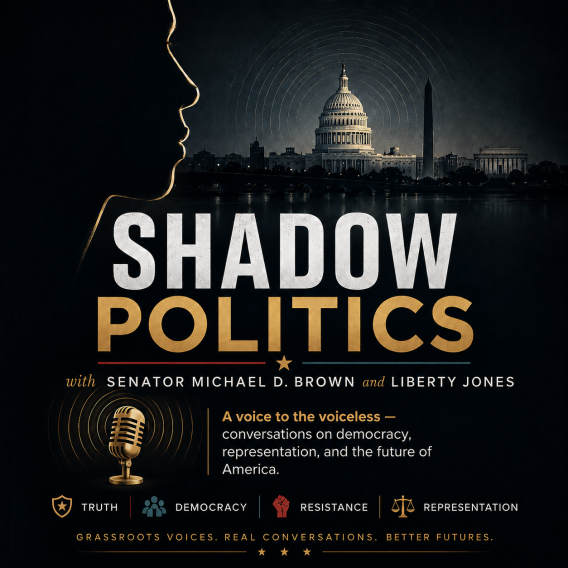
EPISODE · May 25, 2026 · 53 MIN
Shadow Politics, May 24, 2026
from Shadow Politics with US Senator Michael D Brown · host Author
Shadow Politics with Senator Michael D. Brown and Co-host Liberty Jones The Moral Arc of America: Marianne Williamson on History, Democracy, Resistance, and the Soul of Politics Guest, Marianne Williamson Michael D. Brown and Liberty Jones Welcome Marianne Williamson In this episode of Shadow Politics, host Former D.C. Shadow Senator Michael D. Brown is joined by co-host Liberty Jones and special guest Marianne Williamson, whom Michael introduces as a former presidential candidate, bestselling author, and influential spiritual and political voice. The conversation begins with Michael praising Marianne’s writing and asking about an article she wrote concerning the period leading into the Civil War. From there, the discussion becomes an examination of America’s contradictions, the moral responsibilities of citizenship, the failures of party politics, and the question of how a new generation can meaningfully resist injustice and authoritarianism. America as Both Promise and Contradiction Marianne says the truth of American history cannot be understood by viewing the nation as either entirely noble or entirely corrupt. She points to the Declaration of Independence and its universal language of equality while noting that many of its signers were themselves slave owners. In her view, the United States has always contained both the forces of oppression and the forces struggling toward liberation: slaveholders and abolitionists, segregationists and civil rights workers, financial exploitation and labor organizing, the suppression of women and the suffrage movement. She argues that the arc of American history has repeatedly bent toward justice, but only because people in each generation chose to fight for it. Lincoln, the Civil War, and Moral Leadership Much of the opening discussion centers on Abraham Lincoln and the moral stakes of the Civil War. Marianne explains that Lincoln understood slavery as incompatible with the Declaration of Independence and its promise of life, liberty, and the pursuit of happiness. She reflects on the human cost of the war and the political risk Lincoln faced when many Northern voters wanted peace rather than continued sacrifice. In her telling, Lincoln’s refusal to accept a settlement that would allow slavery to endure demonstrated genuine moral leadership: he was willing to risk his political future because he believed the preservation of slavery was fundamentally wrong. Liberty connects this history to the present, observing that moral leadership requires the courage to confront injustice even when doing so threatens one’s own power. Reading History and Reclaiming Moral Imagination Liberty asks whether the courage and injustice of earlier eras have been flattened or sanitized by modern media and politics. Marianne agrees that history has been distorted or erased in education and public conversation but urges people not to accept superficial accounts. Her answer is direct: read serious books, study the founders, Lincoln, Franklin Roosevelt, Martin Luther King Jr., Malcolm X, the suffrage movement, labor history, and the anti-war movement. She argues that the political left has lost much of its moral and spiritual imagination, contrasting the present with earlier movements shaped by religious leaders, nonviolent philosophy, and a clear moral vocabulary. Michael responds by suggesting that Shadow Politics begin recommending a book each week, while Marianne mentions her own books, Healing the Soul of America and Politics of Love, as resources exploring spirituality and politics. The Democratic Party, Superdelegates, and the Loss of Trust The conversation then turns to the Democratic Party and what the speakers describe as its internal failures. Marianne argues that political parties are not established by the Constitution and recalls warnings from George Washington and John Adams about party loyalty overpowering loyalty to country. She criticizes the Democratic National Committee’s handling of the 2016 primary, saying the party undermined Bernie Sanders in favor of Hillary Clinton and later defended itself as a private organization not legally required to operate democratically. Michael, drawing from his experience at Democratic conventions and as a superdelegate, discusses the creation of the superdelegate system and recalls pressure to support Clinton once party leaders considered her nomination inevitable. Both say the party has become disconnected from open democratic contest and from a clear commitment to working people. Liberty Jones Asks What Resistance Looks Like Now Liberty responds emotionally to the discussion, asking how younger people can resist when political obstruction appears embedded in official institutions and when online manipulation makes it increasingly difficult to distinguish truth from propaganda. Marianne says young people are confronting an extraordinarily difficult moment because they lack the lived memory of earlier periods when movements visibly changed society. She argues that resistance now must be broad, decentralized, and persistent: reading, speaking, posting, organizing, podcasting, building relationships, and refusing to become numb or disengaged. Using metaphors of guerrilla resistance and people keeping one another awake during a freezing emergency, Marianne says change cannot depend on one heroic leader, because movements centered on a few individuals can be silenced or destroyed. Instead, millions of people must continue telling the truth and strengthening one another. Spiritual Politics, Peace, and Refusing to Go to Sleep In the final portion, Marianne emphasizes that political action must be rooted in humility, receptivity, availability, and self-examination. She says people seeking justice must also confront hatred within themselves and reclaim a politics based on moral principle rather than party loyalty or personal advantage. Michael raises concern that national defense discussions focus on military confrontation without making peace a serious objective, and Marianne criticizes what she describes as a powerful military-industrial-technological system that profits from war. Liberty closes the discussion with an image from Greek mythology in which chaos gives birth to Gaia, suggesting that new creation may emerge from the present upheaval. Michael thanks Marianne and Liberty, before asking how listeners can find Marianne’s books, and Marianne provides her Substack information and describes the upcoming book-club discussions. Michael closes the episode with music dedicated to his guest.
What this episode covers
Shadow Politics with Senator Michael D. Brown and Co-host Liberty Jones The Moral Arc of America: Marianne Williamson on History, Democracy, Resistance, and the Soul of Politics Guest, Marianne Williamson Michael D. Brown and Liberty Jones Welcome Marianne Williamson In this episode of Shadow Politics, host Former D.C. Shadow Senator Michael D. Brown is joined by co-host Liberty Jones and special guest Marianne Williamson, whom Michael introduces as a former presidential candidate, bestselling author, and influential spiritual and political voice. The conversation begins with Michael praising Marianne’s writing and asking about an article she wrote concerning the period leading into the Civil War. From there, the discussion becomes an examination of America’s contradictions, the moral responsibilities of citizenship, the failures of party politics, and the question of how a new generation can meaningfully resist injustice and authoritarianism. America as Both Promise and Contradiction Marianne says the truth of American history cannot be understood by viewing the nation as either entirely noble or entirely corrupt. She points to the Declaration of Independence and its universal language of equality while noting that many of its signers were themselves slave owners. In her view, the United States has always contained both the forces of oppression and the forces struggling toward liberation: slaveholders and abolitionists, segregationists and civil rights workers, financial exploitation and labor organizing, the suppression of women and the suffrage movement. She argues that the arc of American history has repeatedly bent toward justice, but only because people in each generation chose to fight for it. Lincoln, the Civil War, and Moral Leadership Much of the opening discussion centers on Abraham Lincoln and the moral stakes of the Civil War. Marianne explains that Lincoln understood slavery as incompatible with the Declaration of Independence and its promise of life, liberty, and the pursuit of happiness. She reflects on the human cost of the war and the political risk Lincoln faced when many Northern voters wanted peace rather than continued sacrifice. In her telling, Lincoln’s refusal to accept a settlement that would allow slavery to endure demonstrated genuine moral leadership: he was willing to risk his political future because he believed the preservation of slavery was fundamentally wrong. Liberty connects this history to the present, observing that moral leadership requires the courage to confront injustice even when doing so threatens one’s own power. Reading History and Reclaiming Moral Imagination Liberty asks whether the courage and injustice of earlier eras have been flattened or sanitized by modern media and politics. Marianne agrees that history has been distorted or erased in education and public conversation but urges people not to accept superficial accounts. Her answer is direct: read serious books, study the founders, Lincoln, Franklin Roosevelt, Martin Luther King Jr., Malcolm X, the suffrage movement, labor history, and the anti-war movement. She argues that the political left has lost much of its moral and spiritual imagination, contrasting the present with earlier movements shaped by religious leaders, nonviolent philosophy, and a clear moral vocabulary. Michael responds by suggesting that Shadow Politics begin recommending a book each week, while Marianne mentions her own books, Healing the Soul of America and Politics of Love, as resources exploring spirituality and politics. The Democratic Party, Superdelegates, and the Loss of Trust The conversation then turns to the Democratic Party and what the speakers describe as its internal failures. Marianne argues that political parties are not established by the Constitution and recalls warnings from George Washington and John Adams about party loyalty overpowering loyalty to country. She criticizes the Democratic Nat
NOW PLAYING
Shadow Politics, May 24, 2026
No transcript for this episode yet
Similar Episodes
Mar 26, 2026 ·1m
Jan 2, 2026 ·47m
Dec 21, 2025 ·46m