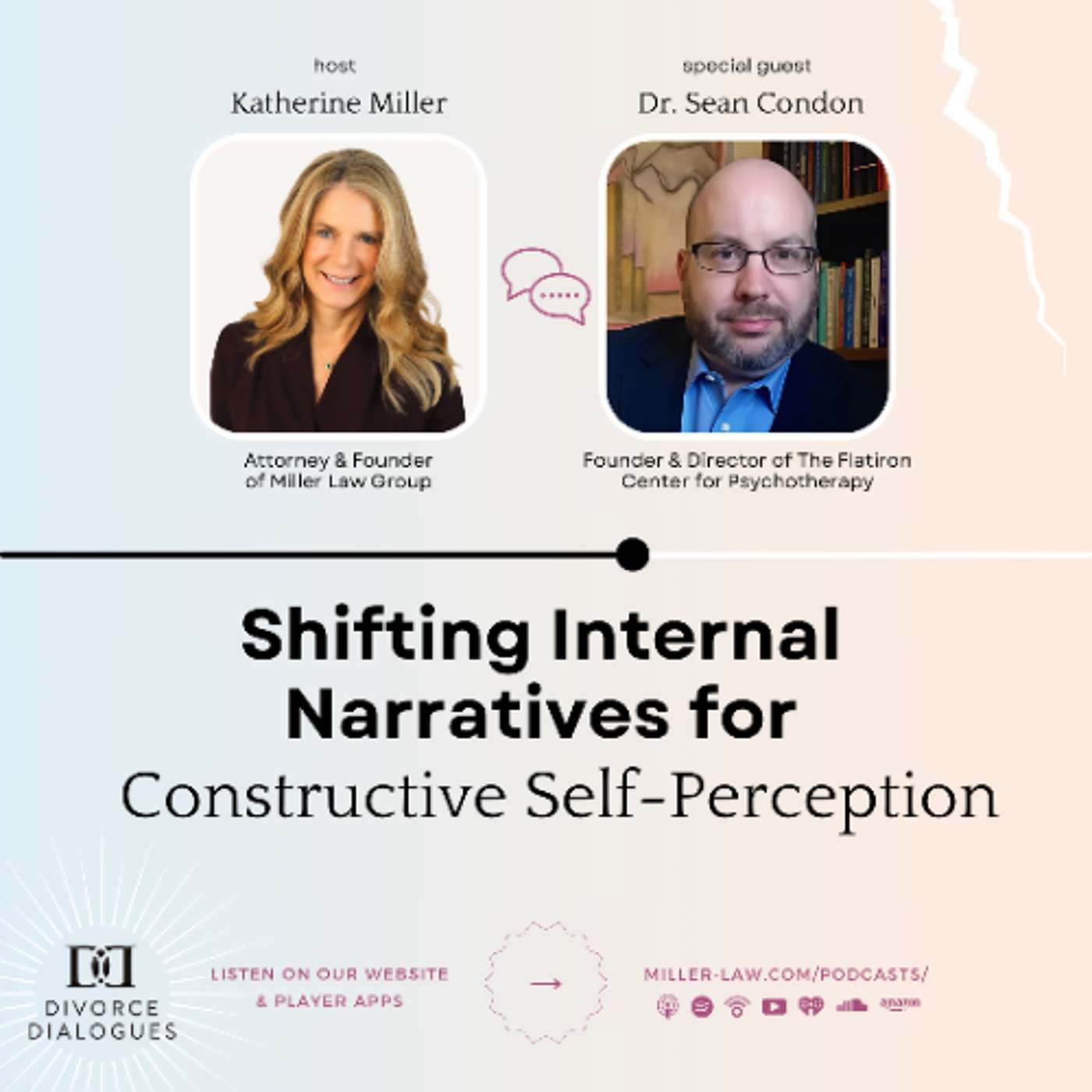
Welcome to Divorce Dialogues on Katherine Miller. The Horse Dialogues brings expert guests to the airwaves to talk through your divorce questions and fill in the gray areas about separating. From thinking about divorce, to have a behavior and divorce. What to do after?
This is Divorce Dialogues. Welcome to Divorce Dialogues. I'm Katherine Miller. I'm the founder of the Miller Law Group and a trainer at the Center for Understanding and Conflict and I am on a mission to change how people divorce and help them divorce with dignity.
And my guest today is Dr. Sean Condon. He's a clinical psychologist and founder of the Flatiron Center for Psychotherapy, where he specializes in helping individuals navigate anxiety, relationship challenges, major life transitions. Known for his warm, direct style and integrative therapeutic approach, he brings over two decades of experience that influenced getting clients toward meaningful insight and lasting change.
Welcome, Dr. Sean Condon. It's a pleasure to have you on the show. Hi, Katherine.
Thanks for having me. You know, one thing that I think is really interesting about your work is that you talk about therapy as being a space for growth, not just relief, symptom relief. And, you know, I think a lot of people go to therapy because they're experiencing anxiety or depression or fear or sadness or dissatisfaction with life. That's a good thing.
Right? There's something that comes out that, and certainly divorce is one of those things. And so for our listeners, after divorce, what does healing really look like in your view from that perspective? Right.
Now, that's a great question, Katherine. And, you know, I think for you and your listeners, I don't want to sugarcoat it either. I think that going through divorce, there are opportunities for healing and even for growth, but I don't want to make it sound like, Oh, you should look at your divorce as an opportunity for growth. I think you and I know it's not so simple as that.
The idea, though, for healing, for example, is that we all go through it a little bit in our own way. And the part of the process actually part of the trick with healing is that we know, Katherine, is that the first step is really getting in touch with the pain first. And while that's not easy, right? And people can struggle with that if they can get in touch with that pain and think about it and process that either on their own or the help of a good therapist, then that really opens the door for kind of healing process, not just feeling better, but getting in touch with yourself in certain ways, seeing how you go through this process, seeing what gets in you more ways, seeing where you get stuck, getting some sense of the sensitivities and discomforts that are hardest for you to grapple with.
And then by being able to grapple with those again, sometimes with the help of a therapist, we can learn a lot about ourselves and approach some things even differently moving forward in our lives. You know, a couple of things that come to mind when I hear you say that. But one thing I can imagine somebody thinking, I don't want to get in touch with the pain. I'm already pretty in touch with it.
You know, it's not comfortable. I really like to not be in more in touch with the pain. So that's one thing. So can you talk a little bit about that?
Yeah, no, absolutely. And that is such a common choice. I suspect actually Katherine that almost everyone feels a little bit that way when they're going through a bit of worse, right? And it would be kind of a natural feeling.
The pain is difficult. It's difficult. But if you think about the five stages of grief that I imagine you've talked to other folks about another therapist about it, it can be one framework for understanding both the process of grief and the healing process, post divorce, right? If you think about those five stages, denial, anger, bargaining, depression, and acceptance, really those first four stages are all about how we grapple with the reality of the loss and the feelings involved with it, how we try to come to terms with those things.
And it's not easy. But by being able to grapple with those, right, by ultimately being able to get to depression, or that is the sadness of loss, which we often think of first when we think of things like divorce, but doesn't always come first. There's many complicated reactions we can have. But if you can get to some of that sadness and experience loss, that opens up the space for something like acceptance.
So from that perspective, can you define and talk a little bit about the therapeutic our close divorce in a way that feels more hopeful or more grounded for people who might feel really anxious and really in that painful spot right now? Yes, you know, I think as much as we've focused in the beginning of the conversation here on the pain part of it, and that is definitely true. It's also true that, and I think you probably know this from your own work, too, Catherine, that people do get through this and come to the other side and having seen people go through this process. When I'm in a new person, I'm in a position of having some more hope and optimism than they are because I've seen about this can go for people and I've seen people starting out feeling so overwhelmed, so distraught, so hopeless about it.
And yet being able to process some of these things and think about and reflect on some of how they go through it and really learn to move forward in their lives. So when I start with someone, you know, my part of my job is, you know, I also in related to this, I also kind of think this healing is a bit of a natural process. Right? It is a natural process.
Part of my job, like any good doctor, right, let's say a doctor setting a bone to heal, right? I'm trying to create the optimal conditions, trying to promote this natural process, trying to promote the natural kind of psychological emotional healing that you can go through. And so that's a little bit of how I think about my role in doing this. And I know that process as much as the pain of divorce is powerful, that process is also powerful and that we can do some things to help you kind of connect with that process and start to feel like you can do some of this.
Yeah. And just to connect this back to Sean, kind of to what we were talking about before, I actually think that divorce, like any challenge in life, whether it's something you choose or something you don't choose, is an opportunity for growth. And if you can shift that, you're thinking that what is it that I can learn about myself? It's certainly the whole divorce process in my own person, what's variants, right?
And I've observed so, so many clients that I've worked with over the years go through this, they are able to find a sort of sense of their own direction, their own authenticity, their own true values, what really matters to them and what doesn't in the kind of kill, like in the fire of that challenge that can be actually a really quite beautiful thing and observing people goes through that. I think that's true. And I actually like how you described some of the ways, I think, that that growth can happen, right? Getting really getting in touch with those things that are and rethinking.
Some of those things are more important to you than perhaps you realize. But I think one of the tricks and I know that we're kind of in front of you right now is it's much easier for someone to see that towards the end of the process than at the beginning. At the beginning, that's very difficult to see. And you and I again know that people get there because we've seen that happen before.
But when people are just starting out, right, they obviously need a lot of support and reassurance at first and to help them with processing these very difficult things so they're in the middle of right now. Yeah. And I think that's why a lot of people enter therapy when they're thinking about divorce or in the middle of divorce. And a lot of the reasons that people struggle to see that is a possible result is that they're feeling ashamed, they're feeling it's broken in some way.
And so when you're working with someone, how do you help them shift that internal narrative to something that is maybe more constructive? Yeah. Yeah. No, a good question and very common feelings.
Shame, guilt, feeling broken. You know, one of the things about shame, feeling shame, or if you're broken. If I'm feeling bad about maybe some of the ways things played out with my partner myself or if I regret some of the things that happened over the course of our relationship, that's one thing. And maybe in some ways we need to be honest about some of that in process, some of that over time.
But shame being ashamed or being broken. One of the things about those thoughts is they have a kind of irrevocable quality to me. They have a kind of sense of permanence to them. I'm broken and that's it.
I'm broken, kind of broken for good. I'm ashamed. It's kind of a judgment in a way. I'm ashamed not just because I did something wrong, but because maybe I'm a bad person.
And that's where a good therapist really wants to shift in thinking about that, because you might have done things that you regret, but none of this adds up to you're a bad person. None of this adds up to you're somehow psychologically broken or broken relationship-wise or incapable of healthy relationships or things like that. And people's minds do go there because the experience of divorce can't be profound. And people do have genuine regrets.
But it's those judgments, almost, they're only accused, tried, and convicted before they can even get started processing this. And that's something that we want to push back on because that's not true. You're not broken in that way. You're not, you might be ashamed of what you did of being ashamed of yourself as a person.
That takes away too far. Yeah. Well, I think that the judgment has happened in the court of their own self-perception, not necessarily in the court of the way the world sees it. That's right.
And people sit in my office all the time and tell me the things that they feel ashamed about, they feel guilty about, and they apologize for having spent too much money, had an affair, whatever it is that they're talking about. And I'm not in the position of judging them. I mean, my gosh, some of the times the things that I've heard over the years, I mean, you just wouldn't believe it. And so it feels like a matter of context.
And so if you have a little broader view, but it doesn't mean you have to blame the other person, but that these things happened and there's a reason that they haven't. Yes. No, I think that you're right. And I think you know, I probably share some of those experiences hearing people talk about themselves in this way and feel so there's some might or that guilt and the self blame.
And it doesn't necessarily look that way to us. And part of the value of therapy for divorce and all sorts of other challenges, actually, but sticking with the worse is, you know, as a therapist, I can see it through a more human lens in some ways, unless you were abusive as a partner or outright exploitative or something like that, which does happen sometimes, but not 99% of the case or not that. 99% of the cases are two people doing their best and it didn't work out. And you sometimes maybe your emotions got the best of you and you said something that you regret.
Sometimes you may have gotten caught up in your own conflicts or your own difficulties in certain ways. People lose sight of the fact that's them being human beings. And it's always easy. And so I think as a therapist and maybe even sometimes as an attorney, you can see that a little bit from the outside and part of my job is to help people see themselves again in that light.
I'm Catherine Miller and you're listening to divorce dialogues, a podcast dedicated to educating people about divorce related topics so that everyone can divorce with dignity. Subscribe to the podcast where every listen to podcast to be sure that you don't miss an episode. And I'm trying today with Dr. Sean Condon.
He's a clinical psychologist and founder of the Flatiron Center. And we're talking about divorce and the emotional elements of it and helping people through that and through the process of divorce recovery, if you will. And one of the things Sean Condon I'd like to talk about is personality patterns and how those, how that impacts the couple's relationship and how it impacts their, what happens in the divorce and how perfectionism, conflict avoidance, you know, how can that impact somebody's experience of the divorce itself and their recovery? Mm hmm.
Lots of different ways actually. And because of personality patterns and other things, people go through relationships and divorces all different sorts of ways. Now, comes to personality patterns. There's different ways of thinking about one thing about personality traits, one thing about personality structure and dynamics.
I actually kind of like to think about it as a style, a personality style or character style, a way of being in the world, a way of experiencing myself and experiencing other people that then informs some of these things like relationships and divorce. And so for example, conflict avoidance, if we think about that, I think that is something that would come, we thought of as maybe a personality trait or pattern. But even that is not all the same. Some people might be confident of it because they have, let's say, an anxious attachment style and they're very worried about losing people that are close to them.
Another person might be confident of it for because they're afraid of their own anger. They see their own anger as dangerous or toxic, not just how other people experience them but how they experience them themselves when they're angry. So when it comes to therapy, right, there might be very different implications for those two different people. For someone who's got an anxious attachment style, you want to help them feel more comfortable.
You want to demystify relationships, maybe some even interpersonal skills or things like that to be relevant at some point, right? And some of those skills might be relevant in sorting through their divorce as well, helping them cope with the stresses of that. For someone, even things like helping them learn to speak up for themselves at times where their needs are very relevant, but they don't recognize that or can't speak directly to that. On the other hand, for someone who's afraid of their own anger and kind of assertiveness training is likely to backfire.
That's not going to work for them, at least not right off the bat. You have to help them get comfortable and more comfortable with their own experience of being able to process it a bit themselves before they can get to the point of actually addressing conflict in the personally more directly. Yeah. And you know what?
I think a lot of times in the training that we do at the Center for Understanding and Conflict, we have the participants take that Thomas Kiliman assessment. I don't know if you're familiar with that, but it's about conflict patterns between couples. You have a person who is like a competitive person and you have someone who's an avoider, right? And now you have a dynamic that can be really infuriating to both people.
That's just one example. You know, I call that the controller Stonewaller because to the person who was perceived by the controller, right, that competitor as being Stonewalling, they're controlling not, you know, into the person who is the Stonewaller's perceived by the controller as being impossible. They never get back to me about anything. And these patterns between people need to be interrupted in order for them to have a conversation that feels at all productive.
And when we work with those people in mediation, one of the things that we're trying to do is to interrupt that. And I think it's useful for people to realize that what their own sort of patterns are. This doesn't define anybody. You know, like, let me give you a personal example.
In the early years of our marriage, I used to say to my husband, what are you doing on Saturday? And he'd say, what do you want? And I would think to myself, well, you're talking about, I'm just asking what you're doing. I said, you know, I realized and I really took some thinking about this, John Condon, that actually I did want to know what he was doing in the afternoon because I had one kid going to a birthday party and another kid who I'd talk about because then I needed some help to kind of figure it out.
So I really was looking for something, right? And his sort of defensiveness was not coming from nowhere. And that is the kind of interest, even though I'm thinking, listen, I'm coming from other places needs to happen, right? Anyway, I just wonder what you thought about that in terms of the work that you do with divorcing people.
No, that's right. That's a great example, actually. And we all have those, you know, examples and it does come up all the time and seeing those patterns, either the time in my career, I did more couples therapy. I don't really do that anymore.
But a lot of what a good couples therapist does, and it sounds like out there is what you do when you're doing mediation, is to be in the room and to see those patterns and to not just point them out to the couple, but also to interrupt them, but to do them in a way where we can each kind of think about what we're bringing to this interaction, you know? And one of the ways essentially in the place that it seems to me is one of the things that can come up in both relationships and forces of people feeling like they've been kind of too much for their partner or they've been not enough for their partner, those are ways that it can play out. And sometimes that happens where needs aren't perfectly met. Sometimes someone really is, has greater needs than are being met in the relationship or wants more distance than their partner does.
But the other thing is those patterns tend to actually kind of take on a life of their own and then increase throughout the course of the relationship so that the person who maybe has some great needs, they're reaching out, their partner pulls back, then their needs get met less, then they reach out more, then their partner pulls back, then they reach out more, then they're part of those back, right? Yeah. So me starting with needs, it ends up being amplified and I end up feeling even needier in some ways and more desperate for what I'm looking for than I started out. And again, when you can interrupt some of those patterns with a couple of therapists, sometimes you can have couples reset, but sometimes when you counter people, you know, post divorce, where that's played out and then they're left with the kind of residual feelings of I was the person and I pushed my partner away and the picture might be more complicated than that.
You're listening to the divorce dialogues podcast and I'm Catherine Miller. Divorce dialogues has been educating people about divorce and relationship issues for over 10 years. So I'll try to do the podcast and don't forget to check out our previous episodes on the podcast website, divorce dialogues.com and I'm talking today with Dr. Sean Condon, he's a psychotherapist and the founder of the Flatiron Center for Psychotherapy and Dr.
Condon, if people are interested in learning more about you or your practice, how can they do that? Yeah, thanks Catherine. So one way is they can just reach out to my website, which is www.theflatterandcenter, all one word.com. They can see me and also the other psychologists I have on my team there.
They call to reach out to me directly by email that's Dr. Condon, D.R., C-O-N-D-O-N at the Flatiron Center. That's great. And I want to turn our attention to working with executives and high achievers and I'm wondering what unique challenges you think and in your perspective from a psychotherapeutic perspective that they challenge when they face a personal crisis like divorce.
Yeah, interesting question. I have had the opportunity in various ways to work with executives and CEOs and startup founders in the course of my career. And they do face some unique challenges. But one of the things I think is an important starting point is these folks, they're human beings like all the rest of us and they struggle with things like divorce and the painful feelings involved, just like we do.
We can be, I think, somewhat blinded by their really notable success and ambition and they tend to be quite high functioning people in many ways. But they struggle with these things. So actually one of the challenges with high functioning, high achieving people is that they have a lot of strengths and also their work when they're going through the worst, their work is such an important part of their identity and their value that they can in some ways retreat into that actually. And in some ways I have to strength it helps them kind of moderate or manage issues around self-esteem and identity and so on as they go through the worst.
But in other ways it can be actually one of the challenges can be that it can be hard to get them to slow down enough to pay attention to what they're actually going through to allow them to make the space in their very busy high speed lives but lives also with lots of responsibilities and lots of things to occupy their minds to slow down enough to allow them to process some of the challenges related to divorce. You know I have a question for you that I am wondering about your thoughts on and that is that a lot of times when someone's work involves a lot of negotiation and that person comes into a divorce, their spouse, their partner worries. Well my husband, my wife, negotiates all the time for living so I'm at a disadvantage. And actually I find that the people who do negotiate a lot in their work like come into the negotiations really wanting to compromise right away and that they're actually not so great at negotiating in their own personal experiences.
I think any lawyer listening to this podcast would be like yeah I understand that but I'm wondering from a psychotherapeutic perspective if that rings a bell for you or what do you think might be going on for that or what could I say to clients who are worried about their spouse being such super negotiators? That's an interesting question and I've never seen that kind of negotiation play out so I'm very curious actually about the dynamic that you described. But I can certainly imagine how it would be different in a personal context than in a business context. In a business context I think these people who have these conversations all the time they're so immersed and familiar with their business's own strategy and approach what their priorities are and things like that that they can balance listening to the other person but also speaking very directly to some of the priorities I think in our personal lives things are messy and can be hard and can be confusing.
And even if I'm a great negotiator maybe in work and personal life when it comes to something as deeply personal as a divorce that's bound to be challenging. That's bound to be challenging. So I don't know exactly how to reassure the person on the other end of that but I think that part of managing divorce and part of even the negotiation around the details is the couple being able to kind of understand each other's emotions and where your partner is coming from and that goes a little beyond negotiating around the facts or the details of it. I don't know if your experience has been that but that's what I would think.
Yeah I mean I think that it's really different when you're negotiating for yourself versus you're negotiating for someone else. When that when it's your job, people who negotiate for a living to negotiate for someone else, your boss, your company, your division, whatever that is then that feels easier because you're not so much on the line. You have to do that that's your job. So that's one thing.
And another thing I think circles back to the opening of the show today and that is that they'd like to get out of that painful spot as quickly as possible and that sitting in the negotiation brings up a lot of pain a lot of times these people who negotiate a lot for living are used to compartmentalizing and they'd like to just like let's just close that compartment and move on and so that trying to reach a resolution as quickly as possible is what they're looking to do. Yeah no that's right that's a good point and it's a reminder that when people are engaged in the process of divorce in some ways so we're negotiating lots of challenging things custody, finances things like that but while we're negotiating that it's kind of simultaneously dealing with my own internal distress about this and my own is the negotiation and how I'm managing how I feel they're not totally independent entities. They're both kind of happening at the same time. So as you pointed out sometimes the way that will play out is I want to get through this negotiation because I just I've got to be done with this.
So one last question I've followed by a sense where close to the end of the show which is that the listeners on the fence about starting therapy after divorce or even during divorce what would you want them to know about that process and about what's possible on the other side of that decision? Yeah I think that's a good question Catherine. I think two things can be true at the same time about the decision. One is that some people don't necessarily want to need therapy.
I think that's okay as I mentioned before there's a natural healing process and whether or not you go to therapy some of that healing can happen a long way and will happen a long way. But I also think the other thing that's true is that many people don't realize how helpful therapy can be in a moment like this and that there is a kind of support and a kind of conversation and a kind of even benefits that they can get out of the process that are hard for them to see right now. So you know for instance I don't think any therapists could promise the specific benefits you get out of the process. But I think a good therapist could promise to have an honest and compassionate conversation.
A conversation that would be actually hard to come by in your life outside of therapy because the other people in your life have different investments in your relationship and your divorce and you. So an honest and compassionate conversation where we can talk about where you get stuck, where you're struggling, we can look at that from a broader perspective, a more human perspective as we noted before and that there could be a lot of benefit just from being able to talk to someone in that way and see yourself in that light. That's super helpful. Dr.
Sean Conan, thank you so much for being my guest. For our listeners, Dr. Conan's contact information that you gave earlier in the show will be in the show notes and I'd really am grateful for our conversation too. It was a lot of fun and I think really educational.
Thank you, Catherine. Thanks again for having me. Great.