
EPISODE · Sep 8, 2024 · 24 MIN
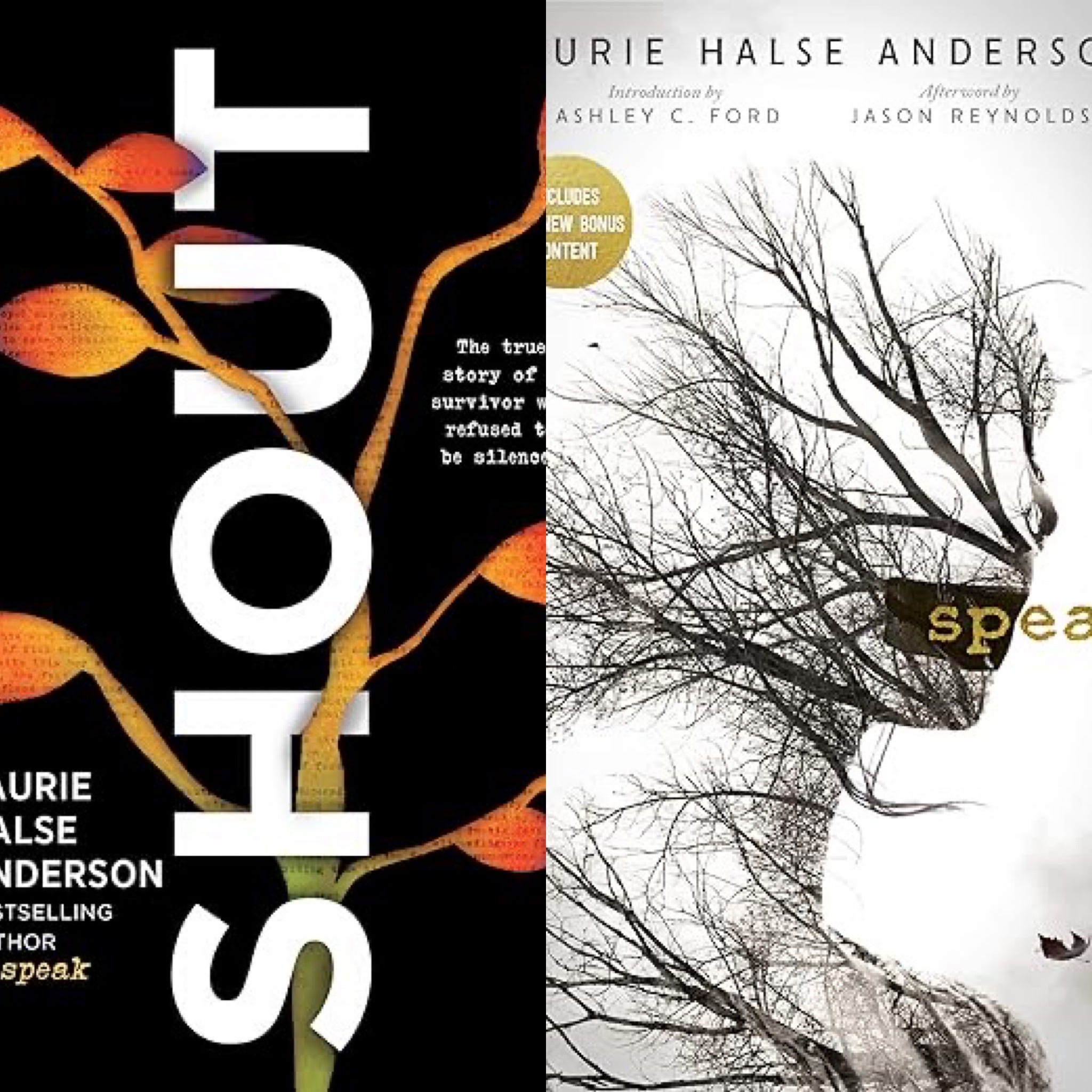
Speak and Shout: Why Librarians Fight for Banned Books
from Be a Cactus Podcast · host Victoria Waddle
Hi Friends,Since Banned Books Week is coming up in two weeks, I want to continue looking at books that have been banned for years and to show why librarians continue to fight to have them in the collection. Over decades, Laurie Halse Anderson’s Speak (1999) is one of the most popular of these books. Twenty years after its publication, Halse Anderson published Shout (2019) to call attention to the the ongoing problem of sexual assault. This gives us plenty of time to judge whether these books—and others about sexual assault—help or harm teen library users.Speak and Shout spoilersI wrote a few reviews of Speak in 2008 and 2011, the short kind without spoilers. This series of the last several weeks is full of spoilers because I need to talk about the things censors object to.Speak quick overviewThe summer before she starts high school, Melinda goes to a party where she calls the police. Because of her action, she is ostracized when school starts. Without a single friend, she pairs up with a new girl who desperately wants to be popular, but who is entirely self-serving. Why Melinda called the police isn’t revealed until late in the book. However, something is clearly wrong with Melinda. The book is broken down into the four grading periods of the school year. As Melinda’s grades plummet–she cuts class and skips a lot of her homework–she speaks less and less often. The only place she is connecting at school is in art class, where her eccentric teacher, Mr. Freeman, seems to understand that she needs a way to express her grief and fear. Melinda eventually reveals that she was raped at that party where she called the police. She finds her voice. Objections and answers to objections to SpeakCensors object to the novel largely because it deals with sexual assault, which they feel that isn’t an age-appropriate topic, and it makes boys feel bad. Here’s Halse Anderson’s response to that:Every parent I’ve ever met has taught their children how to safely cross a road, right? Would anybody ever say, “Well, I don’t know. I’m not going to teach my kid about crossing the road safely, because I don’t want them to be afraid that they could be hurt?” No, that’s ridiculous. That’s ridiculous. One out of every three people who identify as female in the United States have been victims of some form of sexual violence. One out of six people who identify as male in the United States have been victim of some forms of sexual violence. And our siblings, our community members who identify outside of those traditional binaries, they have much higher rates of sexual violence as well. It’s part of life – 93% of the children, people who are aged younger than 18, 93% of them were harmed by somebody that they knew. Nearly a year ago, Halse Anderson was quoted in School Library Journal discussing how book bans have become something different and how the topic of Speak is still important to discuss.Like so many other titles under fire that are being challenged, adults say the books make students uncomfortable and claim that is reason enough to remove them.“So absurd,” Anderson says. “What's really uncomfortable is being the victim of a rape, what’s really uncomfortable is being an unequipped child who's younger than 18, who has limited experience, but no one ever talked to them about this.”Is your son uncomfortable reading about rape? That’s good news, says Anderson. Use it as an opportunity to talk to him.“They should be in their feelings,” she says. “It's a terrible thing to be the victim of a crime, to have your body touched and hurt and broken sometimes. So, good on you that your son is so empathetic, that your son can grow. Being a parent is hard, but sometimes you got to put on your big-girl pants and do it.”Speak ten years inOn the tenth anniversary of the publication of Speak, Halse Anderson wrote a poem, “Listen,” using words from letters she’d received about it. It is VERY powerful and can be viewed on TeacherTube. It would be a GREAT addition to a banned books display. This is such a good book. I haven’t met one student who read it and didn’t love it. In addition to confronting rape, it is one of the best books about school harassment that I’ve read. The reader feels such compassion for Melinda—a goal of all good books—as she tries to make her way back to normalcy. Recently I mentioned the book Dear Author: Letters of Hope, which I reviewed here. Laurie Halse Anderson also has a letter there. I believe the book is out of print, but is available in ebook form. Check for it in your library. When you know readers are writing letters like this, why in the world would you take this book out of the library?ShoutI haven’t reviewed Shout in the past, so I’m going into some detail.Shout is an extension of the novel Speak, but also much more. While it looks at how Speak has affected its readers over decades, it also looks back through Halse Anderson’s life (so it’s a bit of a memoir in poems) including her own sexual assault as a teen. Halse Anderson begins with her parents’ trauma. As a teen, her father saw a buddy’s head sliced in two pieces just above the eyebrows by an exploding brake drum. Later was in military service and repaired planes on an airbase in England. He was sent to Dachau just after the war and saw the victims of that death camp. He had nightmares about it, apparently for the rest of his life. He then became a preacher, but the trauma that haunted him took over his life for decades. At one point, he beat his wife so hard that it knocked out several of her teeth. He eventually became an alcoholic. Though he never hit his wife again, she was traumatized and afraid of speaking up.Halse Anderson’s father’s alcoholism drove the family into poverty for quite a long time. In “cardboard boxes,” Halse Anderson writes: “Poor kids get snatched up by the real world/at seven, eight, nine years old, dragged/onto the front porch of adulthood, forced/to figure it out on their own.” (86)In “unclean,” Halse Anderson writes about having her mouth washed out with soap when she’s a child because she says the word s**t. She heard that from her mother, the same person who washes her mouth out with soap: shoving a bar soap into the mouth of a child.was then a common practice, church lady approved,for scrubbing, dirty words from the mindsof the young, the violenceof generational silencebrutally handed down. (15)She also includes poems on the way girls and women are sexually assaulted in everyday situations.Chum underwater, cityswimming pool.a shiver of slippery boys11, 12 years old.with shark-toothed fingersand gap-toothed smiles theyisolatethe openhearted girlseight, nine years oldtossed in like bloody buckets of chum. The boys circle, then frenzy-feedcrotch-grabbing, chest-pinching,hate-spittingthe water afrothwith glee and destruction.Girls stay in the shallowsafter their baptism as bait,that first painful lesson in how lifeguardslook the other way. (24-25)One poem looks at the year 1972: women could be legally raped by their husbands, be fired from jobs for getting pregnant, be groped by their bosses. Other poems look back on her own lack of sex education—she didn’t know what a menstrual period was when it arrived—the filmstrip she saw in class mentioned hygiene and sanitary napkins, but not blood. All of this is before we come to Halse Anderson’s rape. Afterward, she becomes a stoner (“dirtbag”) and hangs out with the kids who are often high. Fortunately, she has a few teachers who are interested in her and encourage her into clubs. One, a gym teacher, encourages her to join the swimming team; another asked her to be in the international students club. These are things that really help her to move away from substance abuse as a form of self-medicating. She also credits Tolkien in a poem about The Lord of the Rings that begins:when I wasn’t stonedthe only thing that helpedme breathewas opening a bookmist enveloping, welcomingme into the gray space between ink black and page whiteleading me along to the Shireto start the long trek to Mordoragain … (76)Halse Anderson includes a poem about “Lovebrarians” in which she honors those that opened the world of reading to her. She calls out ignorance in a poem that could be used in banned book displays everywhere.IgnoranceWe didn’t get our textbooks in healthin tenth grade until the cold strippedthe trees in late Novembercuz the school board ordered the booksto be gutted, they demanded that the sex chapters be surgically removedso explanations of the menstrual cycleand pics of diseased peniseswouldn't send us into frenzied orgiesin the halls or cause us to drop outso we could do the sex all day.The school board barred as much practical educationas they could. Maybe theyjust really liked babies and wanted usto start breeding as soon as possible. (83)TransformationHalse Anderson succeeds in spite of numerous obstacles. When she’s a senior in high school she decides to go as a foreign exchange student to Denmark. Her parents don’t have the money and tell her no, but she’s been saving her own money for a while (she does a lot of crappy jobs to make money) and also borrows from her grandmother. She goes and lives with a family on a pig farm for a year, learning to speak Danish. This is an important transition for her. in the poem “How it Started” she says “I unscrewed the top of my head/and rinsed out my brainpan/with salt water from the North Sea/and so began my next life.” (99) In the poem that ends the section of her stay in Denmark, she concludes: “My home in Denmark taught me how to speak/again, how to reinterpret darkness and light,/strength and softness/it offered me the chance to reorient my compass/redefine my true north/ and start over.” (114)After she comes home, she lives in a rural community and has a job milking cows around the local farms. It is a very tough life in many ways.Sexual harassment doesn’t end in high schoolHalse Anderson writes about her rape just prior to starting high school. Readers of Speak know this as the IRL attack that is the root of the inciting incident in Speak. But Shout shows how harassment doesn’t stop. Two stanzas of “offending professors” include incidents from community college and then Georgetown University:One: at community college, my health professorinvited me to celebrate the A+ he gaveme for a paper I wrote about LSDhe said we could drink wine at a motel, his treathe said we would have some awesome sex at the motelhe said his wife was totally coolwith him f*****g students at motels …Two: at Georgetown University,my department headinvited me to his office to discuss my needfor a special scholarship to study in Peru.To be able to translate Spanish, I’d need to livein a country where it was spokenI brought notes to the meeting, all my pla—he lifted his hand to interrupt methe department head said that we had been loverscenturies earlierwe’d been Aztecs, had sex in the junglehe said that we were cosmic soulmatesand needed to have sex again, unite our bodies— …(144-5)Writing is the key to overcomingWriting saves Halse Anderson. She started when a teacher introduced her to haiku. It becomes the ultimate weapon against her trauma as she “demystif[ies] a process/that consisted of untwisting the trysting words/in my brainpan and convincing them/to behave/inspiration and craft slowly melding/into this, the consistent beat of my words/against the drum.” (152)High school housekeepingShout is a pretty quick read since it’s verse. Yet every poem is a concise, powerful truth about trauma and agency. Since many are about people confiding in Halse Anderson, it’s a sort of #youtoo story that gives voice to victims of all genders. I know there are people who still ban Speak at libraries and have now added Shout to their no-read list. Why do librarians fight for these books? They are powerful medicine! What Halse Anderson says is true: “the false innocence/you render for them/by censoring truth/protects only you.” (193)Shout, while labeled YA, is a great book for adults as well because it discusses how dealing with trauma can take years. It shows an adult getting through it. I think the teachers at your high school will connect with Shout and it may be a balm to them as well. Why Shout belongs in the libraryWe want this book in the library for the same reasons we want Speak. To grant knowledge about sexual assault, knowledge about the long-tail of trauma, and to create empathy for trauma sufferers. P.S.—Halse Anderson has written so many great books. I have a few reviews of Wintergirls (about eating disorders) here and here and about Twisted (about a boy unjustly accused of sexual assault) here. Alrighty! Thanks for going on this banned book journey with me. If you’d like a few resources for Banned Books Week or the highlights of this week’s book challenge news, continue to Part 2. ❤️Thanks for reading Be a Cactus! Subscribe for free to receive new posts and support my work.Part 2Banned Books Week is comingHere are a few resources for Banned Books Week.3 Professional Reading Resources to Help Librarians Understand Book Bans from School Library JournalCensorship Throughout the CenturiesA timeline of US book bans and the fight for intellectual freedom from American Libraries MagazineLittle Free Library Partners with ALA, PEN America on Banned Books Map From Publishers WeeklyHow One Librarian Battled the Book Bans: Read an Excerpt of THAT LIBRARIAN By Amanda Jones From Book Riot I’ve posted links to reviews of this book, but this has an excerpt from the book, so I wanted to add it.This week’s banned and challenged booksFlorida School Bans Popular BL Manga for Right-to-Left Reading Format (& "Inappropriate" Relationship)After a meeting with Florida's Book Review Committee, which recommended to keep Sasaki and Miyano in school libraries, the Brevard County School Board voted 3-2 to remove the manga, in addition to People Kill People by Ellen Hopkins and Damsel by Elana K. Arnold. In the ban proposal, members objected to the fact that Sasaki and Miyano depicts a relationship between two male adolescents. Brevard County School Board member Jennifer Jenkins, who voted against the ban, also stated on X (formerly Twitter) that their chair "couldn't understand why a Japanese translation was being read from right to left," showcasing submitted arguments from the hearing via their X (formerly Twitter) page.Maryland's Freedom to Read Act protects librarians from book ban retaliationThanks for reading Be a Cactus! Subscribe for free to receive new posts and support my work. This is a public episode. If you would like to discuss this with other subscribers or get access to bonus episodes, visit victoriawaddle.substack.com
Embed this episode
NOW PLAYING
Speak and Shout: Why Librarians Fight for Banned Books
No transcript for this episode yet
Similar Episodes
No similar episodes found.
Similar Podcasts
No similar podcasts found.