
EPISODE · Jan 26, 2026 · 51 MIN
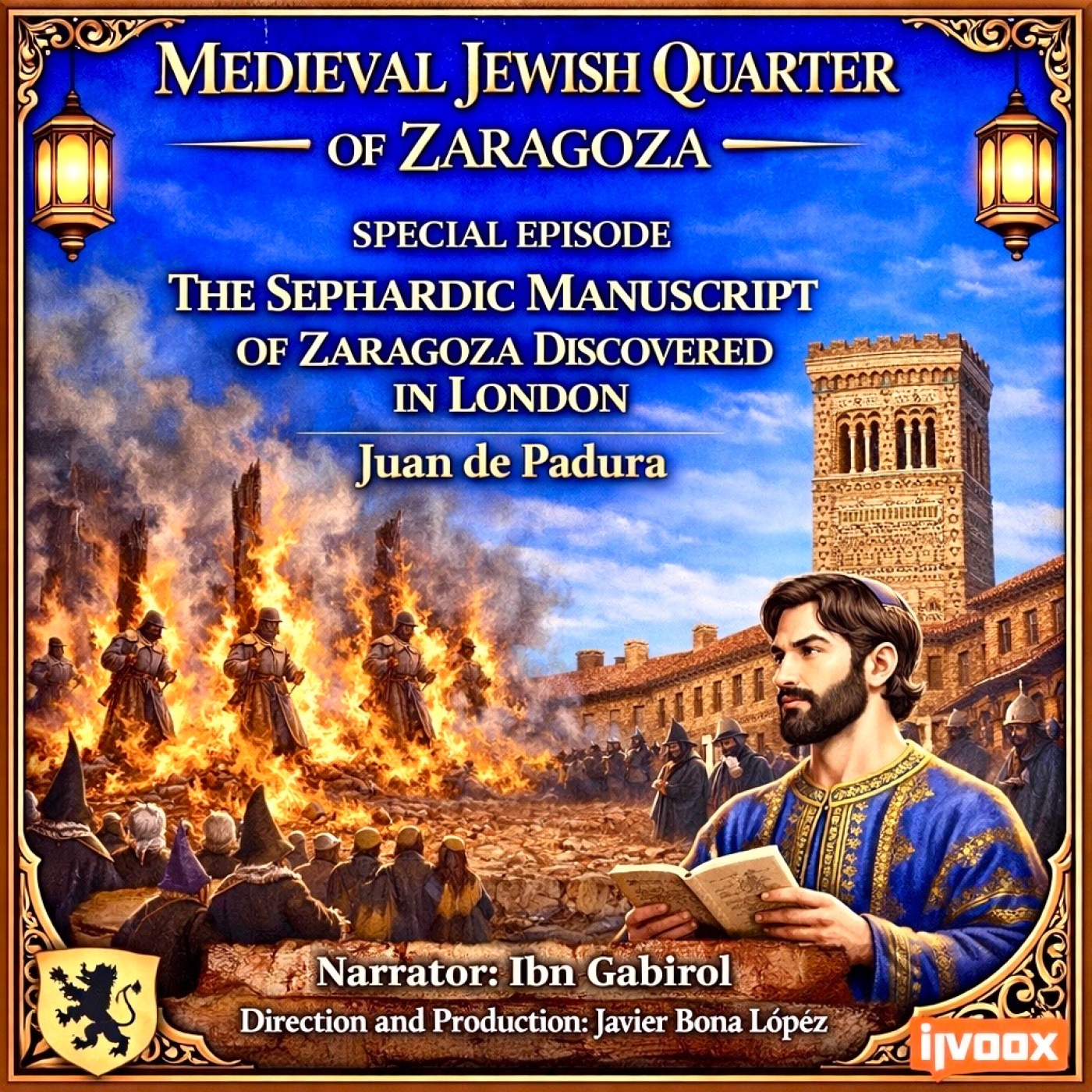
SPECIAL CHAPTER: THE SEPHARDIC MANUSCRIPT OF ZARAGOZA DISCOVERED IN LONDON
from Judería medieval Zaragoza/Jewish quarter Zaragoza
SPECIAL CHAPTER: THE SEPHARDIC MANUSCRIPT OF ZARAGOZA DISCOVERED IN LONDON Series: Medieval Jewish Quarter of Zaragoza Narrator: Ibn Gabirol Direction and Production: Javier Bona López The Sephardic Manuscript of Zaragoza: A Story of Memory and Displacement This special chapter of the "Medieval Jewish Quarter of Zaragoza" series presents a singular work: the Sephardic Manuscript of Zaragoza, a historical fiction written by Dr. Juan de Padura in 2003, which recreates with extraordinary verisimilitude the life of Zaragoza's Jews and conversos during the terrible period of the Spanish Inquisition. The narrative uses the found manuscript technique, a three-level temporal structure that takes us from London in 2003 to Buenos Aires in 1834, and finally to Zaragoza in 1485 and Sardinia in 1493. At each level, a different narrator brings us closer to the tragedy of the Jewish people expelled from Sefarad. In London in 2003, a pediatrician from Zaragoza finds by chance, in a dilapidated bookshop near St. James Park, a book titled "My Days in Zaragoza," published in Buenos Aires in 1834 by a certain D. Elmalen. The bookseller, an elderly man with a grayish beard and an Argentine accent, turns out to be named Samuel, the same name as the protagonist of the original manuscript. The second narrative level introduces us to David Elmalen, a Jewish descendant who in 1834, from Buenos Aires, translates and publishes the memoirs of his ancestor Samuel Benachá, written in Sardinia in 1493. Elmalen travels to Jerusalem, where his family preserves a house built by the refugees from Sefarad four hundred years earlier. There, in an interior courtyard that invites meditation, he translates the manuscript from Sephardic and discovers the immense pain of displacement. "Tears roll down my face, tears that burn," he writes. The third and deepest narrative level is that of Samuel Benachá, a Jewish physician born in Zaragoza in 1435, who tells us in first person about his life as a forced converso, his medical training, his marriage to Esperanza Pradas, daughter of his master Frederic Pradas, and the horror of the Inquisition that arrived in Aragon in 1484. Samuel describes life in the aljama of Zaragoza, where Jews lived amid silences and fears, baptized as Christians but circumcised in secret, celebrating their festivals in private homes after the closure of the Cehán synagogue. He tells us about his medical training at Frederic Pradas' house on Gavín Street, near the river, where he learned to read the texts of Maimonides and Averroes, to diagnose diseases by the color of urine, to prepare ointments and potions, and above all, to treat patients with dignity. The narrative reaches its climax with the assassination of Inquisitor Pedro Arbués in the cathedral of La Seo, on the night of September 14-15, 1485. Samuel describes how a group of desperate conversos, led by powerful families such as the Santángel, Sánchez, Caballería, Ram, and Abadía, decided to end the Inquisition by physically eliminating its most fanatical representative. The names of the material executors—Vidal Durango, Juan de Esperandeu, Juan de la Abadía, Mateo Ram—are not fictional; all of them appear in historical records as the main individuals involved in the crime. The repression that followed the assassination was brutal. Frederic Pradas, Samuel's master and father-in-law, was arrested, tortured in the dungeons of the Aljafería, and finally burned alive in the Market Square on June 30, 1486, along with fifteen other conversos. Samuel describes with heartbreaking precision how his master, tied to a stake, spat at the crucifix offered to him and shouted the Shema Israel before being devoured by flames. After six years of living in constant terror, the Edict of Expulsion of 1492 offered Samuel and his family a way out: to publicly declare themselves Jews and leave Spain. On July 31, 1492, thousands of Jews and conversos left Zaragoza walking toward uncertain destinations. Samuel, Esperanza, and their three children finally arrived in Oristano, Sardinia, where they began a new life. But they never forgot Zaragoza, its streets, its closed synagogue, its Jewish baths, and above all, all those who died to maintain their faith. The manuscript concludes with David Elmalen's reflection on the spirit that endures in the sky of Zaragoza: "There is something strange in the sky of Zaragoza. A special light, a particular color, a unique atmosphere. I believe it is the spirit of all those who lived there, of all those who loved that city, of all those who were torn from it against their will. I believe it is the soul of the Jewish quarter that remains to this day." The narrative closes with a return to the present, when the pediatrician from Zaragoza discovers that the London bookseller is named Samuel Elmalen and understands that the manuscript must return to Zaragoza, its place of origin. "You are the custodian of an entire lost tradition, make it known," the elderly bookseller tells him. Although the Sephardic Manuscript is a work of literary fiction, its historical and emotional value is undeniable. The topography of the Jewish quarter is described with archaeological precision. The assassination of Pedro Arbués and the names of the conspirators are historically verifiable. The description of inquisitorial terror, autos-da-fé, tortures, and executions—all are based on documents from the period. Dr. Juan de Padura, a physician and poet from Zaragoza, wrote this work in 2003 as an act of poetic justice, lending his voice to an imaginary ancestor to narrate the pain of displacement and the lost beauty of coexistence among cultures in medieval Zaragoza. His language, laden with ethical commitment—"their tears fall on our consciences like fire"—belongs to literature committed to the recovery of historical memory. This special chapter is a testimony to the lasting impact that the Jewish past continues to have on the identity of the city of Zaragoza. It is a reminder that intolerance, fanaticism, and racial persecution are deadly flowers that must never bloom again. And it is an invitation to touch the stones of Zaragoza's Old Town, close your eyes, and feel the spirit of those neighbors who were forced to abandon their Sefarad more than five hundred years ago. Final Note If you enjoyed this chapter, I invite you to share it and help spread the word. You can also listen to our other series on the medieval Jewish quarters of Calatayud, Tarazona, and Híjar on the three main podcasting platforms. Zakhor. Remember. Shalom. CREDITS AND SOURCES Narrator: Ibn Gabirol (Shelomó ibn Gabirol, 1021–1058/70) Direction and Production: Javier Bona López Documentation and Advisory: Miguel Ángel Motis Dolader (Universidad San Jorge de Zaragoza) Text: The Sephardic Manuscript of Zaragoza, by Juan de Padura Acknowledgements: We thank José Chamorro for his interest in this document and for bringing it to our attention. Thank you. Main Sources: • Jerónimo Zurita. Annals of the Crown of Aragon. Critical edition by Ángel Canellas López. Institución Fernando el Católico, Zaragoza, 1967–1985. • Asunción Blasco Martínez. The Jewish Quarter of Zaragoza in the 14th Century. Instituto Fernando el Católico (IFC), 1988. • Miguel Ángel Motis Dolader. The Jewish Quarter of Zaragoza: Center of Economic and Social Life. Rolde de Estudios Aragoneses. • Ángel Canellas López. The Jewish Quarter of Zaragoza. Cuadernos de Zaragoza, No. 2, 1974. • Leopoldo Torres Balbás. Studies on the Jewish Quarter of Zaragoza and Its Baths. • Zaragoza Municipal Archive (AMZ). Historical maps. • Inquisitorial trial records of the Provincial Historical Archive of Zaragoza. © Series: Medieval Jewish Quarter of Zaragoza Production: Javier Bona López
Embed this episode
NOW PLAYING
SPECIAL CHAPTER: THE SEPHARDIC MANUSCRIPT OF ZARAGOZA DISCOVERED IN LONDON
No transcript for this episode yet
Similar Episodes
No similar episodes found.
Similar Podcasts
No similar podcasts found.