No one can take this away. Good evening everybody. I hope everybody is really well on this very warm Wednesday evening. I don't actually expect a lot of people to hop onto this class, but it will be recorded so people can watch it at a later date.
Because the weather is so spectacular, I expect most people are out enjoying it, but I'm still going to put the content down. I'm going to talk just like I'm teaching you. For those of you that do hop on, please do say hi. I can see the numbers of who's watching, but I can't see who you are unless you say hi.
So again, this will be recorded. It'll be uploaded to my YouTube channel in case there is someone in your life, your family, your friends that has some high rate issues. And they just want to understand a bit more about it. So I don't want to over complicate things.
I do have a tendency to do that, but I'm well aware that over complicating things is not helpful for people. So I'm going to try keep this as understandable and the information as easy to digest as I can. Tree is a hi. Hee-bye.
Hi. So we're going to look at what is a thyroid because you have to know what the thyroid is. We're going to look at how low thyroid hormones, also known as hypothyroidism, affects the body. And the reason we're focused more so on hypothyroidism is because lower or slower thyroid issues are way more common than hyperthyroidism.
So I'll touch on the hyper aspect a little bit or maybe I'll do another video another time, but we're looking more so at the hypo or lower, slower thyroid this evening. Because it is more common. Everyone I've spoken to over the years, most of them have had hypothyroid issues and I've had three clients over the years that have hyper or Graves disease. So Graves being the autoimmune aspect of hyperthyroidism and then Hashimoto's being the autoimmune aspect of hypothyroidism.
So firstly, and if you want to take notes, you absolutely can, but again, this will be recorded and I may even convert it into a podcast. So you don't have to watch the video. You can just listen. Hey Carla.
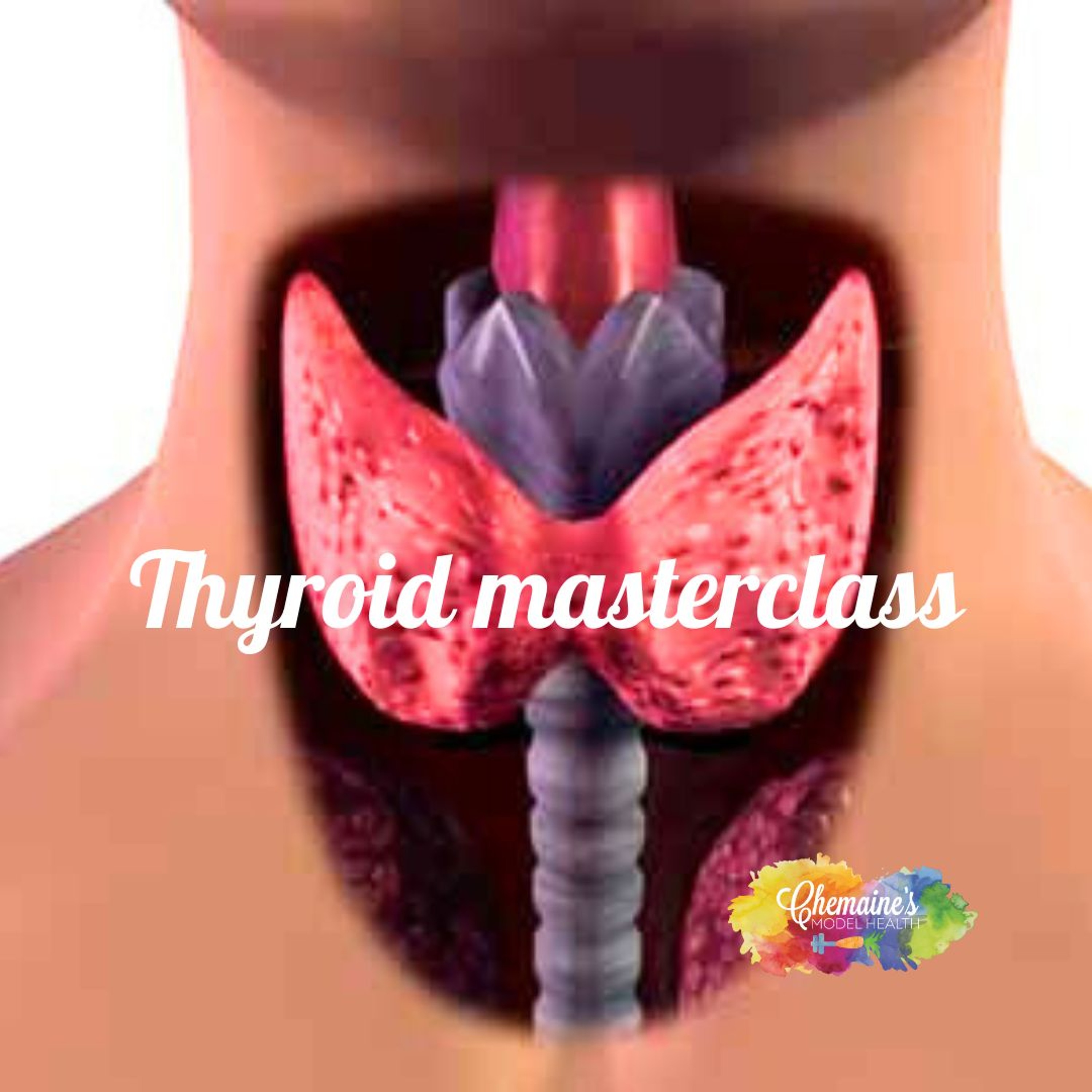
So let's start with the basics. Most people have a good idea of what their thyroid is, but just in case they don't. So your thyroid gland sits in front of your larynx right here and it's kind of shaped like a bow tie or people will refer to it like a butterfly shape. And you can feel it and it can even, some people will say it's like it feels like there's a shield around my throat.
So that's your thyroid there and your thyroid is regulated by a hormone sent from the pituitary gland called TSH, which is thyroid stimulating hormone, which many of you will recognize from being on like a thyroid panel. Hey Jamie, hey Katherine. So on your thyroid panel, most conventional or family doctors, they're going to test TSH to basically see if the thyroid is being spoken to from your pituitary gland and told to make hormones. We'll get into that a little bit more.
So then the pituitary gland sends the signals TSH and TSH basically tells your thyroid gland you need to make T4 and T3. Now T4 and T3, these are both your thyroid hormones. The thyroid does make T2 as well, but we're not going to get into that. And then there's also T1 that can be made.
But we're mostly focusing on T4 and T3. That's what people really recognize. So the numbers T4 and T3, that refers to the iodine, the number of iodine in the thyroid molecule. So your thyroid is basically the hormones are made up of iodine and selenium.
So you'll often hear people including me talk about make sure you're getting your iodine and your selenium. If in supplement form, selenomathenin, otherwise through your food is going to be bioavailable as well. But that's what the numbers means. It means this thyroid molecule has three ions attached to it, triiodine or it has four combined with selenium to make that specific hormone.
And their difference basically is their biological activity. Most of the time your thyroid is making T4 and then that is going to get converted into T3 into its, it's basically the active thyroid hormone. It's the one that sends the signals and stimulates actions all over your body. So one thing a lot of people don't understand is that you have thyroid receptors all over your body.
You have lots of different thyroid receptors right on your cell. Which that means that you can have this really wide range or big variety of symptoms somebody can experience if their thyroid is lower. The most common symptoms with a slower thyroid are going to be that kind of general feeling of fatigue, depression, malaise. And then constipation is a big one as well.
So you have to really think that when you're in a state of hypothyroidism that everything slows down. Everything in your body slows down. So your energy slows down, your brain cognitive performance slows down, your digestive system slows down. That includes your transit time.
So that's where the constipation comes in. Just your stomach acid production slows down. Then you start to see issues with bile production and cholesterol. So really when you're in a state of hypothyroidism or slower thyroid, everything slows down.
That's probably the easiest way to look at it. But because you have got these receptors all over your body, including in your brain, you can have either a lot of different symptoms or you could have one or two. And the person next to you, they could have hypothyroidism, but their symptoms might be completely different. So there's a lot of different symptoms.
But there are some kind of commonalities that these three or four are more common and can kind of make someone guess that they may have hypothyroidism. Another common one, but it's not for everyone, is the hair loss or the loss of the ends of the eyebrows. It's pretty common. Again, it's not everyone.
I speak to a lot of people who have had a hypothyroidism diagnosis, but they didn't lose any hair or eyebrows. It just presented itself in a different way. Another thing a lot of people don't know is that the research shows us that about 90 to 95% of people who have hypothyroidism, they actually have Hashimoto's, which is an autoimmune condition. And this, a lot of the time is genetic.
It'll run in the family. But this then tells you if you have got a diagnosis for Hashimoto's and in order to get that, your doctor, your naturopath, your functional medicine practitioner, they would have to test your thyroid antibodies to give you a diagnosis that you have Hashimoto's. And then once you get that diagnosis, as I was saying to a client yesterday, that's not the end of the world. That doesn't mean, oh my God, things are so much more worse than I taught they were.
That means, well, now I know I have an autoimmune issue. So now I know I have to take an autoimmune approach to this. Now, really a lot of practitioners, a lot of conventional doctors, they won't test for Hashimoto's. The conventional protocol now is that if you see someone that has hypothyroidism, then you're basically treating them like they have Hashimoto's.
So that's really how conventional medicine looks at hypothyroidism. They're just assuming that everyone that has hypothyroidism has Hashimoto's, and that's how they treat you, and that's why they put you on the thyroid replacement. And then usually you're getting scheduled to come back a year later for a checkup and get your thyroid panel and blood tests done again, which is not actually the best thing to do, because depending on someone's lifestyle and how they live, if it's an autoimmune Hashimoto's, hypothyroid problem, your immune system is attacking your thyroid. And depending on your lifestyle, your food choices, your stress, all that, you could be speeding up that attack.
So really, most people who have thyroid issues, they should be getting checked every at least six months to see if there is progression there, if there is damage going to the thyroid, because again, we have stressful lives. Not everyone leads the best lifestyle or makes the best nutritional choices. So if you're only going back to the checkup every year, there could be a lot of damage done in that year. But I do agree with the idea, and I think this is very wise, that if someone has God and a diagnosis of hypothyroidism, and yeah, I get everyone's individual and I do see the different biomarkers and symptom picture when I do consultations.
But in general, if you haven't spoke to me or another professional that can help put you on the right path, I think that everyone that has God, a hypothyroidism diagnosis, should just assume, and treat their body like they have Hashimoto's, treat your body like you do have an autoimmune issue. You will be able to tell. So if you were to do that, just to kind of clarify, because I know people will have a lot of questions, if you were to do something like that, then when it comes to nutritional lifestyle, you're going to be looking at more of an autoimmune nutritional templates. A lot of the recommendations I make with my clients in general are autoimmune or anti-inflammatory, but not all of them.
So this, if you would be taking the next step here, you would be going gluten free here. You will know your body, of course, if gluten agrees what you are, it doesn't agree with you. You might go dairy free then, you might be avoiding soy, corn, a few other things, but you'll be taking it a step further with an autoimmune nutritional template. Now on the other hand as well, I have spoken to people whose symptoms are quite severe, and they are, they have got a hypothyroidism diagnosis, but they didn't get a Hashimoto's diagnosis.
And I have asked them about going gluten free before, and even dairy free because the gluten proteins and dairy proteins, they look very similar in the body. That's why people with celiac issues or non- celiac, they can't tolerate gluten, and they generally can't tolerate dairy either because the proteins look the same in the body, so they have the same reaction. But these people that have severe hypothyroidism and pretty much autoimmune symptoms like fluid retention, aches and pain, sore joints, issues, sleeping, dysfunctional cortisol levels, a fatigue, the whole shebang. And I've asked them, have you gone gluten free before?
And they said, yeah, but it didn't make a difference. Now with someone like that, the chances are, well Jamie, you ask any questions if you want, because I'm trying to speak slow and clear so people can really understand this. So with this person who said, yeah, I went gluten free, but I didn't notice any difference. Well, chances are you didn't go 100% gluten free.
Chances are you were still maybe having a little bit of gluten here and there thinking it would be okay, or maybe you were choosing gluten free in a restaurant, but it was cross-contaminated. Or maybe you were eating stuff and you didn't even look at the ingredients because gluten is in a lot of foods, even in some supplements, even in some teas, places you wouldn't think, Carla, as you know, in chocolate, most people wouldn't think gluten is in chocolate because most people think gluten grains, breads, pasta, carbs, like that. And they wouldn't think, well, the chocolate contains gluten because surely chocolate's just sugar and milk. Well, no, so if you are having severe symptoms that really look like there's an autoimmune issue going on here and you've got a hypothyroidism diagnosis.
You really want to at least attempt going 100% gluten free for a couple of weeks. And it needs to be more than two weeks because it takes approximately two weeks for all the gluten proteins to be eliminated from your body. So you're like, I know it can be annoying, but you got to pick your bottles. You want to continue to feel rubbish and have all this degradation going on in your body, or do you want to just start avoiding gluten?
It's, in my opinion, it's not that hard, but it does take some practice for someone who has normal thyroid, should we still be conscious of our gluten? I'll get two, all the questions at the end, I promise. I want to keep going so I don't lose my train of thought because you all know what I'm like when I start going off. So back to our thyroid hormones.
So the pituitary and the pyro... the pituitary sends your TSH to your thyroid gland, your thyroid gland then makes your T4, which is your inactive version of your hormone. Then that needs to get converted into T3, which is your active version of thyroid hormone, which is what most of your bodily functions are controlled by or influenced by T3. So T3 is the one that aids in metabolism.
It keeps you warm. It helps your hair look strong and beautiful and your nails. It helps you have proper bowel function. It helps with your mental health.
People with hypothyroidism, we see a lot of depression and anxiety and malaise and anomia where they struggle to find joy in life and just a lot of mood issues. So T3 generally gets converted into the periphery for metabolism, but a lot of T3 conversion happens in the liver as well, which for those of you that saw yesterday I announced my liver gallbladder cleanse. This is not a sales pitch, but I'm just showing you the connection because a lot of people don't realize how important the liver and the gallbladder are, but if a lot of your T3 conversion happens in your liver and your liver is struggling, it's not functioning optimally. Maybe you've got some toxicity there.
You've got some fatty liver. Maybe you've got some sludgy bile or gallstones. That's going to influence that conversion. So if you're not converting to T4 into T3, then you're going to start to see issues with all these things with the metabolism, the hair skin, nails, the bowel movement, the energy, the mood issues with the whole lot.
We're going to get a bit more into detail because I really want to hopefully help you connect the dots. I'm not saying everybody has hypothyroidism, but I do think a lot of people do because of the way we live nowadays. And that'll make more sense in a minute. So if the liver is not working properly and you're not converting, there's going to be a problem there.
So here's most people are making enough T4 in their body, but most treatment of hypothyroidism is done by giving the patient some sort of T4 replacement, like your synthroid, with the hopes that their body is going to convert that T4 into its active form of T3 and not reverse T3. So we haven't spoken about reverse T3 yet, but reverse T3 is basically the inactive form of T3 or thyroid hormone that will still attach to the receptors all over your body but blocks the action. No action happens, it slows everything down and it blocks the receptors. So we don't want reverse T3.
To put it really simply, reverse T3 is bad, active T3 is good. But here's the thing with our lifestyle that I've mentioned a few times. People with blood sugar imbalances, low grades, systemic or chronic inflammation, or a very stressful life, which is almost all of us because that's how we live nowadays. It's just society.
People that maybe are not eating a balanced lifestyle are getting exercised to keep the tissues active. They are more likely to convert the T4 into reverse T3, especially if we have this chronic low grade inflammation or a lot of stress. Then yes, you can be taking in some sort of replacement from your doctor or making your own T4, but you're not actually converting it into its active form. So people who do take some sort of synthroid or T4 medication, they might say, well, I felt no difference whatsoever.
Maybe they didn't have a high enough dose or maybe they're just not converting that T4. So for those people, for a lot of people, it might be more beneficial to give them a T3 or even T4 and T3, but the T3, and I know a couple of people are taking it in here, it's commonly known as sideml. That can be a good option, except the problem with sideml is not many people tolerate it very well. So then we can start having other issues like anxiety and central nervous system issues, getting the jitters, getting the shakes, diarrhea, nervousness, that sort of stuff.
So in that case, then we could do that T4 and T3 combination. And again, there's even T2, but this would be something like desiccated thyroid, where you would have T4 and T3 in it, and that would be, you'd recognize the names as nature thyroid or armored thyroid. Or if you were going to do a T3 and you couldn't tolerate sideml, you could do a compounded slow release T3, so a compounding pharmacy would make that up for you. But one side note, and I've said this to a few people that always surprises me when people do this, definitely if you're taking T3, but you want to be taking your thyroid medication in the morning, your thyroid medication is designed to pick you up and energize you and stimulate you.
So taking it before bed, especially if you sleep issues is not a good idea, and if your sleep issues only started when you started taking your thyroid hormone therapy before bed, that's probably why you're having issues. But definitely T3, because T3 is the active form, the one you're receiving is going to be the active form, so it's going to be a stimulant, then you're taking that before bed, and you're not sleeping, and you're wired, and you're actually because you're not sleeping, you're making your symptoms and potential autoimmune disease even worse. So that's important, thinking, well, why am I taking thyroid? Because I'm tired, because everything's slow and low, and I want to speed it up.
So I'm going to take it in the morning to get me going for the day. So moving on to a bit more about how the thyroid hormones affects us in the body, because that's the important part, because that's where we can connect the dots. Well, maybe you can connect the dots and see, oh, well, I have all of these symptoms, maybe this is for me, or I only have one of these symptoms, maybe I don't have hypothyroidism, so I really do hope this does help you. Before I go on, there's two things, and I know people are not going to like to hear this, even I don't like to hear this, but it is the truth.
A low carb lifestyle, a ketogenic lifestyle, will indeed absolutely influence your thyroid. You do need carbohydrates to convert T4 into T3, especially women. You do need carbohydrates to boost serotonin and push down cortisol. If you're not doing that, the body's going to be extra stressed.
So that's going to target the thyroid even more, but also fasting can affect the thyroid. Fasting done too long can be very stressful. Now I know nobody in here is fasting a week or more. Some people are doing up to three days, but just understanding, fasting can affect thyroid hormone levels.
So you really want to, at the very least, get the advice of someone before you start fasting. If you have a hypothyroid diagnosis or you think you have, at the very least message me or someone else that doesn't say, what do you think I should do? Do you think this is a good idea for me? And now when I'm saying fasting, I'm not talking about your 16, 18 hours, I'm talking about 24, 26, 40, 8, 72, and I'm talking about your own life.
You're already 8, 72, like those sort of fasts. 16, 18, you're generally going to be fine. But that may be a problem if you're also doing low carb and you're also over training. There's obviously always these different kind of scenarios and caveats, but in general, if you're eating a balanced diet and you're doing 16 or 18 hours of fasting, you should be fine.
But any longer than that, at the very least, just message someone that knows and they'll give you an answer. Hi, Leanne. Hi, Tracy. Okay.
So, and again, because Leanne and Tracy, you just hopped on. If you've any questions, pop them below and I'll make sure I put a side of it at time at the end for me to answer the questions. And it's good that way, so I don't get distracted and you can type in your questions as I'm talking along. Okay.
So, well, before we go into how does a low-high-royd influence the body? If you were getting your thyroid tested, just because someone's going to ask. And I may do a follow video in a bit more detail. So, your general practitioner, at the very least, they're going to test thyroid stimulating hormone.
So, the idea is that if your thyroid stimulating hormone is very high, then basically your body is screaming at the pituitary saying, help, help, help. We're not mating thyroid hormone. Please pump out more TSH to scream at the thyroid glands to make more thyroid hormone. But if the thyroid hormone, the TSH is very low, that could be an indication that there's some high-worth thyroidism going on there or some sort of Graves issue.
But that's the kind of idea behind testing TSH. But if you go one step further and let's say you go to a naturopath or a functional medicine practitioner, they will then not only test TSH, but they will also test your T4 and then your T3. So, free and active, T4 and T3, and then reverse T3. They may also test for your thyroid antibodies.
And then going a step further, if there is some sort of concern there or maybe you feel lumps or bumps or you have specific symptoms, they may want to do an ultrasound to see if there's any nodules or anything going on there as well. So, those are the testings. But the generic one, which most people will come to me with because family doctors and practitioners, they're more reluctant to do the extensive test because that test is not covered under insurance. So, you generally have to pay out a pocket for something like that.
So, if someone comes to me with a blood test, then I'm looking at the number and I'm also looking at their symptom picture as well. And then based on that, I may get an indication, geez, she's got a lot of inflammation. I think there's some autoimmune issues going on here or this just looks like it may be blood sugars and slower metabolism thyroid. So, it can, it's, you can kind of get a good picture if you bring your results to someone who can help you decipher them, is what we're not looking for.
Can you know Hashimoto's? Can you elaborate on that question? So, I did just mention like the reason that your general practitioner, your family doctor, they'll only test TSHB because it's not covered by insurance. So, that you have to pay out of pocket for unless you have benefits with a naturopath or functional medicine practitioner and then they will test them for you.
And you could also, you can get a glimpse at thyroid levels through the Dutch test as well and you would pay out pocket for that too. Okay, so how does low thyroid hormones influence the body? So, I think I'm going to start with the biggest one that I think of, apart from metabolism, is the brain. I don't think many people are very aware of how hypothyroidism affects the brain and I get a lot of questions about brain health, brain fog.
I can't remember stuff. I can't perform like I used to be able to. I'm worried about my brain. I get questions about Alzheimer's.
People want to prevent it or their parents just got a diagnosis, even Parkinson's disease. So, hypothyroidism plays a huge part in brain health, especially when you look at the blood sugar issues, blood sugar issues can be a big player in causing hypothyroidism, but also in regular brain energy patterns as well. But thyroid hormones, they're vital to the brain, but especially for reducing inflammation in the brain. Some of you will have heard me talk about neuroinflammation in the brain and why sleep is so important for the brain, but an underactive thyroid can increase brain inflammation.
People don't manage type of thyroidism, especially if they're not sleeping. They typically can present multiple cognitive performance issues or symptoms that there's a problem in the brain, like that inability to focus or concentrate or memory recall is gone. Or maybe they have some depression, anxiety. When we say brain health, that also includes mental health issues.
The most common symptoms that coincide with hypothyroidism, and just to be sure, these are the most common symptoms to do with hypothyroidism, but these symptoms can also be caused by blood sugar issues or not sleeping well. To remind you, the whole body is one system. If you want to take care of your health, you want to be healthy, you have to take care of the whole system, not just focusing on one thing all the time, but this is for you to learn. The most common symptoms regarding the brain and hypothyroidism are brain fog, which actually can worsen with eating certain foods or smelling certain chemicals or smells or from overstimulation.
If any of you, which probably all of you have gone into bath and body, is that what it's called? I always get confused with bad bath and beyond. Bath and body, I can't even go into that place. I have hypothyroidism, but I don't take medication, I manage it quite well and I do not have Hashimoto's.
But if I go into bath and body, oh my God, I get so nauseous and I get a headache, I have to be very careful when I'm using perfume, I have to be careful with scented candles, I'm very sensitive to stuff like that. I do think it's because of my hypothyroidism and I've spoken about having slower circulation, which means my detoxification pathways are also slower back to the gallbladder and the liver, but yeah, it smells really, really can get to me. And that's not just you smelling and eating anything that comes into your body directly affects your nervous system and your nervous system connects directly to your brain and a lot of these molecules that we smell or we consume, a lot of them cross into the blood brain barrier as well. So when someone does have hypothyroidism, they really do need to be aware of these brain health conditions that if not diagnosed properly and not taken care of properly, they can accelerate the generation of the brain and raise the risks of neurodegrees.
And so neurodegenerative disorders, light dementia and Parkinson's, a lot of people that have hypothyroidism and that unfortunately didn't take care of themselves throughout their life. They do end up with Parkinson's, that is quite common. So another team to look at with hypothyroidism, before we get to the metabolism aspect of things, another thing that a lot of people are not aware of apart from the brain health aspect is bone health. High on managed especially, or people who don't take care of themselves and they have hypothyroidism, they're very susceptible to osteoporosis and osteopenia because thyroid hormones have a significant impact on bone density and bone quality.
Also that inflammatory aspect of having a slower thyroid. I was speaking to someone earlier and she was talking about she has inflammation in her bones. Did you know that you could get inflammation in your bones? Yes, anything that ends initis is inflammation or is an inflammatory disorder.
So the bones of patients with long term hypothyroidism on an MRI, even on a dexid, they show poor micro architecture and tiny microscopic damage and poor collagen quality. And I speak about collagen and it's actually amazing a lot and increased breakdown of the bone, which all then, not only does it make the bone more prone to developing fractures, it puts you at a higher risk of fall and then early mortality as you get older. So this is very important as you can see, but when people think of hypothyroidism, they are thinking of what we more commonly think of metabolism. I can't lose weight.
My hair, my nails are not good. That kind of thing, they're not thinking, well, this could be why my brain is not performing properly or this could be why I'm always breaking a bone or I don't feel stable in my body kind of thing. And it could be the hypothyroidism that is really having an effect on your body. So we'll move to the metabolism part because everyone wants to know about that.
So your basal metabolic rate, which is your metabolism when you're just sitting like this or you're sleeping, it's one of the most impacted areas by hypothyroidism, but the basal metabolic rate and your non-exercise activity thermogenesis, those are your two really biggest players when it comes to weight management and weight loss. So yes, exercise and weightlifting and whatnot can help kind of push things in the right direction. But when you look at the amount of the biggest percentage of calories that are burnt in your body each day come from your basal metabolic rate and your not neat, your non-exercise activity thermogenesis. So with hypothyroidism, it really impacts both of those.
And a lack of thyroid hormones, it impedes your cells and your mitochondria's ability to make energy, to make enough energy because it slows everything down. So you're not making energy. So your metabolic rate drops, your energy production drops. So not only does the metabolism slow down, but you're feeling lethargic, feeling fatigue, like I'm always tired, I just never feel refreshed.
I just don't have that get up and go kind of thing. So people with low thyroid symptoms, they often suffer from fatigue because of this effect on their metabolism or their mitochondria is just not making energy. And then if you're not receiving enough energy to even power the basic functions, like your heart and your liver and your lungs and your brain, they're going to have work. But you're never going to feel rested regardless of how much sleep you get.
And that doesn't even kind of bring us to, well, if you don't have enough energy for the major organs to work optimally, then how do you think you're going to have any energy for the hair follicles to grow and be healthy or your nails and skin to grow and be vitalis, that word, full of vitality and strong. So whatever energy your body can muster up when you're in this state of low hypothyroid, they're going to use that energy to keep you alive. You're not going to use that energy to make your hair or your nails or your eyelashes or anything grow. So with this lower metabolism, 30% of your daily energy requirements are from your brain as well.
So if you've got this low energy production, then your brain isn't getting a lot of that energy either. So that kind of compounds that brain health kind of negative effect that the thyroid has on it. So for instance, people who, and again, this could be caused by something else. But one thing with people who have hypothyroidism and a slower metabolism and slower energy getting to the brain is that they can't read for very long, or they can't drive long distances or perform cognitive tasks like they used to without needing to maybe take a break or stop and have a nap or something like that.
Because the energy is just not there even for something as simple as reading. You can really feel drained. And then when you look at weight aspect, so if you've got this impact on your BMO or your basal metabolic rate and even the amount of calories you burn with your non-exercise activity thermogenesis, would be something like what I'm doing with my hands? Like this would be that.
Any sort of fidgeting or moving your hands or pacing when you're on the phone, just stuff you're doing without even thinking about it. That is your need. That all accounts for a huge part of your energy expenditure each day. So believe it or not, some people can get so tired that when they talk they're just like very malaise and they don't move their hands and they may not even blink that much.
They're just so tired. So your body's basically conserving all your energy and it's dropping that metabolic rate solo and the energy expenditure solo that what's going to happen there. Well, even if you're not eating a lot of food, you could have some weight issues for sure. So not only is there that aspect, but with the weight, thyroid hormones also co-activate a hormone in the body called hormone sensitive lipase.
And I've spoken about lipase so important for fat loss and maintaining fat loss. But hormone sensitive lipase not only is it important for fat loss and keeping it off. It's also a big part of breaking down body fat and triglycerides into fatty acids so they can be used for energy as well. So overweight, hyperthyroid people, not only do they have this issue where the metabolism is slower, they also have improper fat storage and difficulty burning the fat and then even difficulty building muscle because this whole hormonal system is out of whack to put it simply.
And patients or people that have hyperthyroidism, they generally also have the compounding effect of blood sugar issues. And then when you've got the blood sugar issues, you have the insulin resistance and then that just compounds the whole losing weight issue. And one thing to another thing to note here is that here when you look at the thyroid, if it's hypothyroidism or hyper, it's out of balance. It's not in balance.
I talk about the body wanting to be in a state of homeostasis or balance all the time, but I don't think people really get it. We know we should have balanced nutrition, we should have a balanced lifestyle, blah, blah, blah, but the body wants to be, if you want to be healthy and vital, by tell us, I don't know why I keep wanting to say that, it probably is a word, but if you want to be healthy and full of vitality and energy and feel good and live life the way you want, then your body has to be in balance. And if you are in a state of hypothyroidism, you are out of balance backstage, blood sugar issues will have you out of balance. These hormones are out of balance cortisol issues out of balance.
So we want to really get back to balance, especially when we're hoping to lose weight or get to our ideal body weight or lose weight for health or whatever it is, then we were really looking for balance. And in both hypo or hyper, you can see that there's an imbalance of the metabolism there. It's either too high or too low. So it's out of balance.
You can see sleep issues out of balance there. They either sleep too little or too much. And then you see the other hormone imbalances, even with the sex hormones. So that's, I hope that makes sense on the metabolism aspect of weight.
Just everything again to what I said in the beginning, it all slows down. Everything just slows down. So we're really trying to bring it up, but not crazy high that you would become hyper, hyper, but more balanced. So the next one is, high-volt hyroidism and your gut, because nearly everybody has good health issues nowadays.
I do. Everyone does. Doesn't matter how healthy you are. We are being bombarded from all angles, even just our air.
That nearly everyone has some sort of gut issues. And all you can do is stack conditions in your favor. Take care of yourself and find that balance. And find what works for you as well.
So if you do have some sort of gut flair, you know what to do. For instance, I have diverticulosis. If I have a diverticulosis flair, I know what to do to calm it down and bring my body back into balance. So it is important, as it sounds, to take care of yourself.
So with thyroid hormones, they impact the gastrointestinal tract, including the function of your gallbladder, your liver, your lipid profile, your cholesterol, protein metabolism, blood sugar levels. So a deficiency in your thyroid hormone is going to lead to GI problems. Most people, like I said, about 95% of people with hygothiroidism, they have Hashimoto's autoimmune disease. Most people with Hashimoto's, they also have celiac disease or non-cealiac disease.
They go hand in hand, which is a very severe gut issue. And like I said as well, that most people with hygothiroidism, one of the main symptoms is constipation as well. So you have that issue in the gut. Another thing not to jump around too much or confuse you too much, but it's very common that people who have hygothiroid are going to have gallbladder issues.
In some cases, someone will get their gallbladder removed years before they get their hygothiroid diagnosis. So having gallbladder issues can be an indicator to you that you may actually have hygothiroidism. And then, excuse me, I always remind my clients or anyone I'm speaking to in regards to these two topics, gallbladder and hygothiroidism, that they want to keep an eye on their cholesterol because the hormones with hyroid hormones influence cholesterol clearance and then the gallbladder helps break down and move cholesterol through the body. So you want to keep an eye on your cholesterol there as well.
But when you have a deficiency in these hormones and then you get these gut problems and symptoms that never seem to get better, how hard you try, it could be because you have hygothiroidism and you never got it diagnosed or never considered it. So due to the impact low thyroid hormones have on the gut, people have, like I mentioned, high risk of gallbladder issues, gallstones of high cholesterol, fatty liver, even other liver issues because the thyroid hormones are not helping. They're not in balance. And thyroid hormones are also involved in the contraction of muscles to move the food, which then leads to that constipation.
And then you also what can happen, and this is really common. So if you do have hygothiroid and you slow everything down, that's also going to slow down your hydrochloric acid production and your enzyme production, and then that, well, apart from that, will lead to the bile and gallbladder issues, but that also can lead to dysbiosis or SIBO where we end up having small intestinal bacterial overgrowth, which is a really common symptom that people can experience if they have hygothiroidism because not only do you not have enough acid to kill the bad bacteria, now the foods, the transit time is longer, so there's more time that that food is fermenting and that these bad bacteria can populate and feed off the food as well. So it's a whole compounding effect. And then the liver, because your liver and your gallbladder are directly intertwined, like one is like the daddy and the son, and that's why you have a liver and gallbladder claims you have to do both of them.
You have a pathway in your liver called cytochrome P450, which then impedes the process by which chemicals are clear, which detoxes out of your body. So people with hygothiroidism, they have more liver toxicity, more issues, more toxic accumulation, not just in the liver, through their body, because this detoxification pathway, the CP450, is just not working properly, and then you have this huge toxic burden on your body, so you're in toxic overload, and then you're at risk for these chemical sensitivities, like I mentioned, when I go into bath and body. So not only is it the chemicals are directly impacting my central nervous system and my brain and my sensory system, but also because I have hygothiroidism, my circulation and detoxification pathways work slower, and believe me, I have to stay on top of them. There has been a few times where I've gone into bath and body and not had issues, but I have to stay on top of this all the time, with that's an indication that because my thyroid is a bit slower, now my liver processes are slower, and I get way more sensitive to toxins, which I think is why when we get the really bad smoke in Alberta from the wildfires, my symptoms are mostly through my skin.
I'll get a rash through my skin because my skin really is trying to take on some of that detoxification load and help my body get it out, so then I'll get like a rash, last week I got two rashes on top of my eyelids with the bad smoke, and that's that toxic burden because my liver constantly needs help because I have some hygothiroidism, and people with hygothiroidism have spoken about this before, they're more sensitive to the wildfire smoke and contaminants in the atmosphere. So before I start to get to the questions, I want to just touch really fast on cardiovascular health, I mentioned the thyroid hormones are essential for moving and clearing cholesterol, if we're not doing that, there's potential for cardiovascular issues, stroke, plaque, pilt up. As we age, generally the main marker of aging is inflammation, that's what ages us, but if you have this underlying inflammatory condition, either because you have Hashimoto's or because you just have something else going on, stress not sleeping blah blah blah, then that's going to increase your inflammatory levels, if you're looking at that on a test that would be your CRP, then that's going to further damage the blood vessels around the heart, but it's also going to contribute to plaque, plaque due to cholesterol per se, really only is a problem when we have a lot of inflammation present, the inflammation causes the plaque to stick to the arteries, inflammation then also thickens and hardens the artery walls, but it also thickens your blood, so your blood then becomes thicker and more sludgy, and then that's harder to pass through, so these now tighter, thicker arteries, and then you're hard to strain and then you have blood pressure, and then you have an increased risk of embolism or stroke or hemorrhagic stroke or something, so it's not a fun situation to be in, but it is something that you should be aware of. And the last one I think I'm going to touch on is the hormones, women obviously tend to have more hypothyroid or hormone issues than men, women and men experience hypothyroidism differently because of the impact it has on their hormone levels, but they're designed like the man's liver converts thyroid hormones seven times more efficiently than the woman does, hence why men can lose weight easier or manage their weight easier, they have more energy because of that conversion, so it is just how they're designed as well.
In women, hypothyroid hormones play a huge role in the feedback loop between our progesterone receptors and the pituitary release of luteinizing hormone, as well as the pituitary's release of follicle stimulating hormone and activation of the follicle, so just to kind of put this in context, progesterone is our calming hormone, and what had I said that when people have hypothyroidism, they generally have a lot more anxiety as well and mental health issues, so if the thyroid hormones are now affecting your progesterone and your progesterone is your calming relaxation, see sense hormone, now you can see why you've got this anxiety going on and the adrenaline constantly, you're either irritable or angry or something because the progesterone is out as well as the thyroid hormones, progesterone is that hormone that helps us not see red when someone annoys us, so progesterone, that's the whole PMS thing why we get so irritable at sarin times of the month, then we want to hurt people, so we've got this significant role that we have between your progesterone receptors and then your sex hormones, excuse me, so it's not uncommon for women with low thyroid to experience not only this irritability and maybe anger issues and anxiety, but also infertility, irregular menstrual cycles, heavier, light leading, or even a complete loss of their menstrual cycle, or some people might have it really long, in men, thyroid hormones activate the leadic cells which are responsible for the creation of testosterone, so because of this men with hypothyroidism, they generally present lower testosterone which of course can affect their fertility as well, I think this is going to be helpful for a lot of you guys, especially if I have clients that are dealing with fertility issues for quite a while, and maybe you've tried everything and it's not working, but you never had your thyroid, you or your partner had your thyroid looked at, maybe that's it, so maybe if this class only helps one person with that, then I have very much done my job, so let's look at some questions and I really hope that you find this very helpful, try to keep it clear and concise. For someone who has normal thyroid levels, should we still be conscious of our gluten and dairy intake? I don't have any tolerance to either of them. Well look, I've said many times that not so much dairy because I do think if you can tolerate dairy, there's a lot of benefits to dairy, even when it comes to fat loss, there's a lot of research showing that dairy can be very beneficial for the metabolism and fat loss and the microbiome, and lots of great stuff, so dairy can be great if you can tolerate it and you can get like it preferentially, an organic or a good source of dairy.
Gluten, I think most people benefit from going gluten-free weather or not, you have autoimmune, and when I say gluten-free, I'm saying most of the time go gluten-free. If you haven't got a specific diagnosis of an autoimmune disease or celiac or non-celiac, then going gluten-free most of the time is a good idea. Gluten can really act like glue in your body, it causes your body to hold on to fat and toxins, gluten is higher in deuterium, so that will slow down your metabolism and that aspect of things, which then will cause tiredness and fatigue, but if you haven't got a specific diagnosis, then you're going gluten-free most of the time, but once a week, once every two weeks, you're going to have some gluten to make sure that you're keeping your immune system activated to these proteins, and you're not giving yourself a complete intolerance either. If you don't have an intolerance, don't give yourself an intolerance, so this is where the idea of hormesis comes in, so you still want to have a little bit of the poison every once in a while to keep your system activated for the greater goods, but if you have got an autoimmune diagnosis or celiac or non-celiac, then you are going to have to go 100% gluten-free, you'll have no choice.
But otherwise, I personally, based on what I teach and what I do and what I've researched, I think most women for sure should go gluten-free most of the time. It's not that hard, so it's not 100%. You go mostly gluten-free. When I look at what my clients eat a lot during the day, like gluten-free oats easy enough to get, um, potatoes like your starchy vegetables easy enough, fruit easy enough, if my clients are having chips, they're having like potato chips made with avocado oil and they're gluten-free.
Nowadays, there's a lot of options, but there's also a lot of good options. There's a lot of bad options, but now we've seen to have a lot more good options than we had two years ago. Two years ago, all the gluten-free options were terrible, but now they're getting better, which is great. So I would say yes.
I just think of gluten, glue, and it holds unwanted stuff to your body, including fat. So our next question, and if anyone else has one, pop it in there before I wrap up. Um, low thyroid, I'm sure, but doctors do not them but fatty liver is the issue. Well, your fatty liver could be caused by the low thyroid as well.
Do you believe in parasites and the liver and thyroid? You can have parasites all over your body. You can have parasites in your brain. So for sure, yeah, there was one study done where they showed, um, tapeworm larvae in the brain.
When they dissect the brain, the person was dead, obviously. The brain actually had holes in it where the larvae had hatched them, buried holes. Like your worm would in a worm farmer in your garden through the brain. It was the craziest thing, because when people think of parasites, they think of the gut or the stomach.
But you can get parasites anywhere. I know crazy questions, fasting not good for cortisol and spikes insulin in context. So Joey, everything is in context. So fasting can be good, but it also can be bad.
So everything is in context. So much I would like to do one whole day and three, I hear don't do a lot. Several of my clients will do three days. Many of my clients will do 24 to 36 hours once a week.
It can be done, but it has to be done in the correct context, but also with advice if you think there's issues. But doctors don't check, reverse T3. You have to pay out of pocket for it. And Hashimoto's, if you think of Hashimoto's, you could ask your practitioner to test the antibodies.
So that's what you do for checking Hashimoto's. Or based on your symptom picture, you could assume the biggest markers that you may have an autoimmune issue. It's going to be really severe fatigue. But lots of joint pain, lots of aches and pains, lots of swelling and inflammation.
Like really severe, lots of bowel issues, sleep issues. You'll just say everything is very wrong. So not a little bit wrong, but very wrong. You could kind of guess, and especially if you feel better when you go completely gluten free and dairy free, you could assume then that you have Hashimoto's and just treat your body.
And like I said, as we were going through this video, it's not a bad idea for everyone on high-profile where it isn't to just treat their body like it is an autoimmune issue. And at the very least go gluten free most of the time. And here's one other thing I kind of missed when I was speaking about the metabolism. So you're thyroid hormones directly influence your metabolism, but your metabolism directly influences your thyroid as well.
This is back to the whole one system idea that if you are not also supporting your metabolism through good practices, like keeping a lower deuterium diet, making sure you're getting quality sleep, making sure you're exercising, making sure you're getting good nutrition. And when we say good nutrition, I'm not just talking about nutrition for fat loss. I mean, are you getting balanced meals where all of your nutritional requirements are being met? Are you taking supplements where you may actually need them?
Are you getting specific anti-inflammatory nutrients or herbal teas that might be helping to calm your system down so your metabolism can work properly? Because if your metabolism at the cellular level is not working properly, your hormones will not work. Your hormones and your metabolism, they cross talk, they directly influence each other. My thyroid's not working, metabolism won't work.
If the metabolism's not working, the thyroid won't work. Again, one system and you have to take care of all of it. You can't just go in and say I'm going to take care of my thyroid. If you have a thyroid issue, okay, you know that.
That's at the forefront of my mind. But I have to get my whole body healthy, not just my thyroid. So everything has to be kept healthy. Okay, for those of you still watching, thank you.
Is there any more questions before I wrap this up? Thank you for spending your evening with me. I'm actually surprised so many of you did because it's so beautiful outside. I just figured everybody would be outside getting sun kissed as they say.
I think we covered quite a lot in this class. And I think I tried my best to slow down and be precise and specific. And hopefully I put it out in a way that you can easily understand. But this is how the low thyroid hormones affect our body.
And we'll probably schedule another class in a couple of weeks on, okay, if you have the low thyroid. Now what should you do in regards to nutrition and lifestyle? I do have my thyroid guide, which Joey, I believe you have. And that gives you specific step by step by step.
I also have, I think, three or four podcast episodes on the thyroid as well that you can re-listen to. You can re-listen to this once I upload it on YouTube and take some notes. Well, keep an eye out for that. If I schedule the class in a couple of weeks, we will look at lifestyle, nutrition practices, different protocols, supplements and stuff to start pushing that thyroid back in the correct direction.
And then the last thing, for those of you that stayed until the end, if I am looking at thyroid, and I can share this information probably in the chat or in the description, if I'm looking at thyroid, I have the thyroid reference ranges. But whenever someone sends me their thyroid, thyroid reference ranges, I'm looking at, if the only thing they have is TSH, then I'm looking at, okay, what's the optimal range that TSH should be in? Because the one that you're going to see is not going to be accurate. Like the standard reference range is generally, like, I've seen it as low as 0.2 to 7 will be the range for TSH.
So you could be that low where you're almost making no TSH to that high, 7. That's the normal range. And as you can see, that's really wide. When I'm looking at someone's reference range, I'm looking at more of the functional medicine reference range.
I'm looking at the reference chart provided by the Institute of Functional Medicine, and I can share with you guys when I'm looking at your thyroid levels, the TSH at least is going to be between 0.5 and 1.5 at the highest two. So I want my clients to be within that range to feel secure that their thyroid hormones working well. So for any of you that wanted to know and you have your own blood panel, you can look at your TSH and you're really looking to be in that range of 0.5 to 1.5 or even 0.5 to 2. So I think that's a good note to wrap it up on.
Thank you for spending your day with me. I hope you enjoyed it. I hope you learned lots. And once I have it uploaded to YouTube, feel free to share it with anyone you think would benefit from it, which is probably everyone.
And I will see you guys soon. Have a good evening. Bye-bye.