
EPISODE · Jan 11, 2026 · 1H 33M
Starts With A Bang #125 - Large-scale structure
from Starts With A Bang podcast · host Ethan Siegel
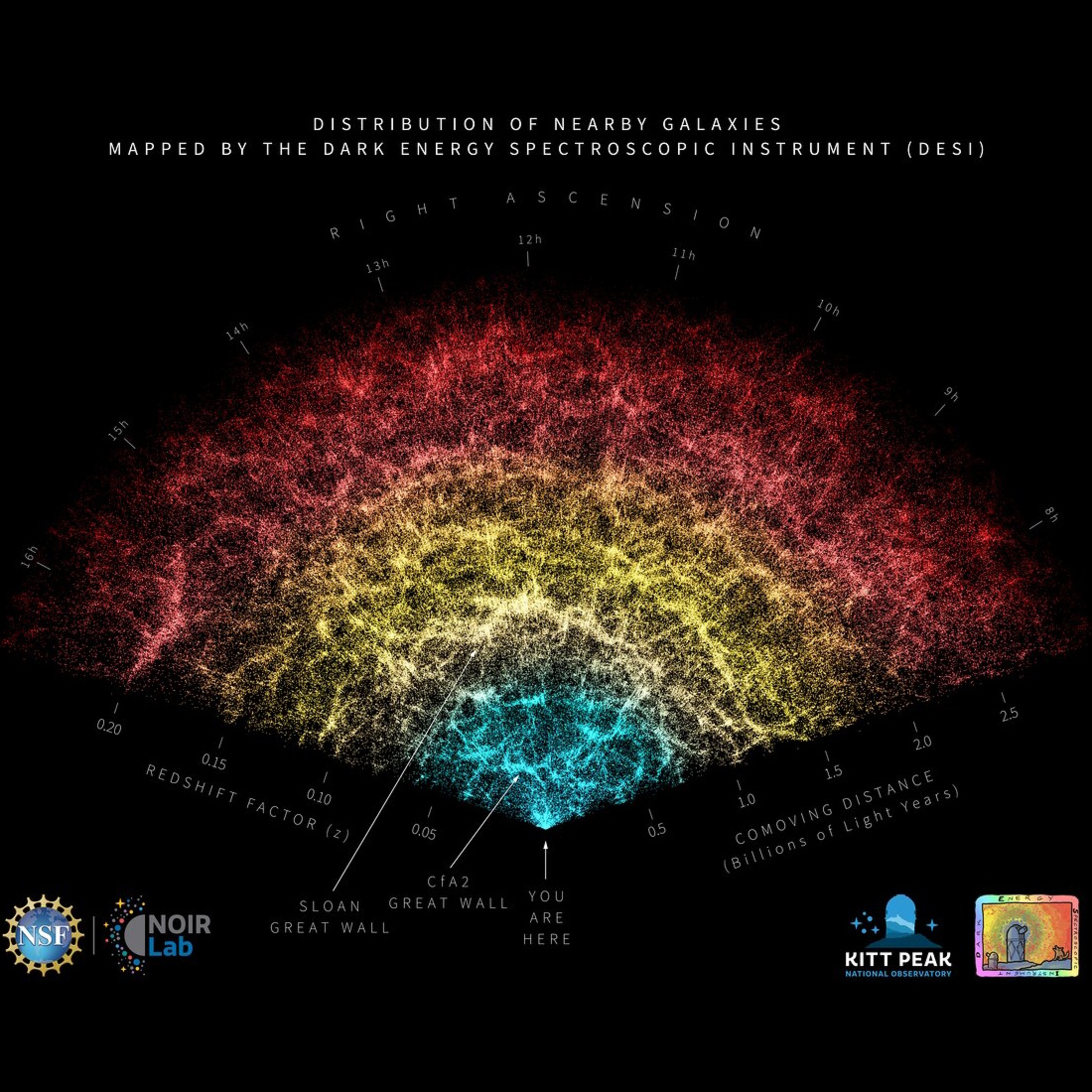
One of the most exciting developments in modern astrophysics isn't merely our standard "concordance cosmology" model, but rather the cracks that seem to be emerging in it. Sure, we've said for some 25 years now that our Universe is 13.8 billion years old, is made of mostly dark energy with a substantial amount of dark matter, and only 5% of all the normal stuff combined: stars, planets, black holes, plasmas, photons, and neutrinos. But more recently, a couple of cosmic conundrums have emerged, leading us to question whether this model is the best picture of reality that we can come up with.We don't merely have the Hubble tension to reckon with, or the fact that different methods yield different values for the expansion rate of the Universe today, but a puzzle over whether dark energy is truly a constant in our Universe, as most physicists have assumed since its discovery back in 1998. While "early relic" methods using CMB or baryon acoustic oscillation data favor a lower value of around 67 km/s/Mpc, "distance ladder" methods instead prefer a higher, incompatible value of around 73 km/s/Mpc. Now, on top of that, new large-scale structure data seems to throw another wrench into the works: supporting a picture of evolving dark energy, and specifically one where it weakens over cosmic time.Here to guide us through this is Dr. Kate Storey-Fisher, a cosmologist whose expertise is exactly on this topic, and who herself has recently become a member of the very collaboration, DESI, that provides the strongest evidence to date for evolving dark energy. The story, however, is only just beginning, and with current and future observatories poised to collect superior data, we take a look ahead as to what's in store for the Universe, and for those of us who are working oh so hard to try and understand it.(This image shows a "slice" through 3D space of the galaxies mapped out by the DESI survey, and color-coded by their distance/redshift from us. Features such as "great walls" can be seen even by eye within the data. Only 600,000 galaxies, or about 0.1% of DESI's total data, is displayed in this figure. Credit: DESI Collaboration/NOIRLab/NSF/AURA/R. Proctor)
What this episode covers
One of the most exciting developments in modern astrophysics isn't merely our standard "concordance cosmology" model, but rather the cracks that seem to be emerging in it. Sure, we've said for some 25 years now that our Universe is 13.8 billion years old, is made of mostly dark energy with a substantial amount of dark matter, and only 5% of all the normal stuff combined: stars, planets, black holes, plasmas, photons, and neutrinos. But more recently, a couple of cosmic conundrums have emerged, leading us to question whether this model is the best picture of reality that we can come up with.We don't merely have the Hubble tension to reckon with, or the fact that different methods yield different values for the expansion rate of the Universe today, but a puzzle over whether dark energy is truly a constant in our Universe, as most physicists have assumed since its discovery back in 1998. While "early relic" methods using CMB or baryon acoustic oscillation data favor a lower value of around 67 km/s/Mpc, "distance ladder" methods instead prefer a higher, incompatible value of around 73 km/s/Mpc. Now, on top of that, new large-scale structure data seems to throw another wrench into the works: supporting a picture of evolving dark energy, and specifically one where it weakens over cosmic time.Here to guide us through this is Dr. Kate Storey-Fisher, a cosmologist whose expertise is exactly on this topic, and who herself has recently become a member of the very collaboration, DESI, that provides the strongest evidence to date for evolving dark energy. The story, however, is only just beginning, and with current and future observatories poised to collect superior data, we take a look ahead as to what's in store for the Universe, and for those of us who are working oh so hard to try and understand it.(This image shows a "slice" through 3D space of the galaxies mapped out by the DESI survey, and color-coded by their distance/redshift from us. Features such as "great walls" can be seen even by eye within the data. Only 600,000 galaxies, or about 0.1% of DESI's total data, is displayed in this figure. Credit: DESI Collaboration/NOIRLab/NSF/AURA/R. Proctor)
NOW PLAYING
Starts With A Bang #125 - Large-scale structure
No transcript for this episode yet
Similar Episodes
Mar 26, 2026 ·1m
Jan 2, 2026 ·47m
Dec 21, 2025 ·46m