
EPISODE · Feb 4, 2026 · 0 MIN
“Stop Asking About the Epstein Files” Trump Explodes at Reporters in Heated White House Clash
from Philip Jones · host Philip Jones
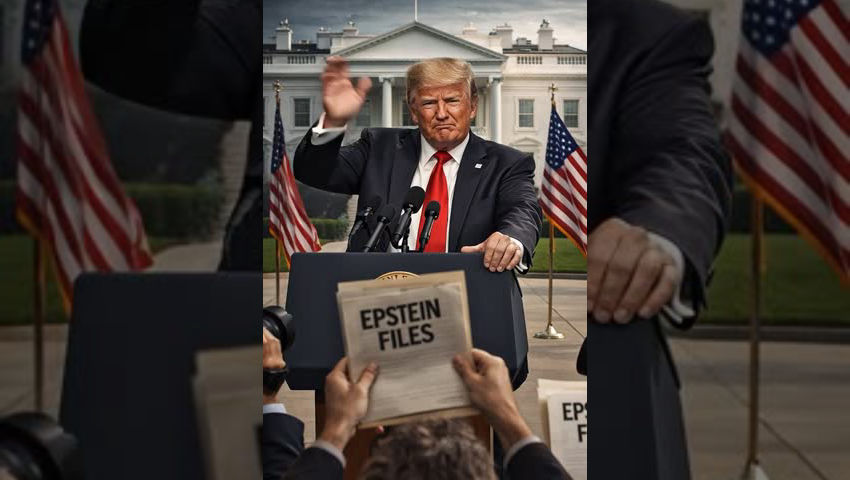
Is the demeanor of a journalist a measure of their integrity or is a stoic face simply the cost of seeking answers in a volatile political landscape? The White House briefing room often a stage for ideological battles recently witnessed a confrontation that veered sharply from policy to the personal What began as a standard inquiry into sealed documents and justice for victims quickly dissolved into a heated critique of facial expressions and professional conduct leaving observers to wonder where the line between presidential defense and personal affront truly lies. The atmosphere was already charged as reporters gathered their attention fixed on the fresh wave of controversy surrounding the newly released files related to Jeffrey Epstein. For the administration the strategy appeared clear: dismiss the noise and pivot the national conversation elsewhere. President Donald Trump standing at the podium, sought to close the chapter decisively He addressed the gathered press with a tone of finality asserting that the documents had revealed nothing incriminating regarding his conduct In his view, the continued focus on these files was a distraction a redundancy that the country could ill afford when other pressing matters demanded attention He urged the American people to look forward effectively declaring the topic exhausted. However the press corps mandated to probe beyond the surface, was not ready to relinquish the subject Amidst the attempt to shift the narrative Kaitlan Collins of CNN interjected refusing to let the moral weight of the issue simply evaporate. She pressed the President not on the political fallout but on the human cost asking a pointed question about the victims who feel denied their day in court "What would you say to the people who say they haven't gotten justice?" she inquired. It was a query grounded in the grievances of survivors, yet it acted as the spark that ignited a fierce counteroffensive from the podium, transforming a briefing on justice into a spectacle of anger. The reaction was instantaneous and visceral. Rather than addressing the substance of the question regarding the survivors the President unleashed a torrent of personal criticism focused squarely on the messenger. He branded Collins as "the worst reporter" a label he has utilized in past skirmishes but then took the critique into unusual territory by focusing on her physical demeanor "I don't think I've ever seen you smile" he remarked his voice laced with evident irritation The comment seemed to strip the interaction of its professional veneer reducing the correspondent’s serious line of questioning to a matter of pleasantries and appearance. Collins attempting to maintain the focus on her original query retorted that she was asking about the survivors—a topic hardly conducive to smiling. Yet the President doubled down offering his own theory for her solemn expression "Do you know why you don't smile?" he challenged answering his own question before she could respond "Because you don't tell the truth." In a rapid escalation he labeled her a "disgrace" and castigated her network asserting that her institution should be ashamed of her performance The exchange highlighted a stark clash of realities: a journalist perceiving her gravity as a necessity of the subject matter and a President perceiving it as a symptom of dishonesty. The briefing eventually moved on but the echo of that personal skirmish lingered in the room long after the cameras cut away It serves as a strange reminder of how fragile the decorum of political discourse has become where the absence of a smile can be weaponized as proof of deceit One is left staring at the screen, contemplating whether we have reached a point where the truth is expected to arrive wrapped in a grin or if the grim faces of the press are simply the inevitable reflection of the hard questions that remain unanswered.
What this episode covers
Is the demeanor of a journalist a measure of their integrity or is a stoic face simply the cost of seeking answers in a volatile political landscape? The White House briefing room often a stage for ideological battles recently witnessed a confrontation that veered sharply from policy to the personal What began as a standard inquiry into sealed documents and justice for victims quickly dissolved into a heated critique of facial expressions and professional conduct leaving observers to wonder where the line between presidential defense and personal affront truly lies. The atmosphere was already charged as reporters gathered their attention fixed on the fresh wave of controversy surrounding the newly released files related to Jeffrey Epstein. For the administration the strategy appeared clear: dismiss the noise and pivot the national conversation elsewhere. President Donald Trump standing at the podium, sought to close the chapter decisively He addressed the gathered press with a tone of finality asserting that the documents had revealed nothing incriminating regarding his conduct In his view, the continued focus on these files was a distraction a redundancy that the country could ill afford when other pressing matters demanded attention He urged the American people to look forward effectively declaring the topic exhausted. ____ ___ However the press corps mandated to probe beyond the surface, was not ready to relinquish the subject Amidst the attempt to shift the narrative Kaitlan Collins of CNN interjected refusing to let the moral weight of the issue simply evaporate. She pressed the President not on the political fallout but on the human cost asking a pointed question about the victims who feel denied their day in court "What would you say to the people who say they haven't gotten justice?" she inquired. It was a query grounded in the grievances of survivors, yet it acted as the spark that ignited a fierce counteroffensive from the podium, transforming a briefing on justice into a spectacle of anger. The reaction was instantaneous and visceral. Rather than addressing the substance of the question regarding the survivors the President unleashed a torrent of personal criticism focused squarely on the messenger. He branded Collins as "the worst reporter" a label he has utilized in past skirmishes but then took the critique into unusual territory by focusing on her physical demeanor "I don't think I've ever seen you smile" he remarked his voice laced with evident irritation The comment seemed to strip the interaction of its professional veneer reducing the correspondent’s serious line of questioning to a matter of pleasantries and appearance. Collins attempting to maintain the focus on her original query retorted that she was asking about the survivors—a topic hardly conducive to smiling. Yet the President doubled down offering his own theory for her solemn expression "Do you know why you don't smile?" he challenged answering his own question before she could respond "Because you don't tell the truth." In a rapid escalation he labeled her a "disgrace" and castigated her network asserting that her institution should be ashamed of her performance The exchange highlighted a stark clash of realities: a journalist perceiving her gravity as a necessity of the subject matter and a President perceiving it as a symptom of dishonesty. The briefing eventually moved on but the echo of that personal skirmish lingered in the room long after the cameras cut away It serves as a strange reminder of how fragile the decorum of political discourse has become where the absence of a smile can be weaponized as proof of deceit One is left staring at the screen, contemplating whether we have reached a point where the truth is expected to arrive wrapped in a grin or if the grim faces of the press are simply the inevitable reflection of the hard questions that remain unanswered. ____
NOW PLAYING
“Stop Asking About the Epstein Files” Trump Explodes at Reporters in Heated White House Clash
No transcript for this episode yet
Similar Episodes
Apr 21, 2026 ·73m
Apr 18, 2026 ·95m
Apr 15, 2026 ·55m
Apr 13, 2026 ·68m
Apr 11, 2026 ·59m
Apr 9, 2026 ·66m