
EPISODE · Jun 5, 2026 · 21 MIN
Tamper-Sensing Meshes in the Wild (gpn24)
from Chaos Computer Club - recent events feed · host jaseg
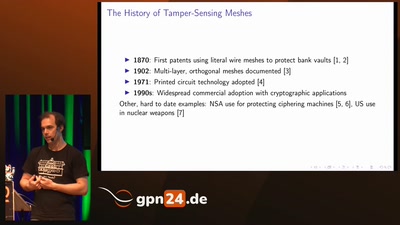
Tamper-sensing meshes are electronic layers that detect an attacker drilling or cutting into a device. There isn’t a lot of public information about their construction, so I did a survey of about 30 devices with such meshes. In this talk, I’ll share the results of that survey. I'll give a quick history of these meshes from the 1800s to today, touch on industry standards, and break down the technical trade-offs behind mesh design. From there, I'll walk you through real-world construction techniques and their weaknesses--covering substrate materials, trace materials, pattern, and 3D assembly styles. From all of this, I've put together a set of criteria for actually secure mesh design. The gist of it is: off-the-shelf PCB processes are a solid proxy for real-world meshes for researchers or hackers; most meshes in the wild use PCB or FPC processes with feature sizes of 0.5mm or larger; and with basic techniques like silkscreen printing--the same process used for keyboard membranes--you can build meshes that match or beat the security of most devices out there. Licensed to the public under https://creativecommons.org/licenses/by/4.0/ about this event: https://cfp.gulas.ch/gpn24/talk/B3B3GD/
Embed this episode
Ready to play
Tamper-Sensing Meshes in the Wild (gpn24)
No transcript for this episode yet
Similar Episodes
No similar episodes found.
Similar Podcasts
No similar podcasts found.