
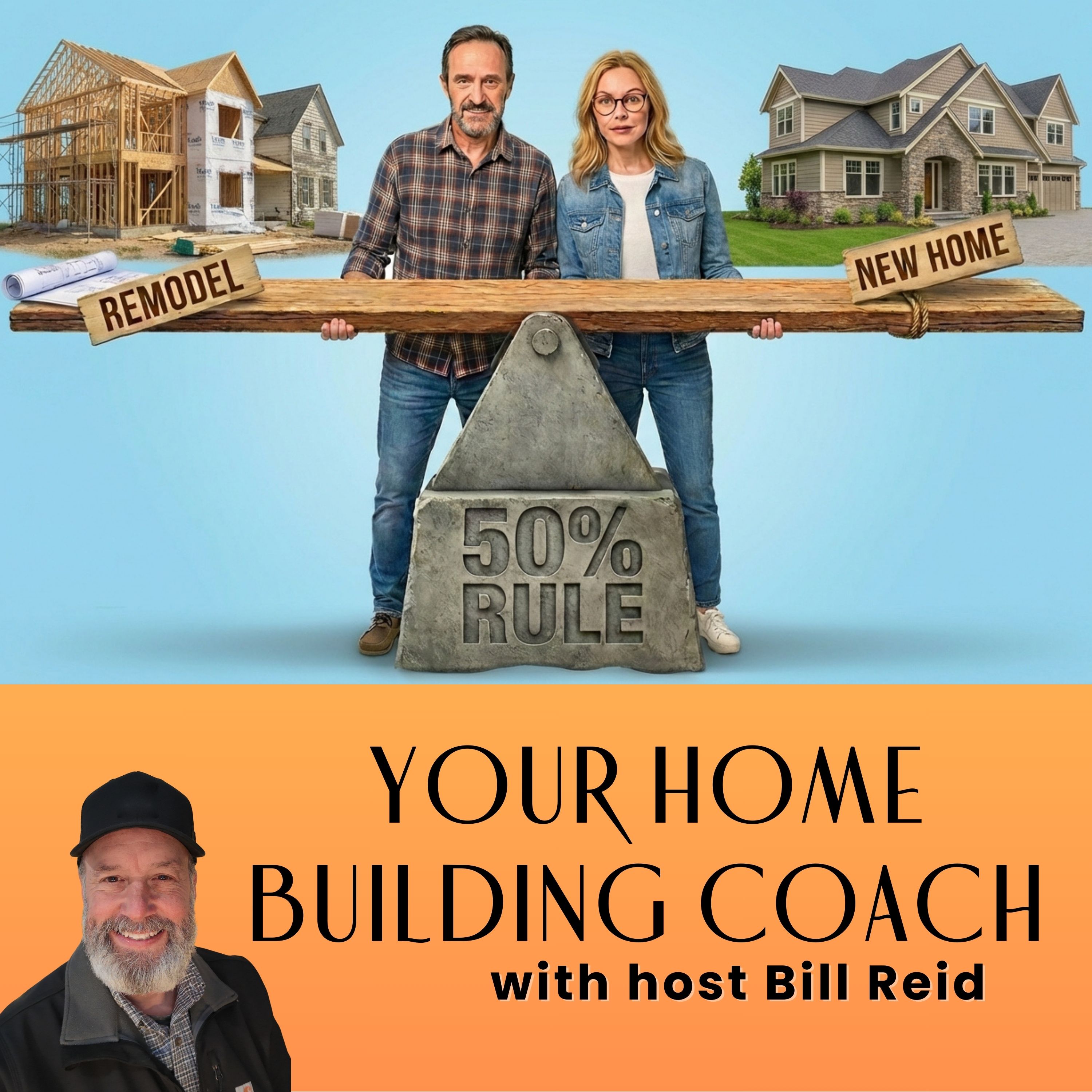
EPISODE · Jan 24, 2026 · 36 MIN
The 50 Percent Rule Home Renovation: When Your Remodel Becomes "New Construction"
from Your Home Building Coach with Bill Reid
The 50 percent rule home renovation is the expensive surprise that derails thousands of renovation projects every year. Homeowners invest in beautiful designs, fall in love with their plans, submit for permits—and then discover their remodel has been reclassified as "new construction," triggering full code compliance that adds $75,000-$150,000+ to the budget.This scenario is devastating. But it's also completely avoidable if you understand project classification BEFORE you design.I'm Bill Reid, Your Home Building Coach, and this is Episode 41—the finale of our Understanding Design Limitations series. Over the past 11 episodes (31-41), we've covered every major restriction that can affect your custom home or major remodel project: zoning regulations, Floor Area Ratio, setbacks, height restrictions, lot coverage, easements, HOA rules, and now—the meta-rule that sits above them all—project classification.Here's why this episode matters: The 50% rule doesn't just affect your budget. It affects whether your project even makes financial sense. It can turn a straightforward $150,000 renovation into a $225,000 nightmare. It can require elevating your entire home on stilts if you're in a flood zone. It can delay your project by 6+ months.But when you understand this rule during the discovery phase—when you ask the right questions BEFORE you invest in design work—you can design strategically to stay under the threshold, phase your project intelligently, or embrace full compliance with eyes wide open.🎯 In This Episode You'll Discover:✅ What project classification actually means and how building departments categorize your work (minor remodel, major remodel, or new construction)✅ The 50 percent rule explained: How crossing this threshold reclassifies your remodel as new construction and triggers full current code compliance✅ The 3 calculation methods cities use to determine the threshold: • Square footage method (addition size vs. existing home) • Cost-based calculation (improvement cost vs. assessed value) • Structural assessment (load-bearing walls, roof changes, framing modifications)✅ Why there's no single national standard: Each jurisdiction calculates differently, and some use multiple methods simultaneously✅ FEMA's substantial improvement rule: How flood zone properties face an additional 50% threshold that can require elevating your entire structure ($100K-$300K+ added cost)✅ Real cost impacts of crossing the threshold: • Fire sprinkler installation throughout entire home: $15K-$25K • Electrical system upgrades to 200-amp service + AFCI breakers: $20K-$40K • All windows replaced to meet energy codes: $25K-$60K • Structural seismic retrofitting in earthquake zones: $15K-$50K • Foundation elevation in FEMA flood zones: $100K-$300K✅ The 801 square foot mistake: Why adding 801 SF to a 1,600 SF home costs $75,000 more than adding 799 SF (and how 2 square feet makes all the difference)✅ Strategy #1: Design Under the Threshold • Calculate using your city's exact formula • Design to 46-48% as safety buffer (not exactly 49.9%) • Document everything with building department in writing✅ Strategy #2: Phase Your Project Strategically • Complete 45-48% of work in Phase 1 • Wait 12-36 months (check jurisdiction's reset period) • Complete remaining work in Phase 2 • Critical warning: Some jurisdictions prohibit this if phases were "planned together"✅ Strategy #3: Embrace Full Compliance (Or Consider Demolition) • Budget for code upgrades across entire home from the beginning • Leverage classification to fix existing safety issues • Consider whether full demolition + new construction makes more sense financially✅ Critical questions to ask your building department BEFORE you design: • "Does this city use the 50% rule, and how exactly do you calculate it?" • "What specific compliance requirements apply if I cross the threshold?" • "Can I review recent similar projects for classification precedent?" • "If I phase the project, what time period resets the calculation?" • "Are there FEMA flood zone requirements for my property?"✅ The property tax impact nobody mentions: When your remodel gets classified as new construction, county assessors often reassess your ENTIRE property at current values, potentially increasing annual taxes by $4K-$6K+✅ Common mistakes that cost six figures: • Designing first, calculating later • Trusting "it won't be a problem" from contractors/designers • Underestimating compliance costs • Ignoring FEMA flood zone status • Believing the "49% myth" (when city uses different calculation)✅ How BuildQuest will help: Our upcoming AI-powered planning platform with Quinn (your project guide) will help you identify 50% rule requirements specific to your jurisdiction, calculate thresholds, and develop strategic approaches📍 KEY TIMESTAMPS:00:00 - Introduction: When Is a Remodel Not a Remodel?02:48 - What Project Classification Really Means07:15 - The 50 Percent Rule Explained (Why Cities Created This)12:30 - Three Calculation Methods Cities Use16:45 - FEMA's Substantial Improvement Rule (The Federal Layer)19:20 - Real Cost Impacts: $75K-$150K+ in Surprise Expenses23:10 - Strategy #1: Design Under the Threshold25:40 - Strategy #2: Phase Your Project Strategically27:15 - Strategy #3: Embrace Full Compliance (Or Demolish and Rebuild)29:30 - Critical Questions for Your Building Department31:00 - The Property Tax Impact Nobody Mentions32:45 - Conclusion: Wrapping Up Understanding Design Limitations Series📚 RESOURCES MENTIONED:📖 The Awakened Homeowner BookSection 2.340 covers remodel classification and the homeowner who discovered their addition triggered full code complianceAmazon: https://www.amazon.com/dp/B0F1MDRPK7All Platforms: https://books2read.com/u/bpxj76📚 The Tale of Two Homeowners (Free Story)See the dramatic difference between an informed homeowner (who did discovery) and one who learned the expensive wayhttps://the-awakened-homeowner.kit.com/09608e1727🌐 External Resources:FEMA Flood Map Service Center: Check your flood zone statusFEMA Substantial Improvement GuidelinesInternational Code Council Building CodesNational Association of Home Builders Resources🎧 Related Episodes:Episode 31: Understanding Zoning Regulations & DistrictsEpisode 32: Floor Area Ratio (FAR) ExplainedEpisode 33-35: Setbacks, Height Restrictions, Lot CoverageEpisode 38: Easements & Right-of-WaysEpisode 40: HOA Architectural Review Requirements🔗 CONNECT:🌐 Website: https://www.theawakenedhomeowner.com/📧 Email: [email protected]📸 Instagram: https://www.instagram.com/theawakenedhomeowner/👍 Facebook: https://www.facebook.com/theawakenedhomeowner/🎥 YouTube: https://www.youtube.com/@TheAwakenedHomeowner🔗 LEARN ABOUT THE BUILDQUEST APP:Reserve your spot for free beta testing (launching late spring/early summer 2025)🌐 Website: https://www.buildquest.co/👤 ABOUT YOUR HOST:Bill Reid is Your Home Building Coach with 35+ years of experience in residential construction. He created The Awakened Homeowner methodology to enlighten, empower, and protect homeowners through their building and remodeling journeys. The mission: transform overwhelmed homeowners into confident project leaders who avoid costly mistakes through proper planning.🔔 SUBSCRIBE & REVIEW:If you found value in this Understanding Design Limitations series (Episodes 31-41), please subscribe to Your Home Building Coach podcast and leave a 5-star review on:Apple PodcastsSpotifyGoogle PodcastsOr wherever you listen to podcastsYour reviews help other homeowners discover the guidance they need to protect their projects!🎯 WHAT'S COMING NEXT:I'm transitioning from design limitations to a new series on understanding architectural plans—how they work, their systems, and the conventions they use so you can become an educated plan reviewer.I'll also be inserting other
Embed this episode
NOW PLAYING
The 50 Percent Rule Home Renovation: When Your Remodel Becomes "New Construction"
No transcript for this episode yet
Similar Episodes
No similar episodes found.
Similar Podcasts
No similar podcasts found.