
EPISODE · Jun 30, 2026 · 35 MIN
The Billionaire and the Teacher in Queens
from Language Matters Podcast · host Elias Winter
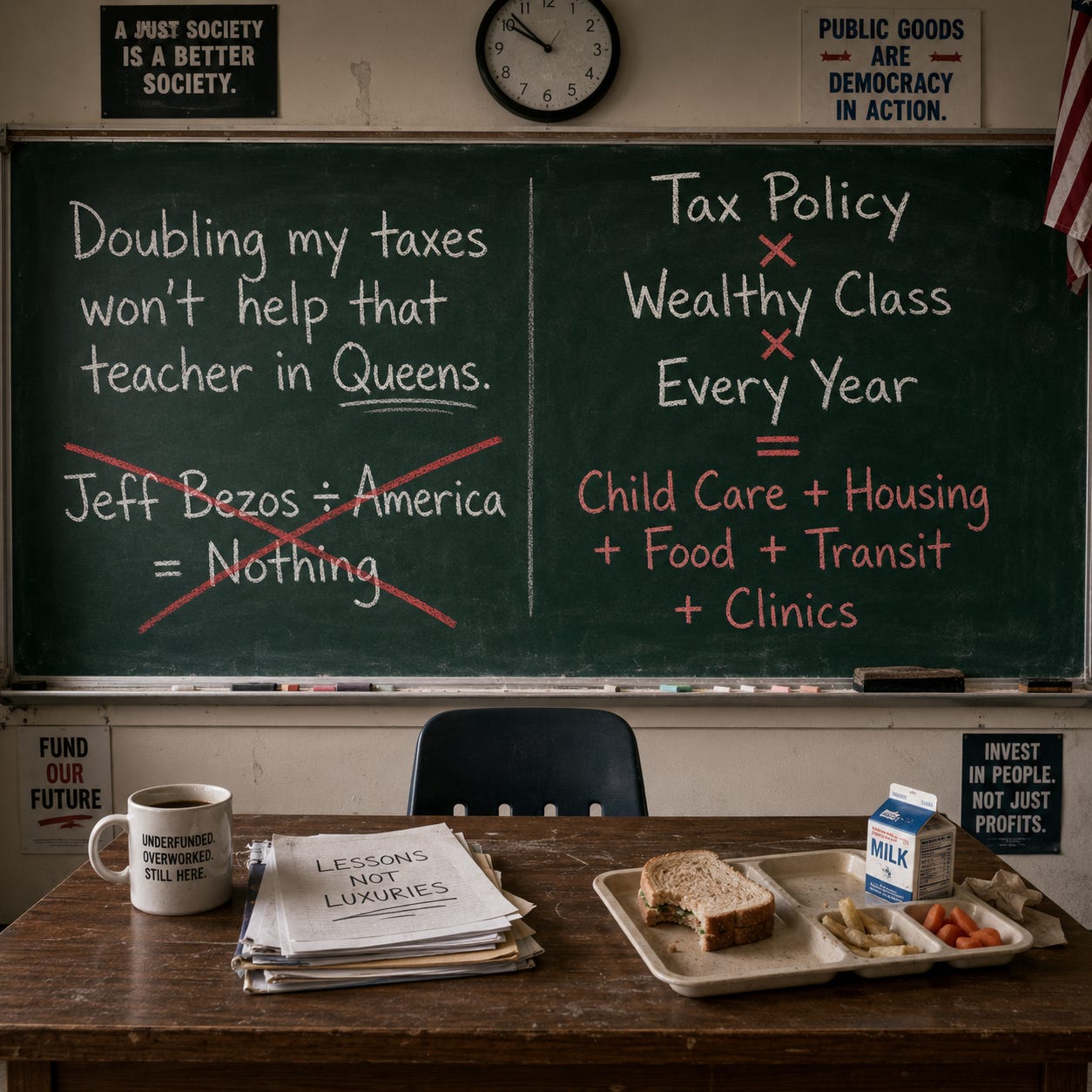
Jeff Bezos recently offered America a sentence so useful that it deserves to be placed on a chalkboard and interrogated until the chalk breaks.Asked about taxing the wealthy, he said, in essence: if people want him to pay more billions, fine, have that debate — but do not pretend it will solve the problem. “You could double the taxes I pay,” he said, “and it’s not going to help that teacher in Queens.” The interview was with CNBC, and the remark was reported in the context of Bezos arguing that the bottom half of earners should pay no federal income tax. He also said the top 1 percent already pays a large share of income taxes. (Business Insider)So let us begin where the honest listener begins.Is he dumb?No.Is he lying?Not exactly.Then what is he doing?He is doing something more elegant, more elite, and therefore more dangerous: he is using a true statement at the individual level to blur a true statement at the social level.One billionaire paying more taxes will not, by itself, rescue the teacher in Queens. That is true. Jeff Bezos could cut an enormous check, and the next morning a teacher in Queens would still wake up to rent, subway delays, student hunger, child care costs, classroom stress, and a public system held together with duct tape and inspirational posters.But that was never the actual question.The question was not: “Can one billionaire personally save one teacher?”The question was: “Can a recurring tax policy on the wealthy, applied across the tax base, raise enough money to materially improve the lives of millions of people?”That answer is yes.And Bezos knows enough math to know the difference. A man does not build Amazon by misunderstanding scale. Amazon is not a lemonade stand with a login page. Amazon is the cathedral of aggregation. It is the holy empire of pennies multiplied by billions of transactions. Bezos understands what happens when small units become massive systems.He simply becomes mysteriously allergic to multiplication when the subject is taxes.So, class, let us begin.Please take out your pencils.No, Jeffrey, you may not erase the denominator.The first thing to understand is a marginal tax rate.A marginal tax rate is not a tax on all your income. It is a tax on the next layer of your income. The IRS explains this directly: Americans pay income tax in layers called tax brackets, and when income rises into a higher bracket, the higher rate applies only to the income in that higher layer, not to the entire income. (IRS)This matters because American tax debates are haunted by a national failure to understand layer cake.If you earn more and move into a higher bracket, the government does not suddenly tax every dollar you earned at the highest rate. Only the top slice changes. The bottom slices remain taxed at lower rates.This is why your uncle on Facebook is wrong when he says he refused a raise because it would “put him in a higher tax bracket.” Your uncle did not defeat socialism. He failed fractions.For tax year 2026, the top federal ordinary income tax rate remains 37 percent. That top rate applies above $640,600 for single filers and above $768,700 for married couples filing jointly. (IRS)In our earlier calculation, we examined a hypothetical: what if the top marginal rate went from 37 percent to 57 percent?That is a 20-percentage-point increase.This is not a tax on every American. This is not even a tax on every dollar earned by a wealthy American. It is a higher tax on the income that lands in the top bracket.Now the chalkboard gets interesting.Using IRS Statistics of Income tax-rate tables for tax year 2022, roughly $1.216 trillion of income was taxed at the 37 percent rate. The IRS publishes these individual tax-rate and income percentile tables as part of its SOI data products. (IRS)So the static math is simple:$1.216 trillion × 20 percent = about $243 billion.Then we scale forward from 2022 into the 2026 fiscal environment. CBO projects federal outlays of about $7.4 trillion and revenues of about $5.6 trillion in fiscal year 2026. (Congressional Budget Office) Given growth in incomes, prices, and tax receipts, the rough static estimate becomes approximately:$300 billion per year.Now, a responsible person must pause here and say the boring but necessary thing: this is not a formal CBO score. It is static arithmetic. Real taxpayers respond. Some income would be deferred. Some would be shifted. Some would be converted into capital gains. Some would flee into the misty kingdom of trusts, partnerships, foundations, timing strategies, and whatever sacred scrolls tax attorneys keep in mahogany drawers.Somewhere in America, the phrase “20-point top-rate increase” causes a tax lawyer to rise slowly from a Herman Miller chair, like Dracula hearing a window open.So the actual collected revenue could be lower than $300 billion.But the number is not imaginary. It is not symbolic. It is not “one rich man buys the teacher a sandwich” money. It is civilization-scale domestic policy money.And here is where Bezos’s sentence begins to wobble.Because the sentence depends on making the frame small enough that justice looks ridiculous.“Double my taxes,” he says.“My taxes.”“My.”That is the trick.The tax base disappears, and the billionaire remains.This is not arithmetic. This is arithmetic wearing a tuxedo and hoping nobody asks about the denominator.Let us now compare $300 billion to the federal government.CBO projects that the federal government will spend about $7.4 trillion in fiscal year 2026. Against that, $300 billion is only about 4 percent. (Congressional Budget Office)So no, $300 billion does not fund the whole state.It does not solve Social Security. It does not pay for Medicare. It does not make the Pentagon say, “Actually, we’re good, thanks.” It does not abolish the deficit. It does not turn America into Denmark with aircraft carriers.Relative to the empire, $300 billion is large but not total.But relative to ordinary life?It is enormous.That is the paradox. The same number can be small beside empire and huge beside a family.In Washington terms, $300 billion is not enough to repair the entire entitlement state. But it is enough to make every underfunded domestic program stare at it like a Victorian orphan looking through a bakery window.So let us build a package.Not a fantasy. Not a slogan. A package.Suppose $300 billion per year were divided like this:Child care subsidies: $80 billion.Housing vouchers and homelessness aid: $50 billion.Food support — SNAP, WIC, school meals: $40 billion.Head Start and pre-K: $30 billion.Transit expansion: $50 billion.Public health and NIH: $30 billion.Rural hospitals, clinics, mental health, and addiction care: $20 billion.Total: $300 billion per year.Now we do the thing elite rhetoric tries to avoid.We count people.Start with child care.Child care is one of the strangest American institutions because the country says it loves work, loves family, and loves babies — then designs a child care system as if all three were discovered yesterday in a storage closet.Child Care Aware reported that the national average price of child care in 2024 was $13,128. In most states, the price of center-based infant care exceeded in-state public university tuition. In nearly every state, center-based care for two children exceeded annual rent by a large margin. (Child Care Aware® of America)That means child care is not merely a family expense. It is a private tax on work.A parent cannot work if no one can watch the child. A parent cannot take a promotion if the promotion is eaten by day care. A mother cannot remain attached to the labor market if the household’s second income is immediately converted into tuition for a toddler who still believes pants are optional.An $80 billion annual child care expansion could help roughly 6 million to 8 million children, depending on subsidy size. At $10,000 per child, that funds 8 million children. At $12,000 per child, it funds about 6.7 million. At $13,000 per child, it funds a little over 6 million.The United States has roughly 23 million children ages 0 to 5. (Childstats) So this would not cover every young child. But it could reach a massive share of low- and moderate-income families.For a family receiving the benefit, the impact could be $10,000 to $13,000 per child per year.That is not a vibe.That is rent. That is groceries. That is a parent going back to work. That is a mother not losing three years of earnings. That is a household moving from panic math to ordinary math.Child care funding is not charity. It is labor infrastructure.If we subsidize roads because adults must travel to work, we can subsidize care because children cannot be stacked in the garage while adults produce GDP.This should not be controversial, but America has a gift for making basic civilization sound like a Bolshevik plot.Now housing.The Housing Choice Voucher program is the federal government’s major rental assistance program, helping more than 2.3 million American families. HUD describes it as the main program helping very low-income families, elderly people, and disabled people afford private housing. (HUD)A $50 billion housing expansion could help roughly 3 million to 4 million households.Here is the math:At $12,000 per household per year, $50 billion helps about 4.2 million households.At $15,000 per household, it helps about 3.3 million.At $17,000 per household, it helps about 2.9 million.Call it 3 million to 4 million households, or perhaps 7 million to 10 million people.For each household, the benefit is not abstract. It is $12,000 to $17,000 a year in rent support.A voucher does not give a family a mansion. It does not install marble countertops. It does not supply a Peloton and a cheese board.It gives them a calendar that is not organized around eviction notices.Economists call it housing instability. Families call it “we have until Friday.”But housing money must be designed honestly. Vouchers without housing supply can become a cruel game: the family has help on paper but cannot find a unit in reality. Landlords can refuse. Rents can rise. Local zoning can turn federal generosity into a scavenger hunt.So housing money must come with supply, enforcement, and administration. Otherwise the landlord becomes the final boss.Still, the magnitude matters. At $50 billion a year, this is not a symbolic gesture toward homelessness. This is enough to dramatically expand rental assistance and stabilize millions of households.And a stabilized household changes everything beneath it: school attendance, health care, sleep, job continuity, mental health, family conflict, and the quiet dignity of knowing where the mail goes.Now food.SNAP served an average of 41.7 million people per month in fiscal year 2024. Federal SNAP spending totaled $99.8 billion, and benefits averaged $187.20 per participant per month. (Economic Research Service)If $40 billion were spread across current SNAP participants, the arithmetic is again simple:$40 billion divided by 41.7 million people equals about $960 per person per year.That is about $80 per person per month.For a family of three, that is $240 per month.No, this does not buy a yacht. It may not even buy eggs if the chickens have unionized.But for a low-income family, $240 a month in food support is real. It is the difference between food lasting until the end of the month and food disappearing on the 21st. It is fewer skipped meals. It is less parental humiliation. It is a child not trying to learn multiplication while hungry.The food package would probably not go only to SNAP. It could also support WIC and school meals. The National School Lunch Program provided more than 4.8 billion lunches in fiscal year 2024 at a federal cost of $17.7 billion. (Economic Research Service) Preliminary FY2025 school nutrition data show about 29.9 million students participating in school lunch each day. (School Nutrition Association)So the $40 billion could fund a mix: higher SNAP benefits, stronger WIC, universal school meals, summer food programs, and administrative simplification.There is no market innovation that makes a hungry third grader better at fractions. Though surely someone in Palo Alto is pitching one.Food programs look small per person until you remember that hunger also arrives per person.Now Head Start and pre-K.Head Start was funded to serve 715,873 children and pregnant women in fiscal year 2024. (HeadStart.gov)A $30 billion expansion would be enormous relative to the current program. At roughly $16,000 to $17,000 per funded slot, it could add around 1.8 million slots. If delivered through lower-cost pre-K models at $13,000 to $15,000 per child, it could reach 2 million to 2.3 million children.This is not simply babysitting with crayons.Pre-K and Head Start combine early learning, nutrition, developmental screening, family support, and school readiness. It is where the future shows up wearing Velcro shoes.The republic may not survive cable news, but it has a better chance if four-year-olds can identify letters, eat breakfast, get screened for developmental delays, and stop being treated as tiny freelancers in the education marketplace.The benefit per child is large: $13,000 to $17,000 per year in early education and related services.But the social value is larger than the check. A child who enters kindergarten ready to learn changes the teacher’s job. A parent with a stable early education slot changes the household’s labor math. A school receiving children with fewer unmet needs changes the classroom.Again: not a vibe.A pre-K slot is Tuesday morning.Now transit.A $50 billion transit expansion would be gigantic relative to current federal transit support. U.S. public transit agencies delivered about 7.7 billion passenger trips in 2024, according to APTA-reported figures. (Metro)Transit is harder to translate into per-person benefit because people experience it as time, reliability, access, and geography.But we can still do the math.If $50 billion benefits 20 million regular riders, that is $2,500 per rider per year.If it benefits 40 million regular or occasional riders, that is $1,250 per rider per year.If measured by 7.7 billion annual trips, $50 billion equals about $6.50 per trip in added investment.That money could buy more frequent buses, better evening and weekend service, bus rapid transit, accessibility upgrades, electrification, station improvements, maintenance, and fare relief.In America, we often treat the bus as a moral failure on wheels, then wonder why people cannot get to work.But a bus that comes every 10 minutes instead of every 40 is not a lifestyle amenity. It is time returned to the poor. It is a mother getting home before bedtime. It is a student reaching community college. It is a disabled person reaching a clinic. It is a worker not needing a second car to survive a low-wage job.Transit is not just transportation.Transit is the geometry of opportunity.Of course, transit money can also be wasted. America has a special talent for turning infrastructure into a catered meeting about a future meeting. Bad procurement, consultant bloat, environmental review dysfunction, fragmented agencies, and local political vetoes can turn billions into a commemorative PDF.So yes, execution matters.But “government might waste money” is not an argument for starving public systems. It is an argument for making them competent.Billionaires also waste money. They just call it a yacht, a platform acquisition, or a space company.Now public health.A $30 billion public health and NIH expansion spread across roughly 340 million Americans is only about $88 per person per year.That does not sound dramatic.That is because public health is the roof you only notice when it leaks.When it works, nothing happens. The outbreak is detected early. The water is tested. The vaccination campaign is organized. The clinic has data. The lab has staff. The health department answers the phone. The maternal health program catches a risk before tragedy. The chronic disease program prevents a hospitalization. The research grant becomes knowledge years later.Public health is the department everyone ignores until the raccoon has rabies, the water is weird, and the pathogen has a podcast.HRSA-funded health centers alone served more than 32.4 million people in 2024, including 1 in 8 children, 1 in 5 rural residents, and 25.1 million uninsured, Medicaid, and Medicare patients. About 90 percent of health center patients had incomes at or below 200 percent of the federal poverty level. (Bureau of Primary Health Care)A $30 billion expansion would not show up as a simple household check. It would show up as capacity: labs, staff, screenings, research, outbreak surveillance, maternal health work, environmental health, data systems, and prevention.The benefit is institutional immunity.No one writes an epic poem about a health department database being modernized. But when the next emergency comes, the database is either there or it is not. The staff are either trained or they are not. The lab either has capacity or it does not.Civilization is often the boring thing that worked before anyone had to panic.Now clinics, rural hospitals, mental health, and addiction care.A $20 billion annual expansion could plausibly reach 20 million to 35 million patients or clients, depending on how it is structured.At 20 million people, the benefit is $1,000 per person per year.At 35 million, it is about $570 per person per year.That money could expand community health centers, stabilize rural hospitals, fund mental health crisis teams, add addiction treatment slots, support medication-assisted treatment, hire behavioral health clinicians, and build alternatives to the emergency room and jail.The American health care system often asks: what if we waited until everything became an emergency, and then paid triple?Untreated addiction becomes jail, homelessness, family collapse, ER visits, foster care, and death.Untreated mental illness becomes police response, school disruption, workplace absence, suicide risk, and family exhaustion.A rural hospital closure becomes a town learning that distance is also a medical condition.The point of this $20 billion is not softness. It is cheaper than collapse.A country that refuses to fund ordinary care will eventually fund extraordinary breakdown. The bill always arrives. The only question is whether it arrives as a clinic appointment or a siren.Now let us return to the teacher in Queens.She was summoned into the debate as a prop. Bezos needed a normal person, a sympathetic person, a public servant. He did not say “private equity partner in Greenwich.” He said teacher in Queens.Good. Let us keep her.Imagine her life not sentimentally, but practically.She may earn a decent salary on paper. But paper does not pay New York rent. Paper does not make child care affordable. Paper does not make the subway reliable. Paper does not feed the student who came to school hungry. Paper does not stabilize the family living doubled up in a cousin’s apartment. Paper does not get a child’s mother into addiction treatment. Paper does not staff a mental health clinic. Paper does not fix the public-health infrastructure that failed before anyone noticed.So how could the $300 billion package help her?If she has young children, child care subsidies could save her $10,000 or more per child per year.If she is rent-burdened, housing support or affordable housing expansion could reduce pressure.If her students are poor, SNAP, WIC, and school meals could reduce hunger in her classroom.If younger children in her community enter pre-K or Head Start, they may arrive at school more ready to learn.If transit improves, her commute may become more reliable, and so may the commutes of parents, aides, students, and school staff.If community clinics and mental health systems expand, fewer untreated crises walk into school as classroom behavior problems.If public health capacity improves, the school is not left to improvise every social failure with a newsletter and a nurse who is already overwhelmed.Bezos is right that his personal tax bill does not walk into her classroom carrying a sandwich.But public revenue can fund the systems that determine whether her students are hungry, housed, cared for, treated, transported, and ready to learn.The money does not arrive wearing a cape labeled “Jeff’s Taxes.” It arrives, if democracy works, as a lunch tray, a rent voucher, a child care slot, a clinic appointment, a bus that actually shows up.That is the part his sentence hides.Not because the sentence is false in the smallest possible frame.Because it invites the smallest possible frame.So: dumb, lying, or something worse?Not dumb.A person who built Amazon understands aggregation. He understands scale. He understands recurring flows. He understands that a tiny margin multiplied over millions of transactions becomes a fortune. He understands logistics, systems, and the magic of denominator management.Not necessarily lying in the narrowest sense.If Jeff Bezos alone paid more taxes, that would not automatically fix life for every teacher in Queens. The federal government would have to allocate the money. New York would have to administer programs. Agencies would have to execute. Institutions would have to function. Democracy would have to do something more advanced than generate outrage clips for people with ring lights.But misleading?Yes.Deeply.The move is this:True micro-claim: one billionaire’s extra tax bill does not solve one teacher’s whole life.False implied macro-claim: therefore taxing the wealthy as a class cannot materially help ordinary people.That is the missing denominator.He invites us to divide one man’s tax bill by the total suffering of America. The result is small. Then he wants us to conclude taxation is futile.But the correct equation is not:Jeff Bezos ÷ America.The correct equation is:A recurring tax policy on high-income households ÷ specific public programs.That equation gives you child care slots, housing vouchers, school meals, SNAP expansions, transit service, public health staff, clinics, addiction treatment, and pre-K.The lie is not in the sentence.The lie is in the invitation.There is, however, a serious counterargument.Government can waste money.This is true, and adults should say it plainly.Housing vouchers without housing supply can fail.Child care subsidies without provider expansion can raise prices or create waitlists.Transit capital money can vanish into procurement hell.Health spending can be captured by large provider systems.Eligibility rules can become a maze that humiliates the people they claim to help.Consultants can multiply like mold in a damp basement.America can turn a moral necessity into a pilot program, a steering committee, a dashboard, a PDF, a webinar, and finally a grant that expires before anyone hires staff.Yes.Execution matters.But execution risk is not an argument against revenue. It is an argument for competence.The answer to bad public administration is not public starvation. It is better administration.If a bridge is badly built, we do not conclude that rivers are fake.If a hospital is mismanaged, we do not conclude that medicine is communism.If transit agencies waste money, we do not conclude that buses are a hallucination.We fix the institution.The billionaire class prefers a different conclusion: because government is imperfect, private accumulation should remain sacred.But private accumulation is not perfect either. It wastes. It distorts. It captures politics. It buys influence. It builds vanity projects. It invents artificial scarcity. It produces men who believe society is inefficient because it cannot deliver justice with the elegance of a cardboard box arriving on a porch.A society is not a warehouse.A teacher is not a package.A child is not an optimization problem.The public realm is harder than logistics because it deals with human beings who cannot be routed around their own suffering.Now, final math.A $300 billion annual package could plausibly do the following:Help 6 million to 8 million children with child care.Help 3 million to 4 million households with housing.Add hundreds or nearly a thousand dollars per year in food support for tens of millions of people, depending on design.Fund roughly 1.8 million to 2.3 million additional early education slots.Improve transit for 20 million to 40 million riders.Rebuild public health capacity for the whole country.Expand clinics, rural care, mental health, and addiction services for 20 million to 35 million people.That does not mean every American gets a check.It does not mean every problem is solved.It does not mean the teacher in Queens wakes up in Finland.But it means tens of millions of Americans experience material changes: rent pressure lowered, child care made possible, food extended, commutes improved, clinics staffed, children prepared, crises prevented.This is the part we must say plainly:A child care subsidy is math.A housing voucher is math.A lunch is math.A bus schedule is math.A clinic appointment is math.A public-health lab is math.A tax bracket is math.A budget is not a metaphor.A program is not a mood.A society that refuses to count honestly will eventually call cruelty realism.Jeff Bezos said doubling his taxes would not help the teacher in Queens. The teacher in Queens does not need Jeff Bezos to personally rescue her. She needs a society that can still multiply.The tragedy is not that billionaires cannot do math.The tragedy is that they know exactly when to stop doing it.—Elias WinterAuthor of Language Matters, a space for reflection on language, power, and decline This is a public episode. If you would like to discuss this with other subscribers or get access to bonus episodes, visit eliaswinter.substack.com
Embed this episode
NOW PLAYING
The Billionaire and the Teacher in Queens
No transcript for this episode yet
Similar Episodes
No similar episodes found.
Similar Podcasts
No similar podcasts found.