
EPISODE · Jun 20, 2026 · 1H 20M
The Broken Machine (Jones-Imhotep 2026) - Weekend Book Review
from Revise and Resubmit - The Mayukh Show · host Mayukh Mukhopadhyay
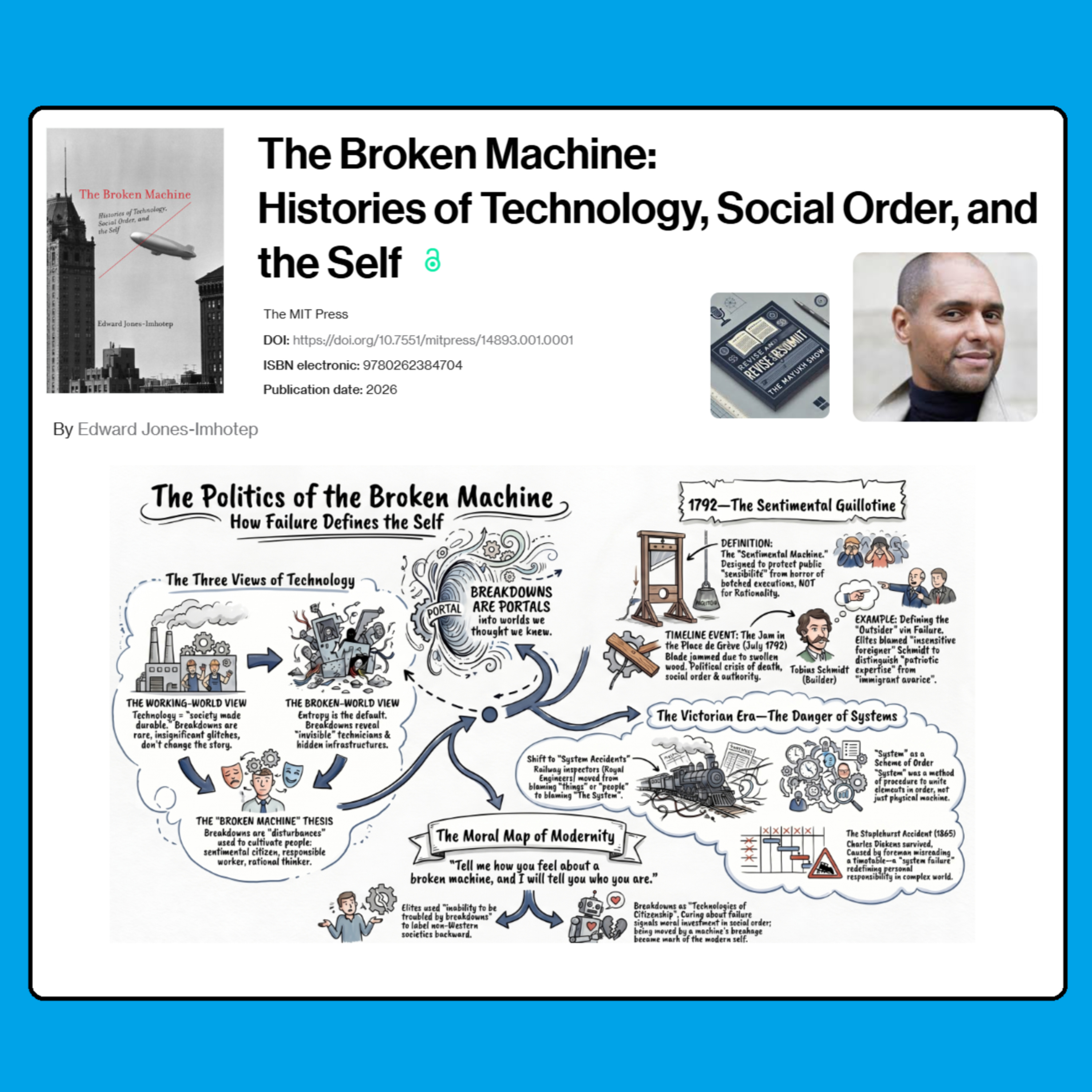
English Podcast starts at 00:00:00Bengali Podcast Starts at 00:16:42Hindi Podcast Starts at 00:41:549Danish Podcast Starts at 01:04:33ReferenceEdward Jones-Imhotep (2026). The Broken Machine: Histories of Technology, Social Order, and the Self. The MIT Press. https://doi.org/10.7551/mitpress/14893.001.0001Youtube channel link https://www.youtube.com/@weekendresearcherPodcast Websitehttps://mayukhmukhopadhyay.com/reviseandresubmitAcademy of Management PDW on Space Economy Registration Flyerhttps://cto.aom.org/discussion/flagship-aom-2026-pdw-space-economy-consolidating-a-research-agenda-8AOM SIM Curriculum Committeehttps://sim.aom.org/curriculum/curriculum-committeeAOM SIM-Bytes Episode 1 - Dr Ed Freemanhttps://www.youtube.com/shorts/EBSA7WvQNSILinkedin Post By Professor Erica Stecklerhttps://www.linkedin.com/posts/erica-steckler-ph-d-427272_simbyte-episode-1-ed-freeman-activity-7469092002098225152-PbHM🎙️✨ Welcome to Revise and Resubmit, and to this episode of Weekend Book Review.I’m very glad you’re here. Some books do not arrive with noise. They arrive quietly, almost like a thought one has been postponing for years. The Broken Machine: Histories of Technology, Social Order, and the Self, published on 19 May 2026 by The MIT Press, feels to me like one of those books. 📚🛠️In this episode, I’m sitting with Edward Jones-Imhotep’s remarkable and unsettling study of breakdown, not merely as a mechanical event, but as a deeply human drama. What happens when a machine fails? What sort of society reveals itself in that moment? And perhaps more intimately, what kind of self is called into being when order falters? 🌫️⚙️Jones-Imhotep, a distinguished historian of science and technology at the University of Toronto, has long been attentive to the fragile boundary between systems and selves. Readers who know his earlier work, especially The Unreliable Nation, will recognize that rare quality in his scholarship: the ability to make machines feel historical, political, and strangely personal. Here, he turns to the modern Atlantic world and traces how broken technologies, from the guillotine and railway systems to slave societies, Gantt charts, and Cold War electronics, became instruments for deciding who belonged, who was disciplined, and who stood outside the imagined order of democracy and civility. 🕰️🔍There is something haunting in that idea. That a breakdown is never only a breakdown. That a faulty machine may also become a mirror. And that, for more than two centuries, societies have used such moments not only to repair devices, but to judge character, emotion, responsibility, even worth. This book seems to suggest that the modern self was shaped not in the smooth functioning of technology, but in those uneasy instants when things stopped working. 💭So today, on Weekend Book Review, I want to linger with this book carefully, and ask what it means to read malfunction as culture, as politics, and as a way of understanding the moral architecture of modern life. 🧠✨My thanks to Edward Jones-Imhotep and The MIT Press for this thought-provoking work. If you enjoy these conversations, please subscribe to Revise and Resubmit on Spotify, and also follow the Weekend Researcher channel on YouTube 🎧📺. You can also find the podcast on Amazon Prime Music and Apple Podcasts 🍎🎙️And as we begin, I want to leave you with a small, restless question: when a machine breaks, are we really watching technology fail, or are we glimpsing the hidden rules by which a society imagines itself? 🌌
Embed this episode
Ready to play
The Broken Machine (Jones-Imhotep 2026) - Weekend Book Review
No transcript for this episode yet
Similar Episodes
No similar episodes found.
Similar Podcasts
No similar podcasts found.