
EPISODE · Jul 4, 2026 · 11 MIN
The Camera Has No Denominator
from Language Matters by Elias Winter · host Elias Winter
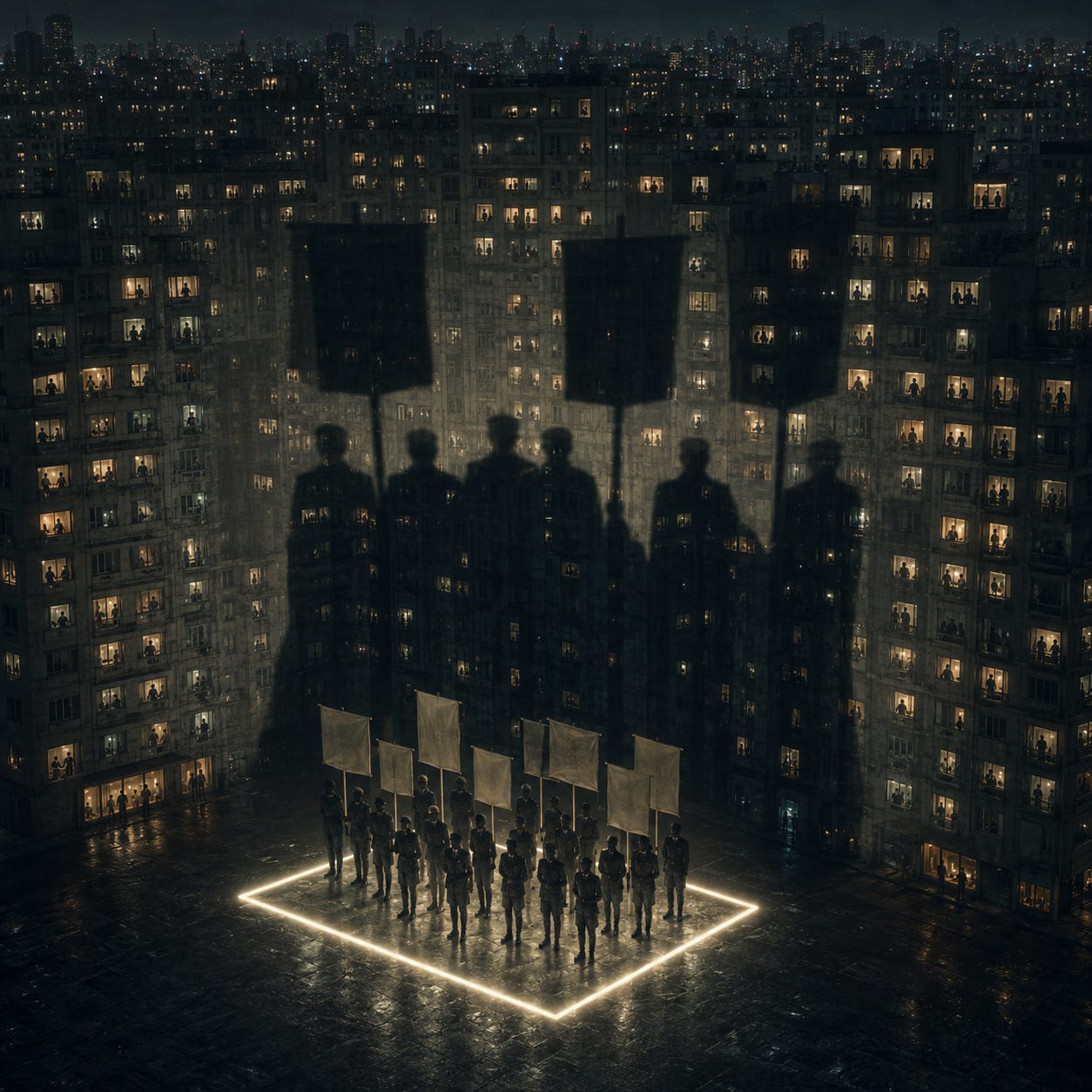
In Tehran, they came dressed in black. Women in chadors gathered beneath the banners of the state, their bodies arranged into the visual grammar of mourning: rows of veiled figures, coffins raised above the crowd, flags moving through the air, grief translated into choreography. The cameras found the most legible symbols first. The loyal. The devout. The disciplined. The people willing to stand for hours beneath the sun and allow their sorrow—or obedience, or fear, or conviction—to become part of a national image. In Washington, they came dressed alike. White masks. Blue shirts. Khaki trousers. Flags held in military formation. A few hundred men moving through the capital as though coordination itself granted them ownership of the country. They called themselves patriots. They marched beneath the symbols of a nation containing hundreds of millions of people and spoke as if that nation had authorized them to act in its name. The two scenes were not identical. In Tehran, the people arranging the photograph possessed the state. In Washington, the men entering it were auditioning for power. One spectacle was backed by ministries, police, television, public money, religious authority, and decades of coercion. The other belonged to a small white-nationalist organization attempting to manufacture importance through discipline and shock. But the images shared a grammar. In both, an organized minority dressed itself as the nation. This is one of the central deceptions of political life: the people most visible are often the least representative. A photograph records who arrived. It does not record who stayed home. It shows the bodies that gathered, not the population from which they came. It captures intensity but conceals proportion. The camera has no denominator. It cannot show the Iranian woman sitting in her apartment without a veil, watching strangers in chadors appear on television as the face of Iranian womanhood. It cannot show the father who despises the regime but fears losing his job. It cannot show the religious Iranian who mourns death but rejects the men who turned faith into government. It cannot show the millions who feel no loyalty at all and have learned that public silence is safer than public truth. Nor can it show the American family cooking outside on the Fourth of July while masked men march beneath the flag. It cannot show the veteran who finds them contemptible, the immigrant they wish to erase, or the ordinary citizen whose patriotism has never required a uniform, an enemy, or a chant. These people do not arrive together. They do not dress alike. Their refusal has no choreography. And so they disappear. Extremists possess a profound advantage over ordinary people: they are easier to photograph. They have slogans where others have complicated sentences. They have uniforms where others have private lives. They have certainty where others have doubt, enemies where others have obligations, and a hunger for spectacle where others feel embarrassment before it. Their politics offers them identity, fraternity, ritual, costume, and historical importance. It tells them that by standing in a square or marching down a street, they are no longer lonely or insignificant. They have become the faithful, the resistance, the nation, the chosen remnant. The fanatic does not need to become the majority. He needs only to become the most visible answer to the question: Who are these people? A few hundred organized men can dominate a national news cycle more easily than millions of unorganized citizens can express their indifference or disgust. A concentrated crowd in Tehran can be framed as the grief of Iran, even when the people inside it arrived for different reasons: conviction, habit, employment, fear, nationalism, religious duty, institutional pressure, or genuine mourning. The image erases motive. It converts all presence into allegiance. This is why spectacle is so useful to authoritarian politics. It reduces a society to its most obedient surface. But the camera does not act alone. The organizer wants magnitude. The state wants unanimity. The broadcaster wants spectacle. The editor wants a legible frame. The platform wants engagement. Each institution takes a partial crowd and rewards it for pretending to be a whole people. The camera has no denominator, and the institutions operating it often have little incentive to supply one. The Iranian regime has understood this for decades. It does not merely wait for its supporters to appear. It creates the conditions of appearance. It buses them, feeds them, broadcasts them, protects them, closes roads for them, and denies opponents the ability to assemble with equal safety. It then points the camera toward the crowd and announces that the country has spoken. The white nationalists in Washington do not yet possess these instruments, but they understand the same principle in miniature. Matching clothes enlarge small numbers. Masks turn weak men into an anonymous formation. Flags convert a faction into an imagined inheritance. Military spacing gives the appearance of order, and order gives the appearance of strength. In Tehran, the spectacle says: Iran mourns. In Washington, it says: America is being reclaimed. Neither image can bear the national claim imposed upon it. A country is not identical to the people most willing to perform ownership of it. Most people are somewhere else. They are working shifts, caring for parents, paying bills, putting children to bed. They are exhausted. They are cautious. They are politically homeless. They may hate the government, hate the opposition, distrust the media, and feel no desire to surrender their remaining life to another movement demanding absolute loyalty. The unorganized majority experiences politics privately. The disciplined minority performs authority publicly. This is how we come to endure people who scarcely represent us. They enter the square. They enter the broadcast. They enter the photograph. Then they use their own visibility as evidence of our absence, and our absence as evidence of their legitimacy. They say: We are the people. But the most dangerous word in politics may be “we,” spoken by those who have mistaken organization for permission. There is, however, a harder truth beneath this. Staying home is not always innocence. Sometimes it is wisdom. Sometimes it is fear. Sometimes it is exhaustion. Sometimes it is the refusal to become what one despises. But sometimes it is also surrender. The sane person does not want to march beside fanatics, yet by refusing every form of public solidarity, the sane person may leave the public square entirely to them. This is the unbearable asymmetry. The fanatic’s willingness to appear is part of his power. Our unwillingness to imitate him is part of our decency. But our permanent disappearance becomes his permission. And over time, symbolic power does not remain symbolic. A disciplined faction first impersonates the nation visually. Repetition then gives the image weight. Weight produces perceived strength. Perceived strength intimidates opponents, attracts the lonely, recruits the ambitious, disciplines the uncertain, and teaches institutions which voices must be taken seriously. What begins as costume becomes legitimacy. What begins as spectacle becomes access. What begins as a photograph becomes policy. This is how a minority can move from representing the country falsely to governing it materially. We should not romanticize the quiet majority. It is not always enlightened. It may be fragmented, passive, selfish, frightened, or resigned. But neither should we allow the organized minority to inherit the moral authority of visibility. A crowd is not a referendum. A funeral is not a nation. A procession is not a people. Most of the country exists outside the frame. It exists in the woman removing the garment the state requires. In the citizen who sees the masked marchers and refuses their definition of belonging. In the millions who remain unconvinced, unorganized, and unseen. In those who understand that love of a country does not require shouting, and faith does not require submission to men who claim God as their instrument. The visible minority is real. Its grief may be real. Its convictions may be real. Its anger may be real. Its claim to totality is the lie. Perhaps the true subject of both photographs is not the crowd before the camera, but the vast unphotographed population behind closed doors, listening to the chants travel through the street, knowing that once again strangers have dressed themselves in the symbols of the country and gone outside to speak in everyone’s name. But a people who remain permanently outside the photograph may eventually discover that the photograph has become the country. —Elias WinterAuthor of Language Matters, a space for reflection on language, power, and decline This is a public episode. If you would like to discuss this with other subscribers or get access to bonus episodes, visit eliaswinter.substack.com
Embed this episode
Ready to play
The Camera Has No Denominator
No transcript for this episode yet
Similar Episodes
No similar episodes found.
Similar Podcasts
No similar podcasts found.