
EPISODE · Jan 27, 2025 · 56 MIN
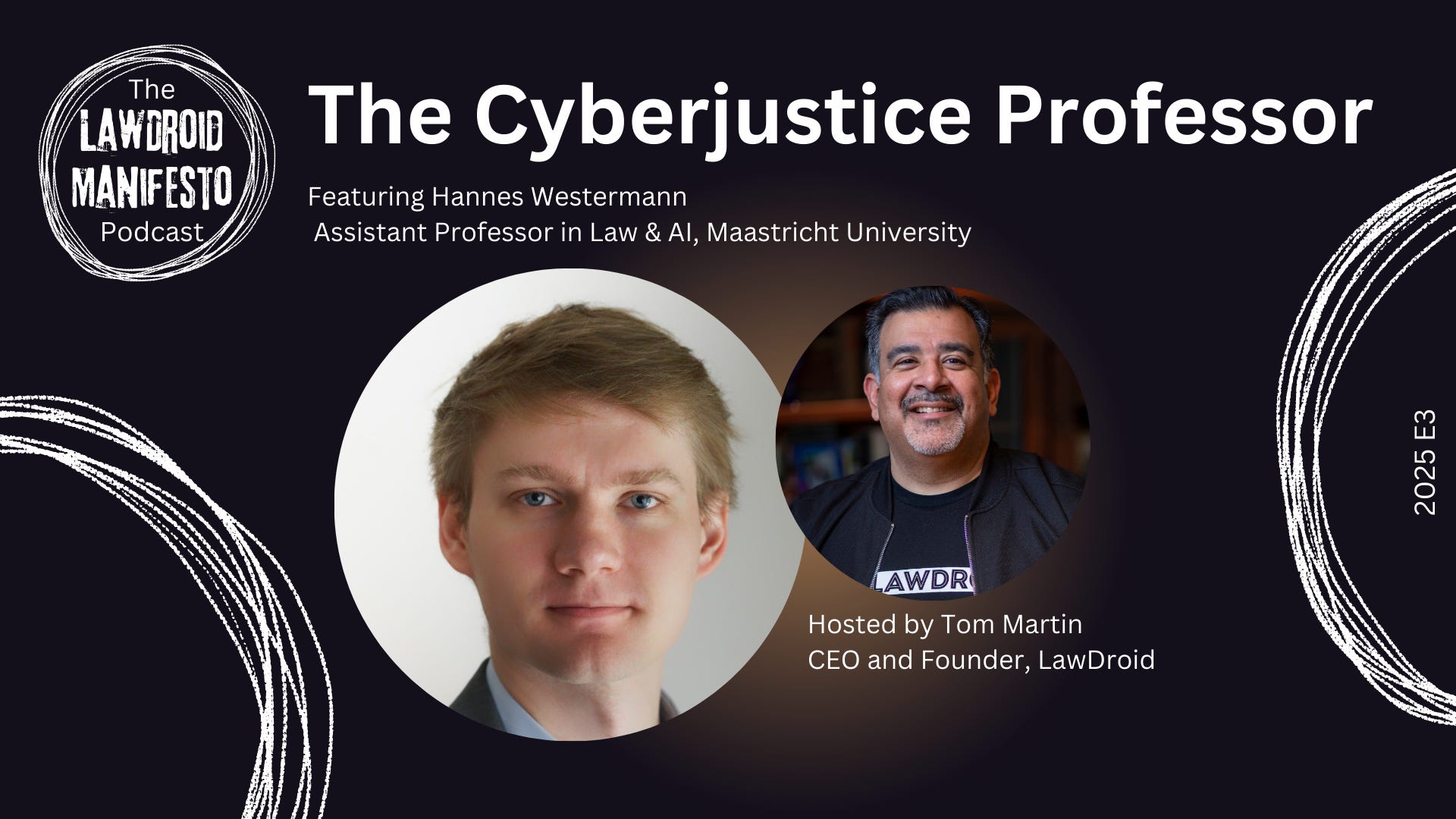
The Cyberjustice Professor: Hannes Westermann
from LawDroid Manifesto Podcast · host Tom Martin
Hey there Legal Rebels! 👋I’m excited to share with you the third episode of the 2025 season of the LawDroid Manifesto podcast, where I will be continuing to interview key legal innovators to learn how they do what they do. I think you’re going to enjoy this one!If you want to understand how AI and programming can be harnessed to solve access to justice challenges and empower the next generation of lawyers, you need to listen to this episode. Hannes Westermann bridges the gap between law and technology, creating practical solutions like JusticeBot while teaching future lawyers to code at Maastricht University.LawDroid Manifesto is a reader-supported publication. To receive new posts and support my work, consider becoming a free or paid subscriber.Cyberjustice: Breaking Down Legal Access Barriers with AIJoin me as I interview Hannes Westermann, Assistant Professor at Maastricht University's Law and Tech Lab, who is pioneering the integration of AI and law to improve access to justice.In this illuminating conversation, Hannes shares his journey from early programming experiences to creating JusticeBot, an AI platform that has helped over 40,000 people navigate legal challenges. He discusses his innovative approach combining symbolic AI with generative AI to provide legal information and support dispute resolution. Hannes also offers insights into teaching the next generation of lawyers to code and use AI tools effectively.His unique perspective at the intersection of law and technology, coupled with practical achievements in deploying AI solutions, makes this episode essential viewing for anyone interested in how technology can bridge the justice gap. Whether you're a legal professional curious about AI's potential or an innovator looking to understand the future of legal services, this discussion offers valuable insights into making justice more accessible through technology.The SkinnyIn this episode, we explore the intersection of AI, law, and access to justice with Hannes Westermann, Assistant Professor at Maastricht University's Law and Tech Lab. From his early programming experiences at age 11 to developing JusticeBot, which has helped over 40,000 people with legal issues, Hannes provides fascinating insights into how technology can democratize legal access while maintaining accuracy and ethical standards.Key Takeaways* JusticeBot combines symbolic AI logic with generative AI to help users understand their legal rights and options, particularly in landlord-tenant disputes* The platform avoids unauthorized practice of law by providing information rather than predictions or advice, empowering users to make informed decisions* The LL Mediator project demonstrates how AI can assist in online dispute resolution by moderating emotional responses and helping mediators draft responses* Teaching law students to code and use AI tools is crucial for preparing the next generation of legal professionals* The democratization of AI through natural language interfaces means legal professionals don't need extensive technical backgrounds to leverage these tools* Combining symbolic logic with generative AI creates a powerful framework for legal applications - using the right tool for the right job* Open-source AI models running locally could help address confidentiality concerns in legal applicationsNotable Quotes* "Due to a number of reasons, this was based on the symbolic AI approach. And so it's a deterministic logic. It's very easy to see what kind of answers it will give, depending on what kind of information the user provides." Hannes Westerman (03:09-03:19)* "So many lay people struggle with the fact of even knowing that they have a legal situation, right? Like something has happened. And but it's kind of making this threshold in or crossing this gap between, oh, here's something that happened to me, like I have a water leak, or I got this letter to there is some legal right involved here." Hannes Westerman (21:00-21:14)* "I think that's been one of the big changes of this generative AI revolution is that you don't need to do programming anymore to be able to use the most sophisticated AI. When I started my PhD, there was AI. But the way you built these systems was usually you would do code. Today, to use really the most powerful AI system out there, you just talk to it." Hannes Westerman (52:42-53:20)* "I really do think these are incredibly powerful tools, but I still think they're tools. Like, there's definitely limits with them today, like in terms of hallucinations and such, but they're also very powerful on certain tasks, right? Like giving ideas, drafting things, and so on." Hannes Westerman (41:34-41:52)* "We always see this as kind of augmented intelligence, sort of artificial intelligence, where we try to give context to the user, try to give them more information to allow them to make a better decision." Hannes Westerman (18:32-18:42)ClipsAI Accessibility and Future PotentialAugmented Intelligence in Legal AIOpportunities and Challenges of AI for LawyersHelping Individuals Recognize Their Legal RightsThe conversation with Hannes Westermann illuminates how thoughtfully designed AI systems can expand access to justice while maintaining professional standards. His work demonstrates that the future of legal technology isn't about replacing lawyers but about creating tools that help both legal professionals and the public navigate the complexities of the legal system more effectively. As AI continues to evolve, Westermann's balanced approach of combining traditional legal knowledge with technological innovation provides a valuable framework for future developments in legal technology.Closing ThoughtsAs someone who has been working in legal technology for years, I find Hannes Westermann's work incredibly inspiring. His approach to combining symbolic and generative AI demonstrates a thoughtful balance between innovation and responsibility. What particularly resonates with me is his focus on making legal help accessible while carefully avoiding unauthorized practice of law.Hannes represents a new generation of legal professionals who are truly bridging the gap between law and technology. His work teaching law students to code while simultaneously developing practical solutions like JusticeBot shows how we can prepare for a future where legal services are more accessible and efficient.What makes Hannes's perspective so valuable is his understanding that AI tools should augment rather than replace human judgment. His emphasis on giving users context and information rather than direct advice is exactly the kind of responsible innovation we need in legal tech. As we continue to develop AI solutions for the legal industry, Hannes's balanced approach provides an excellent model for how we can harness technology to expand access to justice while maintaining professional standards.For those of us working at the intersection of law and technology, Hannes's work reminds us that the goal isn't to create the most sophisticated technology — it's to create the most useful and accessible solutions for real people confronted with real legal challenges. This is a public episode. If you'd like to discuss this with other subscribers or get access to bonus episodes, visit www.lawdroidmanifesto.com/subscribe
NOW PLAYING
The Cyberjustice Professor: Hannes Westermann
No transcript for this episode yet
Similar Episodes
Mar 26, 2026 ·1m
Jan 2, 2026 ·47m
Dec 21, 2025 ·46m