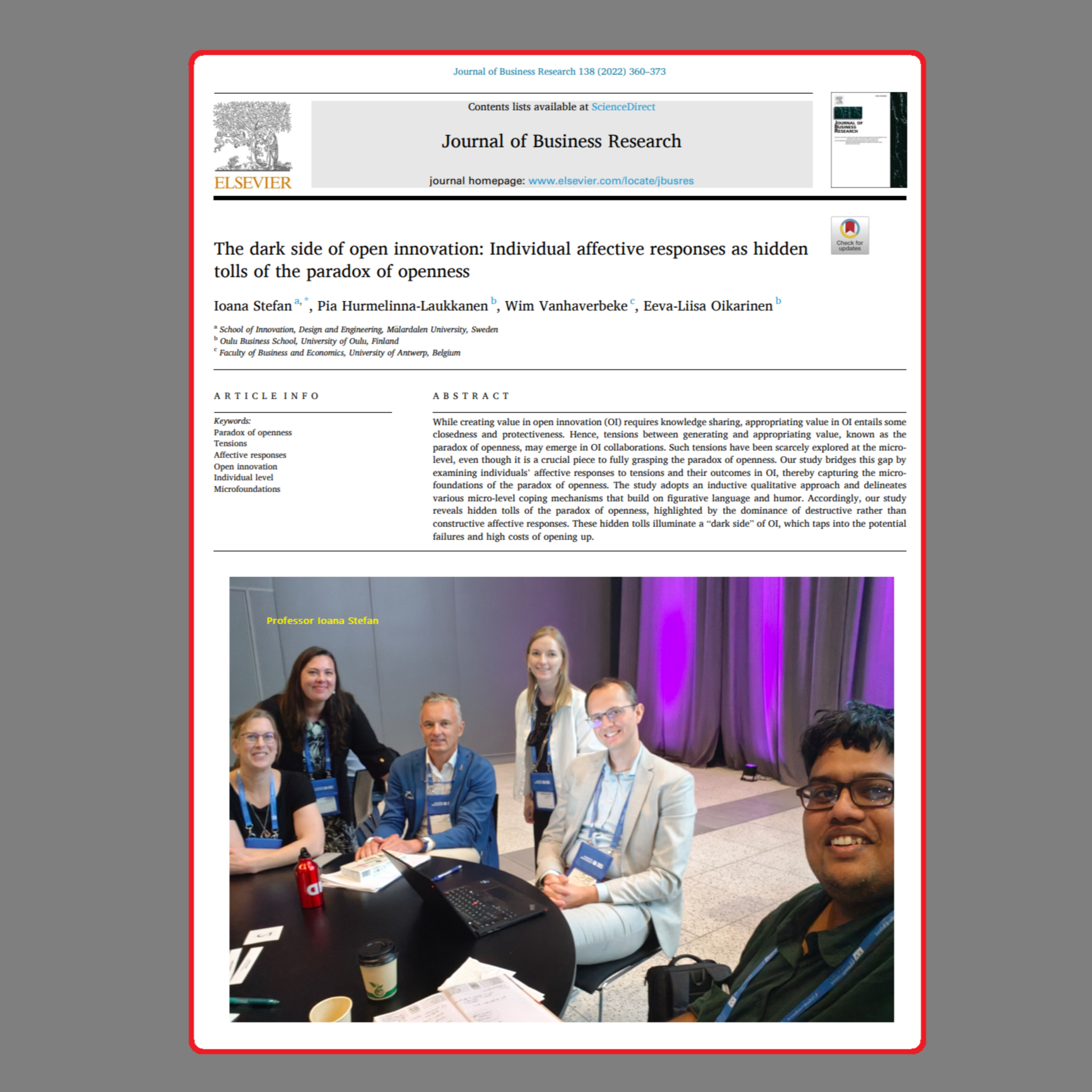
The dark side of open innovation (Stefan et al 2022) | ABDC-A JBR episode artwork

EPISODE · Aug 12, 2025 · 34 MIN

The dark side of open innovation (Stefan et al 2022) | ABDC-A JBR

from Revise and Resubmit - The Mayukh Show · host Mayukh Mukhopadhyay

English Podcast starts at 00:00:00Bengali Podcast starts at 00:18:39Hindi Podcast starts at 00:27:09Welcome to “Revise and Resubmit” 🎙️✨Hey there, word-workers and weekend scholars! Welcome into the podcast “Revise and Resubmit” — the place where ideas get sharper, sentences get braver, and research gets the spotlight it deserves 🔍📚. Today’s episode? It hums. It builds. It questions. It stings a little. And then it sings. Because the best prose — like the best inquiry — plays with rhythm: short beats, longer lines, and the kind of crescendo that makes the mind lean forward to listen.This one matters. The Journal of Business Research is a prestigious venue — an ABDC A-listed journal — and that status isn’t just a letter; it’s a signal of rigor, relevance, and international standing in the research community. Elsevier publishes it, and the journal’s reputation in business and management is anchored by years of high-impact, peer-reviewed work that shapes how firms, scholars, and policymakers think.Today’s feature: “The dark side of open innovation: Individual affective responses as hidden tolls of the paradox of openness,” by Ioana Stefan, Pia Hurmelinna-Laukkanen, Wim Vanhaverbeke, and Eeva-Liisa Oikarinen — Journal of Business Research, Volume 138, January 2022, Pages 360–373 🧠🗝️.Short sentence: Open innovation thrives on sharing. Longer sentence: But when value must be protected while it’s being created — when teams must stay open enough to collaborate and closed enough to safeguard — a paradox forms, and inside that paradox, people feel things they rarely publish: anxiety, defensiveness, fatigue, even cynicism. The authors go micro, interviewing individuals at the coalface of collaboration, mapping affective responses, and surfacing the hidden tolls: the destructive outnumber the constructive, the heat often beats the light, the cost of opening up is not just strategic — it’s emotional 💥🧩. And yet, humans cope; they twist figurative language, crack gallows humor, and stack small, clever shields to carry on — signals that the microfoundations of innovation are as psychological as they are procedural.Listen. Rhythm matters — in writing, in teams, in trust. Vary the cadence; vary the choices; vary the boundaries; that’s how the work breathes. But what happens when the rhythm of openness keeps speeding up, while the rhythm of protection refuses to slow down? 🫨🧪Before we dive deeper, a salute: thank you to the authors — Ioana Stefan, Pia Hurmelinna-Laukkanen, Wim Vanhaverbeke, and Eeva-Liisa Oikarinen — and to the publisher, Elsevier, for this important contribution in the Journal of Business Research (ABDC A).Tap follow and keep the conversation going:Subscribe to “Revise and Resubmit” on Spotify and Apple Podcast — and yes, we’re also on Amazon Prime Podcasts 🎧⭐.Watch extended cuts and behind-the-scenes on the Weekend Researcher YouTube channel 🎥🧪.Here’s the question to carry into the episode: if most emotional responses to the paradox of openness are destructive, how should leaders redesign collaboration so that openness creates value without quietly burning out the people who create it? 🤔🧭ReferenceStefan, I., Hurmelinna-Laukkanen, P., Vanhaverbeke, W., & Oikarinen, E.-L. (2022). The dark side of open innovation: Individual affective responses as hidden tolls of the paradox of openness. Journal of Business Research, 138, 360–373. https://doi.org/10.1016/j.jbusres.2021.09.028‌Youtube Channel⁠https://www.youtube.com/@weekendresearcher⁠Support us on Patreonhttps://patreon.com/weekendresearcher

English Podcast starts at 00:00:00Bengali Podcast starts at 00:18:39Hindi Podcast starts at 00:27:09Welcome to “Revise and Resubmit” 🎙️✨Hey there, word-workers and weekend scholars! Welcome into the podcast “Revise and Resubmit” — the place where ideas get sharper, sentences get braver, and research gets the spotlight it deserves 🔍📚. Today’s episode? It hums. It builds. It questions. It stings a little. And then it sings. Because the best prose — like the best inquiry — plays with rhythm: short beats, longer lines, and the kind of crescendo that makes the mind lean forward to listen.This one matters. The Journal of Business Research is a prestigious venue — an ABDC A-listed journal — and that status isn’t just a letter; it’s a signal of rigor, relevance, and international standing in the research community. Elsevier publishes it, and the journal’s reputation in business and management is anchored by years of high-impact, peer-reviewed work that shapes how firms, scholars, and policymakers think.Today’s feature: “The dark side of open innovation: Individual affective responses as hidden tolls of the paradox of openness,” by Ioana Stefan, Pia Hurmelinna-Laukkanen, Wim Vanhaverbeke, and Eeva-Liisa Oikarinen — Journal of Business Research, Volume 138, January 2022, Pages 360–373 🧠🗝️.Short sentence: Open innovation thrives on sharing. Longer sentence: But when value must be protected while it’s being created — when teams must stay open enough to collaborate and closed enough to safeguard — a paradox forms, and inside that paradox, people feel things they rarely publish: anxiety, defensiveness, fatigue, even cynicism. The authors go micro, interviewing individuals at the coalface of collaboration, mapping affective responses, and surfacing the hidden tolls: the destructive outnumber the constructive, the heat often beats the light, the cost of opening up is not just strategic — it’s emotional 💥🧩. And yet, humans cope; they twist figurative language, crack gallows humor, and stack small, clever shields to carry on — signals that the microfoundations of innovation are as psychological as they are procedural.Listen. Rhythm matters — in writing, in teams, in trust. Vary the cadence; vary the choices; vary the boundaries; that’s how the work breathes. But what happens when the rhythm of openness keeps speeding up, while the rhythm of protection refuses to slow down? 🫨🧪Before we dive deeper, a salute: thank you to the authors — Ioana Stefan, Pia Hurmelinna-Laukkanen, Wim Vanhaverbeke, and Eeva-Liisa Oikarinen — and to the publisher, Elsevier, for this important contribution in the Journal of Business Research (ABDC A).Tap follow and keep the conversation going:Subscribe to “Revise and Resubmit” on Spotify and Apple Podcast — and yes, we’re also on Amazon Prime Podcasts 🎧⭐.Watch extended cuts and behind-the-scenes on the Weekend Researcher YouTube channel 🎥🧪.Here’s the question to carry into the episode: if most emotional responses to the paradox of openness are destructive, how should leaders redesign collaboration so that openness creates value without quietly burning out the people who create it? 🤔🧭ReferenceStefan, I., Hurmelinna-Laukkanen, P., Vanhaverbeke, W., & Oikarinen, E.-L. (2022). The dark side of open innovation: Individual affective responses as hidden tolls of the paradox of openness. Journal of Business Research, 138, 360–373. https://doi.org/10.1016/j.jbusres.2021.09.028‌Youtube Channel⁠https://www.youtube.com/@weekendresearcher⁠Support us on Patreonhttps://patreon.com/weekendresearcher

NOW PLAYING

The dark side of open innovation (Stefan et al 2022) | ABDC-A JBR

0:00 34:39

No transcript for this episode yet

We transcribe on demand. Request one and we'll notify you when it's ready — usually under 10 minutes.

Frequently Asked Questions

How long is this episode of Revise and Resubmit - The Mayukh Show?

This episode is 34 minutes long.

When was this Revise and Resubmit - The Mayukh Show episode published?

This episode was published on August 12, 2025.

What is this episode about?

English Podcast starts at 00:00:00Bengali Podcast starts at 00:18:39Hindi Podcast starts at 00:27:09Welcome to “Revise and Resubmit” 🎙️✨Hey there, word-workers and weekend scholars! Welcome into the podcast “Revise and Resubmit” — the place where...

Can I download this Revise and Resubmit - The Mayukh Show episode?

Yes, you can download this episode by clicking the download button on the episode player, or subscribe to the podcast in your preferred podcast app for automatic downloads.
URL copied to clipboard!