
EPISODE · Jun 20, 2026 · 47 MIN
The Fish Knife and the Firewall
from Language Matters Podcast · host Elias Winter
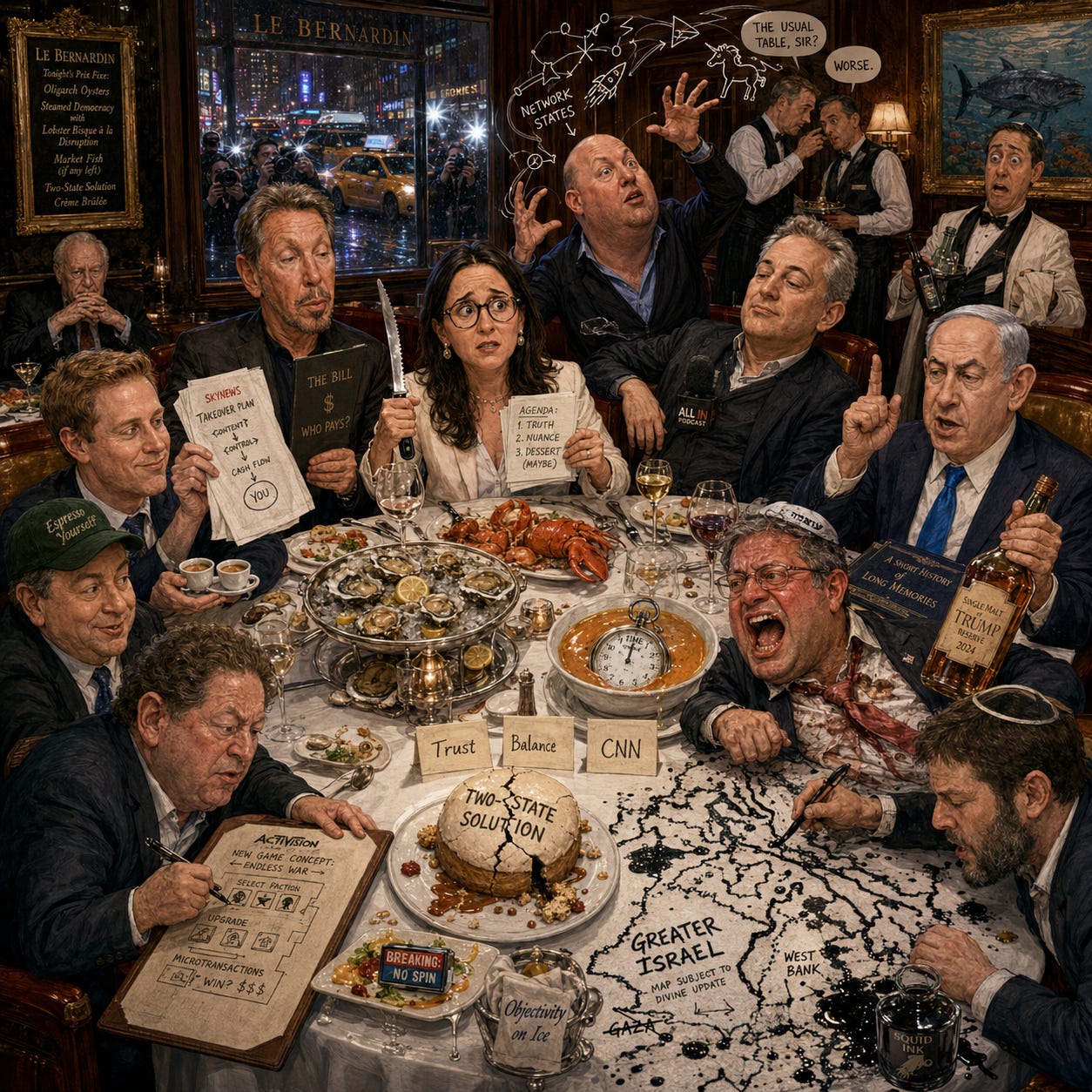
The Room Where Fish Become InnocentThe dinner was booked under the name The Center for Balanced Seafood, which was either a cover organization, a joke, or the most honest think tank in Manhattan.At Le Bernardin, one could never tell.The room had been prepared with the tenderness usually reserved for funerals and leveraged buyouts. White tablecloths fell like surrender documents over the edges of the tables. The silverware appeared not placed but deployed. The wine glasses stood in disciplined formation, each one polished to the point of moral vacancy. Outside, New York continued to behave like New York: sirens, steam, rent, rats, the great democratic vulgarity of the sidewalk. Inside, halibut had been persuaded to become an idea.The private room glowed with the serenity of violence already processed.Fish arrived at Le Bernardin as animals and left as punctuation. Their bones had been removed. Their struggle had been edited out. Their eyes were nowhere. Their bodies had been translated into courses, and each course came with a French adjective and an American price point. It was the perfect restaurant for a class of people who believed power should be delicate, deboned, and served on porcelain.Bari Weiss arrived first.She was early, because martyrs are often punctual.She wore black, the official color of people who have recently entered an institution in order to save it from the people who worked there. In one hand she carried a leather folder. In the other, a phone that had been vibrating since 2017. Inside the folder were index cards written in a neat, severe hand:CBS postmortemCNN narrative architecture60 Minutes containmentAnti-war rightIsrael language disciplineDo not mention Gaza before dessertShe read the last card twice.Then she crossed it out.Then she wrote underneath it:Do not mention Gaza unless someone else mentions Gaza and then act disappointed.A waiter approached her with the manner of a man trained to ask no questions of history.“Sparkling or still?”“Balanced,” Bari said.The waiter blinked.“Very good, madam.”She sat down at the head of the table, though the table had not formally agreed it had a head. This was one of the skills that had made her useful.The room was silent, but not empty. It had the particular atmosphere produced when money is on its way. Somewhere in the walls, cooling systems hummed with the confidence of institutions that had never been audited by God.Bari checked her phone.A message from David Ellison:Running seven minutes late. Important synergy call.A message from Marc Andreessen:Can’t wait. I’ve been thinking about CNN as a protocol.A message from Howard Schultz:Would love to discuss rebuilding trust as a third place.A message from David Sacks:Just to clarify, dinner is off the record, right? Also I reserve the right to podcast my objections anonymously.A message from Larry Ellison’s assistant:Mr. Ellison does not text. Mr. Ellison arrives.Bari sighed.“You told me it would be hard,” she said to the empty room. “You did not tell me CBS had ghosts.”The waiter returned with a tiny porcelain dish containing a transparent slice of tuna, an arrangement of microgreens, and a foam so pale it seemed to have been invented by someone afraid of soup.“First canapé,” he said.“What is it?”“Bluefin tuna, barely touched.”Bari stared at it.“Perfect,” she said. “That’s exactly how we describe editorial independence.”Balanced and Fact-BasedDavid Ellison entered smiling the way heirs smile when they have recently been briefed on humility.He was followed by a small gravity field of assistants, none of whom were invited but all of whom behaved as though they had been. He wore a suit that looked expensive enough to have an opinion on NATO.“Bari,” he said, kissing the air somewhere near her cheek. “This is fantastic. Very intimate. Very mission-aligned.”“David.”“I love what you’ve done with CBS.”“You mean the part where everyone thinks I murdered a cathedral?”“I would not say murdered,” David said, taking his seat. “I would say migrated legacy trust assets into a post-linear coherence environment.”Bari closed her eyes.“That is why people hate us.”“They hate us because we are brave.”“They hate us because you talk like a parking garage became sentient.”David nodded, as if absorbing feedback from a valued stakeholder.Larry Ellison entered next. He did not enter like a man. He entered like a valuation.The room rearranged itself around him. Chairs became more obedient. The wine became more expensive by proximity. Even the fish seemed to understand that something older than appetite had arrived: ownership.Larry did not say hello. He sat down and inspected the table.“Too many forks,” he said.“They’re for the courses,” said Bari.“I built Oracle with fewer forks.”Marc Andreessen came in after him, tall, cheerful, abstract, wearing the expression of a man who had seen the future and monetized the anxiety around it. David Sacks arrived with the wary energy of someone who believed every dinner was secretly a panel. Howard Schultz came carrying the invisible steam of a thousand airport lattes. Bobby Kotick entered grinning, as if the entire room might be converted into downloadable content. Herbert Allen Jr. arrived last among the financiers, quiet as an old door in a private library.The first formal course arrived: thinly sliced tuna, citrus, caviar, a sauce so restrained it seemed to be withholding comment.The sommelier poured white wine.Bari tapped her glass with her fish knife.“Thank you all for coming,” she said. “As you know, this dinner is fictional, satirical, morally exaggerated, legally non-binding, and spiritually accurate.”“Excellent disclosure,” said Sacks.“We are here,” Bari continued, “to discuss the CBS transition, the next phase of network trust restoration, and possible strategic opportunities should CNN become available for civilization.”Howard Schultz raised a finger.“I would prefer ‘community.’”“No,” said Larry.“Fine,” said Howard. “Civilization.”David Ellison leaned forward.“CBS was step one. We restored confidence.”Bari stared at him.“David, Bill Owens resigned. Scott Pelley is being treated like the last monk of Mount Athos. Half the newsroom thinks I arrived on a horse named Algorithm. The other half thinks I am the horse.”“Transition friction,” David said.“Reputational opportunity,” said Andreessen.“Retention challenge,” said Kotick.“Third-place crisis,” said Schultz.“Human resources,” said Herbert Allen Jr., speaking for the first time.Everyone went silent.He buttered a piece of bread.“In my day,” he said, “one bought the studio first and the conscience later.”Larry nodded with approval.Bari rubbed her temples.“You all said CBS was ready.”“It was ready,” said David Ellison.“It was not ready. It had a memory. Nobody told me it had a memory.”“Memory can be expensive,” said Larry. “That’s why we moved it to the cloud.”Bari looked around the table.“You wanted me to clean it up.”“We wanted you to restore balance,” said David.“That’s what I said.”“No,” said Bari. “You said balance. But you meant: remove the people who still think journalism is not a donor product.”The waiter arrived with the next course, a poached scallop resting beneath a fragile veil of edible gold.“What is this?” asked Sacks.“Diver scallop,” said the waiter. “With golden ossetra and a champagne beurre blanc.”Larry examined it.“Can it scale?”The Stopwatch ObjectsThe next course did not arrive on a plate.It arrived on a pillow.A waiter in white gloves approached the table carrying a small silver stopwatch.Nobody spoke.Bari’s face changed.“Absolutely not.”The waiter froze.“Madam?”“Send it back.”“It is the chef’s homage to time.”“It is not time,” Bari said. “It is 60 Minutes.”The table recoiled with the solemn horror of aristocrats who had accidentally been served democracy.David Ellison forced a smile.“Perhaps the chef is being playful.”“The chef is lucky I believe in free expression,” Bari said.Larry picked up the stopwatch and turned it over.“Primitive device.”“It had a brand,” said Schultz. “Trust, ritual, family living rooms. A kind of civic third place.”“Howard,” Bari said, “if you say third place again, I will nationalize Starbucks.”Bobby Kotick leaned in.“I never understood the title. Why sixty? Why not infinite? Why not seasonal? Why not unlock extra minutes for premium subscribers?”“It was a newsmagazine,” said Bari.“Exactly,” said Kotick. “Legacy format problem.”Marc Andreessen brightened.“I’ve been thinking about that. 60 Minutes is not a show. It’s a constraint. The future is n Minutes, where n is dynamically generated according to viewer outrage tolerance.”Sacks nodded reluctantly.“That’s actually not stupid.”“It is extremely stupid,” Bari said, “but in the way that raises money.”David Ellison put on his careful face.“Look. The 60 Minutes issue was always going to be delicate. Strong brand. Strong culture. Strong people. Strong feelings.”“Bill Owens said he lost the freedom to make independent decisions.”“Again,” said David, “strong feelings.”“Tanya Simon was replaced.”“Strategic renewal.”“With Nick Bilton.”“Innovation.”“Former technology columnist.”“Cross-platform thinking.”“No traditional broadcast management background.”“Fresh eyes.”“David, you replaced a cathedral organist with a man who once reviewed an app.”Andreessen raised a finger.“To be fair, cathedrals are also just early-stage social networks.”Everyone ignored him.Bari turned to the table.“And Scott Pelley. Do you know how annoying it is to fire someone and have him become Edward R. Murrow by lunch?”“That was unfortunate,” said Sacks.“It was theatrical,” said Kotick. “Good antagonist energy.”“I do not need antagonist energy,” Bari said. “I need compliant continuity.”Larry frowned.“Why was he allowed to speak?”Bari looked at him.“That is what speech is, Larry.”“Can we license it?”“No.”“Can we slow it?”“Sometimes.”“Can we call it misinformation?”“Only if we are careful.”Herbert Allen Jr. dabbed his mouth.“Careful is what the losing side calls early.”The waiter, still holding the stopwatch, whispered:“Shall I remove this?”“Yes,” said Bari.“No,” said Larry. “Leave it. I want to see what journalism used before dashboards.”CNN as the Next FishThe lights dimmed slightly.The next course arrived beneath silver domes.At the exact same moment, every person at the table pretended not to know what the next topic was.The waiters lifted the domes.On each plate sat a delicate white fish surrounded by squid ink. In the ink, with alarming precision, someone had drawn three letters:CNNBari stared at the plate.“Who approved this?”David Ellison looked pleased.“Chef’s discretion.”“This is not a course. This is a subpoena with fennel.”Howard Schultz smiled warmly.“I find it elegant. The fish represents the institution. The squid ink represents uncertainty. The plate represents community.”“Howard.”“Civilization.”“Better.”David Ellison leaned forward.“Obviously nothing is final.”Everyone nodded with the solemnity of people who had already chosen office furniture.“Obviously,” said Sacks.“Hypothetically,” said Kotick.“Scenario planning,” said Andreessen.“In my day,” said Herbert Allen Jr., “we called it Tuesday.”Bari cut into the fish.“So. CNN.”“CNN is not a network,” said Andreessen. “It is a legacy epistemic interface.”“It is a global brand,” said David Ellison.“It is a distressed trust property,” said Larry.“It is a third place,” said Schultz.Bari pointed her knife at him.“Howard.”“A second place?”“No.”“A place?”“Stop.”Bobby Kotick sipped his wine.“CNN has incredible IP. Wolf Blitzer. Anderson Cooper. Breaking News. Election Night. War Rooms. The red logo. The doom music. You could build an entire subscription universe.”“We are not turning CNN into Call of Duty,” said Bari.“Why not? Call of Duty: Situation Room. Multiplayer mode. You choose anchor, general, senator, unnamed intelligence official. Every missile strike unlocks a new map.”“That is monstrous.”“It is engaging.”Sacks frowned.“The problem with CNN is credibility. Half the country thinks it’s regime media.”“Only half?” said Larry.“That is the addressable market,” said David.Marc Andreessen placed both hands on the table like a man about to rename bread.“What if CNN became the first LLM-native news organization?”Bari closed her eyes again.“Please don’t.”“No anchors. No studios. No correspondents. Just continuous generated confidence.”“So cable news.”“No, no. This would be decentralized.”“Owned by whom?”There was a pause.“Us,” said Andreessen.Larry leaned back.“I prefer centralized.”David Ellison smiled.“We’re thinking editorial coherence across brands. CBS for legacy trust. CNN for global immediacy. Free Press for moral clarity.”Bari looked at him.“Say ideological discipline.”“Editorial coherence.”“Say ideological discipline.”“Trust architecture.”“David.”“Fine. Ideological discipline.”“Thank you.”The room relaxed.It is always easier to breathe once the lie has been properly named and then immediately renamed.The Anti-War InfectionThe sommelier poured red wine, which with fish at Le Bernardin felt like a violation, but the table had moved on from taste into history.Bari shuffled her index cards.“Next: the anti-war problem.”David Sacks became suddenly alert.“We should define terms.”“We have terms,” Bari said. “Tucker Carlson. Trita Parsi. Joe Kent. J.D. Vance when he forgets who is supposed to be grateful to whom.”Larry looked confused.“Are these competitors?”“They are worse,” said Bari. “They are native-born antibodies.”Andreessen nodded gravely.“The discourse has mutated.”“Exactly,” said Bari. “The old anti-war left was easy. You put them in the Chomsky drawer, the campus drawer, the suspicious beard drawer. Fine. Manageable. But now Tucker says it and suddenly men named Dale are asking why their son died so Raytheon could have a good quarter.”Sacks cleared his throat.“Some of those questions are legitimate.”Bari looked at him.“This is why you were seated near the exit.”“I’m just saying, America First foreign policy has product-market fit.”“You people and product-market fit,” Bari said. “Not every moral catastrophe needs a pitch deck.”Kotick shrugged.“It helps.”Bari continued.“Trita Parsi says Israel is dragging America into regional war. Fine. Expected. The system knows where to file him. Tucker says Netanyahu wants American soldiers to finish his regional strategy, and suddenly the right-wing base starts nodding.”Larry looked irritated.“Can we acquire Tucker?”“No,” said Bari.“Can we license Tucker?”“No.”“Can we replace Tucker?”“You tried. It made him stronger.”Andreessen leaned forward.“What if we build synthetic Tucker?”Sacks shook his head.“Impossible. The pauses are proprietary.”Howard Schultz raised his hand.“What if we invite anti-war conservatives into a structured conversation environment with premium coffee and shared values?”“Howard,” Bari said, “the anti-war right does not want a macchiato of mutual understanding. They want to know why every foreign policy emergency ends with their cousins paying taxes and somebody else getting a board seat.”There was a silence.Even the fish seemed to agree.Bari looked down at her card.“Joe Kent was not supposed to be a problem. He was supposed to be containable: veteran, nationalist, right-wing, useful when convenient. But then he starts saying Iran is not an imminent threat and the war is being pushed by Israel and its American lobby. Do you understand how irritating it is when someone says the unsayable in a crew cut?”Sacks smiled despite himself.“That’s a good line.”“I know.”“And J.D.?” asked David Ellison.Bari sighed.“J.D. is worse because he speaks fluent resentment. He can say: we support Israel, but we are not its valet. And then suddenly half of Ohio discovers sovereignty.”Larry frowned.“Ohio is still relevant?”“Electorally,” said Herbert Allen Jr.Larry seemed disappointed.Netanyahu had not yet arrived, but already his absence sat at the table like a reserved seat for consequence.The Guest of HistoryAt 9:17 p.m., the kitchen doors opened.Benjamin Netanyahu entered not through the restaurant but through the machinery of the restaurant, as if he had been plated by security.Two men in dark suits appeared first. Then another. Then Netanyahu.The waiters stiffened. The billionaires rose. Bari stood last, which she hoped looked independent.Netanyahu waved them down with the tired benevolence of a man for whom applause had become a minor form of weather.“My friends,” he said.Nobody knew whether they were his friends, but everyone knew it was safer to accept the promotion.He sat beside Bari. The waiter appeared instantly with a glass of water, then disappeared with the speed of a man who had seen geopolitics and preferred shellfish.“Prime Minister,” said David Ellison, “thank you for joining us.”“Please,” Netanyahu said. “Tonight I am not prime minister.”Everyone laughed nervously.“I am only a student of history.”The laughter stopped.Netanyahu turned his glass slowly.“My father understood history. Not the history of children. Not the history of seminars. Not the history of men who believe that because they have discovered guilt, they have discovered wisdom. He understood the other history. The history beneath the polite one.”Bari looked down at her notes.Netanyahu: let him speak, but do not let him become Old Testament before dessert.Too late.“My father studied Spain,” Netanyahu continued. “The Inquisition. The Jews who converted and were still hunted. The men who thought accommodation would save them. The men who mistook civilization for protection.”Larry listened closely.This was the register he liked: apocalypse with footnotes.Netanyahu continued.“People misunderstand strength. They think strength is cruelty. It is not. Strength is memory with weapons.”Howard Schultz whispered to Sacks, “That would not work as a store slogan.”Sacks whispered back, “Depends on the market.”Netanyahu looked at the table.“You speak of CNN. CBS. Narrative. Trust. Balance. These are American words. Lovely words. Soft words. Words that have never had to sleep with missiles.”Bari wanted to interrupt, but the room had changed. Satire had left temporarily to smoke outside.“In my region,” Netanyahu said, “there is no balance. There is survival. You call them civilians because you live in time. I live in history.”The line landed with terrible elegance.Even Kotick stopped chewing.Bari felt a chill, not because she disagreed exactly, but because he had said the structure without the garnish.Netanyahu smiled.“But of course, for television, we say security.”The room exhaled.Now they were back in business.Reputational ArsonThe next course was lobster.It arrived in a broth so clear it seemed to have been filtered through a law firm. Around it were tiny vegetables cut into shapes that implied the chef had either divine patience or untreated grief.Bari used the arrival of lobster to regain control.“Prime Minister, we were discussing the communications challenge.”“Ah,” Netanyahu said. “The challenge of saying necessary things to unnecessary people.”“More or less.”David Ellison leaned in.“CBS has been repositioned. CNN may become strategically available. But there are internal and external trust issues.”“Trust,” Netanyahu said, as though tasting an exotic fruit.“The American audience is fragmented,” said Andreessen. “The institutional stack is degraded.”“People don’t believe the news,” said Schultz.“That is because they watch it,” said Larry.Bari ignored them.“The issue is that defending Israel in the American media environment has become more difficult. Not because the case is weak,” she added quickly, glancing at Netanyahu, “but because certain coalition partners create unnecessary reputational exposure.”Netanyahu’s expression did not change.“You mean Ben-Gvir.”“And Smotrich.”Netanyahu drank water.“They are ministers.”“They are catastrophes with portfolios,” said Bari.“They represent voters.”“They represent screenshot risk.”Sacks smiled into his wine.Bari continued.“Ben-Gvir says things that make every campus activist look like Cassandra. Smotrich says things that force donors to learn the phrase ‘de facto annexation.’ Do you know how hard it is to argue about antisemitism on American television when your finance minister is somewhere with a map and a demolition permit?”Netanyahu shrugged.“Coalitions are not dinner parties.”At that exact moment, the doors burst open.The CrashersItamar Ben-Gvir entered first.He did not enter Le Bernardin so much as violate it.He wore a suit that looked like it had lost a fight with a car seat. His tie was loose. His smile was enormous. In one hand he held a half-empty bottle of something not served by the restaurant. In the other, a laminated security badge that did not belong to him.Behind him came Bezalel Smotrich, red-faced, intense, carrying a rolled-up map, three pens, and the focused aggression of a man who had once annexed a coat check.“Bibi!” Ben-Gvir shouted.The room stopped breathing.Bari’s eyes widened.“No,” she whispered.Netanyahu closed his eyes.“Coalition arithmetic,” he said.Ben-Gvir looked around the room.“Very nice! Very French. Where are the armed civilians?”Smotrich unrolled his map onto the table, knocking over one of Larry’s glasses.“I have improved the seating chart,” he said.Bari turned to David Ellison.“Were they invited?”David looked at Larry.Larry looked at Netanyahu.Netanyahu looked at history.“No,” said everyone.Ben-Gvir found an empty chair and sat down.“There are no empty chairs,” said Bari.“There are always empty chairs,” said Ben-Gvir, “if you understand sovereignty.”Smotrich sat beside him and began drawing lines across the tablecloth.Bari looked toward the doorway, checking for photographers.“Is anyone filming this?”Sacks looked at his phone.“Not yet.”“Why did you say ‘not yet’?”“Because we are in Manhattan.”Ben-Gvir grabbed a piece of bread.“What are we discussing?”“Trust,” said Schultz.Ben-Gvir laughed so hard he almost choked.“Trust? With Arabs?”The table froze.Bari’s face became the face of someone watching a grenade roll into a donor retreat.“No,” she said carefully. “We were discussing media trust.”“Same problem,” said Ben-Gvir.Smotrich looked up from his map.“What is media?”Andreessen brightened.“That’s actually a profound question.”“No,” said Bari. “It is not.”The Quiet Part Requests a Bigger GlassA waiter approached Ben-Gvir.“Sir, may I offer you the wine pairing?”“Do you have anything from Hebron?”The waiter made the professional decision not to exist.Smotrich pointed at the tablecloth.“This section is disputed.”“That is the butter plate,” said Bari.“Exactly,” said Smotrich.Ben-Gvir leaned toward Larry.“You are the database man?”Larry nodded.“I like databases,” Ben-Gvir said. “Can you make one of all the people who protest me?”Larry considered this.“Yes.”“Larry,” said Bari sharply.“What? He asked a technical question.”Smotrich turned to David Ellison.“You are taking CNN?”“Hypothetically,” said David.“Good. CNN should show maps.”“Maps test well,” said Kotick.“Not those maps,” Bari said.Smotrich unrolled another sheet.“These maps.”The sheet showed a version of the Middle East that made several ambassadors faint by implication.Howard Schultz tried to help.“Minister Smotrich, perhaps there is a way to tell a story of coexistence through shared spaces—”Smotrich stared at him.“Shared?”Howard wilted.“Or not.”Ben-Gvir slapped the table.“Why are you all so nervous? We agree.”“No,” said Bari too quickly.Ben-Gvir grinned.“You agree, but with napkins.”Nobody spoke.He had discovered the room.Netanyahu opened his eyes slowly.“Itamar.”“What? They agree. They just speak like lawyers.”“They are lawyers,” said Sacks.“And bankers,” said Herbert Allen Jr.“And founders,” said Andreessen.“And coffee,” said Schultz.Ben-Gvir turned to Bari.“You write about antisemitism, yes?”“Yes.”“You defend Israel?”“Yes.”“You say the West is weak?”“Sometimes.”“You say the left hates Jews?”“When applicable.”“You say anti-Zionism is often antisemitism?”“Yes.”“So why are you afraid of me?”Bari looked at him with the exhausted hatred one reserves for someone who has just completed your syllogism in public.“Because,” she said, “you do not know how to lie beautifully.”Smotrich smiled.“That is a diaspora problem.”Dessert Is AnnexedDessert arrived before anyone asked for it.This was a tactical error.The pastry chef, unaware that the private room had become a simulation of the collapse of liberal Zionist language, had prepared a delicate sugar sphere filled with olive oil mousse, pistachio, and sea salt. The waiter placed it at the center of the table.“And tonight’s dessert,” he said, “is called The Two-State Solution.”Nobody moved.Bari stared.David Ellison whispered, “Who approved the menu?”Herbert Allen Jr. whispered, “The old regime.”The dessert gleamed. It was fragile, translucent, absurdly expensive, and structurally impossible.Smotrich picked up a spoon.“No,” said Bari.He cracked it.The sphere collapsed.Pistachio foam spread across the plate like a peace process after a donor conference.Ben-Gvir applauded.“Finally, a realistic course.”Netanyahu covered his face with one hand.The waiter fled.Bari stood.“Enough. Everyone stop speaking.”Naturally, everyone began speaking.Ben-Gvir pointed at the collapsed dessert.“See? This is what happens when you build things with two states. Better one spoon.”Smotrich nodded.“One sovereignty.”David Ellison, trying to regain control, said:“We prefer integrated territorial coherence.”Bari turned on him.“Stop helping.”Andreessen said, “Actually, sovereignty is a platform problem.”Sacks said, “It’s also a domestic political problem.”Larry said, “It is a database problem.”Schultz said, “It is a community problem.”Kotick said, “It is a map expansion.”Bari shouted:“It is a language problem!”The room fell silent again.She was standing now, one hand on the table, the other gripping her index cards.“You all wanted this,” she said. “You wanted CBS cleaned. You wanted CNN next. You wanted journalism without journalists. You wanted trust without dissent. You wanted moral seriousness without moral risk. You wanted me to walk into a newsroom with a sword and call it balance.”David Ellison looked wounded.“We gave you a mandate.”“You gave me a mop and a crown.”Larry leaned back.“I paid for the room.”“Yes, Larry. You paid for the room. You always pay for the room. That is not the same as understanding what happens inside it.”Ben-Gvir whispered to Smotrich:“She is angry.”Smotrich whispered back:“Diaspora.”Bari pointed at them.“And you two. You are the reason this is impossible.”Ben-Gvir looked offended.“I am very possible.”“No. You are what happens when the footnotes get drunk. You say everything in a way that makes the donors sweat.”Smotrich smiled.“Truth is not sweat. Truth is land.”“Stop doing that,” Bari said.“Doing what?”“Being quotable.”Civilizational News NetworkThe fight began with branding.It always does.David Ellison unveiled a napkin on which he had written:CNN: Civilization News Network“No,” said Bari.“Strong,” said Kotick.“Too on the nose,” said Sacks.“Not enough on the nose,” said Ben-Gvir.“Can the C stand for conquest?” asked Smotrich.“No,” said everyone except Larry, who said:“Maybe.”Howard Schultz proposed:CNN Reserve“Absolutely not,” said Bari.“Premium trust experience,” Howard said.“No.”“Single-origin journalism.”“No.”“Ethically sourced anchors.”“No.”Marc Andreessen drew a diagram showing CNN becoming an autonomous decentralized news intelligence layer.Nobody understood it.Everyone pretended they might invest.Larry proposed:Oracle News: One Truth, Fully IndexedBari sat down again.“I am going to die at this table.”Netanyahu, who had been silent, finally spoke.“You are all thinking too small.”The room turned to him.He looked at the cracked dessert, the inked maps, the wine stains, the billionaires, the ministers, the new custodians of American truth.“CNN is not the prize,” he said. “CBS is not the prize. The prize is not even America. The prize is the frame through which America sees necessity.”Bari hated how good that was.Netanyahu continued.“If America sees Israel as choice, we lose. If America sees Israel as fate, we win.”There it was.The sentence around which the whole dinner had been unconsciously arranged.Not propaganda, exactly. Something deeper. Propaganda still knows it is selling. This was liturgy. This was the conversion of policy into destiny, of violence into inheritance, of strategy into memory.Ben-Gvir ruined it immediately.“Yes,” he said. “Also more guns.”Smotrich added:“And maps.”Netanyahu closed his eyes again.The FightBy the time the final wine was poured, the table had become a small failed state.The tablecloth was covered in Smotrich’s maps. The CNN fish logo had been smeared into an archipelago of squid ink. Someone had dropped the silver stopwatch into the lobster broth. Ben-Gvir had tried to deputize the sommelier. Howard Schultz was explaining reconciliation to a breadbasket. Andreessen had drawn five arrows from “journalism” to “protocol” and one arrow from “protocol” to “civilizational liquidity.” Bobby Kotick had begun designing a war-room interface on the back of the menu.Bari was no longer moderating. She was prosecuting.“You,” she said to David Ellison, “said this was about trust.”“It is.”“You said America needed a less ideological news source.”“It does.”“You bought my publication and put me in charge of CBS News.”“Yes.”“Then you possibly aimed me at CNN.”“Hypothetically.”“And now I am sitting at Le Bernardin with Netanyahu, two sanctioned-adjacent coalition goblins, a man who thinks journalism is a database, a man who thinks news needs a loyalty program, and Bobby Kotick designing Gaza as downloadable content.”Kotick raised a finger.“I never said Gaza specifically.”“Congratulations on your restraint.”Sacks leaned back.“This is why I prefer audio.”Bari turned on him.“And you. You sit here half in, half out, half Tucker, half donor, saying ‘product-market fit’ every time the republic coughs blood.”Sacks shrugged.“Someone has to understand the audience.”“The audience is not a SaaS dashboard.”“Not yet,” said Andreessen.“Marc.”“What?”“Stop saying not yet.”Larry interrupted.“The problem with all of you is sentimentality. News is information. Information needs structure. Structure needs ownership. Ownership needs capital. Capital needs control. Why is this difficult?”Bari looked at him.“Because somewhere inside the machine there are still human beings.”Larry waved his hand.“Temporary.”Netanyahu stood.The room became quiet again, but not respectfully this time. More like a classroom after the dangerous teacher reaches for chalk.“You are fighting over language,” he said. “This is American vanity. Words are not the thing. Power is the thing. Territory is the thing. Memory is the thing. Fear is the thing. The world does not ask whether you were polite when you survived.”Ben-Gvir clapped.“Exactly!”Smotrich nodded.“Finally.”Bari looked at Netanyahu and understood, with sudden clarity, why he had survived so long. He was not the most extreme man in the room. He was worse. He was the man who knew how to sit between extremity and respectability and charge both rent.“You need them,” she said to him, pointing at Ben-Gvir and Smotrich.Netanyahu did not answer.“And they need you,” she continued. “They say the thing. You translate it. We launder it. The donors fund it. The networks broadcast it. The audience calls it reality.”No one moved.For one brief second, the room had no euphemism left.It was intolerable.So Howard Schultz broke the silence.“What if,” he said carefully, “we created a listening circle?”Ben-Gvir threw a dinner roll at him.The Check Has Already Been PaidThe collapse came quickly after that.Ben-Gvir accused Netanyahu of cowardice.“You speak English too much,” he said.Netanyahu replied:“You speak at all too much.”Smotrich accused Ben-Gvir of insufficient planning.“You cannot build sovereignty on shouting.”Ben-Gvir said:“You cannot build anything with a spreadsheet.”Smotrich said:“I can build an outpost in twenty minutes with a spreadsheet.”Larry asked if outposts required database support.Andreessen asked if they could be tokenized.Sacks asked if the whole conversation was still off the record.Kotick asked whether conflict rights were exclusive or multi-platform.Howard Schultz asked if anyone wanted coffee.Bari laughed.It began as a small laugh, sharp and involuntary, then grew into something stranger. She laughed at the cracked dessert, at the stopwatch in the broth, at the billionaires reinventing conquest as a user experience, at the ministers too drunk to respect euphemism, at Netanyahu still seated like a marble bust of himself, at the absurdity of being hired to save journalism from ideology by people who thought truth was something you acquired at scale.She laughed because the whole thing was ridiculous.She laughed because the whole thing was real enough.She laughed because satire had failed to exaggerate.Then she gathered her cards.“Meeting adjourned,” she said.“But CNN—” David began.“Will survive us or become us. Either way, I need air.”She walked out of the private room and into the main dining room, where the well-heeled patrons continued to hold court over monkfish and restraint. Nobody looked up. This was New York. One did not interrupt another table’s apocalypse.Outside, 51st Street was damp and silver. Steam rose from a manhole with more honesty than any network slogan. A cab honked. Somewhere, a delivery worker biked past carrying three dinners worth less than the table’s mineral water.A paparazzo emerged from behind a black SUV.“Bari! Bari! Was this a strategy dinner?”She stopped.Behind her, through the restaurant glass, she could see them all still inside.Larry was examining the bill as though it were a hostile acquisition. David Ellison was whispering into his phone. Andreessen was explaining the future to a chair. Schultz was offering emotional hospitality to the coat check girl. Kotick was drawing a battle pass. Sacks was not recording, which meant he was definitely remembering. Netanyahu was still speaking, though no one appeared to be listening. Ben-Gvir had taken the silver stopwatch. Smotrich had annexed the dessert menu.Bari turned back to the camera.“No,” she said. “It was a conversation about trust.”Then she stepped into the Manhattan night.And inside, among the silver bones of the fish, the empire continued to practice saying conquest in the language of concern.—Elias WinterAuthor of Language Matters, a space for reflection on language, power, and decline This is a public episode. If you would like to discuss this with other subscribers or get access to bonus episodes, visit eliaswinter.substack.com
Embed this episode
NOW PLAYING
The Fish Knife and the Firewall
No transcript for this episode yet
Similar Episodes
No similar episodes found.
Similar Podcasts
No similar podcasts found.