
EPISODE · Jun 18, 2026 · 41 MIN
The Gravity of Not Knowing
from Language Matters Podcast · host Elias Winter
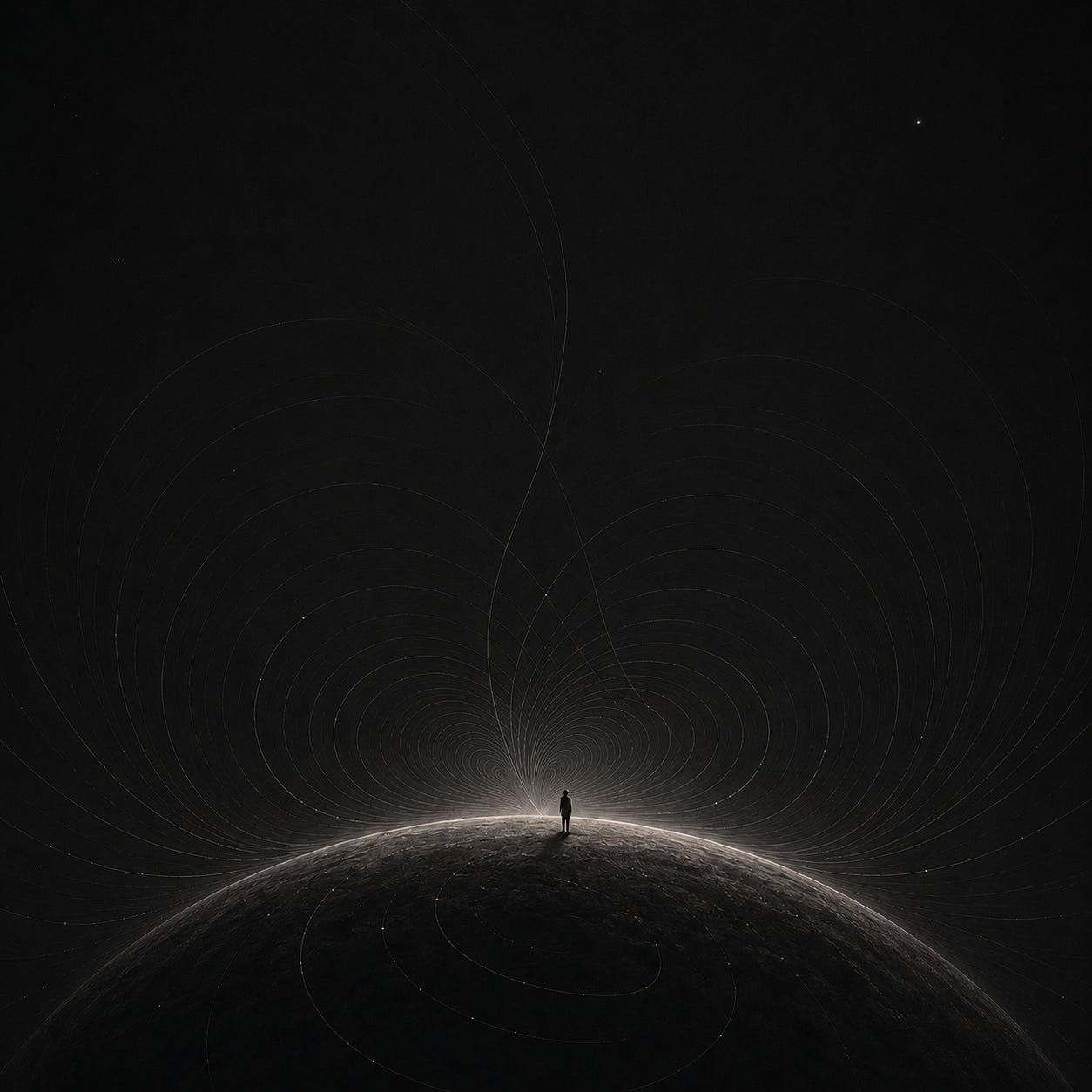
I. The Insult of the GlobeIt is strange that we ever got used to the floor.Every morning, we place our feet on it as though it were a given. We walk to the kitchen. We boil water. We check messages. We open laptops. We discuss weather, rent, meetings, war, elections, lunch. We speak of “the world” as though it were a room whose furniture we understand.But the actual situation is obscene.We are soft-bodied animals stuck to the exterior of a spinning sphere by an invisible principle we can measure but cannot finally explain. We live on the skin of a planet. Not in a house, not in a country, not even in a world in the way the body imagines a world, but on a globe: a rotating mass of rock, metal, water, weather, bacteria, memory, and bone, wrapped in a thin layer of breathable gas, falling around a star.The floor is not a floor. It is local obedience to gravity.“Down” is not an absolute direction. It is merely toward the center of the Earth. “Up” is not a ceiling. It is exposure. The sky is not a blue roof. It is the beginning of everything we cannot survive.This should disturb us more than it does.The body experiences the Earth as flat because the body is mercifully provincial. It knows the table, the street, the handrail, the bed. It knows stairs. It knows the weight of a cup. It knows the distance between the door and the car. The body does not wake up every morning screaming, “I am adhered to a sphere.” That would make civilization difficult.And yet the mind knows.The mind knows that there are people standing, from our perspective, sideways and upside down, all of them equally convinced of their uprightness. It knows that upright means nothing except away from the planetary center. It knows that night is not a curtain but a rotation, that day is not a gift but an angle, that the sun is not rising but being revealed by the turning of the rock.Modern life depends on forgetting this.Civilization is the organized suppression of cosmic fact. We cannot answer email while continuously remembering that we are mammals on a ball. We cannot attend quarterly planning sessions while fully inhabiting the truth that our bodies are temporary arrangements of ancient elements clinging to a cooling planet in a universe whose origin we do not understand. So we reduce existence into surfaces. We call the planet “ground.” We call the atmosphere “weather.” We call the rotating sphere “home.”But occasionally the spell breaks.You look at a globe. You look at a photograph of Earth from space. You imagine people on the other side of it, standing there with the same confidence you have here. You realize that the world you experience is only a local hallucination produced by scale. You realize that reality is not built for your nervous system. Your nervous system has merely negotiated a truce with it.This is the first insult of cosmology: the world is not the way it feels.The second insult is worse: knowing this does not make it less strange.We can learn the facts. We can repeat them calmly. We can say: Earth is roughly spherical; it rotates once every twenty-four hours; it orbits the sun; gravity holds us to its surface. We can teach this to children with plastic models and classroom diagrams. We can domesticate the terror into curriculum.But the weirdness remains.We live on a globe.A planet.A thing.And somehow we became the part of the thing that can ask what the thing is.II. Why Spheres, Not Cubes?A planet is not round because it has chosen beauty. It is round because gravity has no patience for corners.This, too, is strange.The universe could have been full of cubes, slabs, towers, jagged cathedrals of matter. But large objects do not keep their arrogance. Once enough matter gathers, gravity begins its long humiliation of irregularity. It pulls from every direction toward the center. It drags the high places down. It presses the protrusions inward. It makes excess unstable.A cube planet would be a rebellion against equilibrium. Its corners would reach too far from the center. Its edges would stand as accusations. Gravity would begin correcting them. The mountains of the corners would crack, collapse, melt, flow, shear, and slump. Given enough mass and time, the cube would lose the argument. It would become rounder. Not perfect, not smooth, not ideal, but obedient.A sphere is not decoration. It is settlement.It is the shape matter takes when no direction has been granted special privilege. It is the shape of equal surrender. Every point on the surface is, as much as possible, reconciled to the center. No corner gets to remain exceptional. No face gets to pretend it is the world.Small things can resist this. Asteroids can remain potatoes, bones, fragments, rubble, failed sculptures. Their gravity is too weak to defeat the stubbornness of rock. Material strength still has a vote. But at planetary scale, matter loses its local opinions. Gravity wins. The object rounds itself into submission.There is a philosophical violence in this.A planet’s shape tells us that reality has preferences before it gives us explanations. Not preferences in the human sense. Not desire. Not intention. Not taste. But tendencies. Laws. Pressures. Forms of obedience.Matter gathers.Matter falls inward.Matter seeks lower energy states.Matter arranges itself according to principles it did not invent and cannot refuse.This is where the scientific account begins to tremble into metaphor. We must be careful. Rocks do not yearn. Gas clouds do not feel lonely. Planets do not admire symmetry. To say otherwise literally would be childish.But to refuse the metaphor entirely would also be a failure of perception.Because something is happening.Across the universe, matter does not remain indifferent to matter. Dust gathers into clouds. Clouds collapse into stars. Stars forge heavier elements. Those elements scatter and gather again into planets. Planets hold oceans. Oceans hold chemistry. Chemistry becomes cells. Cells become bodies. Bodies become minds. Minds become loneliness. Loneliness becomes language.And language looks back at gravity and says: I recognize something.The sphere is the first icon of this recognition. It is not a cube because reality does not preserve distance equally. It curves. It draws inward. It breaks the pride of corners. It teaches matter that separation has consequences.A planet is a sermon preached by mass to form.The sermon says: come closer.III. The Failed “Because”Then the child asks the question that ruins the adult.Why?Why is there gravity?The adult answers badly. The adult says, “Gravity exists because matter attracts matter.” But that is not an explanation. That is a repetition wearing a lab coat. It is a definition disguised as a cause.Matter attracts matter because gravity.Gravity is the attraction of matter.The circle is clean. It is also empty.Newton gave us a magnificent description. He told us how masses attract one another, how the force depends on the product of their masses and the square of the distance between them. His law was not a small achievement. It was one of the great acts of human compression: the fall of an apple and the orbit of the moon brought under the same grammar.But even Newton did not truly explain why matter attracts matter. He described the behavior. He gave the rule. He did not uncover the metaphysical engine. The invisible pull remained invisible.Einstein went deeper.In general relativity, gravity is no longer merely an attraction between objects. Mass-energy curves spacetime, and objects move along the straightest available paths through that curvature. Earth is not pulled around the sun by a cosmic rope. It follows a geodesic in curved spacetime. You are not pulled downward in the crude sense. Your body is following its natural path through curved spacetime, and the ground interrupts you. That interruption is what you experience as weight.This is more beautiful than Newton. Stranger, too.Gravity becomes geometry. The universe is not a stage on which matter moves. The stage itself bends. The presence of energy changes the shape of possibility. Space and time are not passive containers. They participate.But the child can still ask:Why does mass-energy curve spacetime?And here the adult becomes less confident.One can point to Einstein’s field equations. One can speak of the stress-energy tensor. One can describe the relationship between geometry and energy. One can calculate, predict, confirm, refine. One can explain Mercury’s orbit, gravitational lensing, black holes, gravitational waves. One can say true and astonishing things.But eventually the answer becomes: because that is how the universe behaves.The equation is not the universe confessing. It is the universe leaving tracks.Physics does not eliminate mystery. It disciplines it.This is not an insult to physics. It is the source of its dignity. Science is not weak because it refuses false completion. It is strong because it admits the difference between description and ultimate cause. It does not need to pretend that a law explains why lawfulness exists. It can say: here is the pattern; here is the prediction; here is the measurement; here is the boundary beyond which our current language fails.That boundary matters.The modern mind often confuses naming with understanding. Once we name gravity, spacetime, mass-energy, curvature, inflation, dark matter, dark energy, quantum fields, we feel we have reduced the terror. We have not. We have given the terror handles.The deeper question remains untouched.Why should there be anything that behaves lawfully at all?Why should matter have mass?Why should energy bend geometry?Why should existence have grammar?No answer presently available to us fully escapes the structure of description. Even a future theory of quantum gravity, even a deeper unification, even a mathematical account more elegant than our current imagination can hold, may still leave the final question standing behind it:Why this?Why any of it?At some point every explanation reaches bedrock. And at bedrock, the universe does not explain itself.It behaves.IV. Matter Misses MatterThis is where the forbidden romance enters.Scientifically, gravity is not love. Matter does not want. The moon is not faithful. The Earth is not maternal. The sun is not generous. Galaxies do not embrace one another out of tenderness. To project human emotion onto the cosmos is to mistake metaphor for mechanism.But metaphor is not always evasion. Sometimes metaphor is the mind recognizing kinship across categories.There is something almost unbearable in the fact that the universe is mostly emptiness, and yet things still gather.The distances are obscene. Between stars, vastness. Between galaxies, more vastness. Between particles, more emptiness than substance. Reality is not crowded. It is not intimate. It is not warm by default. It is a near-infinite architecture of separation, punctuated by fragile islands of relation.And yet matter calls to matter.Not consciously. Not romantically. Not with intention. But structurally.A hydrogen cloud collapses. A star ignites. Dust circles. Planets accrete. Moons are captured. Oceans cling. Atmospheres remain. Bodies form. Hands reach. Eyes look for other eyes.The universe expands, but locally it gathers.This is the drama.If expansion were the only principle, everything would thin into sterile distance. If gravity were the only principle, everything might collapse into undifferentiated density. But between the two, a world becomes possible: separation and return, distance and attraction, cooling and ignition, collapse and form.Stars are not born because matter is lonely. But loneliness becomes possible because stars were born.The metaphor runs backward through us.We are not imposing longing onto matter from nowhere. We are matter that has become capable of longing. Our loneliness is not alien to the universe. It is one of the universe’s later inventions. We are not ghosts trapped in matter. We are matter complicated enough to miss.That sentence should disturb us.We are matter that learned to miss other matter.Every desire is made of elements. Every prayer is carbon speaking under pressure. Every act of love is a temporary arrangement of atoms resisting the verdict of separation. The hand held in grief, the body beside another body in sleep, the child reaching for the mother, the exile longing for home, the addict reaching for false union, the mystic reaching for God — all of it is matter haunted by relation.Gravity is not love.But love may be what attraction becomes after consciousness enters the room.This does not mean the universe is benevolent. Attraction can destroy. Stars consume. Black holes devour. Gravity crushes as well as gathers. Love itself is not pure safety. To be drawn toward another is to risk collision, dependence, loss, grief. Relation creates suffering as surely as isolation does.But total isolation would create nothing.No stars.No planets.No oceans.No bodies.No language.No one to ask why matter attracts matter.The loneliness of the universe is not that nothing touches. The loneliness is that everything that touches can be separated. Gravity does not abolish distance. It contests it. It says: not all separation will have the final word.There is tenderness in that contest.Not sentimental tenderness. Not the tenderness of greeting cards or easy consolations. A deeper tenderness. The tenderness of a universe in which relation is built into structure before it becomes built into feeling.Matter gathers before it loves.Then one day, matter opens its eyes and calls gathering love.V. The First SplashBut why was there separation in the first place?The common image of the Big Bang is wrong, or at least too crude. We imagine an explosion: a point bursting into darkness, matter flying outward like sparks from a cosmic grenade. We imagine a center. We imagine an outside. We imagine space as a pre-existing room into which the universe arrived.But the Big Bang was not an explosion inside space.It was the expansion of space itself.There was no central location where it happened. No privileged point. No outside chamber waiting to receive the debris. Every region of the observable universe was once hotter, denser, closer. Then the scale of space increased. Distance itself bloomed.This is harder to imagine because the mind wants images, and the truth breaks them. We are creatures of rooms, containers, horizons, edges. We want to ask what the universe expanded into. But “into” may be the wrong word. It smuggles in an outside the theory does not grant us.The first splash, then, was not matter thrown into emptiness.It was emptiness becoming possible between things.Or, more carefully: it was the expansion of the metric of space, the growth of distance, the cooling of a hot dense early universe into a cosmos where structure could eventually form.But the poetic truth remains: the universe, as we can imagine it, begins in separation.Distance appears.Difference appears.Cooling appears.Time becomes meaningful as change unfolds.The first act of the universe was not creation in the childish sense of a craftsman making objects. It was separation — the terrifying permission for things to be apart.This is why every creation story is secretly a story about division.Light from darkness. Heaven from earth. Waters above from waters below. Order from chaos. Name from namelessness. Body from dust. Breath from silence. The ancient mind knew, symbolically, that to create is to divide. A world without distinction is not yet a world. It is fullness without form. It is everything and therefore nothing in particular.The Big Bang, in modern cosmology, is not Genesis. It does not validate the old myths. But it reveals why the old myths took the shape they did. Human beings intuited that existence requires separation. A thing must become distinct to appear. A world must open distance within itself to make room for relation.If everything remained one, nothing could meet anything.Only separation makes love possible.Only distance makes gravity meaningful.Only exile makes return imaginable.This is the terrible bargain at the heart of existence. The universe must come apart enough to gather. It must expand enough for gravity to do its work. It must cool enough for stars to ignite, for atoms to bind, for planets to form, for chemistry to become restless, for life to become aware of its own incompleteness.The first splash is therefore not just an event in cosmology. It is the archetype of all later longing.A child leaves the body of the mother.A people leaves a homeland.A language leaves silence.A lover leaves the room.A mind leaves innocence.A universe leaves unity.And then everything begins trying, in partial and dangerous ways, to return.Not to erase separation entirely. That would be death, not love. Love requires two. Relation requires distance crossed but not annihilated. Gravity itself does not make all things one. It brings them into orbit, collision, formation, dependence. It creates systems, not sameness.The universe begins by allowing things to be apart.Then matter spends billions of years inventing ways not to be alone.VI. The Collapse of Creation StoriesThis is where literal creation stories fail.They fail not because ancient people were stupid, but because symbolic imagination is not cosmology. Genesis, the Enuma Elish, Greek cosmogony, Norse myth, Zoroastrian dualism, Hindu cycles of creation and dissolution — these are human attempts to narrate origin from inside the condition of not knowing. They are not scientific accounts of planetary formation, cosmic expansion, biological evolution, or geological time.They are shelters made of story.And shelters are not worthless. A shelter can keep a people alive. A myth can organize grief. It can place suffering inside a moral universe. It can tell the frightened animal that it belongs somewhere. It can bind tribes, sanctify rituals, encode memory, warn against chaos, teach humility, justify hierarchy, resist despair.But a shelter becomes dangerous when it mistakes itself for the sky.The Earth was not assembled in six ordinary days as a stage for human drama. The stars are not lamps hung in a dome. The sky is not a ceiling. Humans were not biologically placed fully formed into a garden. Disease is not best understood as curse. Thunder is not the mood of a god. The planet is not the moral center of the cosmos. The universe is older, stranger, more violent, more intricate, and less human-sized than our inherited stories could bear.Modern cosmology destroys literalism.It does not destroy meaning.That distinction is everything.The adolescent critique of religion says: myths are false, therefore meaningless. The priestly defense says: myths are meaningful, therefore literally true. Both fail. Both confuse categories.Creation myths are false as physics.They may still be true as records of human terror before origin.They tell us less about how the universe began than about how human beings survive the fact that they do not know how the universe began. They are not maps of the cosmos. They are maps of bewilderment. They reveal what consciousness does when confronted with a reality it cannot possess: it narrates, personifies, ritualizes, moralizes, sings.The mistake was not that human beings made myths.The mistake was that some myths forgot they were made.Once myth forgets it is myth, it becomes law. Once poetry forgets it is poetry, it becomes police. Once symbol hardens into literal authority, it begins punishing the very questions that gave birth to it. It stops helping human beings stand before mystery and starts protecting itself from mystery.Dogma is failed poetry that seized power.This is why the modern encounter with cosmology is spiritually violent. It does not merely correct a few ancient details. It dethrones the human. It says: you are not central. Your planet is not central. Your species is recent. Your scriptures are young. Your myths are local. Your categories are provincial. The universe was not waiting for you in the way your stories suggested.And yet the dethronement contains a strange mercy.If the universe is not built around us, then our task is not to defend the childishness of our centrality. Our task is to mature into awe. To let the old myths become transparent. To see them as human artifacts, not divine transcripts. To ask what they were trying to hold before they became systems of control.The creation story we need now cannot be literal.It must be honest enough to say: we do not know why there is something rather than nothing.It must be disciplined enough to respect science.It must be humble enough not to turn metaphor into mechanism.It must be brave enough to admit that the deepest mystery remains.And it must be tender enough to understand why human beings made stories in the dark.VII. The Artificial Intelligence BoundaryArtificial intelligence enters this mystery at precisely the wrong time, wearing precisely the wrong costume.It arrives as an oracle in an age that has lost faith in oracles but still wants one. It speaks in polished sentences. It compresses libraries. It imitates understanding. It accelerates pattern. It rearranges the symbolic residue of civilization with astonishing speed. It can answer, draft, translate, summarize, code, simulate, classify, generate, optimize.And so the priests of the new machine begin to whisper the old religious fantasy in technical language:It will transcend us.It will become superintelligent.It will solve what we could not solve.It will escape the limits of the human.Perhaps in some domains, it will surpass us spectacularly. We should not be stupid about this. A machine made by humans can exceed humans in specific capacities. The calculator defeats the arithmetician. The telescope defeats the eye. The chess engine defeats the grandmaster. The protein model sees patterns no unaided biologist could hold in mind. A system can be derived from human intelligence and still outperform individual humans in speed, scale, memory, search, and formal manipulation.But operational superiority is not metaphysical transcendence.A language model trained on human language does not thereby step outside the human condition. It inherits our categories, our metaphors, our documents, our equations, our myths, our propaganda, our brilliance, our stupidity, our unresolved arguments, our wounds. It does not awaken in a laboratory with direct access to the origin of being. It is trained on the traces left by creatures who do not know why there is a universe.This matters.A machine trained only on worm-trails would not become Shakespeare. It would become a god of worm-trails.A machine trained on human symbolic production may become superhuman at arranging human symbols. It may discover latent structures in our own thought. It may combine fields faster than we can. It may assist in mathematics, physics, engineering, medicine, governance, manipulation, artifice, surveillance, and war. It may become a terrifying amplifier of intelligence as performance.But unless it is coupled to reality in a way that generates genuinely new contact — experiment, embodiment, measurement, self-correction, risk, falsification — it remains inside the library.And even if it gains those capacities, even if artificial systems one day design experiments, build instruments, propose physical theories, and discover patterns beyond unaided human cognition, they will still not automatically abolish the deepest boundary.They may extend the map.They may not explain why there is a territory.This is the distinction the age refuses.To know more is not the same as knowing finally.To calculate faster is not the same as standing outside existence.To generate language about mystery is not the same as overcoming mystery.Artificial intelligence may inherit the library. It does not inherit the origin of the fire.The fantasy of AI transcendence often rests on a childish view of intelligence as a ladder with one top rung. Worm, dog, ape, human, machine, god. But intelligence is not one ladder. It is a family of capacities: calculation, memory, abstraction, social judgment, embodied perception, moral discernment, aesthetic attention, suffering, courage, historical consciousness, spiritual hunger. To dominate one axis is not to master all being.A machine may become better than us at predicting protein folding and still know nothing of grief.It may write a sonnet and never have waited beside a hospital bed.It may model planetary formation and never feel the vertigo of standing on a globe.It may explain general relativity and never experience weight as a body interrupted by ground.It may describe loneliness without being lonely.This does not make it useless. It makes it bounded.The lie is not that AI can exceed human beings in particular domains. It can, and already does.The lie is that scale equals transcendence.The lie is that the symbolic exhaust of humanity, accelerated through silicon, becomes a god.The lie is that a machine trained on our maps can finally answer why there is a world.It can speak about the mystery. It can help us think near the mystery. It can recombine everything we have said about the mystery. But it cannot, merely by being fast, climb outside the mystery and look down.It is here with us.Inside the same unanswered universe.VIII. The Dignity of Not KnowingSo we return to the discomfort.We do not know where the universe comes from.Not fully. Not ultimately.We know astonishing things. We know the universe has expanded from a hotter, denser early state. We know there is a cosmic microwave background, a relic afterglow. We know stars forge elements. We know planets form from disks of dust and gas. We know gravity shapes large-scale structure. We know spacetime bends. We know galaxies collide. We know black holes exist. We know the Earth is old, life evolved, atoms bind, bodies die.We know enough to be dangerous.We do not know enough to be gods.The origin remains.Not the early moments only. Not the first fractions of a second only. Not the technical frontier alone. The deeper origin: why there is existence at all; why there are laws; why mathematics touches matter; why anything behaves; why something rather than nothing; why this universe and not another; why intelligibility exists but stops short of final possession.This ignorance is humiliating.It should be.The human mind wants closure. It wants the first cause, the final account, the parent behind the door, the equation underneath all equations, the god behind the veil, the mechanism beneath the mechanism. It wants reality to become a story because the mind itself is narrative. Beginning, middle, end. Cause, effect. Sin, punishment. Loss, return. Birth, death.But the universe does not submit to our need for plot.It gives us patterns, not final reassurance.It gives us laws, not their source.It gives us beauty, not ownership.And yet the same ignorance that humiliates us also enlarges us.There is awe in not knowing.Not ignorance as laziness. Not superstition. Not anti-science resentment. Not the cheap mystery of refusing to learn. The opposite. The awe that comes after knowledge has done its honest work and reached the edge of itself.This is a mature mystery.A mystery not used to smuggle in doctrine.A mystery not sold as enlightenment.A mystery not weaponized by priests, gurus, executives, or machines.A mystery that remains after the equations, after the telescope, after the particle accelerator, after the model, after the myth has been exposed as myth, after the machine has rearranged every sentence in the library.The mystery remains because we are inside what we are asking about.We cannot step outside the universe to inspect its cause. We cannot hold existence at arm’s length. We are not neutral observers hovering beyond reality. We are made of the thing we question. Our minds are local events inside the cosmos, temporary arrangements of matter trying to understand matter, time trying to understand time, the universe becoming articulate in one fragile animal and asking where it came from.That is the scandal.That is also the dignity.A planet turns. A body stands on it. The body looks up. The mind inside the body asks why there is anything. The answer does not arrive.But gravity remains.Matter still gathers.The stars continue their ancient labor. The galaxies continue their slow motion through the dark. Oceans cling to the planet. The atmosphere holds. The body breathes. The hand reaches. The mind, unable to possess the mystery, becomes capable of reverence.We do not need to turn this into religion.We do not need to turn it into nihilism.We do not need to pretend science has failed because it has not answered every metaphysical question. We do not need to pretend myth is literal because mystery survives science. We do not need to pretend artificial intelligence will become divine because human beings are frightened of their own limits.We can say something harder and cleaner.We know much.We do not know finally.We are not the masters of the mystery.We are one of its symptoms.And perhaps this is enough: not enough for control, not enough for certainty, not enough for the frightened child in us that wants an origin with a face and a voice and a reason, but enough for awe.Enough to stand on the skin of the planet and feel the insult of the globe.Enough to know that “down” is only a local mercy.Enough to look at the roundness of worlds and see gravity’s long argument against corners.Enough to admit that every “because” eventually reaches silence.Enough to feel, without lying, the romance of matter drawn toward matter.Enough to understand that creation myths were human shelters, and that shelters must not be mistaken for stars.Enough to see that machines may accelerate intelligence without abolishing mystery.Enough to let not knowing become not defeat, but posture.The posture is humility.The posture is attention.The posture is reverence without surrendering the mind.The universe does not explain itself to us.Still, it holds us.We do not know.And somehow, we are held.—Elias WinterAuthor of Language Matters, a space for reflection on language, power, and decline This is a public episode. If you would like to discuss this with other subscribers or get access to bonus episodes, visit eliaswinter.substack.com
Embed this episode
NOW PLAYING
The Gravity of Not Knowing
No transcript for this episode yet
Similar Episodes
No similar episodes found.
Similar Podcasts
No similar podcasts found.