
EPISODE · Jun 25, 2026 · 0 MIN
The Happiness Blueprint: What a World Series Organization Knows About Joy
from AgilEmpath · host Alexia Georghiou
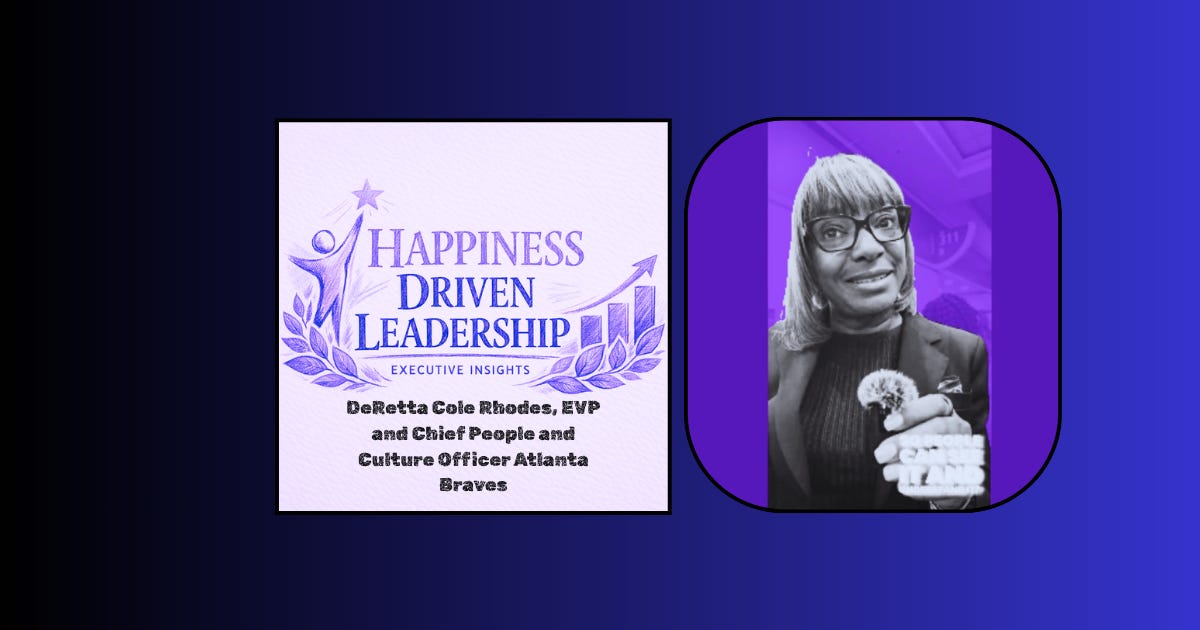
At SHRM 2026, some of the most powerful HR leaders in the world took the stage for a panel called “HR Executive Insights: Architecting the Future of the Global Frontline Workforce.” The conversation was extraordinary — a masterclass in how the world’s most forward-thinking organizations are rethinking work itself.But it’s what happened after the panel that became the seed of this series.I approached Dr. DeRetta Cole Rhodes — Executive Vice President and Chief People & Culture Officer of the Atlanta Braves — and asked her one simple question:“What is happiness in leadership?”Her answer wasn’t a corporate platitude. It was a philosophy. And it’s backed by decades of science most leaders have never read.What DeRetta Said“It’s all about the fact that we’re trying to ensure people are enjoying what they’re doing. So happiness becomes a cornerstone of everything. How do you deal with fans? How do you deal with the community? But how do you deal with it internally — and how it can come out for you, so people can see it and understand it. We talk about happiness, but we really want to think about how joy and happiness are ensuring that people are enjoying themselves — and it’s a part of wellness and mindfulness.”Read that again slowly.She didn’t start with the customer. She didn’t start with the brand. She started inside the building. Internal joy first; then it radiates outward so that fans, community, and the world can see it and feel it.This is not accidental. This is architectured happiness from one of the most accomplished Chief People Officers in professional sports.Who Is DeRetta Cole Rhodes?Before we unpack the science behind her words, you need to understand who’s saying them.Dr. DeRetta Cole Rhodes holds a Ph.D. in Adult Education from the University of Georgia, an MBA from Clark Atlanta University, and has led people strategy at some of the most recognized organizations in America: Turner Broadcasting, Ernst & Young, First Data, YMCA of Metro Atlanta, and now the Atlanta Braves, where she oversees people capital, communications, and community affairs across Major League operations, The Battery Atlanta, and Spring Training facilities.She is the author of Courage of Voice: Empowering Women to Open Professional Doors, a TEDx speaker, a Georgia Titan 100 honoree, and serves on the boards of the Woodruff Arts Center, Goodwill of North Georgia, and the International Women’s Forum. Her doctoral dissertation, “Courage Under Fire: How Black Women Have Learned to Survive in Corporate America,” examined how racism and sexism impacted the career progression of executive Black women in Fortune 500 organizations.In short: DeRetta doesn’t theorize about people and culture. She has built it, rebuilt it, and transformed it, across industries, across decades, and now inside one of the most iconic sports franchises on the planet.The Inside-Out Principle: Why Her Words MatterLet’s break down what DeRetta is actually teaching us. Her insight contains three distinct leadership lessons:1. Happiness Is Infrastructure, Not DecorationWhen she says happiness is “a cornerstone of everything,” she’s positioning joy not as a perk, not as a wellness initiative tacked onto Q4 planning; but as foundational architecture. The way a building needs a cornerstone before it can rise, an organization needs internal happiness before it can perform, serve, or grow.2. Joy Moves Inside-OutDeRetta draws a clear directional arrow: internal first, external second. “How do you deal with it internally — and how it can come out for you, so people can see it and understand it.” She’s describing emotional contagion as organizational strategy. The internal experience of employees doesn’t stay internal. It transmits to fans in the stands, to community partners, to every touchpoint of the brand.3. Happiness Is Wellness and MindfulnessBy connecting joy to “wellness and mindfulness,” DeRetta reframes happiness from something you feel to something you practice. This is not passive. This is intentional, cultivated, and sustained. It’s a discipline not a mood.The Science: Emotional Contagion in the WorkplaceNow here’s where it gets powerful. DeRetta’s inside-out philosophy isn’t just executive intuition, it’s been validated by one of the most important studies in Industrial/Organizational Psychology.The Study: “The Ripple Effect: Emotional Contagion and Its Influence on Group Behavior”Researcher: Dr. Sigal Barsade, The Wharton School, University of Pennsylvania Published: 2002, Administrative Science QuarterlyDr. Barsade’s landmark study demonstrated that emotions are literally contagious in group settings, and that this contagion has measurable effects on cooperation, conflict, and performance.Here’s what she found:The Setup: Barsade placed a trained actor into small working groups. The actor was instructed to display either positive or negative emotional energy; enthusiasm, warmth, and optimism versus irritability, hostility, or sluggishness. The group members didn’t know the actor was planted.The Results:* Positive emotional contagion spread through the group. When the actor displayed positive energy, group members unconsciously “caught” those emotions and began displaying more positive affect themselves.* Groups with positive emotional contagion showed greater cooperation and less interpersonal conflict.* Positive contagion improved perceived task performance — the groups believed they performed better, and independent evaluators agreed.* The effect was unconscious. Participants didn’t realize their emotions had been influenced. The ripple was invisible but measurable.The Conclusion: Emotions don’t stay with the person who feels them. They ripple outward — shaping the mood, behavior, and performance of everyone in the environment.The Tutorial: Connecting DeRetta’s Insight to Barsade’s ScienceHere’s the teaching moment; the bridge between a world-class executive and a world-class study.DeRetta says: “How do you deal with it internally and how it can come out for you, so people can see it and understand it.”Barsade proved: Emotions radiate outward from individuals to groups — unconsciously, inevitably, and with measurable impact on performance.They’re describing the same phenomenon from two different vantage points. DeRetta sees it from the C-Suite, architecting culture so that internal joy becomes visible externally. Barsade sees it from the lab, measuring exactly how that transmission works.What Leaders Can Do Monday MorningThis isn’t abstract. Here’s how to apply the DeRetta-Barsade framework in your own organization:🔹 1. Audit Your Emotional ArchitectureAsk: What emotions are people catching inside our building right now? Barsade’s research shows that the dominant emotional tone of a group shapes everyone in it. If your leadership team radiates stress, urgency, and scarcity — that’s what your entire organization will catch. Start measuring emotional climate, not just engagement scores.🔹 2. Make Joy a Wellness Practice, Not a MoodDeRetta connects happiness to wellness and mindfulness — meaning it’s something you cultivate, not something you wait to feel. Build mindfulness practices, recovery time, and joy-generating rituals into the workweek. This isn’t soft. This is strategic infrastructure.🔹 3. Design the Internal Experience FirstBefore you worry about your customer experience, your fan experience, or your brand experience — design the employee experience. DeRetta’s insight is clear: if people inside aren’t enjoying themselves, nothing authentic can radiate outward. The external brand is a mirror of the internal culture.🔹 4. Recognize That Leaders Are Emotional BroadcastersBarsade’s research shows that the most emotionally expressive person in a group disproportionately shapes the group’s emotional climate. That’s usually the leader. Every meeting you walk into, you’re either broadcasting joy or broadcasting something else. Choose intentionally.🔹 5. Connect Happiness to Enjoyment of the Work ItselfNotice DeRetta’s precision: “We’re trying to ensure people are enjoying what they’re doing.” Not enjoying the perks. Not enjoying the office snacks. Enjoying the work itself. This means leaders must design roles, responsibilities, and team dynamics so that the actual daily work generates meaning, mastery, and satisfaction.The Bottom LineDr. DeRetta Cole Rhodes didn’t give me a soundbite. She gave me a leadership architecture.And Dr. Sigal Barsade’s research proves exactly why that architecture works: because emotions are contagious, happiness is infrastructure, and the internal experience of your people is the single most powerful driver of what the outside world sees.The Atlanta Braves didn’t just build a World Series team. They built a culture where joy is the cornerstone, and one of the most accomplished Chief People Officers in America is the architect.The question for every leader reading this: What are your people catching from you?For more executive insights from that SHRM 2026 panel, read my full article: Motivating the Global Frontline Workforce — Vulnerability at SHRM 2026 This is a public episode. If you'd like to discuss this with other subscribers or get access to bonus episodes, visit alexia.substack.com/subscribe
Embed this episode
NOW PLAYING
The Happiness Blueprint: What a World Series Organization Knows About Joy
No transcript for this episode yet
Similar Episodes
No similar episodes found.
Similar Podcasts
No similar podcasts found.