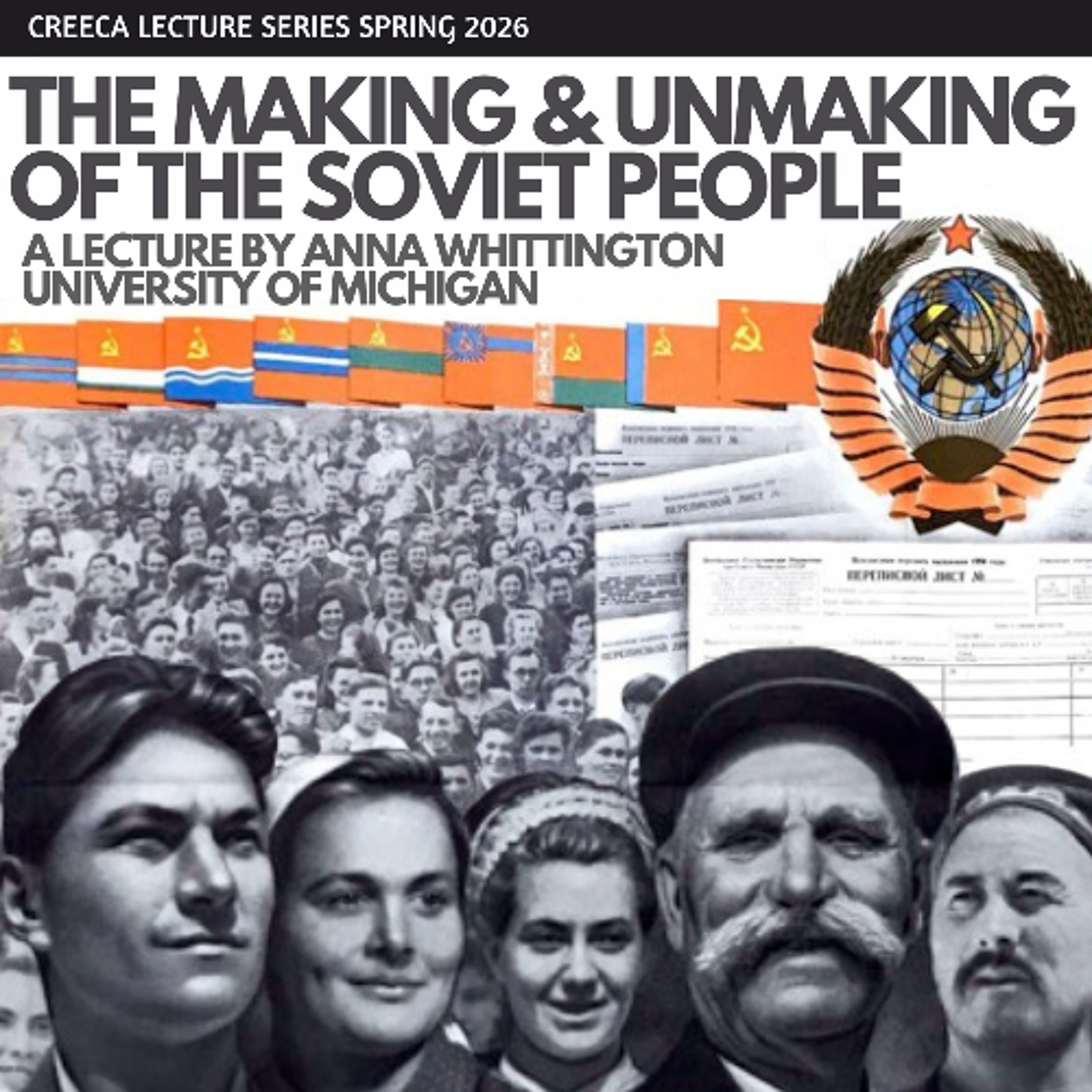
The Making and Unmaking of the Soviet People episode artwork

EPISODE · Feb 17, 2026 · 46 MIN

The Making and Unmaking of the Soviet People

from CREECA Lecture Series Podcast · host Center for Russia, East Europe, and Central Asia at the University of Wisconsin, Madison

This lecture is co-sponsored by the Alice D. Mortenson/Petrovich Distinguished Chair of Russian History. About the Lecture: After the October Revolution, Bolshevik leaders inherited a vast geographic expanse that was home to some 200 different ethnicities—some 130 million people who needed to be integrated into the new Soviet order. To reverse prior oppression, Bolsheviks organized their polity as an ethno-territorial federation and promoted minorities in politics, the economy, and culture. Alongside this embrace of diversity, however, a larger challenge remained. How could leaders forge cultural unity among an extraordinarily diverse citizenry? This talk investigates the dual promotion of unity and diversity in the Soviet Union through the lens of citizenship and identity, demonstrating that political and cultural elites promoted a civic identity built on active participation in public life that citizens embraced across a wide geographic and cultural spectrum. At the same time, the official rhetoric of equality, inclusion, and multiethnic representation coexisted with systemic inequalities that shaped lived experience and ultimately undermined the Soviet state. Drawing on a range of multilingual materials collected from across the former Soviet Union, this talk offers fresh perspectives on both the forging of Soviet unity and its long-term unmaking. The talk opens by describing new ways of conceiving civic identity after the revolution and the evolution of this identity under Stalin and his successors—in short, the making of the Soviet people—before detailing the fracturing of this civic identity in the 1980s. Combining the voices of both elites and ordinary citizens from across the country, the talk considers how ideas of equality and experiences of inequality profoundly shaped the rise and fall of Soviet citizenship. About the Speaker: Anna Whittington is an assistant professor of history at the University of Michigan, where she focuses on citizenship and inequality across Soviet Eurasia. Her in-progress book manuscript, "Repertoires of Citizenship: Inclusion, Inequality, and the Making of the Soviet People," traces the discourses and practices of Soviet citizenship from the October Revolution to the Soviet collapse, based on multilingual research conducted across the former Soviet Union. Future projects include a history of perestroika from below and a history of enumeration in the Russian Empire and Soviet Union.

This lecture is co-sponsored by the Alice D. Mortenson/Petrovich Distinguished Chair of Russian History. About the Lecture: After the October Revolution, Bolshevik leaders inherited a vast geographic expanse that was home to some 200 different ethnicities—some 130 million people who needed to be integrated into the new Soviet order. To reverse prior oppression, Bolsheviks organized their polity as an ethno-territorial federation and promoted minorities in politics, the economy, and culture. Alongside this embrace of diversity, however, a larger challenge remained. How could leaders forge cultural unity among an extraordinarily diverse citizenry? This talk investigates the dual promotion of unity and diversity in the Soviet Union through the lens of citizenship and identity, demonstrating that political and cultural elites promoted a civic identity built on active participation in public life that citizens embraced across a wide geographic and cultural spectrum. At the same time, the official rhetoric of equality, inclusion, and multiethnic representation coexisted with systemic inequalities that shaped lived experience and ultimately undermined the Soviet state. Drawing on a range of multilingual materials collected from across the former Soviet Union, this talk offers fresh perspectives on both the forging of Soviet unity and its long-term unmaking. The talk opens by describing new ways of conceiving civic identity after the revolution and the evolution of this identity under Stalin and his successors—in short, the making of the Soviet people—before detailing the fracturing of this civic identity in the 1980s. Combining the voices of both elites and ordinary citizens from across the country, the talk considers how ideas of equality and experiences of inequality profoundly shaped the rise and fall of Soviet citizenship. About the Speaker: Anna Whittington is an assistant professor of history at the University of Michigan, where she focuses on citizenship and inequality across Soviet Eurasia. Her in-progress book manuscript, "Repertoires of Citizenship: Inclusion, Inequality, and the Making of the Soviet People," traces the discourses and practices of Soviet citizenship from the October Revolution to the Soviet collapse, based on multilingual research conducted across the former Soviet Union. Future projects include a history of perestroika from below and a history of enumeration in the Russian Empire and Soviet Union.

NOW PLAYING

The Making and Unmaking of the Soviet People

0:00 46:25

No transcript for this episode yet

We transcribe on demand. Request one and we'll notify you when it's ready — usually under 10 minutes.

French Your Way Jessica: Native French teacher founder of French Your Way Boost your French listening skills and test your comprehension with this one of a kind series of podcasts. Get the chance to listen to a real conversation between native speakers talking at normal speed AND customise your learning experience through carefully designed sets of questions (2 levels of difficulty) available for download at www.frenchvoicespodcast.com. All interviews also come with the transcript. French teacher Jessica interviews native speakers of French from around the world who share a bit of their life and passion. Where else would you meet in one same place a French yoga teacher based in Melbourne, a soap manufacturer from Provence, or a couple cycling around the world? That Hoarder: Overcome Compulsive Hoarding That Hoarder Hoarding disorder is stigmatised and people who hoard feel vast amounts of shame. This podcast began life as an audio diary, an anonymous outlet for somebody with this weird condition. That Hoarder speaks about her experiences living with compulsive hoarding, she interviews therapists, academics, researchers, children of hoarders, professional organisers and influencers, and she shares insight and tips for others with the problem. Listened to by people who hoard as well as those who love them and those who work with them, Overcome Compulsive Hoarding with That Hoarder aims to shatter the stigma, share the truth and speak openly and honestly to improve lives. The Small Business Startup School – Business Notes | Financial Literacy | Retail Psychology – For Professionals & Entrepreneurs The Small Business Startup School Inc. Starting or buying a small business? While personal circumstances may vary, business patterns remain timeless. On The Small Business Startup School, we explore strategies, insights, and practical solutions to help entrepreneurs confidently navigate their journey.Hosted by Ola Williams—a retail entrepreneur, fintech founder, and financial coach with over two decades of experience—this podcast marries financial awareness and retail psychology with optimism to deliver actionable takeaways.Join us to learn, grow, and connect as we uncover the keys to business success.Let’s continue to learn together and be encouraged to keep on connecting! DIOSA. Carolina Sanper This podcast is a sacred space created by Carolina Sanper where you connect with your inner wisdom and embody your magnetic feminine power.It is the realization that the mystical realm is where you plant the seeds of your desired reality.It is a portal to your true essence: awareness, presence, and receiving with ease. Welcome home, DIOSA. 🖤

Frequently Asked Questions

How long is this episode of CREECA Lecture Series Podcast?

This episode is 46 minutes long.

When was this CREECA Lecture Series Podcast episode published?

This episode was published on February 17, 2026.

What is this episode about?

This lecture is co-sponsored by the Alice D. Mortenson/Petrovich Distinguished Chair of Russian History. About the Lecture: After the October Revolution, Bolshevik leaders inherited a vast geographic expanse that was home to some 200 different...

Can I download this CREECA Lecture Series Podcast episode?

Yes, you can download this episode by clicking the download button on the episode player, or subscribe to the podcast in your preferred podcast app for automatic downloads.
URL copied to clipboard!