
EPISODE · Jul 1, 2026 · 38 MIN
The Man Who Sold the Scroll
from Language Matters by Elias Winter · host Elias Winter
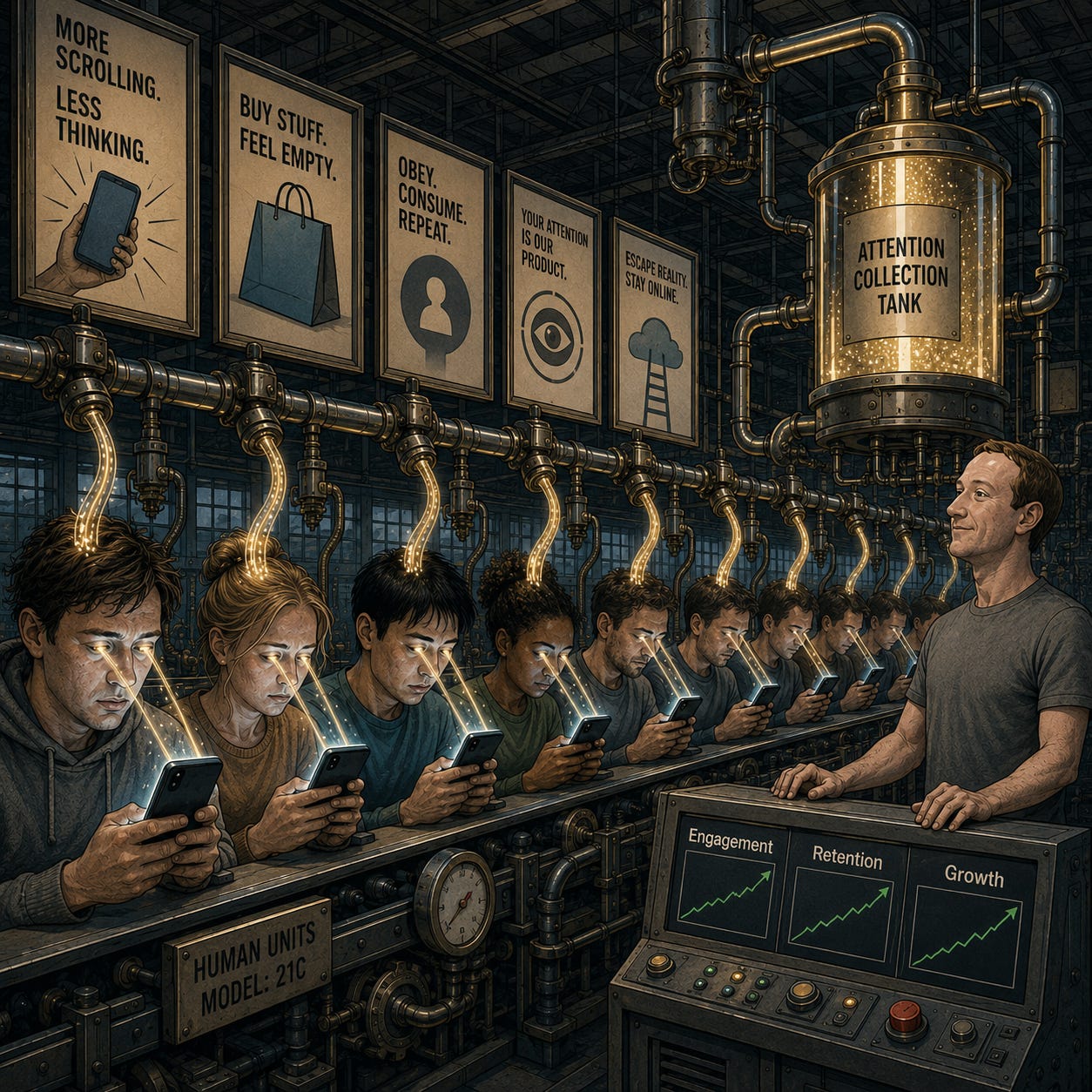
Opening: A Car, a Feed, and a Man in Pajamas A car is not a saintly object. It pollutes. It breaks down. It costs too much. It turns ordinary men into philosophers of parking. It gives suburban fathers an excuse to say things like “torque” while standing in driveways. And Henry Ford himself was, to put it with maximum charity, not exactly a walking retreat center of moral enlightenment. Still, the car does something. It takes a nurse to work. It takes groceries home. It takes children to school. It carries tools, luggage, medicine, grandmothers, dogs, plumbers, arguments, prayers, and the occasional bag of fast food whose smell will haunt the upholstery until the Second Coming. The car has use. It moves a body through space. You can ask a simple question of it: does it start in the morning? This is one version of capitalism: imperfect, often exploitative, sometimes brutal, but at least intelligible. Someone builds a thing. Someone buys the thing. The thing has a function. If the builder profits, we can argue about the profit, the labor, the wages, the factory, the supply chain, the pollution, and the grotesque tendency of rich men to believe that owning a factory makes them prophets. But the basic moral exchange remains visible. Then there is the feed. The feed does not take you to work. It prevents you from leaving for work. The feed does not carry your groceries. It carries you, gently and invisibly, from one small humiliation to the next. It shows you your old classmate’s vacation, your cousin’s promotion, a stranger’s body, a celebrity’s apology, a war reduced to a graphic, a motivational quote from a person who appears to own seven bathrooms, and an advertisement for mushroom coffee that somehow knows you are spiritually tired. No one wakes up in the morning and says, “Thank God Mark Zuckerberg has made it possible for me to see a man I barely knew in college standing beside an infinity pool with the caption ‘grateful for the journey.’” And yet there we are. Scrolling. Not because the thing is useful in the ordinary sense. Not because it helps us finish a task. Not because we leave it with more dignity, attention, courage, or practical freedom. We scroll because the system has learned something about us that older capitalism could only dream of learning: our weakness is scalable. That is the difference. The old capitalist sold us machines. The new oligarch made machines out of us. 1. The Old Capitalist at Least Had to Build the Damn Thing There is no need to romanticize industrial capitalism. The old world of factories was not a village bakery run by cheerful elves. It was often dirty, violent, hierarchical, and cruel. It broke backs. It swallowed workers. It poisoned rivers. It produced fortunes large enough to deform politics and egos large enough to require their own weather systems. But industrial capitalism had one important constraint: matter resisted it. If Ford wanted to sell another car, Ford had to build another car. That meant steel, rubber, glass, engines, workers, machines, roads, rail, oil, distribution, dealerships, repairs, and all the unglamorous friction of the physical world. The car had to be assembled. It had to be shipped. It had to occupy space. It had to survive weather, gravity, and the terrifying moral battlefield known as the American commute. The old capitalist could be greedy, but he still had to wrestle with matter. He could dream of dominating the market, but the world pushed back. Every additional unit required resources. Every factory required labor. Every vehicle required parts. Scale was possible, but it was heavy. It was slow. It had mass. Then came the digital platform, and capitalism discovered a lighter form of empire. Once the platform exists, the same basic behavioral machine can be replicated across millions, then billions, at comparatively low marginal cost. The feed does not need a new engine for every user. It does not need a steering wheel, tires, seatbelts, or a catalytic converter. It needs servers, software, data centers, behavioral engineers, advertisers, and a sufficiently large population of lonely mammals willing to donate their attention in exchange for tiny electric feelings. The car at least had the courtesy to require steel. The feed only requires my weakness. This is not a minor technical distinction. It is a moral one. Digital scale removes much of the friction that once tied profit to production. The old capitalist accumulated wealth by producing more of the thing. The new platform capitalist accumulates wealth by duplicating the same environment of capture across every available human nervous system. That does not mean all digital scale is evil. Scaling useful software, medical infrastructure, search tools, education, logistics, or open knowledge can be a genuine social good. The problem is not scale by itself. The problem is what gets scaled. If you scale a tool, you may expand human agency. If you scale a trap, you expand captivity. And the modern internet oligarch, in his most profitable form, is not merely scaling technology. He is scaling the conditions under which human beings become easier to distract, measure, predict, agitate, and sell. That is not ordinary entrepreneurship. That is industrial psychology with a payment processor. 2. The Product Appears to Be Free, Which Is Usually When You Should Check Your Pockets The first genius of the platform is that it appears to cost nothing. No one hands over money to scroll. There is no cashier at the entrance of Instagram. No teenager enters a credit card before comparing her body to a stranger’s edited beach photo. No tired man pays three dollars to lose half an hour watching people argue about politics under a video of a dog. The product is free. This should make us suspicious. When a thing is free, the question is not whether there is a price. The question is where the price has been hidden. The user thinks the product is the app. Facebook. Instagram. TikTok. X. Whatever glowing rectangle currently has humanity tapping glass like lab pigeons with better shoes. But the user is not the customer. The advertiser is the customer. The user is not buying the product. The user is being prepared. He is being classified, softened, agitated, stimulated, sorted, measured, and delivered. His attention is packaged. His habits are studied. His insecurity is mapped. His social graph is analyzed. His desires become predictions. His pauses become signals. His boredom becomes inventory. This is where the moral structure changes. A useful product helps you complete a task and leave. An engagement product wins when you cannot leave. A hammer does not become more profitable because you compulsively hold it for six hours. A washing machine does not send you notifications asking whether you have considered washing just one more sock. A car company does not increase revenue because you sit in your driveway turning the ignition on and off while comparing yourself to your cousin. But a platform becomes more valuable the longer you remain inside it. Its business model is not satisfied by usefulness. It requires duration. It requires return. It requires compulsion dressed as participation. Its favorite user is not the one who arrives, accomplishes something, and leaves. Its favorite user is the one who forgets why he arrived. This is the difference between use-value and engagement-value. Use-value asks: did this thing help the person live? Engagement-value asks: did this thing keep the person available? That is the great moral reversal of the platform economy. The system does not need to make you better. It needs to keep you present. It does not need to strengthen your agency. It needs to occupy it. It does not need to serve your life. It needs to insert itself between you and your life, then sell the view to advertisers. This is why the phrase “free product” is so obscene. It is free the way a casino buffet is free. It is free the way the first taste is free. It is free the way the hook is free. You are not paying at the door. You are paying in attention, time, envy, agitation, and the slow erosion of your ability to be alone with your own mind. 3. Envy, But Make It Scalable The feed did not invent envy. Human beings were perfectly capable of resenting one another long before broadband. Cain did not need Wi-Fi. The Book of Genesis contains no algorithm, unless one counts the serpent as a very early recommendation engine. Envy is old. Vanity is old. Lust is old. Status anxiety is old. The desire to be admired by people we do not even respect is practically one of the pillars of civilization. The platform’s innovation was not the creation of these weaknesses. Its innovation was automation. The feed took envy and gave it infinite scroll. It took comparison and gave it machine learning. It took human vanity, put it under studio lighting, attached a distribution network, and called the result connection. Open the app and there it is: bodies, vacations, promotions, engagements, weddings, babies, abs, houses, conferences, spiritual awakenings, humblebrags, outrage, grief performed at optimal length, moral clarity with good lighting, and people announcing that they are “excited to share” something that will make you feel behind in life by 8:43 in the morning. This is not incidental. The feed is not simply a neutral list of things people posted. It is an emotional arrangement. It sorts the world in ways that keep us looking. And one of the easiest ways to keep a human being looking is to show him a life that appears to be better than his. Not necessarily better in reality. Just better in image. Someone richer. Someone hotter. Someone more loved. Someone more connected. Someone more certain. Someone who has apparently discovered balance, purpose, discipline, wealth, community, and visible abdominal definition while you are eating leftovers over the sink. And because comparison hurts, you keep looking. Because you keep looking, advertisers pay. Because advertisers pay, the platform optimizes the conditions that keep you looking. This is not a conspiracy. It is worse. It is an incentive structure. The platform does not need to hate you. It merely needs your pain to be profitable. And here humility is necessary, because none of us is above this. I am not writing from a monastery. I have also opened an app to check one message and emerged thirty-seven minutes later spiritually uglier, vaguely angry, and somehow interested in a supplement that promises focus, calm, metabolic clarity, and possibly a repaired relationship with my father. This is the genius of the machine. It meets us exactly where we are weak. Lonely? Here are people together. Insecure? Here are bodies. Unsuccessful? Here are announcements. Angry? Here is an enemy. Bored? Here is novelty. Aroused? Here is almost-sex. Afraid? Here is catastrophe. Hopeful? Here is a product. The feed is not a window onto the world. It is a casino of the self. And the house does not care which emotion keeps you playing, as long as you keep playing. That is why envy scales so beautifully. It requires no factory, no shipping container, no assembly line. It only requires images, metrics, and human beings who have not yet made peace with being finite. The internet oligarch did not invent envy. He merely found a way to put ads inside it. 4. You Are Not Addicted, You Are Merely Experiencing Excellent Product-Market Fit The language of the tech world is one of its great achievements in moral laundering. No one says, “We are trying to make people compulsively return to a system that degrades their attention and makes them easier to monetize.” They say “engagement.” No one says, “We are testing which emotional triggers weaken self-command most efficiently.” They say “optimization.” No one says, “We have built a machine that profits when people fail to leave.” They say “retention.” There are daily active users, monthly active users, session duration, impressions, conversions, click-through rates, growth loops, recommender systems, notifications, nudges, reactivation strategies, and product-market fit. It all sounds so clean. A dashboard is a marvelous device for making human suffering look like a weather report. But morally, many of these words circle the same question: how successfully did we get people to do something they did not intend to do for longer than they wanted to do it? This is where the usual defense begins. No one forces you to use the app. You can leave anytime. You chose this. There is truth here, but it is thin truth. It is the kind of truth that becomes false when stretched over the actual conditions of human life. Yes, the user chooses. But choice can be manipulated. Consent can be weakened. Agency can be surrounded by an architecture designed to defeat it. If a system studies loneliness, boredom, lust, outrage, vanity, tribal belonging, insecurity, and fear at planetary scale, then rearranges the environment to trigger those states more efficiently, it cannot defend itself by pointing to the user’s freedom. That is like the buffet saying you are free to leave after moving the dessert table next to the exit, pumping sugar smell into the room, studying your childhood memories, and hiring a behavioral scientist to whisper, “You deserve this.” The platform says: you are in control. But its revenue grows when your control fails. That is the moral indictment. The issue is not that people use social media. The issue is that the system improves when self-command deteriorates. The business model is most alive when the user is least sovereign. A good tool respects the boundary of the user’s intention. You pick it up, use it, and put it down. A corrupt platform invades the space between intention and action. It makes leaving feel like loss. It makes returning feel automatic. It turns boredom into an entrance ramp. This is why addiction is not an accidental metaphor. It is structurally close to the truth. The platform does not need every user to become clinically addicted. It only needs ordinary weakness distributed across billions of people. It needs small failures of attention, repeated endlessly. Five minutes here. Twelve minutes there. A morning mood bent out of shape. A workday punctured. A dinner half-attended. A child ignored for a notification that turns out to be nothing. No single moment looks catastrophic. That is how the system hides. It does not destroy life all at once. It shaves life into monetizable fragments. 5. The Factory Is Now Inside the Person Industrial capitalism put workers inside factories. Platform capitalism put the factory inside the person. This is the deepest change. The old factory was visible. It had walls, gates, whistles, machines, supervisors, smoke, time clocks, loading docks. You could point to it. You could organize around it. You could say: here is where labor is extracted, here is where profit is made, here is where the body is disciplined by production. The platform factory is harder to see because it is distributed across inner life. The person becomes the site of extraction. His attention is mined. His preferences are modeled. His emotions are stimulated. His friendships become a graph. His searches become predictions. His hesitation becomes data. His boredom becomes opportunity. His envy becomes retention. His outrage becomes distribution. His face becomes content. His desire becomes a targeting category. This is more than “the user is the product.” That phrase is true, but too small. The user is the raw material, the labor process, the distribution channel, and the behavioral residue being sold. A man sits on a toilet looking at photos of people richer than him while an ad tries to sell him focus gummies. Somewhere, revenue is generated. That is platform capitalism in one sentence. The genius of this system is that it gets the user to participate in his own extraction while calling it self-expression. He posts the photo. He performs the identity. He updates the profile. He reveals the preference. He clicks the link. He strengthens the model. He trains the machine that will later be used to target him more precisely. And he does much of this voluntarily, because the platform has fused extraction with recognition. To be seen, he must become legible. To belong, he must produce signals. To participate, he must feed the system that feeds on him. The old capitalist sold things to people. The platform capitalist sells through people, out of people, and against people. This is what I mean by productionizing human beings. The person is no longer merely a consumer. He is infrastructure. He is a behavioral surface. He is a measurable stream of attention whose inner life has been made economically available to strangers. This violates something deeper than privacy. Privacy is only the legal word we use because we have forgotten how to speak about the soul. The real violation is not only that the platform knows things about us. It is that the platform redesigns the conditions under which we come to know ourselves. It teaches us to experience our lives as content. It teaches us to measure reality by visibility. It teaches us to process grief, joy, beauty, outrage, friendship, sex, politics, and even moral conviction through the imagined gaze of an audience. It does not merely observe our humanity. It formats it. And once formatted, it can be sold. 6. The Modest Billionaire and His Planetary Slot Machine It is tempting to make this essay about one villain. Mark Zuckerberg is convenient for this purpose because he appears to have been assembled in a lab to test whether democracy could be defeated by a man with the emotional temperature of a conference badge. But the point is not Zuckerberg as a uniquely evil person. That would be too easy. It would also be comforting. If the problem were one strange billionaire, we could simply replace him with another strange billionaire and pretend civilization had been repaired. The deeper problem is the type. The internet oligarch is not necessarily a cartoon villain. He may not wake up each morning and whisper, “Today I shall diminish the inner lives of the masses.” That is precisely the problem. Modern evil rarely announces itself with a cape. It arrives as a dashboard. It arrives as growth. It arrives as connection. It arrives as innovation. It arrives as a mission statement written in the frictionless dialect of people who have never doubted their right to reorganize the lives of others. The terrifying figure of our time is not the tyrant in uniform. It is the founder with insufficient moral imagination and unlimited distribution. He builds a product for a campus, a subculture, a network, a niche. It works. People use it. Investors arrive. The language changes. The thing becomes a platform. The platform becomes infrastructure. The infrastructure becomes unavoidable. The unavoidable becomes civilization. At every stage, the founder can say: people want this. But wanting is not moral proof. People want many things that do not make them free. They want sugar, revenge, flattery, pornography, gambling, tribal certainty, and the ability to see whether their ex has become less attractive. Desire is real. It is not sacred. The platform oligarch’s corruption comes from scale joined to abstraction. He does not see the teenager whose self-worth collapses under comparison. He sees engagement. He does not see the worker who loses an hour of focus before noon. He sees session duration. He does not see the lonely man trained to mistake stimulation for companionship. He sees retention. He does not see a population growing more anxious, vain, distracted, polarized, and available for manipulation. He sees growth. Scale creates distance from consequence. The greater the reach of the system, the more abstract the people inside it become. Billions of users cannot be loved. They can only be counted. And once counted, they can be optimized. This is the special moral danger of the tech oligarch. He possesses civilizational power without civilizational wisdom. He governs attention without being elected. He shapes discourse without accountability. He accumulates wealth from the interior lives of people he will never meet. This is not entrepreneurship in the old sense. It is private government over consciousness. The modest billionaire stands beside his planetary slot machine and tells us it is a community. 7. In Defense of Useful Things The answer to this is not to hate technology. That would be childish, and worse, boring. I am not writing this with a goose feather in a candlelit cave, though I admit the branding would be excellent. I use digital tools. I like maps that prevent me from becoming lost. I like search engines when they are not actively degrading the concept of knowledge. I like software that helps doctors, teachers, engineers, writers, families, and ordinary people trying to survive the administrative obstacle course of modern life. Not all profit is theft. Not all scale is evil. Not all technology dehumanizes. A society needs tools. It needs infrastructure, medicine, housing, logistics, communication, agriculture, transportation, boring software, functioning databases, and machines that do what they promise without asking us to subscribe to a newsletter. The distinction is not between old and new. The distinction is between tools and traps. A tool extends agency. A trap consumes it. A good tool disappears into the task. You use the map to arrive. You use the calendar to remember. You use the car to travel. You use the washing machine to clean clothes. You use the search engine to find an answer, assuming the answer has not been buried beneath forty-seven affiliate links and a paragraph generated by a machine that appears to have learned English from airport signage. A corrupt platform interrupts the task and calls the interruption community. It does not help you do what you intended. It replaces your intention with a sequence of stimuli. It does not serve your life. It competes with your life. This is the moral test of a product: Not whether people use it. What using it does to them. Does it make them more capable? More free? More connected in reality, not merely visible? More competent? More truthful? More able to love, work, rest, think, create, repair, and attend? Or does it make them more compulsive, distracted, envious, performative, agitated, lonely, dependent, and available for manipulation? This is the question capitalism cannot answer by itself. Markets reveal demand. They do not reveal dignity. A thing can be desired and degrading. A thing can be profitable and socially poisonous. A thing can be popular because it exploits the very weaknesses that make popularity easy to manufacture. This is why we need a moral theory of value beyond price. The market can tell us what people click. It cannot tell us what clicking does to the person. The defense of useful things is therefore also an indictment of useless captivity. I am not against innovation. I am against calling extraction innovation because it happens on a screen. Human beings need tools. They do not need planetary systems for the monetization of their weakest moments. 8. Ban the Machine, Not the Internet So what should be done? This is where one must be careful, because the easiest way to lose the argument is to sound like an old man yelling at a router. The point is not to ban communication. The point is not to ban software. The point is not to ban people from posting photos of lunch, though some lunches deserve federal review. The point is to ban, or at least severely restrict, the business model that combines behavioral surveillance, addictive design, algorithmic manipulation, and targeted advertising into a single system of human capture. That is the machine. Not the internet. The machine is not messaging your friend. The machine is not sharing a family photo. The machine is not finding directions, reading an essay, learning a language, publishing a poem, joining a recovery group, or watching a video on how to fix a sink. The machine is the economic structure that says: capture attention by any means psychologically available, study the user’s behavior, predict his weakness, feed him stimuli that keep him engaged, and sell access to him. That machine should not enjoy the full moral legitimacy of ordinary commerce. A society can allow markets without allowing markets in everything. We already prohibit or restrict many profitable forms of harm. We regulate drugs, gambling, financial products, unsafe goods, child labor, environmental toxins, fraud, and predatory schemes. We do this because profit alone does not sanctify an activity. So why should behavioral extraction be exempt? Why should a company be allowed to build addiction-like systems for minors? Why should infinite scroll be treated as a neutral design choice when its purpose is to dissolve stopping points? Why should platforms be permitted to target people based on surveillance of their fears, compulsions, insecurities, political vulnerabilities, loneliness, body image, financial desperation, or altered states? Why should algorithmic feeds optimized for engagement be allowed to dominate public life when engagement so often means outrage, envy, arousal, anxiety, and tribal stimulation? The remedies need not be mystical. Ban behavioral advertising based on surveillance. Restrict algorithmic feeds optimized for compulsive engagement. Create hard limits on addictive design patterns, especially for minors. Mandate user-controlled chronological feeds. Prohibit targeting based on sensitive vulnerabilities. Treat large platforms as public-interest infrastructure when they become unavoidable spaces of communication. Force transparency around recommendation systems. Make the business model less profitable when the product degrades human agency. None of this abolishes the internet. It abolishes the right to industrialize human weakness for profit. The objection will come immediately: but people like these platforms. Yes. People like many things that can destroy them. The purpose of civilization is not to give every appetite a venture-backed interface. The purpose of law is not to protect every profitable method of making people less free. A serious society must know the difference between usefulness and capture. Between communication and manipulation. Between a tool and a trap. Between a market in goods and a market in souls. Closing: The Man, the Car, and the Soul Return, then, to the car. It was never innocent. It came with smoke, debt, highways, suburbs, oil, accidents, and the strange American belief that a man becomes more himself when surrounded by cup holders. But the car took someone somewhere. The feed takes someone nowhere and makes him feel late, ugly, poor, excluded, aroused, angry, morally superior, politically endangered, socially behind, and available for purchase. That is the difference. A civilization can survive imperfect tools. It cannot survive a ruling class whose wealth depends on making human beings more distracted from their own lives. The internet oligarch wants to be remembered as a builder. But what did he build? Not a car. Not a bridge. Not a home. Not a school. Not a hospital. He built a mirror that watches us back. He built a casino in the nervous system. He built a factory whose raw material is attention and whose exhaust is envy. He built a marketplace where advertisers buy pieces of the person while the person is told he is connecting with friends. This is why the corruption is not incidental. It is structural. The old capitalist sold a product to the human being. The new oligarch turned the human being into the product. And because the product could scale, the corruption could scale. That is the great discovery of platform capitalism: the cheapest thing to reproduce is not software. It is temptation. The cheapest thing to distribute is not information. It is comparison. The cheapest thing to monetize is not attention as such, but attention weakened by loneliness, insecurity, desire, fear, and boredom. We are told this is progress. Perhaps. But not all progress moves toward the human. Some progress is merely the increasing efficiency with which the person can be separated from his own attention. So the question is not whether we are grateful for technology. Of course we are. The question is whether gratitude requires surrender. Whether convenience requires captivity. Whether connection requires surveillance. Whether innovation requires the mass production of envy. Whether a billionaire’s right to scale a platform includes the right to redesign the inner lives of billions. The car, for all its sins, had a destination. The feed has only continuation. And a society that cannot tell the difference between being transported and being consumed will eventually discover that it has mistaken motion for freedom, stimulation for life, and the profitable ruin of attention for the future. The old capitalist sold us machines. The new oligarch made us into machines. The question is whether we still know the difference. —Elias WinterAuthor of Language Matters, a space for reflection on language, power, and decline This is a public episode. If you would like to discuss this with other subscribers or get access to bonus episodes, visit eliaswinter.substack.com
Embed this episode
Ready to play
The Man Who Sold the Scroll
No transcript for this episode yet
Similar Episodes
No similar episodes found.
Similar Podcasts
No similar podcasts found.