
EPISODE · Apr 16, 2026 · 1H 37M
The National Hydraulic Mission — A South African Story - Episode 3
from ARCLIGHT Strategic Insights Podcast · host Arclight
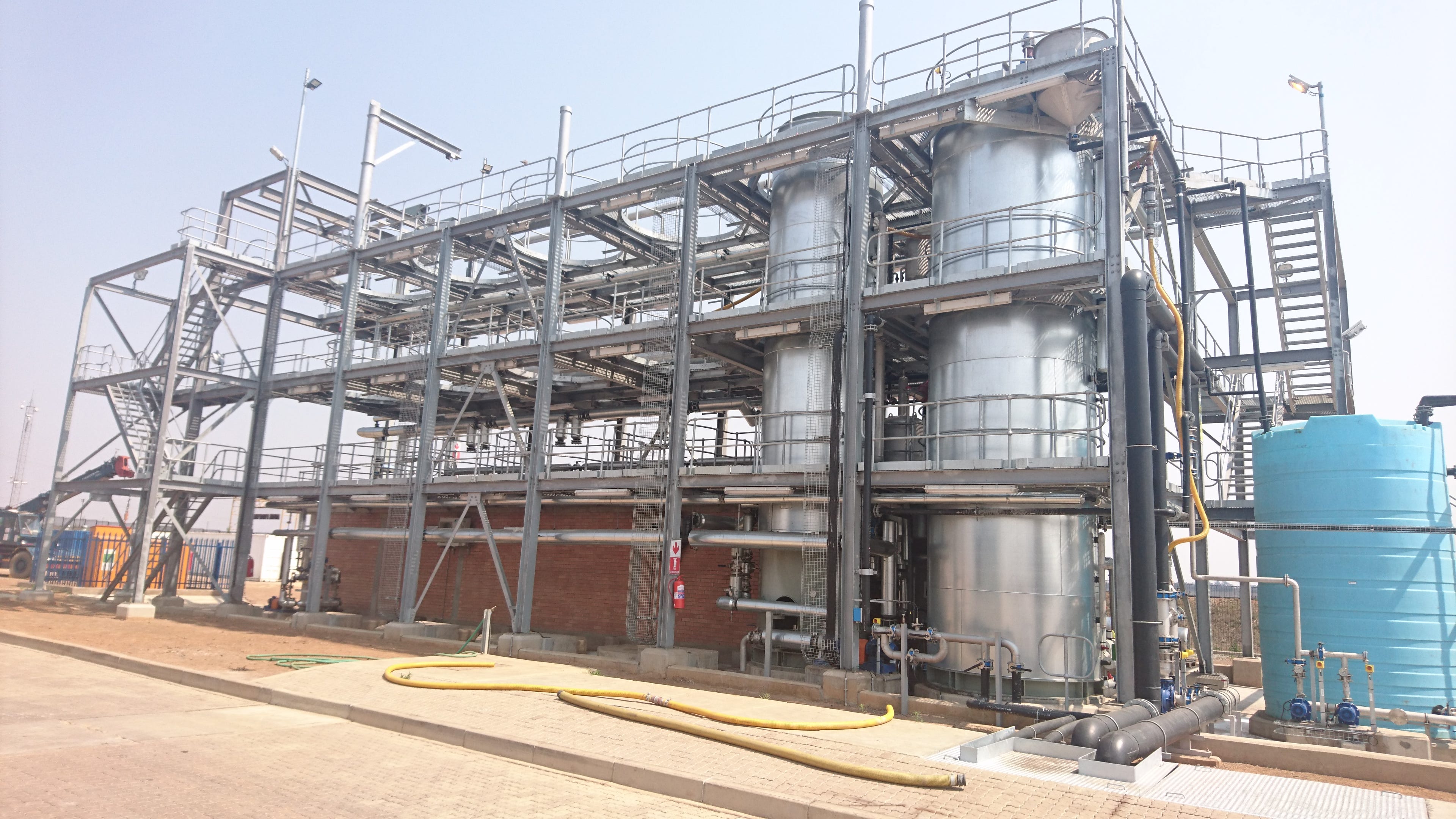
Eutectic freeze crystallisation pilot plant, Tweefontein, near Ogies. Nanodyn Group.Ninety-eight per cent. That’s how much of South Africa’s available water had been allocated by 2003. Not estimated. Not projected. Measured, modelled, and published in the first National Water Resource Strategy — a document that should have triggered a national emergency. It didn’t.This is the third episode of the conversation between Andrew Charter and Dr Anthony Turton — the episode where the engineering story meets arithmetic, and the arithmetic wins.Episode 2 traced the hydraulic mission through Vorster’s hydro-diplomacy and the interbasin transfer era — tunnels through the Drakensberg, dams that doubled as batteries, rivers connected to rivers until South Africa ranked in the top twenty dam-building nations on earth. This episode picks up in 1978, when PW Botha replaced Vorster after the Info Scandal and the posture shifted from engagement to enforcement — from pouvoir to puissance.The national water security model. South Africa is at T2 — demand exceeds supply and no further interbasin transfers are possible. The choice is between prosperity through the creation of new water, or austerity as systems fail. Model by Dr Anthony TurtonThe Info Scandal itself was a propaganda war lost before it started. A modest budget — thirty million rand, diverted through the Bureau for State Security — was spent trying to counter a liberation narrative that was winning internationally by a thousand cuts. The two Bothas manoeuvred Connie Mulder out of the succession. The collateral damage was that South Africa entered the negotiation era with no information warfare capability at all. The ANC had one. It was very good.But the hydraulic mission kept building. The Water Research Commission. The CSIR. Transboundary river basin agreements across the Orange, the Limpopo, the Inkomati, the Maputo — two-thirds of South Africa’s land area sits in river basins shared with neighbouring states, and the institutional architecture to manage that is more sophisticated than anywhere else on the continent. It all traces back to this period.Then came 1994. Everything that had been built was handed over intact. The Commission of Inquiry into Water Matters — a technical document, an engineering document — was rejected as tainted by its association with the previous dispensation. It was not replaced with anything of equivalent rigour.The National Water Act of 1998 nationalised all water rights, established the ecological Reserve, and mandated a reconciliation every five years between what the country wanted and what the rivers could give. It was ambitious legislation. But ideology outran implementation. Water resource management was to be democratised — handed to catchment management agencies staffed by communities with no exposure to the engineering logic underneath. The institutional capability that had built the system was allowed to erode.Turton puts on his intelligence officer’s hat and makes the observation plainly: liberation movements are driven by ideological purity as a performance metric. You can reject inherited systems easily on ideological grounds. But ideology tells you what you think you should do — it doesn’t tell you how to actually do it. Andrew draws the parallel across revolutionary history: Bolsheviks, Maoists, Pol Pot, Venezuela. The pattern is consistent. The question is whether a post-revolutionary government demonstrates the capacity for reformation. China did. Most don’t.And then the numbers. The numbers that should keep people awake.The total mean annual runoff — every drop of rain that ends up in a South African river — was originally estimated at 49 billion cubic metres. It has since been revised downward to roughly 46. Total groundwater: 10 billion. Total dam storage: 31 billion. The national surface capture ratio stands at 65 per cent — well past the 60 per cent international threshold beyond which river ecosystems begin to collapse. In the Orange River basin, 2.7 times the total annual flow has been captured. Evaporative loss in that basin is 97 per cent. For every hundred units of rain, three reach the river.The projected deficits to 2025 — which we can now measure against reality — were 764 million cubic metres in the Upper Vaal, 788 in Durban, 508 in Cape Town. The Limpopo shows a surplus, but it’s a surplus of sewage: wastewater from the PWV complex flowing untreated back toward Mozambique.Two-thirds of South Africa’s dams now carry blue-green algae. The dominant genera — Microcystis and Anabaena — produce neurotoxins chemically related to sarin. A third organism, Euglena, has appeared at Hartbeespoort Dam and on the Garden Route, thriving in the warmer, more saline conditions that degraded rivers provide. The trajectory for multi-drug-resistant pathogens in waterways receiving untreated sewage is, in Turton’s words, a purely scientific logic. It is not speculation. It is what the numbers say.The episode ends not with crisis but with a challenge - two of them, in fact.South Africa needs to recycle every unit of water 1.7 times by 2035 and create approximately 30 billion cubic metres of new water per annum — a volume equivalent to the total storage capacity of every dam in the country. Desalination. Wastewater recovery. Aquifer storage and recovery. The technologies exist. The capital is looking for exactly this kind of infrastructure — institutional investors mandated to fund projects who cannot find enough bankable ones.Turton proposes two ARCLIGHT Challenges: how do you stop evaporation from 31 billion cubic metres of open dam surface, and how do you store water at scale without building another dam? Three-minute pitches. Technically viable, economically sustainable, socially acceptable. A platform where investable ideas meet the capital that needs them.The era of dam-building is over. The question is what replaces it — and whether anyone has the institutional courage to ask.ARCLIGHT is a strategic intelligence platform documenting African geopolitics, security, and defence history through long-form dialogue with the operators, engineers, and analysts who were there. This is a public episode. If you would like to discuss this with other subscribers or get access to bonus episodes, visit arclightafrica.substack.com
NOW PLAYING
The National Hydraulic Mission — A South African Story - Episode 3
No transcript for this episode yet
Similar Episodes
Mar 26, 2026 ·1m
Jan 2, 2026 ·47m
Dec 21, 2025 ·46m