
EPISODE · May 11, 2026 · 41 MIN
The Not to Distant Future of Dispute Resolution
from LawDroid Manifesto Podcast · host Tom Martin
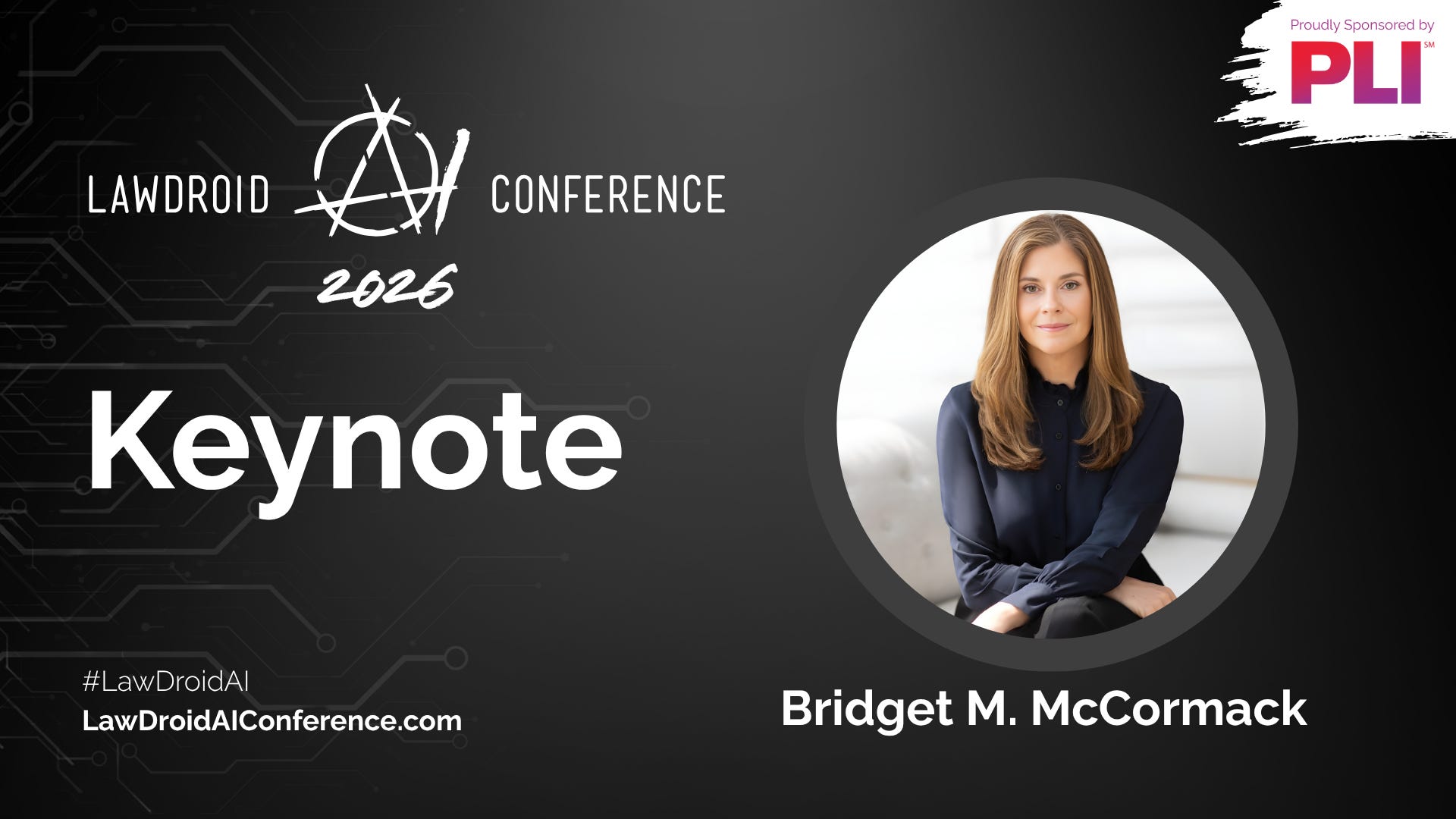
Hey there Legal Rebels! 👋 I’m excited to share with you the 70th episode of the LawDroid Manifesto podcast, where I will be continuing to interview key legal innovators to learn how they do what they do. I think you’re going to enjoy this one!If you want to understand how AI is reshaping the future of dispute resolution and why lawyers must be part of building that future, you need to listen to this episode. Bridget is at the forefront of AI-native dispute resolution and brings a uniquely visionary yet grounded perspective on what’s possible when mission-driven institutions embrace exponential change.LawDroid Manifesto is a reader-supported publication. To receive new posts and support my work, consider becoming a free or paid subscriber.AI, Access, and the Architecture of What Comes NextJoin me as I share Bridget McCormick’s keynote from the LawDroid AI Conference 2026, delivered live to our community of legal innovators.In this powerful keynote, Bridget, President and CEO of the American Arbitration Association, lays out a sweeping and inspiring vision for the future of dispute resolution. She shares how the AAA became the first ADR organization in the world to offer AI-native dispute resolution, and what the journey of building that looked like from the inside. From deploying a fully agentic AI arbitrator to building a resolution simulator and an AI-native case management platform, Bridget walks us through how a 100-year-old nonprofit is reimagining what justice delivery can look like.Her talk is grounded in data, rooted in the AAA’s founding mission, and animated by a genuine belief that AI’s best legal use case may be dispute resolution itself. This is a must-watch for anyone who cares about access to justice, the future of legal institutions, and what it means to lead with imagination rather than compliance in a moment of exponential change.The SkinnyBridget McCormick, President and CEO of the American Arbitration Association, delivered the opening keynote at the LawDroid AI Conference 2026, offering a sweeping and data-rich vision for AI’s role in the future of dispute resolution. Drawing on three years of leading the AAA’s AI transformation, Bridget traces the organization’s journey from early internal experimentation to launching the world’s first AI-native dispute resolution product, a fully agentic AI arbitrator currently operating in document-only construction disputes. Anchored in the AAA’s founding mission (democratized access to dispute resolution for individuals) not just institutions, Bridget connects the idealism of founder Frances Kellor to the urgent opportunity AI represents today. She challenges the legal profession to stop waiting for task forces and white papers, and instead take a seat at the table where the future is being built, with or without lawyers.Key Takeaways:* The AAA became the first ADR organization in the world to offer AI-native dispute resolution, launching a fully agentic AI arbitrator for document-only construction disputes in November 2025* Bridget’s four-part framework for navigating exponential change: ground decisions in data, anchor to mission, move fast because action leads to information, and treat AI as a platform shift, not an incremental improvement* A recent MIT study found 90% of employees had used AI at work while only 40% of their companies had purchased an AI solution, employees aren’t waiting for permission* According to Law360, the share of lawyers using AI for at least one purpose jumped from 35% in 2024 to 54% in 2025, and frequent users are dramatically more optimistic than non-users* The AAA’s AI arbitrator uses a fully agentic architecture where agents parse claims and evidence, show their work to the parties, and iterate until both sides feel heard, a breakthrough for procedural fairness* The AAA is also building a resolution simulator, an AI-assisted mediation system, and a fully AI-native case management platform, expected to be live within two years* Bridget invokes the AAA’s founder, Frances Kellor, who created the organization after being disappointed by international institutions that failed to prevent World War I — as the North Star for its mission: democratized, individual-level access to dispute resolution* Three out of four state court cases involve at least one self-represented party, and Bridget sees AI as the most promising catalyst for closing that gap* Tech innovation follows a pattern of hobbyists → automators → innovators, and Bridget believes we are now entering the innovator phase, where entirely new forms of legal service delivery become possible* The legal profession risks being “Ubered” out of its own domain if lawyers don’t take a seat at the table where AI is being builtNotable Quotes:* “Building in the middle of exponential change can be extremely paralyzing. We move fast because we believe that action leads to information. We’re not waiting for a white paper.” - Bridget McCormick (00:02:15-00:02:58)* “The deeper I went, the more I realized this was not another wave of legal tech. This was a platform shift.” - Bridget McCormick (00:06:11-00:06:16)* “If there’s one thing that matters in any dispute resolution process, it’s that the parties feel heard.” - Bridget McCormick (00:06:53-00:07:01)* “I think AI’s best legal use case may be dispute resolution. At its core, we have two parties asking for a neutral reasoned decision from a process that’s fair, consistent, and affordable. They want a resolution. They don’t want lawyers or arbitrators or judges. We’re just the tools they have right now to get there.” - Bridget McCormick (00:19:15-00:19:41)* “The mission is the root of all of our work. We’re lucky that as a mission-based nonprofit, we had a clear North Star.” - Bridget McCormick (00:27:13-00:27:37)* “Our civil justice system is failing most people. Three out of four state court cases involve at least one self-represented party — not by choice, and in most cases it’s because people can’t afford it. I can’t think of a bigger threat to the rule of law than that.” - Bridget McCormick (00:31:14-00:31:37)* “The technologists can Uber right through our regulatory barriers if we cede the territory by failing to take a seat at the table.” - Bridget McCormick (00:36:43-00:36:51)* “That future is not promised. It’s ours as long as we’re willing to lead, as long as we’re willing to be in the conversation, as long as we’re willing to be at the table.” - Bridget McCormick (00:36:09-00:36:20)ClipsInside the AI Arbitrator AI Isn’t an Incremental Shift AI Adoption Exploded in Enterprise AI Could Reduce ConflictBridget’s keynote stands out for the clarity with which it connects past to future. The AAA’s founding story, Frances Kellor building a democratized dispute resolution institution after the failures of international arbitration to prevent World War I, becomes more than historical context. It becomes the lens through which every AI investment the AAA makes is evaluated. That kind of mission alignment is rare, and it’s precisely what allows an organization to move fast without losing its way.What makes Bridget’s vision especially compelling is her insistence that continuous improvement is not enough. Automating what we already do better is valuable — but it is the innovator phase, where entirely new forms of justice delivery become imaginable, that holds the real promise. The AI arbitrator isn’t just a faster version of what arbitrators do. It’s a fundamentally new architecture for helping people feel heard, understood, and fairly resolved.Closing ThoughtsBridget McCormick’s keynote was one of the highlights of the LawDroid AI Conference 2026, and listening to it again, I’m struck by how much she managed to pack into a single talk: data, history, product vision, and a genuine moral urgency that you don’t often hear from the stage at legal tech conferences.What resonates most with me is her point about the innovator phase. For years, the conversation in legal tech has been dominated by automation, doing the same things faster and cheaper. That’s important. But Bridget is pointing at something bigger: the moment when entirely new forms of legal service delivery become possible. The AI arbitrator isn’t just a more efficient version of arbitration. It’s a new art form, to use her analogy, like cinema emerging from the innovation of the movie camera.For our Legal Rebels community, the message here is both inspiring and urgent. The future of dispute resolution, and legal services more broadly, is being built right now, largely by people who are not lawyers. Bridget’s call to action is direct: we need to be at the table. We need to be part of the architecture of what comes next. Because if we’re not, the technologists will build it without us, and it may not reflect the values of fairness, access, and procedural justice that our profession, at its best, is supposed to stand for.Frances Kellor believed that giving individuals the tools to resolve their own disputes could change communities, countries, and the world. A hundred years later, we finally have technology powerful enough to make that vision real. That’s the moment we’re in, and I don’t intend to miss it! This is a public episode. If you'd like to discuss this with other subscribers or get access to bonus episodes, visit www.lawdroidmanifesto.com/subscribe
NOW PLAYING
The Not to Distant Future of Dispute Resolution
No transcript for this episode yet
Similar Episodes
Mar 26, 2026 ·1m
Jan 2, 2026 ·47m
Dec 21, 2025 ·46m