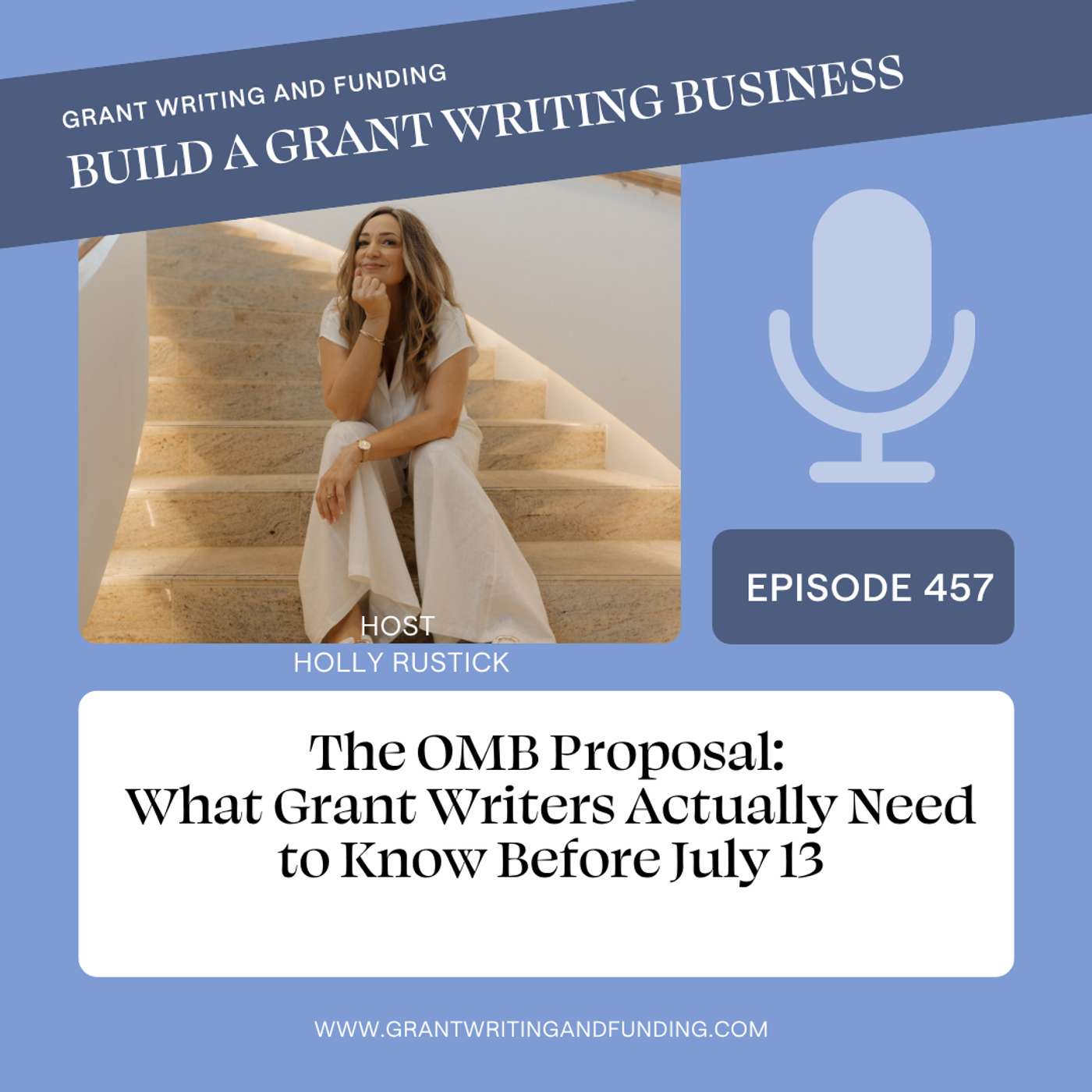
The OMB Proposal: What Grant Writers Actually Need to Know Before July 13 episode artwork

EPISODE · Jun 9, 2026 · 26 MIN

The OMB Proposal: What Grant Writers Actually Need to Know Before July 13

from Grant Writing & Funding · host Holly Rustick

The headlines about federal grants this week are a lot — and most of them are missing the most important detail: the OMB proposal is not a law. It is not final. It is a proposal, and you have until July 13, 2026 to weigh in on it.In this episode, Holly breaks down what the White House Office of Management and Budget actually published on May 29th, what it would change about how federal grants are reviewed, awarded, and terminated, and,  just as importantly, what it would NOT change yet. Holly also shares two new sections in the proposal the news isn't covering, why this issue goes beyond politics, and what it means for the communities your clients serve every day.You'll also hear why the language changes in federal grants (trigger words, DEI screening) are already in effect under earlier executive orders, and why that's a separate and current issue from the structural overhaul being proposed now.Take Action Before July 13#1 — Submit a Public Comment to the OMBGo to regulations.gov and search for docket OMB-2026-0034.Start your comment with the section number in brackets — for example [200.340] for the termination section. That formatting step makes your comment more likely to be taken seriously.Copy and adapt this template:[200.340]My name is [NAME] and I work as a [grant writer / executive director / program manager] for [ORGANIZATION NAME], a nonprofit serving [COMMUNITY/POPULATION] in [CITY, STATE].The Uniform Guidance provides the common framework governing how federal grants are applied for, awarded, and administered. The proposed overhaul could significantly disrupt the ability of nonprofits like ours to apply for and manage federal funding — funding that directly supports [housing / health services / education / disaster recovery / INSERT YOUR PROGRAM AREA] for the people and communities we serve every day.Changes to how grants are reviewed and awarded, new authority to terminate active grants, and sweeping simultaneous changes across all federal agencies create significant uncertainty for organizations that have built programs and hired staff in good faith around existing federal commitments. If these disruptions occur, it is not nonprofits that bear the cost — it is the children, seniors, veterans, and families who rely on the services we provide.I urge OMB to carefully consider the real-world impact of these proposed changes on nonprofits and the communities they serve before moving forward.Submit your comment here: regulations.gov — search docket OMB-2026-0034#2 — Email Your Member of CongressFind your representative at house.gov or senate.gov by entering your zip code.Copy and adapt this template:Dear [REPRESENTATIVE'S NAME],My name is [NAME] and I work as a [grant writer / executive director / program manager] for [ORGANIZATION NAME], a nonprofit serving [COMMUNITY/POPULATION] in [CITY, STATE].The Uniform Guidance provides the common framework governing how federal grants are applied for, awarded, and administered. The OMB's proposed overhaul could significantly disrupt the ability of nonprofits to apply for and manage federal funding — funding that directly supports housing, health services, education, disaster recovery, veterans, and community services for the people we serve every day.The proposed changes would give political appointees the power to override independent grant review, allow active grants to be terminated mid-program, and impose sweeping simultaneous changes across all federal agencies — creating enormous uncertainty for organizations that have built programs and hired staff in good faith around existing federal commitments. If these disruptions occur, it is not nonprofits that bear the cost. It is the children, seniors, veterans, and families who rely on the services we provide.I also want to note that this rule, if passed, does not belong to one administration. It becomes permanent structure that any future administration can use to screen federal grants for political alignment — regardless of party. Federal grants should be awarded based on the merit of the work, not on who holds political office. That is a principle worth protecting for everyone.I urge you to use your oversight authority to scrutinize this proposal and protect the integrity of federal grantmaking for the nonprofits and communities that depend on it.Warmly, [YOUR NAME AND TITLE]Find your representative: house.gov or senate.govResources Mentioned in This EpisodeSubmit a public comment (deadline July 13, 2026): regulations.gov — search docket OMB-2026-0034Free Banned and Trigger Words Guide + Replacement Checklist (for federal grant language already in effect under current executive orders): grantwritingandfunding.com/banned-and-trigger-words-in-federal-grant-writing-in-the-trump-administration-2-0Freelance Grant Writer Academy: grantwritingandfunding.com/freelance-grant-writer-academyConnect with HollyWebsite: grantwritingandfunding.com Instagram: @hollyrustick LinkedIn: linkedin.com/in/holly-rustick-0765b817 Podcast: Grant Writing & Funding — available on Apple Podcasts, Spotify, and everywhere you listenRESOURCES:Weekly Newsletter: “Write Grants. Get Paid” - Get thought leadership on grant and freelance grant writing strategies every week in your inbox. https://grantwritingandfunding.com/Freelance Grant Writer Academy: Replace your Full-Time Income Writing Grants Part-Time from Home.https://grantwritingandfunding.com/freelance-grant-writer-academy/Grant Professional Mentorship: Double your Monthly Revenue with an Income Stream Outside of Grant Writing.https://grantwritingandfunding.com/mentorshipRATE, REVIEW, & FOLLOW THE PODCASTFavor, please? If you love this podcast, would you please do me a favor and leave a review on iTunes or your podcast listener?This helps others find the podcast and I read each and every review!“Every time I listen to Holly’s show, I learn something” <-- If that sounds like you, please consider rating and reviewing my show!Also, if you haven’t done so already, follow the Grant Writing & Funding podcast to get grant and freelance grant writing proven strategies and conversations in your podcast player every single week.Thanks for listening!Warmly,Holly RustickLeading the $1 Billion for Good Movement: By 2030, aspiring and ...

The headlines about federal grants this week are a lot — and most of them are missing the most important detail: the OMB proposal is not a law. It is not final. It is a proposal, and you have until July 13, 2026 to weigh in on it.In this episode, Holly breaks down what the White House Office of Management and Budget actually published on May 29th, what it would change about how federal grants are reviewed, awarded, and terminated, and,  just as importantly, what it would NOT change yet. Holly also shares two new sections in the proposal the news isn't covering, why this issue goes beyond politics, and what it means for the communities your clients serve every day.You'll also hear why the language changes in federal grants (trigger words, DEI screening) are already in effect under earlier executive orders, and why that's a separate and current issue from the structural overhaul being proposed now.Take Action Before July 13#1 — Submit a Public Comment to the OMBGo to regulations.gov and search for docket OMB-2026-0034.Start your comment with the section number in brackets — for example [200.340] for the termination section. That formatting step makes your comment more likely to be taken seriously.Copy and adapt this template:[200.340]My name is [NAME] and I work as a [grant writer / executive director / program manager] for [ORGANIZATION NAME], a nonprofit serving [COMMUNITY/POPULATION] in [CITY, STATE].The Uniform Guidance provides the common framework governing how federal grants are applied for, awarded, and administered. The proposed overhaul could significantly disrupt the ability of nonprofits like ours to apply for and manage federal funding — funding that directly supports [housing / health services / education / disaster recovery / INSERT YOUR PROGRAM AREA] for the people and communities we serve every day.Changes to how grants are reviewed and awarded, new authority to terminate active grants, and sweeping simultaneous changes across all federal agencies create significant uncertainty for organizations that have built programs and hired staff in good faith around existing federal commitments. If these disruptions occur, it is not nonprofits that bear the cost — it is the children, seniors, veterans, and families who rely on the services we provide.I urge OMB to carefully consider the real-world impact of these proposed changes on nonprofits and the communities they serve before moving forward.Submit your comment here: regulations.gov — search docket OMB-2026-0034#2 — Email Your Member of CongressFind your representative at house.gov or senate.gov by entering your zip code.Copy and adapt this template:Dear [REPRESENTATIVE'S NAME],My name is [NAME] and I work as a [grant writer / executive director / program manager] for [ORGANIZATION NAME], a nonprofit serving [COMMUNITY/POPULATION] in [CITY, STATE].The Uniform Guidance provides the common framework governing how federal grants are applied for, awarded, and administered. The OMB's proposed overhaul could significantly disrupt the ability of nonprofits to apply for and manage federal funding — funding that directly supports housing, health services, education, disaster recovery, veterans, and community services for the people we serve every day.The proposed changes would give political appointees the power to override independent grant review, allow active grants to be terminated mid-program, and impose sweeping simultaneous changes across all federal agencies — creating enormous uncertainty for organizations that have built programs and hired staff in good faith around existing federal commitments. If these disruptions occur, it is not nonprofits that bear the cost. It is the children, seniors, veterans, and families who rely on the services we provide.I also want to note that this rule, if passed, does not belong to one administration. It becomes permanent structure that any future administration can use to screen federal grants for political alignment — regardless of party. Federal grants should be awarded based on the merit of the work, not on who holds political office. That is a principle worth protecting for everyone.I urge you to use your oversight authority to scrutinize this proposal and protect the integrity of federal grantmaking for the nonprofits and communities that depend on it.Warmly, [YOUR NAME AND TITLE]Find your representative: house.gov or senate.govResources Mentioned in This EpisodeSubmit a public comment (deadline July 13, 2026): regulations.gov — search docket OMB-2026-0034Free Banned and Trigger Words Guide + Replacement Checklist (for federal grant language already in effect under current executive orders): grantwritingandfunding.com/banned-and-trigger-words-in-federal-grant-writing-in-the-trump-administration-2-0Freelance Grant Writer Academy: grantwritingandfunding.com/freelance-grant-writer-academyConnect with HollyWebsite: grantwritingandfunding.com Instagram: @hollyrustick LinkedIn: linkedin.com/in/holly-rustick-0765b817 Podcast: Grant Writing & Funding — available on Apple Podcasts, Spotify, and everywhere you listenRESOURCES:Weekly Newsletter: “Write Grants. Get Paid” - Get thought leadership on grant and freelance grant writing strategies every week in your inbox. https://grantwritingandfunding.com/Freelance Grant Writer Academy: Replace your Full-Time Income Writing Grants Part-Time from Home.https://grantwritingandfunding.com/freelance-grant-writer-academy/Grant Professional Mentorship: Double your Monthly Revenue with an Income Stream Outside of Grant Writing.https://grantwritingandfunding.com/mentorshipRATE, REVIEW, & FOLLOW THE PODCASTFavor, please? If you love this podcast, would you please do me a favor and leave a review on iTunes or your podcast listener?This helps others find the podcast and I read each and every review!“Every time I listen to Holly’s show, I learn something” <-- If that sounds like you, please consider rating and reviewing my show!Also, if you haven’t done so already, follow the Grant Writing & Funding podcast to get grant and freelance grant writing proven strategies and conversations in your podcast player every single week.Thanks for listening!Warmly,Holly RustickLeading the $1 Billion for Good Movement: By 2030, aspiring and ...

NOW PLAYING

The OMB Proposal: What Grant Writers Actually Need to Know Before July 13

0:00 26:57

No transcript for this episode yet

We transcribe on demand. Request one and we'll notify you when it's ready — usually under 10 minutes.

The Ultraspeaking Podcast Tristan de Montebello, Michael Gendler The Ultraspeaking Podcast explores modern-day solutions to greater confidence, skill, and ease when speaking at work. Each episode features the founders, Tristan and Michael, as they detail unconventional strategies to thrive under pressure and speak with less preparation. Working on hand-gestures and eye contact is OUTDATED advice. Writing a script or creating a structure is a TRAP.It’s time for a better way. Join the Ultraspeaking movement and you’ll never look back. WW2 - the Key Questions, answered by Laurence Rees. Laurence Rees A former Head of BBC TV History programmes, Laurence has specialized in writing books and making television documentaries about World War Two, the Nazis and Stalinism for thirty years. He won a BAFTA and a Peabody for his TV series 'The Nazis: A Warning from History' and a British Book Award for his book on Auschwitz, which is also the world's best selling book on this notorious camp. His book 'the Holocaust: A New History' was described by the Times as 'exemplary' and by the Daily Telegraph as 'the best single volume account of the atrocity ever written'. Educated at Oxford University, for several years he was a visiting senior fellow at the London School of Economics, London University. He holds honorary doctorates from the University of Sheffield and the Open University. Professor Robert Service, of Oxford University, described Rees as 'one of the world's experts on the Second World War'. Sir Max Hastings wrote in the Sunday Times, in a review of Laurence Rees' 'World War Two: Behi Hot Copy Kate Toon & Belinda Weaver The Hot Copy podcast is a collaboration between seasoned copywriters Belinda Weaver and Kate Toon.Tune in for copywriting tips, shortcuts, writing resources, interviews and laughs. All focused on helping you become a better copywriter. The Writers' Show Geoff Hughes A podcast about writing, featuring interviews with authors and songwriters at all levels of success.Inspiring and successful authors reveal the secrets about writing, creativity and the business of independent publishing and songwriting.Featuring interviews with successful authors and songwriters excited to share the journey from idea to published book and song.Host Geoff Hughes is the founder of Madhouse Media PublishingMore info on the Writers Show Website

Frequently Asked Questions

How long is this episode of Grant Writing & Funding?

This episode is 26 minutes long.

When was this Grant Writing & Funding episode published?

This episode was published on June 9, 2026.

What is this episode about?

The headlines about federal grants this week are a lot — and most of them are missing the most important detail: the OMB proposal is not a law. It is not final. It is a proposal, and you have until July 13, 2026 to weigh in on it.In this episode,...

Can I download this Grant Writing & Funding episode?

Yes, you can download this episode by clicking the download button on the episode player, or subscribe to the podcast in your preferred podcast app for automatic downloads.
URL copied to clipboard!