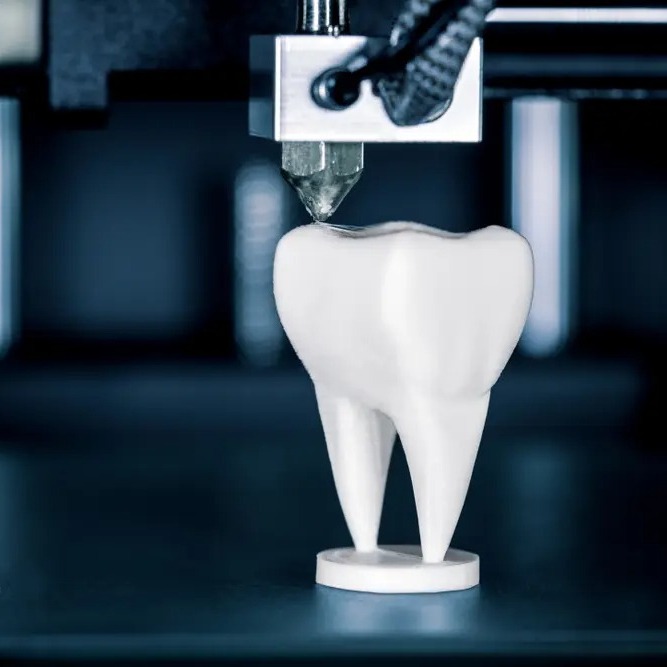
The OPTISMILE Podcast 103 - 3D Printing in the Dental Office and Laboratory episode artwork

EPISODE · Apr 13, 2026 · 24 MIN

The OPTISMILE Podcast 103 - 3D Printing in the Dental Office and Laboratory

from eRadio SA

Hello and welcome to Save Your Money, Save Your Teeth, the podcast where we help you protect your smile and your wallet with clear, practical advice. I'm Eon and as always joined by Dr. Clifford Yudelman from OptiSmile, based in Sea Point in the beautiful Mother City, Cape Town. Today we're talking about one of the biggest changes happening in modern dentistry — and that is 3D printing.Many people may think this only applies to crowns or futuristic gadgets, but the reality is that 3D printing is already being used in dental practices and laboratories for a wide range of things, including whitening trays, retainers, bite splints, models for crowns, surgical guides, smile design mock-ups, partial dentures, and even full dentures. So today we're going to unpack how it all works, what can be done in the dental office and what still happens in the laboratory, and most importantly how this technology can make treatment more accurate, more comfortable, and in some cases more efficient and cost-effective for patients. Dr. Yudelman, it's great to have you back.Dr. Clifford Yudelman: Great to be back. Thank you for that nice intro. In fact, I think we're done with the podcast now. That sounds like everything I wanted to say.Eon Engelbrecht: No, I still have a lot of questions for you. I hope you're ready. I've got 10 questions coming your way.Dr. Clifford Yudelman: I thought you were giving me the answers and the questions today. You must have a lot of time on your hands.Questions & AnswersQ1:  When people hear the words '3D printing in dentistry', what does it actually mean in a dental practice or a lab?We scan your mouth with one of our 3D scanners in about 90 seconds, save it to the cloud, and then design whatever is needed on a computer. That design is sent to our 3D printer or directly to the lab. Most dental 3D printing uses resin, building up layers as thin as 50 microns — the thickness of a piece of paper — producing highly accurate results. We can print surgical guides, bite splints, dentures, and soon even veneers and inlays. At OptiSmile we use the SprintRay Pro 2, designed in California.Q2:  Most people would not expect whitening trays to involve advanced technology. How does 3D printing help with custom whitening trays?Whitening trays are one of the most common uses of 3D printing in dentistry. If a tray doesn't fit precisely, the gel leaks onto the gums and causes irritation. With digital scans and printed models, we produce trays that fit far more accurately and comfortably, keeping the gel exactly where it belongs. It also makes remakes simple — if the tray gets lost or the family dog gets hold of it, we just print another one from the same digital file.Q3:  How are retainers and bite splints benefiting from 3D printing and digital design?These appliances need great precision — a poorly fitting retainer lets teeth shift, and an inaccurate night guard won't protect the bite. With digital scans, we position the upper and lower jaws in exactly the right relationship before sending to the lab, so the finished splint just pops in without adjustment. The material we use, e.stone soft, is rigid at room temperature but can be briefly softened in hot water for a perfect fit. Digital records also mean we never have to start from scratch if something is lost or damaged.Q4:  On the laboratory side, how are 3D printed models used when making zirconia and lithium disilicate crowns?Even when the final crown is milled or pressed rather than printed, a 3D printed model gives the lab technician a highly accurate physical reference. They use it to check the margins, contact points, and overall fit before the crown ever reaches the patient. The result is that crowns made on digitally printed models typically seat correctly first time, with little or no grinding needed at the appointment.Q5:  What are 3D printed guides and where do they make the biggest difference in dentistry?A printed guide is a template that transfers the digital treatment plan directly into the mouth. In implant surgery, the guide tells us exactly where to place the implant — there is no guesswork. We also use guides in cosmetic and restorative work to ensure precise positioning. The result is more predictable outcomes, less chair time, and greater confidence for both the clinician and the patient.Q6:  You often talk about injection moulding and minimally invasive dentistry. Where does 3D printing fit into that workflow?3D printing fits in beautifully. We design the ideal tooth shape digitally, print a model, and then use it to make a mould for the injection process. The printed item is often just a step in the workflow, not the final restoration, but it makes the final result far more accurate. Crucially, this approach lets us add to teeth rather than drill them down — the opposite of "turkey teeth" dentistry, and the whole point of conservative composite bonding.Q7:  How can 3D printing help with smile design and printed try-ins before the final treatment is done?We design the new smile digitally, print a model, take a putty mould over it, and use that mould to place a temporary tooth-coloured material directly in the patient's mouth. The patient walks to the mirror and sees exactly what their new smile will look like before any tooth is touched. They can ask for adjustments, we photograph and re-scan, and the lab matches the final work to what the patient approved. This is the correct use of the technology — full transparency from the start, not an emotional ambush.Q8:  How far along is 3D printing technology for partial dentures and full dentures?The technology is remarkable. For patients who need all their teeth replaced, guided implant surgery places the implants precisely, and 3D printing produces the try-in, the denture base, the teeth, and ultimately the final bridge that screws onto the implants. Every component of the process can now be digitally designed and printed. If a denture is ever lost, the lab can reprint it within a day from the stored digital file — no fragile plaster models required.Q9:  From a patient's point of view, what are the main advantages of all this 3D printing technology?The key benefits are accuracy — things fit correctly the first time — and comfort, because a well-fitting restoration causes far less adjustment and irritation. Treatment is often significantly faster; a crown that used to take two weeks can be ready in two days. There are no messy impressions, mock-ups can be done in a single visit, and we preserve more healthy tooth structure through better planning. The real value is not that the practice looks high-tech — it's that the patient receives more precise and predictable treatment.Q10:  Are there still limits to 3D printing in dentistry, and how do you decide what should be printed and what should not?Not everything should be printed just because it can be. For crowns and veneers, milled or pressed materials like Emax and zirconia still have a proven longevity advantage that 3D printed resins haven't yet matched. I've invested in two in-depth courses on printed veneers and fillings, and we do use them selectively — for elderly patients or those on tight budgets. But the printer is a tool, not a magician. The decision always comes down to what gives the patient the best long-term result.Disclaimer: The content provided in this podcast, "Save Your Money Save Your Teeth" on Medical Mondays, is for informational and educational purposes only. It is not intended to serve as dental or medical advice. The insights and opinions expressed by Dr. Clifford Yudelman and any guests are designed to foster a better understanding of dental health, preventive measures, and general well-being, but should not be interpreted as professional dental or medical recommendations. Dr. Clifford Yudelman does not diagnose, treat, or offer prevention strategies for any health conditions directly through this podcast. This platform is not a substitute for the personalized care and advice provided by a licensed dental or healthcare professional. We strongly encourage our listeners to consult with their own dental care providers to address individual dental health needs and concerns. The information shared here aims to empower listeners with knowledge about dental health but must not be used as a basis for making health-related decisions without professional guidance. Your dental care provider is the best source of advice about your dental and overall health. Please always seek the advice of your dentist or other qualified health professionals regarding any questions or concerns about your dental health.

Hello and welcome to Save Your Money, Save Your Teeth, the podcast where we help you protect your smile and your wallet with clear, practical advice. I'm Eon and as always joined by Dr. Clifford Yudelman from OptiSmile, based in Sea Point in the beautiful Mother City, Cape Town. Today we're talking about one of the biggest changes happening in modern dentistry — and that is 3D printing.Many people may think this only applies to crowns or futuristic gadgets, but the reality is that 3D printing is already being used in dental practices and laboratories for a wide range of things, including whitening trays, retainers, bite splints, models for crowns, surgical guides, smile design mock-ups, partial dentures, and even full dentures. So today we're going to unpack how it all works, what can be done in the dental office and what still happens in the laboratory, and most importantly how this technology can make treatment more accurate, more comfortable, and in some cases more efficient and cost-effective for patients. Dr. Yudelman, it's great to have you back.Dr. Clifford Yudelman: Great to be back. Thank you for that nice intro. In fact, I think we're done with the podcast now. That sounds like everything I wanted to say.Eon Engelbrecht: No, I still have a lot of questions for you. I hope you're ready. I've got 10 questions coming your way.Dr. Clifford Yudelman: I thought you were giving me the answers and the questions today. You must have a lot of time on your hands.Questions & AnswersQ1:  When people hear the words '3D printing in dentistry', what does it actually mean in a dental practice or a lab?We scan your mouth with one of our 3D scanners in about 90 seconds, save it to the cloud, and then design whatever is needed on a computer. That design is sent to our 3D printer or directly to the lab. Most dental 3D printing uses resin, building up layers as thin as 50 microns — the thickness of a piece of paper — producing highly accurate results. We can print surgical guides, bite splints, dentures, and soon even veneers and inlays. At OptiSmile we use the SprintRay Pro 2, designed in California.Q2:  Most people would not expect whitening trays to involve advanced technology. How does 3D printing help with custom whitening trays?Whitening trays are one of the most common uses of 3D printing in dentistry. If a tray doesn't fit precisely, the gel leaks onto the gums and causes irritation. With digital scans and printed models, we produce trays that fit far more accurately and comfortably, keeping the gel exactly where it belongs. It also makes remakes simple — if the tray gets lost or the family dog gets hold of it, we just print another one from the same digital file.Q3:  How are retainers and bite splints benefiting from 3D printing and digital design?These appliances need great precision — a poorly fitting retainer lets teeth shift, and an inaccurate night guard won't protect the bite. With digital scans, we position the upper and lower jaws in exactly the right relationship before sending to the lab, so the finished splint just pops in without adjustment. The material we use, e.stone soft, is rigid at room temperature but can be briefly softened in hot water for a perfect fit. Digital records also mean we never have to start from scratch if something is lost or damaged.Q4:  On the laboratory side, how are 3D printed models used when making zirconia and lithium disilicate crowns?Even when the final crown is milled or pressed rather than printed, a 3D printed model gives the lab technician a highly accurate physical reference. They use it to check the margins, contact points, and overall fit before the crown ever reaches the patient. The result is that crowns made on digitally printed models typically seat correctly first time, with little or no grinding needed at the appointment.Q5:  What are 3D printed guides and where do they make the biggest difference in dentistry?A printed guide is a template that transfers the digital treatment plan directly into the mouth. In implant surgery, the guide tells us exactly where to place the implant — there is no guesswork. We also use guides in cosmetic and restorative work to ensure precise positioning. The result is more predictable outcomes, less chair time, and greater confidence for both the clinician and the patient.Q6:  You often talk about injection moulding and minimally invasive dentistry. Where does 3D printing fit into that workflow?3D printing fits in beautifully. We design the ideal tooth shape digitally, print a model, and then use it to make a mould for the injection process. The printed item is often just a step in the workflow, not the final restoration, but it makes the final result far more accurate. Crucially, this approach lets us add to teeth rather than drill them down — the opposite of "turkey teeth" dentistry, and the whole point of conservative composite bonding.Q7:  How can 3D printing help with smile design and printed try-ins before the final treatment is done?We design the new smile digitally, print a model, take a putty mould over it, and use that mould to place a temporary tooth-coloured material directly in the patient's mouth. The patient walks to the mirror and sees exactly what their new smile will look like before any tooth is touched. They can ask for adjustments, we photograph and re-scan, and the lab matches the final work to what the patient approved. This is the correct use of the technology — full transparency from the start, not an emotional ambush.Q8:  How far along is 3D printing technology for partial dentures and full dentures?The technology is remarkable. For patients who need all their teeth replaced, guided implant surgery places the implants precisely, and 3D printing produces the try-in, the denture base, the teeth, and ultimately the final bridge that screws onto the implants. Every component of the process can now be digitally designed and printed. If a denture is ever lost, the lab can reprint it within a day from the stored digital file — no fragile plaster models required.Q9:  From a patient's point of view, what are the main advantages of all this 3D printing technology?The key benefits are accuracy — things fit correctly the first time — and comfort, because a well-fitting restoration causes far less adjustment and irritation. Treatment is often significantly faster; a crown that used to take two weeks can be ready in two days. There are no messy impressions, mock-ups can be done in a single visit, and we preserve more healthy tooth structure through better planning. The real value is not that the practice looks high-tech — it's that the patient receives more precise and predictable treatment.Q10:  Are there still limits to 3D printing in dentistry, and how do you decide what should be printed and what should not?Not everything should be printed just because it can be. For crowns and veneers, milled or pressed materials like Emax and zirconia still have a proven longevity advantage that 3D printed resins haven't yet matched. I've invested in two in-depth courses on printed veneers and fillings, and we do use them selectively — for elderly patients or those on tight budgets. But the printer is a tool, not a magician. The decision always comes down to what gives the patient the best long-term result.Disclaimer: The content provided in this podcast, "Save Your Money Save Your Teeth" on Medical Mondays, is for informational and educational purposes only. It is not intended to serve as dental or medical advice. The insights and opinions expressed by Dr. Clifford Yudelman and any guests are designed to foster a better understanding of dental health, preventive measures, and general well-being, but should not be interpreted as professional dental or medical recommendations. Dr. Clifford Yudelman does not diagnose, treat, or offer prevention strategies for any health conditions directly through this podcast. This platform is not a substitute for the personalized care and advice provided by a licensed dental or healthcare professional. We strongly encourage our listeners to consult with their own dental care providers to address individual dental health needs and concerns. The information shared here aims to empower listeners with knowledge about dental health but must not be used as a basis for making health-related decisions without professional guidance. Your dental care provider is the best source of advice about your dental and overall health. Please always seek the advice of your dentist or other qualified health professionals regarding any questions or concerns about your dental health.

NOW PLAYING

The OPTISMILE Podcast 103 - 3D Printing in the Dental Office and Laboratory

0:00 24:52

No transcript for this episode yet

We transcribe on demand. Request one and we'll notify you when it's ready — usually under 10 minutes.

No similar episodes found.

Le comptoir de la psychologie Le comptoir de la psychologie Je suis Jo, psychologue clinicienne et j'ai crée ce podcast afin de rendre accessible les différents reliefs de la psychologie. Il s'agit d'un travail de construction et de déconstruction pour apprendre et s'ouvrir autour des différents thèmes que logent la psychologie et la psychanalyse. J'aborde le métier du psychologue et de sa rencontre mais aussi ses outils, concepts, représentations, symptômes etc... Pour me soutenir, j'ai crée une page Patreon : https://www.patreon.com/lecomptoirdelapsychologie Merci beaucoup pour vos contributions ainsi que vos encouragements, vos retours ❤️ Bonnes écoutes :-) Contact : [email protected] Hébergé par Acast. Visitez acast.com/privacy pour plus d'informations. Tech Of The Future With AppSumo (Hosted by Chris Cownden) Christopher Paul Cownden Visionaries like you and I see the world differently—and deserve the right tech to match. Listen to the people behind our favorite AppSumo tools on the Tech Of The Future podcast including BIGVU, VistaSocial, Sessions, VBOUT, Castmagic and lots more. Listen out for exclusive deals and best practices for using these tools to your advantage as a podcaster, entrepreneur or content creator. Topics include ai, software, digital marketing, productivity, email marketing, content repurposing, podcast hosting, search engine optimization and podcast editing. Guests include: Jacob Bozarth, Richard Fallah, Blaine Bolus, Rob Winters, Melinda Wittstock, Kareem Mostafa, Dante Healy, Lisa Khera, Tonya Gossage, Jonathan Reid, JaMarr John Johnson and Austin Armstrong, SA Grant, Phil Better, Mike Cavaggioni, JaMarr John Johnson and Noah Kagan. Hosted by Chris Cownden in partnership with AppSumo. Beyond the Headlines with Dr Q: The Learning Edition Dr Q BTH (Beyond the Headlines) with Dr Q is your deep dive into the stories shaping the world today, beyond the surface-level coverage. In each episode, we explore the untold perspectives and social nuances that often go unnoticed. Join Dr Q as he engages experts and people in our communities to uncover the forces driving global issues, from politics and culture to science and innovation. If you’re looking for insightful, in-depth conversations that go beyond the buzzwords and soundbites, this is the podcast for you. Podcast Credits:Editing by: Hype Media SA Parenthood Parenthood Bienvenue sur Parenthood, le premier podcast romand qui traite de parentalité. De l’envie d’avoir un enfant à sa conception, de la grossesse à l’accouchement, du post-partum aux tracas de l’éducation, rendez-vous chaque semaine pour découvrir les témoignages inspirants de parents mais aussi de super bons plans accessibles à Genève et alentours !

Frequently Asked Questions

How long is this episode of eRadio SA?

This episode is 24 minutes long.

When was this eRadio SA episode published?

This episode was published on April 13, 2026.

What is this episode about?

Hello and welcome to Save Your Money, Save Your Teeth, the podcast where we help you protect your smile and your wallet with clear, practical advice. I'm Eon and as always joined by Dr. Clifford Yudelman from OptiSmile, based in Sea Point in the...

Can I download this eRadio SA episode?

Yes, you can download this episode by clicking the download button on the episode player, or subscribe to the podcast in your preferred podcast app for automatic downloads.
URL copied to clipboard!