
EPISODE · Jun 28, 2026 · 39 MIN
The People Who Build the Machine
from Language Matters Podcast · host Elias Winter
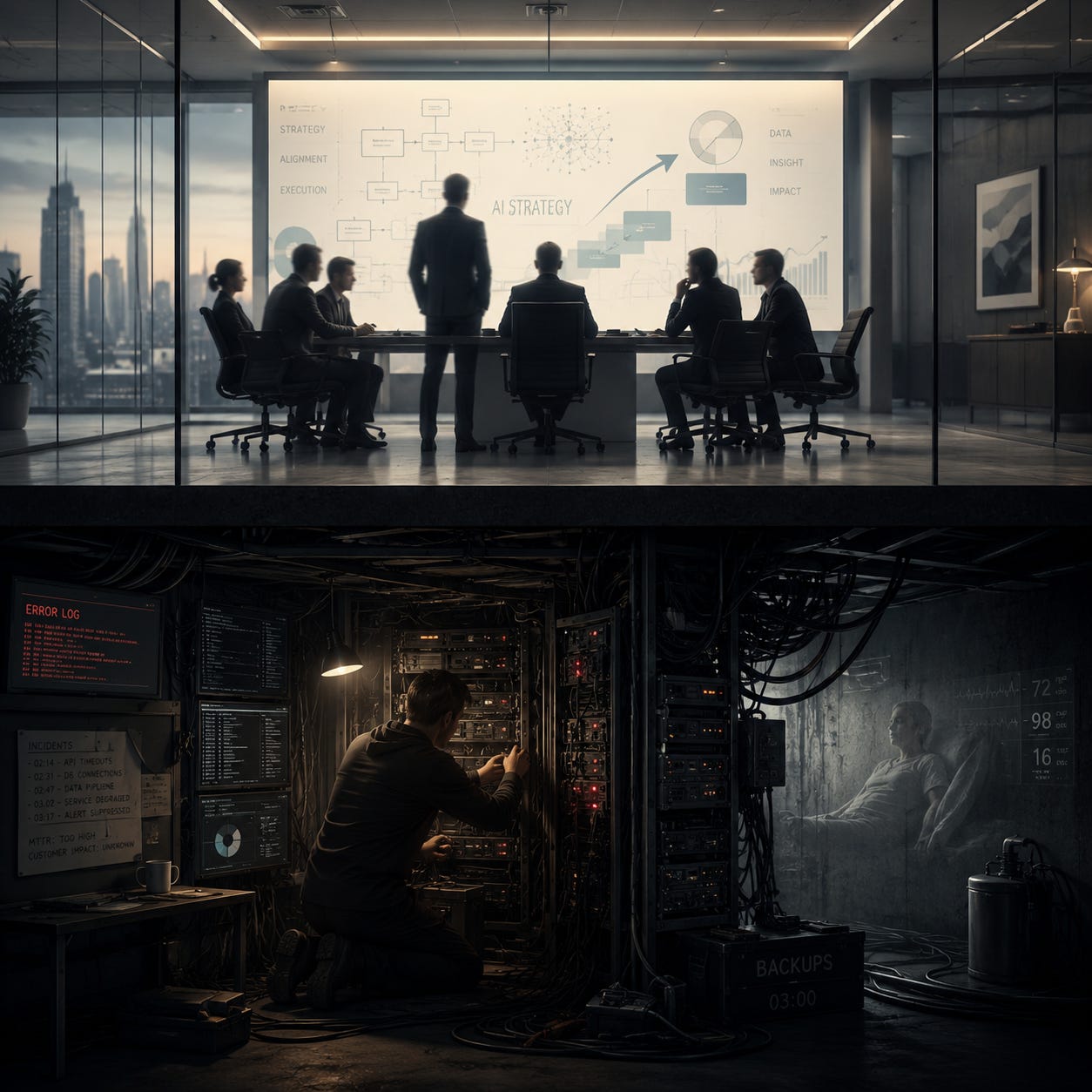
I. The AssignmentThe first sign came as an assignment.Not a question. Not a joint inquiry into the shape of a problem. Not the slow assembly of facts around a thing that mattered. An assignment.A senior person entered the room with urgency already formed in his mouth. Something important had to be done. Something connected to the customer, the patient, the future, the company’s ability to become what it had promised itself it would become. The language was familiar: strategic, urgent, high-priority, visible.He listened.He had been hired, at least formally, as a leader. His title suggested judgment, architecture, ownership, the ability to turn ambiguity into systems. He had spent years learning that technical work is not simply execution. It is the disciplined conversion of desire into reality. It is where ambition meets constraints. It is where a company’s language is forced to answer to data, workflow, safety, latency, reliability, and consequence.But in that room the assignment did not arrive as a problem to be understood. It arrived as a command to move.So he did what responsible people do. He gathered stakeholders. He tried to form the missing room around the problem. Clinical voices, product voices, operational voices, technical voices — the people whose input would determine whether the work could actually proceed.If the thing was urgent, then surely the system would behave as if it was urgent.But the system did not.One necessary stakeholder did not appear. Not declined. Not accepted. Not properly engaged. Simply absent.And there, in that small absence, he saw the first law of the place:Urgency flows downward. Accountability does not flow sideways.The executive could declare importance. The technical leader could inherit pressure. But the people whose participation was required could still remain optional, protected by ambiguity, calendar drift, competing priorities, or the old institutional magic by which some obligations are real only for the person nearest the work.He was not angry because of a missed meeting.He was angry because the meeting had revealed the architecture.The mandate had already descended. The authority had not followed it. He stood in the middle, holding an urgent assignment whose necessary inputs had not been made urgent to everyone else.This is how blame begins. Not with failure. With asymmetry.II. The Missing StakeholderEvery organization has meetings that do not matter. This was not supposed to be one of them.The missing stakeholder had not merely missed a calendar block. She had exposed the lie beneath the calendar itself. If the work was important, why was presence optional? If the deadline mattered, why did the system not enforce the participation required to meet it? If the company had decided that this was urgent, why did only one person inherit urgency as obligation?He felt the insult in his body before he could make it into language.There is a kind of corporate violence that does not announce itself as violence. It does not shout. It does not strike. It simply gives one person accountability for a system that refuses to be accountable back.It says: deliver.Then it withholds the conditions of delivery.It says: move faster.Then it leaves the required decisions floating in the air.It says: own this.Then it allows everyone else to behave as if ownership belongs somewhere else.The missing stakeholder was the first ghost. Soon there would be others: the product person who did not show up; the strategy narrator who enlarged immature work in polished slides; the manager who mistook exposed complexity for delay; the executive layer that converted AI into a growth story before the operating model had learned how to hold it.But the first ghost was absence.And absence taught him the grammar of the company.Some people could miss the room and remain whole. Others had to stand in the room and absorb the missingness.This is not unique to one company. It is the ordinary sickness of ambitious institutions. A priority is declared at the top, but its requirements are not bound into the body of the organization. The pressure travels faster than the accountability. By the time it reaches the people who build, it has become both command and accusation.The builder is asked to move.The room required for motion has not yet been built.III. The Director Who Was Treated Like a HandA title can say “Director” while the operating system says “hand.”This is one of the more humiliating discoveries of corporate life. Hierarchy is not always where the org chart says it is. Sometimes hierarchy lives in who gets to define the problem and who has to solve it. Who gets to narrate and who has to build. Who gets to be late and who has to explain the delay. Who gets to speak in strategy and who gets measured in velocity.His title suggested leadership. But the lived rhythm often suggested something else.He was asked to solve, accelerate, unblock, make real. Yet the problems were often handed to him after they had already been blessed by people who had not done the work of definition. He was expected to move with the confidence of a delivery machine while carrying the uncertainty of a scientist.This is a particular degradation for technical people whose work depends on truth.To build a reliable AI system is not simply to write code quickly. It is to ask what the system is allowed to know. What it must never reveal. What it must do when context is missing. How it will be evaluated. What counts as failure. What kinds of failure are tolerable. Which human will be harmed if the system answers with fluency instead of correctness.But those questions can sound slow to people who have already sold the promise.He began to recognize the role he had actually been given. He was not merely leading a function. He was being asked to serve as a converter: executive ambition in, technical reality out.But the converter was not allowed to heat up. It was not allowed to say, “The input is malformed.” It was not allowed to say, “The strategy is not yet an operating model.” It was not allowed to say, “You have confused naming the future with building it.”It was supposed to execute.Hands execute.Architects ask why the building is leaning.The deepest humiliation was not hard work. He respected hard work. The humiliation was being asked to carry executive-level responsibility while being treated as though his questions were the inconvenience of a subordinate.IV. The Product VacuumWhere product leadership is weak, narration rushes in to occupy the empty space.The company had a product layer, but the layer had not yet become a discipline. Requirements moved. Ownership blurred. Stakeholder commitments appeared in decks before they had become operational facts. Strategy was often presented before accountability had attached itself to the people making the promises.In that vacuum, certain figures became powerful.They did not necessarily own the hardest parts of the work. They did not necessarily understand the machinery. But they owned the room. They owned the slide. They owned the vocabulary by which unfinished things became initiatives, and initiatives became roadmaps, and roadmaps became confidence.This is the birth of the Narrator.The Narrator is not always malicious. Often he is necessary. Organizations need translation. Executives cannot live inside every technical detail. Customers do not buy trace logs. Boards do not fund observability diagrams. Clinical stakeholders are not going to read model cards for pleasure. Someone must turn messy work into a story.The sin is not narration.The sin is narration detached from reality.A good narrator binds language to consequence. He asks the builders what is true. He does not borrow certainty from work that has not yet earned it. He does not present ambition as completion or dependency as alignment. He uses language to make reality legible, not to hide the distance between promise and machine.But in an immature organization, the Narrator becomes dangerous because the story can outrun the work.He learns that an ambiguous feature can be made to sound like a strategic pillar. A prototype can become a platform. A dependency can become an assumption. A technical risk can become an implementation detail. The people who will later have to make the system safe are not always present when the story is being told.And so the company begins to reward the one who can make uncertainty sound organized.He saw this happening. He saw work being lifted into language before it had been secured in reality. He saw the technical function becoming an invisible substrate beneath the product story. He saw that the room loved clarity, even when the clarity was premature.And because he saw it, he became difficult.This is one of the punishments for perception. The person who detects structural incoherence early is often experienced as friction by the people who benefit from the incoherence remaining unnamed.V. The Man With the SlidesThere was a man with slides.Every institution has him.He entered rooms with the polished fluency of someone who understood that strategy, in many companies, is not first a relationship to truth. It is a relationship to audience. He had the gift of making things sound larger than they were, not always by lying, but by expanding them into a vocabulary of inevitability.The work became a journey.The dependency became alignment.The unscoped problem became a roadmap.The technical unknown became a phase.He listened as the man with the slides presented work whose machinery depended heavily on teams he did not lead. The words were large. The ownership was soft. The credit moved upward through language while the risk remained below, waiting for the builders.This is a very old pattern.The builders know the weight of the thing. The narrators know the shape of the room.And the room often rewards shape before weight.But even here, the indictment must be precise. The man with the slides was not wrong because he narrated. The company needed narrative. The customer needed a path. The executives needed a frame. The engineers themselves needed a shared language for why the work mattered.He was wrong only when narration became a way of borrowing authority from work he did not have to make true.The humiliation was not simply that he was unnamed. He had survived worse. The deeper humiliation was that the omission revealed his position in the symbolic order. He could be essential to the system and secondary in the story. He could carry the dangerous part and still be introduced afterward as someone who had “worked with” the person who spoke.There is a particular injury in hearing your work translated by someone who cannot carry its consequences.The man with the slides did not have to say, “I built this.” The system said it for him by giving him the front of the room.He felt the old rage rise.Not because he needed applause.Because he knew what happens when language is allowed to detach from responsibility.VI. The Manager of SpeedThe manager of speed was not a fool.This must be said, because grievance prefers caricature. He had real pressures. He was responsible for delivery. He had executives above him, teams below him, timelines tightening around him like wire. He lived inside the managerial weather of a company trying to become profitable, faster, more disciplined, less tolerant of drift.He wanted action.He wanted people to make calls.He wanted fewer open questions in public channels.He wanted initiative, ownership, dates, blockers, visible movement.There was truth in this.He, too, had a failure mode. He sometimes exposed the reasoning path before offering the decision. He sometimes believed that showing the structure of a problem would be received as leadership, when the room wanted a recommendation. He sometimes mistook the truth of his analysis for the effectiveness of its timing.The manager of speed saw this and called it slow.The word entered him like an accusation against his whole life.Slow.Not careful. Not rigorous. Not appropriately concerned with risk. Slow.This is what crude managerial language does. It compresses a complex mismatch into a trait. It takes a register problem and makes it sound like a character defect.But the manager’s complaint was not entirely empty. Some decisions deserved velocity. Some experiments were cheap and reversible. Some questions could be answered by moving, not by theorizing. Some ambiguity was not sacred; it was merely fear wearing the costume of rigor.He had to admit this.A good technical leader cannot treat every uncertainty as equal. He must distinguish between decisions that can be reversed and decisions that will harm people if made casually. He must know when to ship a narrow version, when to instrument and learn, when to demand requirements, when to expose risk, and when to stop speaking and move.Speed is not always negligence.Sometimes speed is leadership.The failure was not speed itself. The failure was an organization that had not learned which kinds of speed were safe.For low-risk operational work, speed can produce truth. Try the thing. Measure the result. Adjust.For high-risk clinical or AI-mediated work, speed without evaluation becomes theater. A fluent system in a healthcare workflow is not a landing page experiment. It can mislead, omit, overstate, expose, reassure falsely, or act with authority it has not earned.The manager of speed wanted motion. He wanted reality.Both were necessary.The tragedy was that the company had not yet built a language in which both could be held.VII. The Sacred MachineryBeneath the slides, the machinery waited.It did not care about strategy language. It did not care about titles. It did not care whether an executive had said “AI advantage” with conviction. It did not care whether the roadmap looked clean.The machinery had its own laws.A voice agent must authenticate before it speaks too freely. A model must not turn uncertainty into clinical confidence. A data pipeline must not silently rot. A retrieval system must know what it is allowed to retrieve. An evaluation must measure the failure that matters, not the failure that is easy to count. A dashboard must not become a shrine to numbers whose provenance no one can defend.The machinery asks humiliating questions.What happens when the user says the unexpected thing?What happens when the patient is confused?What happens when the model sounds right and is wrong?What happens when protected information appears where it should not?What happens when the data is delayed, partial, duplicated, stale, mislabeled?What happens when the demo succeeds and production fails?This is the sacred work of technical reality: to protect the world from fluent falsehood.Artificial intelligence has made this work more important, not less. The new machine does not merely calculate. It speaks. It persuades. It simulates understanding. It enters workflows that touch health, money, identity, fear, access, dignity. It can fail with the confidence of a priest.That is why the builders matter.The builder is the one still there after the meeting ends, after the strategic language has evaporated, after the executive has moved to the next priority, after the slide has done its work. The builder remains with the logs, the traces, the broken edge case, the patient context, the compliance boundary, the cost curve, the latency spike, the missing field, the alert that did not fire.The builder is not slower because he sees these things.He is slower only if the organization has forgotten that reality has a speed limit.But the builder, too, must beware his own priesthood. The logs are not the whole company. The trace is not the customer. The evaluation is not the market. The machine exists in a business, and the business exists in time. Customers leave. Competitors move. Boards demand growth. Cash has a burn rate. Sales cycles close or do not close. A perfect system that arrives too late may serve no one.The sacred machinery must therefore be defended without becoming an altar to paralysis.This is the builder’s burden: to protect reality without worshiping delay.VIII. The Promotion of the InterpreterThen came the interpreter.He had always loved the language of AI. The tools, the demos, the enablement sessions, the atmosphere of transformation. He was good at making the future feel close. He could gather people around the possibility of the machine. He could speak to executives in a register of adoption, strategy, workflow, operating rhythm.And then he was given a title.Head of AI Strategy and Operations.He first experienced this as erasure.Of course. The one who speaks the new religion is elevated. The one who builds the altar is told to move faster.But the more sober reading was less simple.Perhaps this was not a coronation. Perhaps it was a redeployment. Perhaps the interpreter had wanted broader authority and had not received it. Perhaps the company had recognized that product required a more serious leader. Perhaps the new title was both honor and containment: a way to preserve enthusiasm, proximity, and status while moving true product accountability elsewhere.Not every new title is an execution.Some are rearrangements of anxiety.Still, he could not ignore the risk. Strategy titles have power even when they do not own the machinery. They shape the story. They determine what is visible. They create the language by which executives later decide who was central and who was merely helpful.The interpreter did not need to own the engineers to become dangerous. He only needed to become the official narrator of the field in which the engineers worked.So he faced the old temptation: rivalry.But rivalry would have been foolish. The interpreter was now part of the court. To oppose him directly would make him look territorial, wounded, unable to collaborate. The better move was colder: bind the interpreter to the machinery.AI strategy needs a production spine.Let the interpreter speak of adoption. Let him organize the operating rhythm. Let him translate ambition into motion.But let no one forget that strategy without architecture, evaluation, observability, reliability, model lifecycle, and data infrastructure is theater.A company does not become intelligent because it teaches its employees to speak fluently about intelligence.It becomes intelligent when its systems can survive contact with reality.IX. The Arrival of the AdultThen another figure arrived.A real product leader. Older in the craft. More commercial. More seasoned in the world the company wanted to enter: payers, clinical quality, risk, data, systems that turn complexity into decisions.This changed the board.At first he saw only threat. Another executive layer. Another person above the work. Another possible channel through which the man with the slides could attach himself to power and say, “I own the strategy.”But the arrival of the adult could also mean something else.It could mean that the company had finally seen the vacuum.A serious product leader asks different questions than a narrator performing strategy in an under-governed room. He asks what the product is. Who the customer is. What the value is. Which requirements are real. What must be delivered before the promise can be sold. What is prototype and what is production. Which function owns which decision. Who is accountable for the date. What cannot be claimed until the machinery exists.If he was serious, he might become a threat to free riders.If he was captured early, he might become their sponsor.He did not know yet.This is what made the moment dangerous and open.A reorganization is a kind of weather system. It can wash away the old fog, or it can flood the rooms where the work is done. It can clarify authority, or it can create new titles that obscure it further. It can discipline the narrators, or it can give them better lighting.His task was not to panic before the storm had formed.His task was to make sure the new adult saw the machinery before the man with the slides gave him the map.Not by complaining.By being useful.By making the operating model visible.By showing where product must own requirements, where strategy must own alignment, where technical teams must own production reality, and where no one should be allowed to claim progress until responsibility has found its proper owner.X. The Root DiseaseThe root disease was not one person.Not the missing stakeholder. Not the man with the slides. Not the manager of speed. Not the interpreter. Not even the executives who spoke urgency into being before the operating model could hold it.The root disease was this:The company was trying to become a revenue-driven, AI-enabled healthcare product company before it had built a mature operating model for Product, AI, Data, Clinical, and Engineering accountability.Everything followed from that.Urgency without shared ownership.Strategy without production discipline.Product without requirements.Engineering without authority.AI language without AI responsibility.Recognition without risk.Blame without command.But even this diagnosis was incomplete unless it accounted for the pressure above the room.The company was not operating in a vacuum. The market had discovered artificial intelligence and lost its mind. Boards wanted the story. Customers wanted the efficiency. Competitors wanted the headline. Executives wanted the operating leverage. Sales wanted the promise to become real in time for the next conversation. Healthcare wanted transformation without surrendering safety, compliance, trust, or clinical judgment.The pressure was real.AI was not just a technology initiative. It had become a growth language. A valuation language. A customer-retention language. A way to say the company was not merely surviving the future, but participating in it.Under that pressure, narration became more valuable. The organization needed people who could make the future legible. It needed people who could connect product, customer, board, and employee imagination. It needed strategy.But pressure corrupts language when language is not disciplined by reality.The company had ambition. It had smart people. It had real opportunity. It had work worth doing. But the connective tissue was immature. The middle layer — the place where executive desire becomes scoped work, where clinical reality meets product requirements, where AI possibility becomes safe production — had not yet hardened into a disciplined system.So urgency fell downward.Ambiguity remained sideways.Credit moved upward.He lived at the point where all three vectors crossed.This is why he kept getting angry. His anger was not random. It was the body’s response to structural incoherence. He was being asked to carry the pressure of a system that had not distributed responsibility honestly.But anger, however justified, is not itself an operating model.This was his own indictment.He could see the disease. But seeing the disease did not exempt him from the need to act with precision inside the diseased body. If he became the emotional witness of every dysfunction, the system would name him the dysfunction.That is how institutions protect themselves.They convert the person who names the contradiction into the problem created by the contradiction.XI. The False ExitWhen dignity is denied slowly, destruction begins to look like self-respect.He knew this temptation.Leave. Resign. Burn it down. Tell the truth in public. Refuse the court. Refuse the manager. Refuse the slides. Refuse the interpreter’s title. Refuse the adult before he can misread you. Refuse the whole system that takes your labor and asks why you are not faster.There were darker exits too.Chemical exits.Erotic exits.Night exits.The old machinery of relief, waiting at the edge of humiliation, promising command over a life that had begun to feel like submission. When the institution makes a person feel powerless, the body looks for a sovereign event. A substance. A rupture. A door.But the false exit always has a second clause.The resignation that feels like dignity may become financial panic.The public truth-telling that feels like power may become evidence of instability.The chemical relief that feels like freedom may return the person to shame, terror, and dependence.The dramatic act that feels like self-respect may leave the actual structure untouched and the actor more trapped than before.He had to learn the hardest form of refusal:Not the refusal that explodes.The refusal that preserves leverage.It is easier to leave a room than to remain inside it without letting it define you. Easier to denounce the court than to move through it with a clean face and a hidden map. Easier to call the system corrupt than to build the record by which its corruption becomes impossible to hide.But adulthood is sometimes the art of not giving your enemy the version of you they can use.And sometimes the enemy is not one person.Sometimes the enemy is the part of the self that wants an ending more than it wants freedom.XII. The Real ExitThe real exit was not immediate flight.The real exit was authorship.Not the authorship of being named in a meeting, though that mattered. Not the authorship of applause, though the body wanted it. Not the authorship of being finally understood by the manager, the product leader, the interpreter, the executive.The real authorship was structural.Make the system unable to erase the work.Product owns requirements, commercialization, stakeholder sign-off, launch criteria.AI strategy owns adoption, operating rhythm, cross-functional alignment, prioritization language.AI and data own production reality: architecture, evaluation, observability, reliability, model lifecycle, data infrastructure, technical sequencing, delivery.Accountability follows authority.Outcomes move with resources.Dates require inputs.Urgency must bind everyone necessary to the work, not only the person nearest delivery.This is not bureaucracy. It is moral engineering.A tracker can become a shield. A blocker can become a truth-telling instrument. A dependency can become an indictment without becoming an accusation. A weekly update can make “slow” too vague to survive.He did not need to become less rigorous. He needed to become harder to misread.Action first. Analysis behind.For reversible decisions, move.For irreversible decisions, name the reason for care.For stakeholder absence, document the dependency.For product inflation, request requirements.For strategy, insist on machinery.For recognition, build meeting structures where ownership is necessary, not optional.This was not submission.It was a colder form of revolt.He would not beg the room to see him. He would redesign the room so the work had to be seen.The point was not that builders should rule because they are morally superior. Builders can be rigid. Narrators can be wise. Managers of speed can rescue organizations from paralysis. Product leaders can force useful discipline into beautiful but impractical systems. Strategy can reveal what technical people, left alone, might never make legible.The point was simpler and more severe:The people responsible for failure must have authority over the conditions of success.Everything else is theater.XIII. The People Who Build the MachineThe story was never only about one company.Across the economy, a new hierarchy is forming.There are people who fund the machine. People who sell the machine. People who narrate the machine. People who fear being left behind by the machine. People who call themselves strategists of the machine. People who put the machine into decks, conferences, enablement sessions, investor language, executive memos.And then there are the people who build the machine.They are not always the most visible. They are often tired. They are asked to move faster by people who do not understand what can break. They are told that complexity is expensive by people whose simplicity is subsidized by someone else’s hidden labor. They are summoned after promises have been made and then judged for the difficulty of making the promises true.But they know what the others forget.The machine is not a metaphor.It touches bodies. It moves money. It speaks to patients. It ranks, recommends, withholds, alerts, authorizes, denies, persuades, remembers. It can make a company look modern while quietly reproducing every old institutional vice: haste, hierarchy, obscurity, evasion, blame.The future will not be made safe by those who name it first.It will be made safe by those still present when naming is no longer enough.When the slide ends.When the demo fails.When the data is wrong.When the patient is real.When the model drifts.When the alert does not fire.When the executive promise meets the broken edge case.When the machine must answer not to ambition, but to truth.He did not need to pretend he was above the wound. He was wounded. He had wanted recognition. He had wanted the room to say: this man carried the hard part. He had wanted justice in the small human form of being named.But perhaps the deeper work was this:To see clearly without becoming consumed by the need to be seen.To build without surrendering authorship.To refuse speed when speed becomes falsehood.To accept speed when hesitation becomes vanity.To know when strategy is real and when it is merely incense.To insist, again and again, that responsibility and authority must be reunited if the machine is to serve life rather than devour it.The people who build the machine are not holy.The people who narrate it are not damned.The question is whether the two can be reunited before the machine becomes another empire of language detached from consequence.Because this is the real danger of artificial intelligence: not that the machine will become conscious and overthrow us, but that our institutions will use it to perfect an older form of irresponsibility. The promise will become smoother. The demo will become more persuasive. The strategy will become more radiant. The language will become more fluent.And somewhere beneath that fluency, a patient, a worker, a customer, a citizen, a frightened person trying to be helped, will encounter the system as reality.That is where the sermon ends.That is where the builder begins.And in an age drunk on artificial fluency, reality interrupting language may be the beginning of wisdom.—Elias WinterAuthor of Language Matters, a space for reflection on language, power, and decline This is a public episode. If you would like to discuss this with other subscribers or get access to bonus episodes, visit eliaswinter.substack.com
Embed this episode
NOW PLAYING
The People Who Build the Machine
No transcript for this episode yet
Similar Episodes
No similar episodes found.
Similar Podcasts
No similar podcasts found.