
EPISODE · Jul 6, 2026 · 30 MIN
The Pleasure Off-Switch
from Fully Expressed with Ayesha Hilton Podcast · host Ayesha Hilton
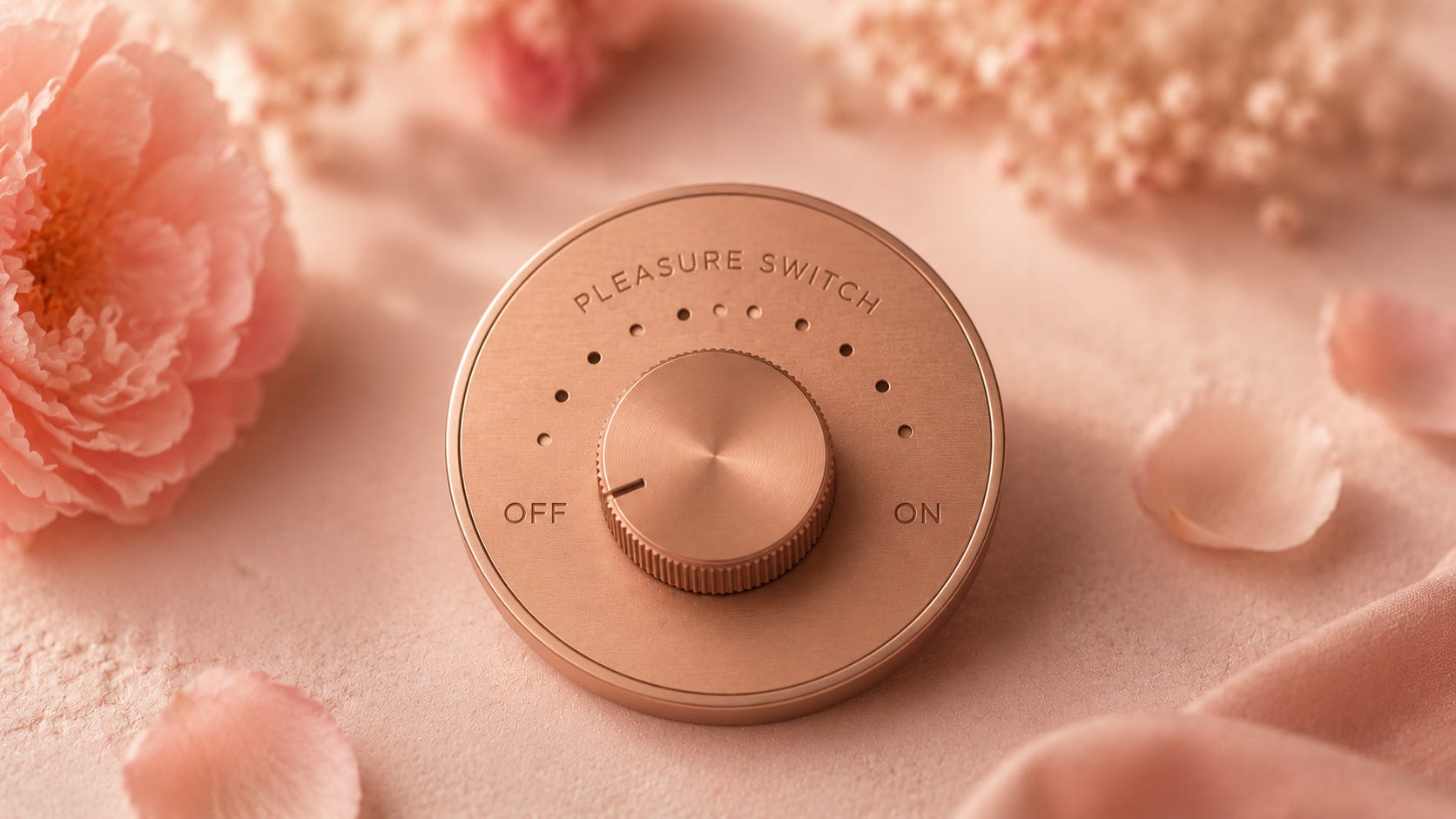
Everyone is telling us to reclaim our pleasure right now. Almost nobody is asking who convinced us to surrender it.So before we go any further, I want to ask you a question — and I would love you to answer it honestly. Not the answer you’d give over coffee with your girlfriends. The real one.When was the last time you felt pleasure?Real pleasure. Not relief. Not distraction. Not the exhale when everyone’s finally in bed and the house goes quiet and you finally have a moment to yourself. Pleasure. The kind you feel in your body. The kind that makes you close your eyes for a second just to savor it.If you have to stop and think about it... this episode is for you.I have been noticing pleasure is a topic that is suddenly everywhere, isn’t it? Pleasure audits. Pleasure resets. Soft life. Romanticize your morning. There are influencers building entire brands on telling us midlife women to reclaim our pleasure.And at the exact same time, there’s a backlash. People rolling their eyes and saying it’s all performative — that ‘joy is resistance’ has become a caption under a photo of someone’s martini but is that really joy. They are saying the soft life is just another thing women are performing instead of feeling.And here’s the thing. I think both camps are missing it.Because they’re both arguing about the behavior. What we do. What we buy. What we post. And nobody is talking about the switch. The one inside us. The one that got turned off so long ago that we can do every pleasure practice on the internet and still feel... nothing much.That’s what today is about. Not how to add pleasure to our lives. Why we turned it off. Because we didn’t lose our pleasure.Somewhere along the way, we decided it wasn’t safe. And no bubble bath overrides that decision.Nobody wakes up one morning and decides to stop feeling. And nobody flicks the switch off in one go. It’s more like a dimmer — turned down click by click, so slowly we never notice the room getting darker.Click: We’re seven, and we’re too loud, too much, told to settle down, be a good girl.Click: We’re fifteen, and we learn our bodies are something other people have opinions about — that they exist to be looked at, judged, managed.Click: We’re thirty-something, and our wants go last. After the kids. After the partner. After the work. We eat standing up. We can’t remember the last thing we did purely because it felt good.Click: We’re in midlife, and someone asks how we are and we say ‘I’m fine’ before they’ve even finished the question. And the wild thing is — we believe it. Because ‘fine’ is what it feels like when the dimmer’s been down for so long we’ve forgotten there was ever more light in the room.Nobody steals our pleasure. We surrender it — one ‘I’m fine’ at a time.For me, I can tell you the exact moment I became conscious of my own dimmer. It was almost ten years ago — nearly to the day, actually.I was standing in my kitchen late at night. The house was quiet. My two children were asleep. And I was alone at the kitchen bench when this one thought rose up out of nowhere: ‘All I want is some tenderness.’I longed for that moment where someone would kiss me so gently on the forehead and hold me lovingly and tenderly.I was completely shut down and unhappy in my marriage. And I was afraid to leave — especially because I had young children to care and support. I was in my early forties, standing there in the dark, and I remember thinking:‘Is this what the rest of my life is going to be like?’And I knew, in my bones, that I couldn’t bear it.I had been so focused on everyone else’s needs for so long — being the supportive wife, breastfeeding babies, raising these two young humans — that somewhere along the way, I’d stopped feeling the joy and pleasure of my own life. I was going through the motions. I was on auto-pilot and I didn’t even realize it. I still had those moments of joy that we all experience, like seeing my son gleefully stand up holding onto the coffee table for the first time.But when I look back at that woman standing at the kitchen bench, I can see now that my numbness wasn’t a malfunction. It wasn’t burnout, exactly, and it definitely wasn’t a hormone problem — though heaven knows we get told everything in midlife is hormones. It was something much older, and much smarter, than that.Here’s what I’ve come to understand — through my own healing, and through years of sitting with women in this exact territory. The pleasure switch doesn’t live in our calendars. It doesn’t live in our habits. It lives in our subconscious — in beliefs that got installed so early we’ve never heard them spoken out loud.Beliefs like:* My pleasure costs someone else something.* Rest has to be earned. I have to be productive first.* If I feel too much, I’ll be too much. (This is especially true for me as the crier in my family.)* Good women give — they don’t take.* Wanting things is dangerous and/or selfish.And I want to tell you about something that happened to me recently, because it showed me just how deep this conditioning still runs. I was at the funeral of a lovely young woman — a mother of very young children, taken far too early by cancer. And as person after person stood up to speak about her, the same two phrases kept coming back, over and over:She never said a bad word about anyone. She always put the needs of others first.That was the thing. Of everything this woman was — her whole life, her whole self — the quality people reached for, the thing they most treasured about her, was her selflessness.And I sat there with this quiet fury rising in me. Because even now — in the twenty-first century — the highest compliment we can apparently pay a woman is that she asked for nothing.And I want to be clear — this is not a criticism of her, or of the people who loved her. It’s the water we are all swimming in. But if selflessness is what we’re praised for in death... is it any wonder we practice it in life? Is it any wonder the beliefs go in so early, and so deep?This is the part where we start blaming ourselves, and that is the opposite of the point I am making.We didn’t choose those beliefs. A little girl chose them — the little girl each of us was. And she was brilliant to do it. Turning the feeling down was how she stayed safe, stayed loved, stayed acceptable in the family she was in, in the world she was in. Numbness wasn’t a flaw. It was a survival strategy. It worked.It’s just that it’s still running. Forty, fifty years later, that same program is running our Saturday afternoons. It’s the reason we can be standing in the most beautiful place, with people we love, and feel like we’re watching it all through glass.And I’ll say this: The world has never minded women being numb.A woman disconnected from her own pleasure is a woman who’ll keep giving without asking what she wants.Whole systems run on that.Audre Lorde (an American writer, professor, philosopher, intersectional feminist, poet, and civil rights activist) was writing about this nearly fifty years ago — that our aliveness, our capacity to feel deeply, is a source of power, which is exactly why we’re trained out of it.When we start feeling again, we start demanding that our lives actually feel like something. That’s inconvenient... for everyone except us. (And it might even be inconvenient for us too but well worth it.)So this is the reframe I want us to take from today.We don’t have a pleasure problem. We have a permission wound.And we cannot heal a permission wound with a product. We can’t matcha or cacao our way over the top of a belief that says feeling isn’t safe.Which brings me to what most of us are doing instead. Because when the real thing is switched off, we don’t just go without. We reach for counterfeits.There are two big ones. The first is performed pleasure. The rest that’s arranged for the photo for Instagram. The self-care Sunday that somehow feels like another job. We’re not resting — we’re proving that we rest. And our nervous systems know the difference, even when our Instagram doesn’t.The second is the dopamine snack. The scroll. The third coffee. The wine at five. The online cart. None of these are sins — hear me — but they’re not pleasure. They’re sedation dressed up as a treat. Pleasure asks us to be in our bodies. These are mostly ways of leaving them.Here’s the test, and it’s the only one we need.After — not during, after — do we feel more here, or less here? More or less present with ourselves and our bodies?Real pleasure leaves us more present, more in our skin, more ourselves. Counterfeit pleasure leaves us slightly foggier than it found us.And I’ll be honest — I’m still learning about pleasure. But it has become one of my highest values now, right up there with family, beauty and freedom.I want to enjoy my body. I want to enjoy my life.And I was absolutely one of those women who did things that looked pleasurable. I’d have massages and doing nice things for myself.I love a bubble bath — give me a bubble bath and a good Netflix show any day. And it’s supposed to be heaven, right? But did I actually allow myself the full experience of the pleasure? Often... no.My mind would get busy right in the middle of it — running lists, replaying conversations, thinking about stuff or even scrolling Facebook — and I’d come out the other side of this supposedly pleasurable thing having barely been there for any of it.These days, it’s different.When I get one of those beautiful calf and foot massages that come with a good pedicure — you know the ones — I don’t reach for my phone. I close my eyes. And I surrender to it. Fully. That’s the difference. Same pedicure. Completely different experience. Because I’m actually in it now.None of this makes us frauds. It makes us women with dimmed switches, doing our best to feel something through the glass. The counterfeit isn’t the disease. It’s the symptom.So how do we turn it back on? And I promise, this is not the part where I hand us all a seven-step morning routine. We have enough protocols. This is simpler, and deeper, and slower. Three movements.First: Decide. Name the decision. Somewhere in our history, a younger us decided feeling wasn’t safe. Find her. The question I give the women I work with is this: ‘When did I learn that my pleasure was a problem?’ Don’t force it. Ask it, and let the body answer over the next few days. The memory that surfaces will probably surprise us. It’s rarely the big dramatic thing. It’s usually something small, and searing.Second: Change it at the level it lives. Because insight alone doesn’t move the subconscious. We can understand our permission wound perfectly and still not feel the sun on our skin.The belief has to be rewritten where it’s stored — the old ‘my pleasure costs someone something’ replaced with what’s actually true for the women we are now: It is safe for me to feel good. My pleasure nourishes the people I love. There is nothing I have to finish first. This is deep work and it’s exactly where we’re going next.In part two, I’ll show you how these beliefs got written into us in the first place... and then I’ll walk us through something I’ve created for us: the Pleasure Switch Meditation.A guided practice for beginning to rewrite those beliefs — right at the level they live. We’ll do it together, inside the episode. And for those of us who’ll want to keep it — it’ll also be waiting as a standalone recording, free, for everyone subscribed on Substack. That’s the part nobody’s teaching. Don’t miss it.Third: Re-sensitise the body. Once permission exists, the body needs practice receiving and it needs it small. I’ll tell you what this looked like for me.During the Covid lockdowns, I started a little organic tea business called TeaBliss. And truthfully? It was never really about the tea. It was about creating a ritual of pleasure around the simplest act in my day. These days I have gorgeous cups and saucers and teapots, and my daily tea ritual is sacred. Sitting down. Tasting it. Doing nothing else. Ninety seconds of being completely in my body, once a day, every day.That’s the scale I want us to start at. Ninety seconds. One sense. The sun on our forearms. The actual taste of our tea. One honest question — ‘what do I want right now?’ — and the smallest true answer.And here’s why this matters for everything else we talk about on this show. Pleasure is not the reward we get after we become fully expressed. It’s the fuel. A woman who can feel is a woman who can want, and a woman who can want is a woman who can speak, write, create, ask, build.Every fully expressed life I’ve ever witnessed started with a woman coming back into her own body. This is the ground floor.Because think about what pleasure actually is, for a moment.Pleasure is the body saying yes.And every single thing we have ever created began as a yes. Desire is the seed of creation. The podcast we keep meaning to start. The book that taps us on the shoulder at two in the morning. The oracle deck, the garden, the business, the painting.Every one of them begins as a want — as pleasure, imagined. So a woman who has switched off her capacity to feel pleasure has switched off the very frequency her creativity broadcasts on. We can’t hear the book through the numbness. We can’t feel the pull of the work we came here to do.This is why I say we cannot live a fully expressed life without pleasure. Not shouldn’t. Can’t. Full expression is pleasure moving through us and out into the world. They are not two separate projects. They are the same river.And in daily life, this is rarely the grand thing. It’s wearing the good perfume on an ordinary Tuesday. It’s cooking dinner with music on instead of resentment on. It’s choosing the beautiful cup. Stepping outside to feel the cold morning air on our face before anyone else is awake. Writing one paragraph, purely because it wants to be written. Flowers on the desk we work at.And…Saying no to the thing that dims us, and yes to the thing that lights us up, in a hundred tiny domestic ways, every single day. Pleasure as a practice of attention. That is what living fully expressed looks like on an ordinary Wednesday.And yes — since we’re being honest here — let’s talk about sex. Because I know some of us hear the word ‘pleasure’ and assume it’s code for sex, and some of us hear it and quietly hope it isn’t. So here is my truth. I am perimenopausal... and I am having the best sex of my life. Right now. In this body. At this age.The woman standing at that kitchen bench ten years ago, aching for some tenderness, could not have imagined it. And I fully intend to keep having great sex and intimacy with my man. I am not handing that over to some tired story about ageing and perimenopausal. The more great sex you have, the more you want it (even if it’s solo time, go for it).And I’ll be real with you about the practical side, because we don’t talk about this enough. HRT and vaginal estrogen cream are part of what’s helping me — that’s my experience, not medical advice, and every body is different, so that’s a conversation for each of us to have with our own doctor.But here’s what I want us to hear: the belief piece came first. Before any cream, I had to decide that my desire wasn’t finished. The culture will happily tell us that desire ends at menopause. It’s a lie. For so many of us, this is where it finally begins — because for the first time in our lives, it’s actually ours. Not for anyone’s approval. Not on anyone’s schedule. Ours. And I say it a lot, we can be Juicy at Any Age! I consider myself a ripe juicy peach and my partner agrees.(Yes, this is intentionally evocative. We can’t be scared of women’s vaginas! You wouldn’t believe how many people freak out when they see an image like this.)Before we close, I want to say something directly to the woman who’s tried it all. The pleasure resets, the journals, the apps, the retreat — and felt almost nothing, and quietly concluded that she’s the problem. That she’s broken in some way the other women aren’t.You aren’t failing. You were right. Your instinct that none of it was touching the real thing? Correct. Because the real thing was never on the surface where those tools operate. It was a decision, made decades ago, by a little girl protecting herself the only way she knew how.And that other knowing you carry — the one that whispers there is more to life than this? You’re right about that too. The greyness is not the truth of who we are. It’s just the light turned down.We were never, ever meant to settle for a dimmed switch. We can stop trying harder now. Trying harder was never the medicine. Permission is.If a woman came to mind while you were listening to or reading this post... the one who says ‘I’m fine’ before you’ve finished asking... send her this episode. No explanation needed. She’ll know.And there’s one more thing I want to offer — something I’ve never really spoken about on this show before. I mentor a small number of women, one to one, in living a fully expressed life. It’s deeply personal work — your voice, your body, your beliefs, your soul work brought all the way out into the world — and it is the most powerful thing I do.If, somewhere in this episode, something in you leaned forward and whispered ‘that — I want that’... don’t overthink it, and don’t talk yourself out of it by Thursday. Reach out to me, and we’ll have a real conversation. Not a pitch. No pressure. Just two women talking honestly about what wants to come through you.Our pleasure was never lost. It’s been waiting, patiently, on the other side of a decision we’re finally old enough — and wise enough — to unmake.Here’s a song I wrote to go with this exploration of the Pleasure Switch and produced it with Suno AI. I hope you enjoy it. My invitation is to move your body while you listen to the song. Be present. Enjoy the sensation of moving your body to the beat.Here’s to living Fully Expressed in all our juiciness! To feeling alive, to feeling pleasure in our bodies and our souls.LoveAyesha xoxJoin a growing community of midlife women who are done playing small and ready to express their soul’s music - Fully Expressed with Ayesha on Substack:https://fullyexpressedwithayesha.substack.com/ Get full access to Fully Expressed with Ayesha Hilton at fullyexpressedwithayesha.substack.com/subscribe
Embed this episode
Ready to play
The Pleasure Off-Switch
No transcript for this episode yet
Similar Episodes
No similar episodes found.
Similar Podcasts
No similar podcasts found.