
PODCAST · business
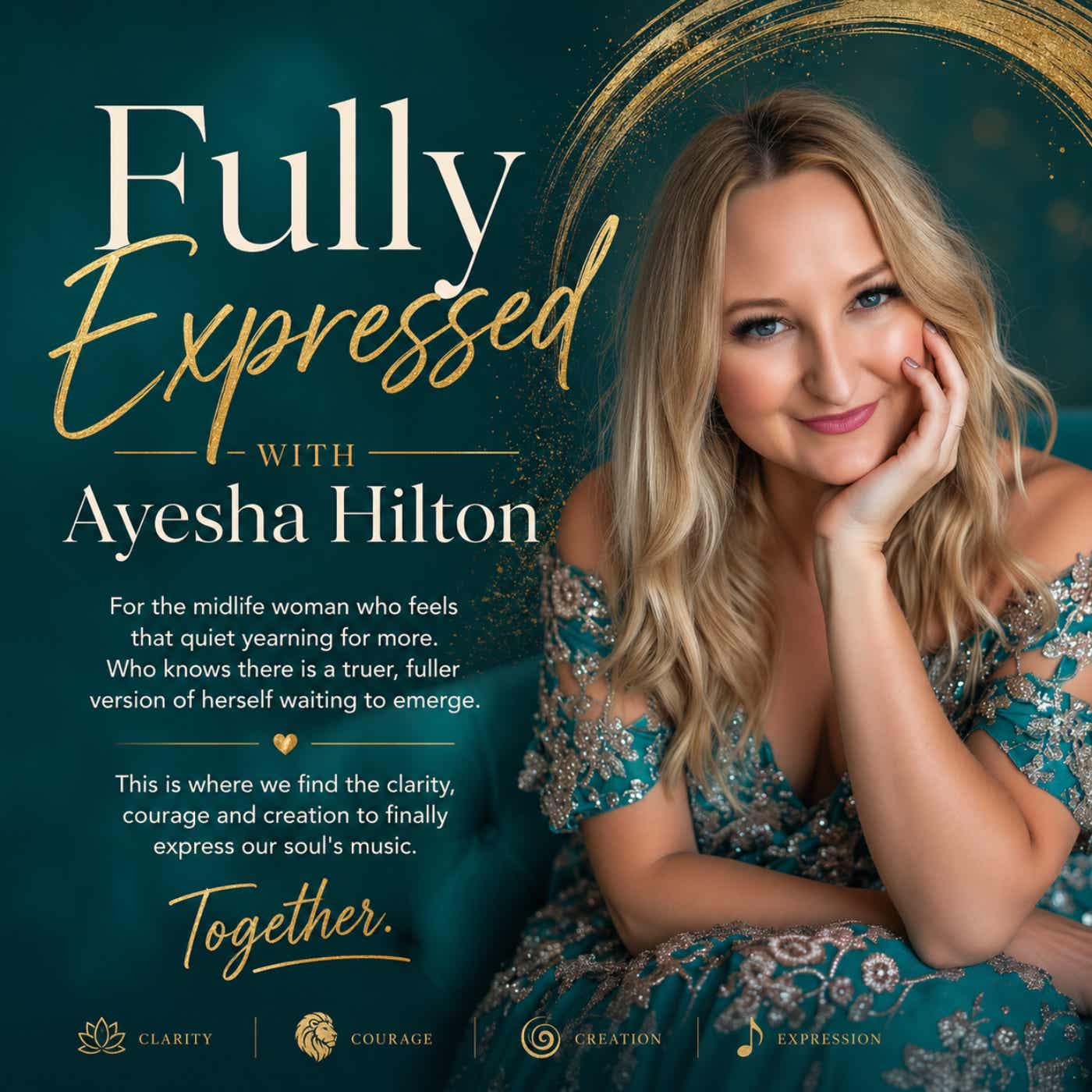
Fully Expressed with Ayesha Hilton Podcast
by Ayesha Hilton
For the midlife woman who feels that quiet yearning for more. Who knows there is a truer, fuller version of herself waiting to emerge. This is where we find the clarity, courage and creation to finally express our soul's music. Together. fullyexpressedwithayesha.substack.com
-
24
My Voice is Medicine
Your Voice Is Your MedicineKnowing your voice is not the same as using it.In this episode, I share what happened when I went to a retreat determined to give everything, and found myself terrified to speak, even in the safest room I've ever been in. I talk about the essence of our voice, why so many of us know exactly what we want to say and still can't get it out, and the deep, ancient roots of that fear, both in our own lives and in the long history of women being silenced.I share a tender moment of coming home to myself, the truth that unravelled in the circle, and how one of my most exposed moments became the thing that connected me to everyone in the room. And I talk about what I built out of it all: my own radio station, a home for my voice on my own terms.We finish with a meditation to help you claim your own voice, and one of my original songs, My Voice is Medicine.If you've ever felt yourself shrink, go quiet, or make yourself smaller to feel safe, this one is for you.In this episode:The terror of speaking, even when we're safeThe essence of your voice, and why we can't always see our own lightWhy knowing your voice isn't the same as using itThe ancient roots of the fear of being seenComing home to your right to be hereTurning our most exposed moments into connection and creationA meditation and a song to help you claim your voiceLinks:🎧 Listen at Fully Expressed Radio: https://fullyexpressedradio.com/📖 Subscribe to Fully Expressed on Substack: https://fullyexpressedwithayesha.substack.com/✨ Join Your Voice by Design (live workshop, 20/21 September) by upgrading to an annual paid subscription this month, with Marketing by Design gifted as a bonus. Already an annual subscriber? It's yours free. [ADD SUBSCRIPTION/UPGRADE LINK]💛 The fuller story of the online harassment I mention: "Online Stalking Nearly Silenced Me" → https://fullyexpressedwithayesha.substack.com/p/online-stalking-nearly-silenced-meCome and take up space with me:Your voice is your medicine. Knowing it is a beautiful start. Using it is where the healing is. Come and join a whole community of women choosing expression over silence.Here's to living Fully Expressed!Love, Ayesha xox Get full access to Fully Expressed with Ayesha Hilton at fullyexpressedwithayesha.substack.com/subscribe
-
23
Live with Ayesha Hilton & Kristy-Lea Tritz - The Grief of Losing Parents (already or in the future)
Get full access to Fully Expressed with Ayesha Hilton at fullyexpressedwithayesha.substack.com/subscribe
-
22
A Thousand Tabs Open at Once - The Mental & Emotional Load of Being a Midlife Woman
I am one of those people who cry in supermarkets if they are upset. I can’t hold it in. I often have my sunglasses on. Mascara running down my face (the amount I cry, I should really only wear waterproof mascara).In the supermarket, and other “inappropriate” places, I have overshared with people I barely know. Told them things that were on the surface that I couldn’t push down. And sometimes has a vulnerability hangover from sharing too much.In my family, I am known as the emotional one. For my entire life, my emotions have lived close to the skin, not buried deep or pushed down. I felt self-conscious about this growing up, and even now with my family, I joke that I am the emotional one so that I can say it before they say I am being too sensitive, or too emotional.I feel things. And I feel them deeply. And immediately. I don’t have the ability to hide or mask them, and I don’t know why that is.I would try to keep it all tucked away, and it would leak out anyway, in my face, in my voice, in tears escaping.I spent a lot of time doing this exhausting thing where I felt I had to hide a huge part of who I am despite me being so bad at hiding my feelings.Interestingly, this ties in with another part of me that I have tried to minimize over the years. And it’s strange because it sounds like a good problem to have. I learned early on to hide the things I am naturally good at and that come easily to me.In my final year of high school, I had glandular fever. I was unwell and could barely get out of bed, so I barely studied. Despite this, I still did really well. And I remember a friend being so annoyed with me, because she had worked so hard, and her results came in below mine.Instead of feeling proud of my results, I felt embarrassed. Like I had done something wrong by being good at it without the struggle. I love learning. I always have. I pick up new things quickly, technology especially. And somewhere along the way I got the message that this was a bit much too. That having gifts that come easily is something to play down, to apologize for, so that other people do not feel bad or inadequate.So I experienced this odd mixture of feeling too much and being too capable. When I look at these two things, side by side, I can see they were the same lesson, I experienced over and over again.Make yourself smaller so everyone else is comfortable.Do not feel so much.Do not shine so bright.Apologize for the space you take up.And I know I am not the only one, because this is everywhere right now. I see so many midlife women writing about it on Substack.The reflexive sorry. The saying sorry when someone else bumps into us. The softening of every opinion so it does not offend people or get you cancelled.The over-explaining and justification of why we are allowed to want the thing we want.A lot of women have picked unapologetic as their word for this year, as if we all reached the same point at the same time. The point where we are done shrinking, even if we are not quite sure how to stop.Which brings me to a tool I fell in love with about seven years ago from Brene Brown. She calls them permission slips. And the story of how she started is my favorite part. The morning she was going to meet Oprah for the first time, she was terrified, and so serious, and so in her head about it. And her daughter texted her to check she had signed a permission slip for a school trip.And Brené sat on the edge of the bed and thought, I need one of those. I need permission to stop being so serious and just enjoy this. So, she wrote herself a note on a Post-it.Permission to be excited and goofy and have fun.And that was the first of hundreds she went on to write.The idea is simple and it works. You write yourself a permission slip for how you want to show up.Permission to take up space.Permission to not be perfect.Permission to feel.Permission to want more.It is a permission slip from you for you. You are the one granting permission to yourself.And while I love permission slips, and did a course with Brené and Oprah online where we created our own, my new question is why do we even need one?Why does a grown woman need to write herself a note giving herself permission to have fun, or to rest, or to want something, or to be good at what she is good at?Somewhere along the way, the authority over our own selves got handed to somebody else or to the collective “them.”And we have been waiting ever since to be excused, like children putting our hand up, hoping to be allowed to use the bathroom. (My son’s school has banned toilet breaks during class time as kids were vaping in the loos, so we have discussed this a lot in our house.)I think for many women in midlife, we were raised to be good girls. To put others first. As I mentioned in a previous episode/post, I was at the funeral of a wonderful young mother and the eulogies that were delivered all said the same thing, she never said a bad word about anyone, she always put others first.We have been made to feel like that is what it means to be a “good woman.”We were raised to be nice. Do not make a fuss. Do not be too loud, too much, too big for your boots.As with many things I am sharing in Fully Expressed, it comes back to safety. And I have only come to realize just how much the need for safety effects us as women.From an early age, we may have learned that being fully ourselves was not safe. That we might be judged, or rejected, or left out, or brought down. So of course, our brain new what it was doing and it subconsciously programmed us to make ourselves smaller to stay safe.Then as adults, we encountered the same lessons in workplaces, in marriages, in friendships. And we did it without realizing it.If you listened to the witch wound episode, you may hear the echo here too. It comes back to the same thing: when it doesn’t feel safe to be seen, we learn to shrink.I couldn’t stop thinking about those permission slips. I wanted something I could hold, something beautiful, that would keep giving me permission for the things I found hardest.So, I made a deck of permissions slips and sold them online.Permission to have fun. Permission to be more joyful. Permission to do daggy dancing in my kitchen. Permission to shine brightly. Permission to stop hiding who I am.Since I made that deck, and started actually living by it, my life has changed for the better. The part I love is not just what it did for me. It is what it did once it left my hands and the life that deck had without me off doing it’s own thing.One of my coaching clients, who does Reiki healings, started offering a card from the deck to people as they left her sessions. They would take one on the way out, whatever they were meant to receive that day. And people loved it so much that she kept buying more packs.Then one day I got an email from a man in Newcastle, Australia. He had been in rehab hospital. And in one of his art therapy classes, they had used my deck. He was so touched by the card he received that when he got out, he went looking for it online, found my deck, and ordered his own set.To this day, I have no idea who that art therapist was. A person I have never met, in a hospital I have never been to, put one of my cards into the hands of a man I will never meet, at a moment when he really needed it. And it reached him. It touched him enough to go and buy his own copy.I did not know any of that was happening while it was happening. The deck took on a life of its own, and went and did its work places I will never know.And that is the thing about our gifts. When we stop hiding them, they go out and reach people we will never know about, in ways we would never have planned. But only if we let them out in the first place. The man in the hospital got that card because one day I gave myself permission to make the thing, and to put it into the world with my name on it.And when I think back to that girl who learned to play down what came easily to her, I wish I could tell her this:Your gifts aren’t something you need to apologize for. They aren’t taking anything away from anyone else. They’re yours to use.And sometimes, when you use them, they become something someone else needs.I could never have known, sitting there making that deck, where it would end up or who it might reach. I just had to make it and let it go out into the world.I think it is sad that we need permission slips at all. That we have to formally write ourselves a note to be allowed to be who we already are. There is something in that which makes my heart ache for all of us - for every woman has subconsciously had to make herself small to stay safe.And yet, for now, I think we do need them. Because the conditioning is real, and it is deep, and it doesn’t go away just because we noticed it.So we can write the slip and give ourselves the permission, over and over, until one day maybe we forget we ever needed it.The permission is a way we can practice remembering that we were always allowed – even though we didn’t realize it.We are allowed to be ourselves.And for me, that includes the part of me who cries in supermarkets. The woman whose feelings live close to the surface. Who makes friends with random people while buying milk and eggs.I still cry. I still sometimes tell people more than I intended to. I’m still sensitive. The difference is that I’m trying not to make that part of myself wrong anymore. And that has been very freeing.Just as I don’t want to hide the things I’m good at, I don’t want to hide the things I feel.They’re both me.Maybe I have been too much for some people. Too emotional. Too capable. Too sensitive. Too something.But maybe “too much” is sometimes just what we call ourselves when who we are makes someone else uncomfortable.We don’t have to keep making ourselves smaller because of that.We don’t have to live our lives with the focus on keeping everyone else comfortable.That the authority was ours the whole time. We just had to stop waiting for someone to hand it back to us, and claim it for ourselves.What would you give yourself permission to do, or feel, or want, or be?What is the permission slip you need to write?If this stirred something, come and join me over on Substack. It is called Fully Expressed, the same as the podcast, and it is where I keep writing through all of this, week by week, vulnerabilities and all.Join a growing community of midlife women who are done playing small and ready to express their soul’s music.https://fullyexpressedwithayesha.substack.com/subscribeAnd if you want to keep doing this work alongside other women, I’d love you to become a paid member of Fully Expressed. We gather each month for Futurecasting and our Q and A and Creators’ Circle. It is a space to explore what you want, bring more of yourself into the world, and do it in the company of women doing the same. If that calls to you, come and join us.And maybe you are too much for some people. So what. They are not your people.Unapologetically Me SongI wrote a song about this too, called Unapologetically Me. I generated the music with AI. You can hear it at the end of this episode.It feels like the right way to finish this episode, because really, that’s what all of this comes down to.Giving ourselves permission to stop apologizing for who we are.So I’m going to leave you with Unapologetically Me.Here’s to living Fully Expressed!Love,Ayesha xoxPS Find out how to work with me if you’ve got something you want to express in the world! Get full access to Fully Expressed with Ayesha Hilton at fullyexpressedwithayesha.substack.com/subscribe
-
21
Becoming Unapologetically Me
I am one of those people who cry in supermarkets if they are upset. I can’t hold it in. I often have my sunglasses on. Mascara running down my face (the amount I cry, I should really only wear waterproof mascara).In the supermarket, and other “inappropriate” places, I have overshared with people I barely know. Told them things that were on the surface that I couldn’t push down. And sometimes has a vulnerability hangover from sharing too much.In my family, I am known as the emotional one. For my entire life, my emotions have lived close to the skin, not buried deep or pushed down. I felt self-conscious about this growing up, and even now with my family, I joke that I am the emotional one so that I can say it before they say I am being too sensitive, or too emotional.I feel things. And I feel them deeply. And immediately. I don’t have the ability to hide or mask them, and I don’t know why that is.I would try to keep it all tucked away, and it would leak out anyway, in my face, in my voice, in tears escaping.I spent a lot of time doing this exhausting thing where I felt I had to hide a huge part of who I am despite me being so bad at hiding my feelings.Interestingly, this ties in with another part of me that I have tried to minimize over the years. And it’s strange because it sounds like a good problem to have. I learned early on to hide the things I am naturally good at and that come easily to me.In my final year of high school, I had glandular fever. I was unwell and could barely get out of bed, so I barely studied. Despite this, I still did really well. And I remember a friend being so annoyed with me, because she had worked so hard, and her results came in below mine.Instead of feeling proud of my results, I felt embarrassed. Like I had done something wrong by being good at it without the struggle. I love learning. I always have. I pick up new things quickly, technology especially. And somewhere along the way I got the message that this was a bit much too. That having gifts that come easily is something to play down, to apologize for, so that other people do not feel bad or inadequate.So I experienced this odd mixture of feeling too much and being too capable. When I look at these two things, side by side, I can see they were the same lesson, I experienced over and over again.Make yourself smaller so everyone else is comfortable.Do not feel so much.Do not shine so bright.Apologize for the space you take up.And I know I am not the only one, because this is everywhere right now. I see so many midlife women writing about it on Substack.The reflexive sorry. The saying sorry when someone else bumps into us. The softening of every opinion so it does not offend people or get you cancelled.The over-explaining and justification of why we are allowed to want the thing we want.A lot of women have picked unapologetic as their word for this year, as if we all reached the same point at the same time. The point where we are done shrinking, even if we are not quite sure how to stop.Which brings me to a tool I fell in love with about seven years ago from Brene Brown. She calls them permission slips. And the story of how she started is my favorite part. The morning she was going to meet Oprah for the first time, she was terrified, and so serious, and so in her head about it. And her daughter texted her to check she had signed a permission slip for a school trip.And Brené sat on the edge of the bed and thought, I need one of those. I need permission to stop being so serious and just enjoy this. So, she wrote herself a note on a Post-it.Permission to be excited and goofy and have fun.And that was the first of hundreds she went on to write.The idea is simple and it works. You write yourself a permission slip for how you want to show up.Permission to take up space.Permission to not be perfect.Permission to feel.Permission to want more.It is a permission slip from you for you. You are the one granting permission to yourself.And while I love permission slips, and did a course with Brené and Oprah online where we created our own, my new question is why do we even need one?Why does a grown woman need to write herself a note giving herself permission to have fun, or to rest, or to want something, or to be good at what she is good at?Somewhere along the way, the authority over our own selves got handed to somebody else or to the collective “them.”And we have been waiting ever since to be excused, like children putting our hand up, hoping to be allowed to use the bathroom. (My son’s school has banned toilet breaks during class time as kids were vaping in the loos, so we have discussed this a lot in our house.)I think for many women in midlife, we were raised to be good girls. To put others first. As I mentioned in a previous episode/post, I was at the funeral of a wonderful young mother and the eulogies that were delivered all said the same thing, she never said a bad word about anyone, she always put others first.We have been made to feel like that is what it means to be a “good woman.”We were raised to be nice. Do not make a fuss. Do not be too loud, too much, too big for your boots.As with many things I am sharing in Fully Expressed, it comes back to safety. And I have only come to realize just how much the need for safety effects us as women.From an early age, we may have learned that being fully ourselves was not safe. That we might be judged, or rejected, or left out, or brought down. So of course, our brain new what it was doing and it subconsciously programmed us to make ourselves smaller to stay safe.Then as adults, we encountered the same lessons in workplaces, in marriages, in friendships. And we did it without realizing it.If you listened to the witch wound episode, you may hear the echo here too. It comes back to the same thing: when it doesn’t feel safe to be seen, we learn to shrink.I couldn’t stop thinking about those permission slips. I wanted something I could hold, something beautiful, that would keep giving me permission for the things I found hardest.So, I made a deck of permissions slips and sold them online.Permission to have fun. Permission to be more joyful. Permission to do daggy dancing in my kitchen. Permission to shine brightly. Permission to stop hiding who I am.Since I made that deck, and started actually living by it, my life has changed for the better. The part I love is not just what it did for me. It is what it did once it left my hands and the life that deck had without me off doing it’s own thing.One of my coaching clients, who does Reiki healings, started offering a card from the deck to people as they left her sessions. They would take one on the way out, whatever they were meant to receive that day. And people loved it so much that she kept buying more packs.Then one day I got an email from a man in Newcastle, Australia. He had been in rehab hospital. And in one of his art therapy classes, they had used my deck. He was so touched by the card he received that when he got out, he went looking for it online, found my deck, and ordered his own set.To this day, I have no idea who that art therapist was. A person I have never met, in a hospital I have never been to, put one of my cards into the hands of a man I will never meet, at a moment when he really needed it. And it reached him. It touched him enough to go and buy his own copy.I did not know any of that was happening while it was happening. The deck took on a life of its own, and went and did its work places I will never know.And that is the thing about our gifts. When we stop hiding them, they go out and reach people we will never know about, in ways we would never have planned. But only if we let them out in the first place. The man in the hospital got that card because one day I gave myself permission to make the thing, and to put it into the world with my name on it.And when I think back to that girl who learned to play down what came easily to her, I wish I could tell her this:Your gifts aren’t something you need to apologize for. They aren’t taking anything away from anyone else. They’re yours to use.And sometimes, when you use them, they become something someone else needs.I could never have known, sitting there making that deck, where it would end up or who it might reach. I just had to make it and let it go out into the world.I think it is sad that we need permission slips at all. That we have to formally write ourselves a note to be allowed to be who we already are. There is something in that which makes my heart ache for all of us - for every woman has subconsciously had to make herself small to stay safe.And yet, for now, I think we do need them. Because the conditioning is real, and it is deep, and it doesn’t go away just because we noticed it.So we can write the slip and give ourselves the permission, over and over, until one day maybe we forget we ever needed it.The permission is a way we can practice remembering that we were always allowed – even though we didn’t realize it.We are allowed to be ourselves.And for me, that includes the part of me who cries in supermarkets. The woman whose feelings live close to the surface. Who makes friends with random people while buying milk and eggs.I still cry. I still sometimes tell people more than I intended to. I’m still sensitive. The difference is that I’m trying not to make that part of myself wrong anymore. And that has been very freeing.Just as I don’t want to hide the things I’m good at, I don’t want to hide the things I feel.They’re both me.Maybe I have been too much for some people. Too emotional. Too capable. Too sensitive. Too something.But maybe “too much” is sometimes just what we call ourselves when who we are makes someone else uncomfortable.We don’t have to keep making ourselves smaller because of that.We don’t have to live our lives with the focus on keeping everyone else comfortable.That the authority was ours the whole time. We just had to stop waiting for someone to hand it back to us, and claim it for ourselves.What would you give yourself permission to do, or feel, or want, or be?What is the permission slip you need to write?If this stirred something, come and join me over on Substack. It is called Fully Expressed, the same as the podcast, and it is where I keep writing through all of this, week by week, vulnerabilities and all.Join a growing community of midlife women who are done playing small and ready to express their soul’s music.https://fullyexpressedwithayesha.substack.com/subscribeAnd if you want to keep doing this work alongside other women, I’d love you to become a paid member of Fully Expressed. We gather each month for Futurecasting and our Q and A and Creators’ Circle. It is a space to explore what you want, bring more of yourself into the world, and do it in the company of women doing the same. If that calls to you, come and join us.And maybe you are too much for some people. So what. They are not your people.Unapologetically Me SongI wrote a song about this too, called Unapologetically Me. I generated the music with AI. You can hear it at the end of this episode.It feels like the right way to finish this episode, because really, that’s what all of this comes down to.Giving ourselves permission to stop apologizing for who we are.So I’m going to leave you with Unapologetically Me.Here’s to living Fully Expressed!Love,Ayesha xoxPS Find out how to work with me if you’ve got something you want to express in the world! Get full access to Fully Expressed with Ayesha Hilton at fullyexpressedwithayesha.substack.com/subscribe
-
20
The Witch Wound: Why It Hasn't Felt Safe to Be Seen
[You can listen to this as a podcast or read below. In the podcast, I share more than in the writing below, so I encourage you to listen. Scroll down for music and a poem relating to this topic of the Witch Wound. There’s also some images I generated with Midjourney.]I once set up a room in my house especially for seeing clients. I got the business cards printed. I built a website. I’d done all the training. And then I saw one person. One. And I could never bring myself to see anyone again. I had this innate and unexplainable fear of working as a healer or being an intuitive.It wasn’t because I didn’t believe in the work. I’d been drawn to healing since I was very young. I was reading Louise Hay in my early teens – Heal Your Body (and I still have the little blue companion book that lists all the ailments and their probable causes).From my late teens and early twenties and on from there, I trained in modality after modality. Pranic healing. Reiki. I trained as a death doula, and a birth doula.When I trained in EFT, I travelled down to Melbourne, did all of it, came home, and I used it every single day on myself. I believed in it completely. I just couldn’t bring myself to share it with anyone else.And it happened again and again. I’d train in something, pour my time and energy into learning, I’d get right to the edge of stepping into it and working with people, and then something would pull me back.You wouldn’t believe how many domain names I have purchased over the years for various healing businesses I wanted to start.For a long time, I thought there was something wrong with me. I couldn’t understand how my love of healing could not be translated into working with people. It was really confusing.I have since come to realize that perhaps I am carrying what’s known as a Witch Wound. I know this sounds very out there and very woo. And if you don’t believe in past lives like I do, then bear with me as I explore this with you.In this lifetime, I don’t identify as a “witch” but the things I am interested in are witch-life – the moon cycle, manifesting, healing, natural remedies, intuition. And I feel like women across the ages have been punished for their gifts in these areas.I don’t think you have to identify or call yourself a witch to be impacted by the Witch Wound.Join a growing community of midlife women who are done playing small and ready to express their soul’s music.From my understanding, the witch wound is the inherited, bone-deep fear of being persecuted for our gifts. For our power, being too much, too outspoken, standing up for what is right.For centuries, women who were those things were punished for it. The women burned and drowned and hanged as witches were so often just women who stood out. Healers. Midwives. Women who knew things. Women who wouldn’t comply.And the theory, which I feel in my body as true, is that the fear of being seen and punished for our power got passed down through the generations. And it still runs in us. It can make us hide our gifts out of fear.I can see the Witch Wound like a thread running through my own life in a few different ways, and you might recognize some of them in yours.I knew that I had a fear of persecution because as a young child, I was terrified that I would go to jail for a crime I didn’t commit. This was such real fear for me. As a little girl, I was often falsely accused of things I hadn’t done, including by my brothers, so I learned early that I could be innocent and still be punished.Being blamed for something I didn’t do was a real and present danger. It taught my young nervous system that being singled out is unsafe. That visibility itself can get you punished, whether you did anything wrong or not.All those times I trained as a healer and I was about to work with people, I felt like I was like I was standing in concrete and couldn’t step forward.For years, I was perplexed by the polarity of loving training in healing modalities and so scared to use those modalities. There was a part of me that I couldn’t control that believed that being a visible, powerful healer was dangerous.And historically, it was. Healers were exactly the women who got persecuted. So, every time I got close to fully claiming that role, some ancient part of me hit the brakes to keep me safe. My subconscious was trying to keep me safe and protect me from danger, even when my mind couldn’t fully understand it.So many of us built our businesses following the bro marketing playbook. The aggressive tactics. The fake scarcity. The manipulation. The push, push, push. And a lot of us did it for years even though it made our skin crawl, because we were told that was how you succeed, and we didn’t feel safe doing it our own way.We may have betrayed our own knowing because we watched how others became successful. And if you’re like me, you now want to build our business your own way. Marketing from trust instead of pressure. Aiming for win-win instead of just win. And building a relationship with our clients who you genuinely care about. I love the women I work with and that’s important to me.So, if you’ve ever done what I did, trained for the thing and never launched it, written the book and never published it, had the gift and kept it hidden, started and stopped and started and stopped, you are not alone.You were not a failure. You were unconsciously protecting yourself from danger. There is nothing wrong with you. There is something very old moving through you, and it was trying to help keep you safe.Thankfully, this wound can be worked with. It can be cleared. For me it is happening in layers, as most of us know when we peel the healing onion – one layer at a time, with a few tears.As you may know, I love to create music. My very first album was around Witch Wound and I called it The Sacred Ones. It explores how women have been told to hide their gifts, how we have been controlled and persecuted for being healers and intuitive.Interestingly, when I went to publish this album, it kept getting rejected for no reason and that’s why it wasn’t the first album I released, and it’s only on a couple of platforms due to being rejected. I haven’t had that issue with any of my albums.I listened The Sacred Ones album over and over again when I first created it. It fed my soul. I felt like I could reclaim my power.I then worked with a healer called Linda Nevin who worked with me specifically on the Witch Wounds.I don’t think I would be doing this podcast if I had not worked on my Witch Wounds with Linda or created the Sacred Ones album. My fear around being a healer was so fierce, that even now, I have moments of it lingering in the background trying to hold me back from speaking my truth.Part of the process for me was naming and claiming how women have been treated, the persecution, the fear, the silencing, of having to do deep healing work in secret. And then claiming how genuinely precious these healing gifts are. Knowing how much the world needs them. And acknowledging how much this fear of persecution has cost us.In a previous episode I talked about how I was at an event where we had to write down our biggest fear. Shockingly, nearly everyone wrote the same thing. The whole room of three hundred amazing women were afraid of being seen. That’s how afraid we are, and I do believe it could come from the persecution of women over the generations.As for me, I am not sure I am fully healed of this or if I am picking up on the collective fear, but through working with Linda and creating and listening to my album, The Sacred Ones, I feel bolder and less afraid. I still feel the fear sometimes like a soft whisper, but I am not letting that fear hold me back.This podcast, Fully Expressed, this is me walking straight into the wound. Putting myself out here, very vulnerably at times, where I could be judged.I’m doing it while I’m still afraid. I’ve just decided that hiding my gifts costs me more than the risk of sharing them.That’s what I think courage really is – doing what we are called to do despite the fear. The wound is still here in the psyche of the collective and a small shadow of it within me, but I am sharing myself in spite of it.And interestingly, we’re living through a time where so many of the old structures are falling down. The hard, rigid, purely masculine ways of doing things are cracking, and you can feel it everywhere.In Human Design they talk about us leaving the era of planning, the last four hundred years of building big collective structures, and moving into a new era, the era of the individual, where we come back to our own intuition and our own authority.It’s why we’re watching so many gurus fall off their pedestals. We’re done outsourcing our knowing. What the world needs now is more of the feminine way of being and doing. More healing. More people listening to their intuition. And caring for others.Interestingly, my life’s work in Human Design is the Right Angle Cross of Planning – what this means is that I have the gifts of the old era and as we move into the new era, we don’t want to destroy all the good things that we need like democracy (though we need a better more honest version), sanitation and sewage (we definitely don’t want this to go away), and the best of modern medicine.In the new era though, it’s about following your own intuition and doing things your way. Which I love. And I think we can all benefit from honoring our intuition more.When we hide our gifts, we are depriving the world of our light and our ability to have an impact on the lives of others and the planet as a whole. The world needs these gifts, and it needs them now, at the very moment we’ve been most afraid to offer them.So, you can’t wait until you feel 100% safe, confident or healed to share your gifts. I think the courage comes first, and the safety is built by doing the thing, one brave, terrified step at a time.Not long ago I worked with a woman who came to me carrying so much grief about this. She had real gifts, and she was so afraid to be visible, so afraid to let herself love and value what she carried. And underneath it was this deep sadness, a grief for all the years she’d spent hiding.We did the work together to clear that fear, to let her claim her gifts without the old terror attached. And watching her come back into herself, watching her stop apologizing for her own light, is why I do what I do.If you recognize yourself in any of this, if you’ve got gifts you keep hiding and you’re ready to stop, I work with women one to one using PSYCH-K to clear exactly these visibility wounds, the beliefs that tell us it isn’t safe to be seen. It’s gentle, and it goes right to the root, to the place where the old fear lives. If this resonates with you, I invite you to reach out and we can have a conversation about how we can work with you.Please know that you have gifts that the world needs right now. The fear that it wasn’t safe to share them is a wound so many of us carry.What if it was safe to fully express your gifts, your knowing, your expertise, and your wisdom?If this spoke to you, here’s how we go deeper together. Subscribe to Fully Expressed, it’s free, to get every new article and episode straight to your inbox. This is where I keep writing through all of it, week by week.And if you’re ready to stop hiding your own gifts, come and join as a paid Collective member. You get a monthly Futurecasting session, where we drop in together and write ourselves into the future we actually want. And you get to join me for the Creators’ Cuppa, where you get to pick my brain on your work, your visibility, and whatever you’re building or bringing into the world.I want to leave you with the words of Marianne Williamson“Our deepest fear is not that we are inadequate. Our deepest fear is that we are powerful beyond measure. It is our light not our darkness that most frightens us. We ask ourselves, who am I to be brilliant, gorgeous, talented and fabulous? Actually, who are you not to be?You are a child of God.Your playing small does not serve the world.There’s nothing enlightened about shrinking so that otherpeople won’t feel insecure around you.We were born to make manifest the glory ofGod that is within us.It’s not just in some of us; it’s in everyone.And as we let our own light shine,we unconsciously give other peoplepermission to do the same.As we are liberated from our own fear,Our presence automatically liberates others.”Marianne Williamson wrote that in 1992, and women have been passing it to each other ever since, because it talks to something we feel to be true.Our deepest fear was never really that we are inadequate or not enough. It’s that we are powerful. And for so many of us, across so many lifetimes, being powerful is the exact thing that got us punished. So of course we played it small. Playing small kept us alive.As you can see, the world is a mess right now.So now, we have the opportunity to stop shrinking to stay safe, and start shining because the world needs our light.Who are you not to be your gifts, your knowing, your medicine?The world doesn’t need one more woman playing small.It needs you and me to be fully expressed.PoemHere’s a poem relevant to what we’ve talked about today. I felt teary when I read this as it resonated so deeply with me.The Women Who Learned to HideWe learned to make ourselves smaller.To swallow the knowing before it reached our lips.To feel the answer rise within us and call it imagination.To place our hands upon the hurting and pretend we did not know what they could do.We learned to dim the light before anyone else could see it.Because once, being seen was dangerous.Once, a woman who knew too much, felt too much, healed too well, spoke too loudly, stood too firmly in herself could pay dearly for it.So we learned.We learned to hide the herbs, hide the wisdom, hide the knowing.We learned to whisper what we once might have spoken.And somewhere along the way, hiding became so familiar we forgot we were doing it.We called it doubt.We called it procrastination.We called ourselves inconsistent, afraid, not ready.But perhaps beneath all of that was something much older.A memory that said:Do not let them see you.Do not show them what you know.Do not become too powerful.It isn’t safe.And still...the gifts remained.Quietly waiting.The knowing never left.The hands still remembered.The voice was still there beneath the silence.And now I wonder how much the world has lost while we were hiding.How many healers never healed.How many writers never wrote.How many women stood at the edge of their own becoming and stepped backwards.How much wisdom went with them to the grave.I don’t want to do that anymore.I don’t want fear to decide what I give to this world.I don’t need to be fearless.I don’t need every wound healed.I only need to stop abandoning what I know is mine to give.So if my voice shakes, let it shake.If being seen frightens me, let me be seen afraid.If some ancient part of me whispers,Hide...I will hear her.I will understand why.And then I will step forward anyway.Because there are gifts inside us that were never meant to disappear with us.There is wisdom the world has waited long enough to hear.And perhaps this is how the wound begins to heal.Not by forgetting the women who had to hide.But by becoming the women who no longer do.The Sacred Ones AlbumInterestingly, this album was really hard to publish compared with my other albums. It kept getting rejected (Witch Wound in action maybe?).You can listen here on Spotify:https://open.spotify.com/album/59Uc4FypRs5CI5ai9Jbi9z?si=IzDUqwC4Tf6izWuEnPtZ5AHere’s have the courage to live Fully Expressed!Love,Ayesha xoxJoin the Fully Expressed Collective on Substack:https://fullyexpressedwithayesha.substack.com/subscribe Get full access to Fully Expressed with Ayesha Hilton at fullyexpressedwithayesha.substack.com/subscribe
-
19
Turning Lead Into Gold
▶️Prefer to listen? Click play above. I share a little more in the podcast and it feels a bit more personal, but if you prefer to read, it’s still juicy and you can follow along with the meditation and Futurecasting process. There is also a song! You can access these below as well.In April this year, I broke my own heart. I was in a relationship with someone I really loved, and who really loved me. But there were some serious issues on his side that weren’t going to change, things that were harming me and that I couldn’t fix no matter how much I loved him.So, I made the hard choice and I ended it. I broke my own heart, on purpose, because staying would have cost me more than leaving. And I was heartbroken. More than I imagined I would be. It wasn’t the kind of thing you get over in a week or two.And in the middle of all that, still raw, still nowhere near ready, not looking for anyone, I sat down and I wrote from the future.I imagined it was New Year’s Eve, the very end of 2026, and I wrote in the present tense, as if the whole year had already happened. And in it, I’d met someone. Someone amazing. I described the relationship, how it felt, the ease of it, as though it was already real and already mine. I did it almost as an act of faith, because I know this practice works, even when I’m not feeling hopeful. And I was not feeling hopeful. I’d been on so many first and second dates, and couldn’t face doing online dating again when I was recovered from my broken heart.And then this is what happened...I was scrolling Facebook while away for the weekend with my bestie, and I was in one of those singles groups, the kind that had never once popped up in my feed the whole time I’d been in my previous relationship.And suddenly, there it was. A photo of this really lovely guy, mountains behind him, out at Wilson’s Promontory in Victoria, Australia.I zoomed in, and he had the kindest eyes. So, I commented on his post, which is something I would never normally have done. We messaged back and forth a few times, then had a phone call where we chatted easily. Then we went on a first date.There was this really strong connection, straight away. Our date went for a few hours as we sat in a café having multiple cups of tea for me and coffee for him, followed by a walk around the local lake next to the café.It’s early days, we’ve been getting to know each and it’s been nearly three months now. But there he was. Weeks after I wrote him into being, while I was still heartbroken and absolutely not looking.So how does that happen? How do you write something from the future while you’re heartbroken and not even trying, and then watch it show up early?Is it magic?Is it woo?Is it just a nice coincidence I’m reading too much into?What I want to talk about today is that it’s a bit of everything.There is real science underneath this. There’s also, I believe, genuine mystery. And there’s a structure, an actual method, that makes it work far more reliably than crossing your fingers and hoping. It’s part brain chemistry, part paying attention, and part something I can only call alchemy and working from the superconscious.I first explored the word, alchemy, properly, when I read Paulo Coelho’s The Alchemist. It came out in English in 1993, and I read it as a young woman at university. And I loved it. It lit something up in me, this idea that when you truly want something, the whole world conspires to help you get it.Alas, loving this idea didn’t change my life because I had no idea what to actually do with it. I had the inspiration and none of the instructions. I had the wanting, but no structure for the wanting. And so, it just stayed a beautiful book on my shelf for a very long time.It took me until 2020 to find the structure despite watching The Secret and reading lots of books on manifesting. That’s when I started to properly studying alchemy and the creative process, through the work of William Whitecloud and his Natural Success teachings. And that changed everything, because it turned a lovely idea into an actual practice but even then, I needed something even more powerful, which I have termed Futurecasting.I’ve created so much from it, in my work, my creativity, my life. The heartbreak story I just told you is just the most recent one.And one of the things I learned that has stayed with me most is this: success isn’t personal. It’s not about being special, or chosen, or luckier than the next woman. Success follows structure. It follows principles. Which means it’s available to anyone willing to work with those principles. That took so much pressure off me, and it’s the opposite of what a lot of the manifesting world tells you.So, let’s start with the brain, because this is where it stops being woo and starts being fascinating. There’s a growing body of neuroscience showing that your brain cannot fully tell the difference between something vividly imagined and something real.When you picture an experience in enough detail, your brain lights up many of the same pathways it would use if you were actually living it. Imagine biting into a chocolate cake and your mouth waters. Imagine something frightening and your heart rate climbs, your body floods with adrenaline. Your body responds to the image, not just the event.Researchers describe it as a difference of degree, not kind. Your brain runs a kind of reality threshold, and when an imagined signal is vivid enough and emotional enough, it can cross that threshold and get treated as real.And here’s the part that matters most for us, and it’s why I keep talking about pleasure and the body on this podcast.Emotion is the amplifier.A dry, detached visualization does very little. But when you feel it, when you get in your body, put music on, let yourself actually experience the joy of the thing as if it’s happening, that’s when the brain really takes the imprint. Mental rehearsal done with feeling creates real changes. Athletes have used this for decades.So, when I wrote from that future New Year’s Eve, I wasn’t just listing what I wanted. I was feeling it as if it was already true and something I had already experienced. I let myself feel what it would be like to be loved well again. And my brain took that seriously.It was a remembering rather than an imagining.Then there’s the second piece, and this one is beautifully practical. Confirmation bias. We usually hear about confirmation bias as a bad thing, the way we only notice evidence that agrees with what we already believe. But it works powerfully in our favor too.Once you hold a clear, vivid vision of what you want, your brain quietly starts filtering the whole world for anything that matches it. It’s like when you’re thinking about buying a certain car and suddenly see that car everywhere. It was always there. You just weren’t tuned to see it.So, when you hold a vision of love, or a full bookshelf with your name on the spine, or a business that thrives, your attention re-tunes. You start noticing the opportunities, the openings, the people, that were probably there all along but that you were too closed or too busy or too heartbroken to see.Look for the good and you are genuinely more likely to see it. I don’t think the universe delivered a man to my door. I think I became someone who could notice him when he appeared, and open enough to say yes.But here’s where it becomes more than positive thinking, and where the alchemy really lives. Because just imagining nice things is not enough. And this is my problem with a lot of what’s out there right now, the be delusional, lucky girl version of manifesting, where you’re told to just believe hard enough and act as if.That version skips the most important step, and it can be a bit cruel, because when it doesn’t work, you’re left thinking you didn’t believe hard enough. As if it’s your fault.Real alchemy, the old alchemists were trying to turn lead into gold, has three parts, not one. First, yes, you need a strong, vivid vision of the gold, the thing you want – the desired end result.But second, and this is the step everyone skips, you have to look clearly and at your current reality. The lead. Where you actually are right now, no sugar-coating.And third, you build the bridge between the two. You find the path from here to there, and you take real steps along it. Action is required, not just wishful thinking.Vision, current reality, and the bridge between them. That’s the alchemy. And notice that it asks you to hold two things at once, the dream and the real truth of where you are, without collapsing into either one. Which, if you’ve been listening to this podcast for a while, is a thread that runs through everything I talk about. Holding two true things at the same time.Carl Jung took alchemy seriously, by the way, which I love, because it means this isn’t just fluffy. He read the old alchemical texts as a symbolic map of inner transformation.The turning of lead into gold was really about turning the raw, unformed self into a whole, realized one. He called it individuation. So, when I talk about alchemy, I’m not talking about magic tricks. I’m talking about a genuine process of transformation, one that serious minds have studied for a very long time.Now, where do I stand on all of this?I believe in both the science and I believe in the mystery.I don’t think you have to choose. I think there’s real brain chemistry here, real attention, real structure. And I also think there’s something we can’t fully explain, something a bit magic, in how fast that man arrived, in the timing of things, in the way life seems to move when you get clear.Science and mystery, living in the same two hands.And the other thing I want to say, is that I don’t do this from a place of force. I’m not white-knuckling my vision into being through sheer hustle. I do it from rest. From pleasure. From getting in my body and feeling good and writing from a place of joy rather than desperation.I genuinely think we manifest more from softness than from strain. The tight, grasping energy of I have to make this happen tends to push things away. The open, pleasured, already-have-it energy tends to draw them in. And because we remembering a version of the past from the future, we aren’t grasping or coming from a place of lack.But before you can write yourself into any future, there’s a harder question underneath all of this…What do you actually want?Not what you think you should want. Not what your family expects, or what looks impressive, or what everyone around you seems to be chasing.What do YOU truly desire?Because most of us have never really asked. We’ve filtered our wanting through so many layers of should that we’ve lost the thread of what we truly desire.I know this one intimately, because I got it wrong for years. When I was young, I badly wanted a career in a big, important business. I wanted to feel significant. And I got it, I ended up at an international consulting firm. And it was hollow. I didn’t fit the mold at all.I had way too many emotions for that environment, I’m a people person, and I was working in this very buttoned-up, almost robotic world. What I actually wanted, underneath the shiny version I’d been chasing, was freedom. The freedom to be creative and to express myself in a hundred different ways. But I couldn’t see that yet.Here’s an even clearer one. When I went to university, I somehow enrolled at ANU in Canberra in a Bachelor of Economics. I have never had the slightest interest in economics. To this day I’m not entirely sure how it happened. I think my brother’s friend was doing it, and I was staying with my brother, and I wanted to be near him.So, there I was, studying something I didn’t care about at all. And I hated it. So did most of my fellow students and that course had a famously high fail rate. So, I decided to change. And because I had stepchildren at the time and thought, oh, children are lovely, I decided to become a primary school teacher. And then, on my practical placement, a six-year-old spat on me. And I thought, “You could not pay me enough to be spat on.”I’d always, always been interested in communications. But it never once occurred to me to do it as a career. And yet somehow, I ended up graduating with a Bachelor of Communications in professional writing, well, half of it, because the other half was still stuck in primary school education from my detour.And when I look back now, it is so blindingly obvious. Communications was always it. Writing was always it. It had been there the whole time, and I just could not see it, because I kept reaching for what I thought I was supposed to want.That’s how sneaky this is. Your true desire can be sitting right in front of you, obvious to everyone but you, while you chase the versions of success you’ve been handed.Here’s what I’ve learned:A true desire doesn’t need defending. You don’t have to justify it, or rationalize it, or explain to anyone why you want it. Sometimes you won’t even know why you want it, and that’s fine, because it’s often serving a bigger purpose you can’t see yet.You just have to be brave enough to own it. To say, this is what I want, full stop, no apology. Getting that clear is the hardest part of this whole thing, and it’s why I’m going to guide you through a short practice for it in a moment.Now, before I share the practice I am using, I want to say something about the physical act of writing. You could do a version of this in your head. You could lie in bed each morning and imagine your future, and that would genuinely help. Day dreaming is powerful in itself.But there is something far more powerful about writing it down. There’s research on this. A study by a psychologist called Dr Gail Matthews found that people who wrote their goals down were significantly more likely to achieve them than people who just thought about them, we’re talking a large difference, not a small one.Writing forces the vague wanting into actual words. It makes it specific. It creates a record your brain treats as more real and more committed than a passing daydream. And there’s something about the physical act of writing, especially by hand, that takes it so much deeper. So please, don’t just think or imagine. Write it.So here’s how I actually do it. I call it Futurecasting. I pick a date in the future, sometimes six months out, sometimes a year, sometimes just a month. I write that date at the top of the page. And then I write, in the present tense, as if I am already standing in that future and it has all already happened. I reflect back on the time in between.“Oh my goodness, I can’t believe how much has changed. I feel amazing. This happened, and this, and this. I write it as though it’s already real.”And this is the key, the part that makes it work, I let myself feel it in my body as I write. I don’t write it coldly, like a to-do list. I write it from joy, as if I’m already living it. That feeling is what makes the brain take it seriously. I feel excited and grateful in that moment for what I have already created and lived through.That’s the whole practice. And it’s simple, but it does all three parts of the alchemy at once. It builds the vivid, emotional vision your brain treats as real. It re-tunes your attention, so you start noticing the bridge. And when you write it down, it sits right alongside your true current reality instead of denying it.It’s the structure I wish I’d had at university, sitting there loving The Alchemist and having no idea what to do with it.Join a growing community of midlife women who are done playing small and ready to express their soul’s music.So let’s actually do the first part together, right now. I’m going to guide you through a short practice to help you get clear on what you truly desire. You can come back to this meditation anytime you want to tune into your truest desire.If you’re driving or you need your eyes, just listen now and come back to it later. Otherwise, find a comfortable position, and let’s begin.Meditation - Tuning into Your DesireLet your eyes close. And take a slow breath in through your nose, and let it go with a soft sigh out through your mouth.Again. Breathe in and let the day fall away as you breathe out.Let your shoulders drop. Let your body be held by whatever is underneath you. There is nowhere to be and nothing to fix for the next few minutes.Now I want you to let go of every should. Just for now. Every version of what you’re supposed to want. What your parents wanted for you. What your friends are chasing. What would look good, or impressive, or sensible. Imagine setting all of it down on the ground beside you, like a heavy bag you’ve been carrying. You can pick it back up later if you want to. But for now, set it down.And in the quiet that’s left, I want you to imagine that anything is possible. No one is watching. No one will ask you to explain yourself. There are no rules, no limits, no judgement.And from that place, let a question float up. What do I actually want?Don’t reach for the answer with your mind. Let it come from lower down, from your body, from your chest, your belly. Notice what lights up. Notice what your body leans toward.It might be a clear picture. It might be just a feeling, a warmth, a pull. It might surprise you. It might be something you’ve never let yourself say out loud. Whatever comes, don’t argue with it. Don’t ask it to justify itself. Just let it be here. Let yourself want it.And if nothing clear comes, that’s completely okay. Just ask the quieter question. What would feel like freedom right now? What would feel like more life?And notice what stirs.Now, whatever came, I want you to place a hand on your heart, and simply own it. Say inwardly, this is what I want. I don’t have to explain it. I don’t have to earn it. I’m allowed to want this.Let that be true, just for this moment.Take a mental snapshot of it. The image, or the feeling, or the word. You’re going to carry it out of this meditation with you, because it’s the seed of everything we’re going to cast into the future.Now begin to come back. Feel where your body meets the chair or the floor. Wiggle your fingers. Take one deeper breath. And when you’re ready, open your eyes.Welcome back.Whatever came up for you, even if it was faint, even if it surprised you, that’s your starting point. Write it down as soon as you can, before the should-voices come back and start negotiating. That desire is the thing you’re going to do Futurecasting with.Futurecasting Process1. Pick a future date. Six months, a year, or even a month from now. Write it at the top of the page.2. Write in the present tense, as if that future has already arrived. Reflect back on everything that has happened since now. You are remembering what happened.3. Be specific. Name the actual things. The relationship, the book, the money, the feeling. Any steps that you took to get to your desired end result. Vague wanting becomes real when it becomes words.4. Feel it as you write. Don’t write it coldly. Write from joy, in your body, as if you are already living it. Emotion is what makes your brain take it as real.5. Then look at your current reality and take one real step toward the bridge between where you are and where you wrote yourself to be.Your Invitation to Futurecast TogetherAnd this is something I’d love to do with you, not just tell you about. Once a month, I’m going to gather my paid subscribers and we’re going to Future Cast together.We’ll drop in, get in our bodies, and write ourselves into the future we actually want. And there is something powerful about doing this in a room full of women all reaching for more at the same time. The energy of it is different. If that calls to you, come and be part of it. It’s the structure, and the room, I wish I’d had all those years ago.If this episode sparked something in you, I would love you to share it with a woman who has a dream she’s been sitting on. And if you don’t already subscribe to Fully Expressed, it would mean a lot to me to have you as a subscriber. And if you are a paid subscriber, I look forward to seeing you on our monthly Futurecasting sessions.And if you’ve been with me for the other episodes, you’ll feel the thread. The pleasure, the body, holding two true things at once, refusing to disappear. This is all the same work. It’s all about becoming fully, unmistakably alive, knowing what we truly want, and then daring to reach for it.The Tuning into Your Desire Meditation we just did together is also available on its own for my subscribers, so you can come back to it any time you need to get clear again.MusicI have written a song about owning our desire for what we want. I also wrote for my new man about our meeting. The songs are written by me and the music generated by AI. I hope you enjoy them.🧈Turn Lead into Gold💖Love Found Us - About meeting my new manYou can listen to my new album - Love Stories - that features this song on your favorite music platform.Here’s to living Fully Expressed! And going for what we truly desire!Love,Ayesha xoxPS If you want to listen to a previous podcast I did about breaking my own heart, see the episode called The Heartbreak of Self-Betrayal.[All images were generated by me using Midjourney.]If this space resonates with you and you’d like to go a little deeper,you’re warmly invited to join the Fully Expressed Collective.About Ayesha HiltonAyesha Hilton is a writer, creator and mentor who believes there is often far more within us than we have yet expressed. Through Fully Expressed, she explores creativity, identity, self-expression and life in midlife, and what it means to bring more of who we are into the world.She also mentors women who want to turn their ideas into something real, including books, journals, podcasts and oracle decks. Her Card Deck Creators Toolkit has helped more than 1,200 women create their own card decks.Find out how to work Ayesha if you’ve got something you want to express in the world!Other Fully Expressed Episodes you might like: Get full access to Fully Expressed with Ayesha Hilton at fullyexpressedwithayesha.substack.com/subscribe
-
18
I Haven't Made Peace with Aging
I haven't made peace with getting older, and I'm not sure I ever will. This one goes deeper than wrinkles or weight. It's about the grief of aging. The strange mismatch between who I feel like inside and who looks back at me in the mirror. The doors that close as we age with no ritual to mark them. Get full access to Fully Expressed with Ayesha Hilton at fullyexpressedwithayesha.substack.com/subscribe
-
17
I'm a bit vain (and I'm not sorry)
I’m a little bit vain. And I’m not sorry.I like looking good. I love to dress nicely. Wear makeup. Dye my hair. And I do it for myself. Not for other people.I know some people think that’s shallow, or silly, or a bit much for a woman in her fifties. I know I get judged for it. I don’t care.I want to look nice. I didn’t even really wear makeup until my forties — and now I love it. And it does hide one age spot on my face! I like doing it and find it fun to wear makeup and watch makeup tutorials on Facebook. It’s also a form of self-expression for me.I have quite unruly hair, so I love to dry and straighten my hair. With the amount of hair I’ve got, this is a genuine time commitment, let me tell you.And I’ll confess something less flattering. Sometimes I’m walking down the street or in a shopping center, and I catch myself wondering, how someone left the house the way they have. I know this is not my finest quality. I’m judgy about it, and I own that.But here’s the thing that actually gets me. We’ve been told our whole lives that a woman’s worth is tied to her looks — and in the very same breath, told not to be vain.We’re constantly judged on how we look (even by other women, like myself), and yet society shames women for being vain and caring about how they look. It’s a fine line that we are meant to walk on.So, my question isn’t ‘is vanity good or bad.’ It’s this: where’s the line? Where’s the difference between a healthy bit of vanity — the kind that makes you feel good, walk taller, feel more confident, enjoy yourself more — and the kind of obsession with how you look that actually shrinks your life? That stops you taking the chance, saying yes, being seen doing the thing even if you look bad doing it.Let’s explore that ridiculous double bind. Think about how it works. The word for a woman who cares too much about her looks is vain. Other phrases used to describe such a woman are shallow or up herself.And the phrase for a woman who’s stopped?She’s let herself go.There’s no safe place to stand. Care, and you’re vain. Don’t, and you’ve let yourself go.It’s rigged.And it goes back a long way. Who’s the villain in every fairy tale we were raised on? The one at the mirror. The wicked queen, the vain stepsisters — vanity was literally how the story marked the bad woman.And the heroine? Beautiful, of course, but she never seemed to know it. She was good precisely because she didn’t look at herself. So we learned young: wanting to be beautiful is human, but being caught wanting it is a sin. And that’s why we all do that thing — ‘oh, this old dress’ — ‘oh, I just threw this on.’Society has told us how we look matters too much, and yet we must hide that we care about how we look. This is an exhausting conundrum. And for me, it was exhausting.I wear nice dresses all the time. Most days I could attend a job interview, a funeral, or a wedding in the same outfit, unless I’m heading to the gym. I even wear a dress to the gym; people find it amusing, but it’s a cute little black dress that hides a bit of my belly.While consulting for a community organization, a staff member once told me at the Christmas Party, “Oh, you’re actually really nice. I always saw you and saw how you dressed, and I thought you were a snob.”That comment upset me because I’ve always been friendly, and I never intended my clothing to appear snobby or unapproachable. I buy most of my clothes from thrift stores (or the op shop, if you’re Australian). They are definitely not overpriced, and I don’t like brand‑name clothing.In my experience, a healthy bit of vanity adds to your life. You put the nice dress on and you walk taller, you feel more confident. You apply makeup to your face and you feel more like yourself, more up for the day. It gives you something. It’s fun. It’s play. It expands you.A bit of vanity lifts you up.Too much runs your life.That’s the difference I keep coming back to.Obsession about how we look doesn’t give — it takes. It’s the woman who won’t go to the party because she’s got nothing to wear and hates how she looks. Who won’t get in the photo. Who cancels because of a breakout. Who won’t try the dance class, the swim, the new thing, because someone might see her not being perfect or looking good while doing it. That’s not healthy vanity lifting a life. That’s vanity shrinking one.I was out, wearing a dress I really loved. Feeling good. And a woman about my age got chatting with me — lovely woman — and at some point she turned to me and my partner and said, all delighted: ‘Oh gosh — are you expecting a baby?’I’m in my early fifties. I am perimenopausal. And I have a perimenopausal belly — that soft little roundness under the boobs and in that particular dress, apparently, it read as ‘baby on board.’ I still menstruate, technically. I am also in no way whatsoever interested in having a baby at this stage of my life. That ship has not only sailed, I waved it off from the dock with a glass of something cold in my hand.So someone just told me, in public, in a dress I loved, that I looked pregnant. This exactly the kind of moment that can flip a woman’s whole relationship with her body in one sentence. That’s the comment you replay at 2am for weeks. The one that makes you stop wearing the dress, stop going out, start hiding.Here’s what I did with it. Later, in that same chat, we got to talking about our ages — and it turned out she and I were exactly the same age. Same age. And she’d thought I was thirty-eight. Thirty-eight! So I walked away from that conversation and I did not think ‘I looked pregnant.’ I thought: she took fifteen years off me. I’ll take it. That’s a win.I told my girlfriends the story and they were horrified. Horrified on my behalf — ‘how dare she, how awful, you must have felt terrible about your tummy.’ And I loved them for it. But I genuinely hadn’t gone there. They heard an insult about my belly. I heard ‘you look thirty-eight.’ Same sentence. Two completely different women could receive it — and I got to choose which one I was.Full honesty, though? I never did wear that dress again — I donated it to a clothing charity. So I’m a work in progress, like all of us.I do struggle with my weight. That’s true, and I’m not going to pretty it up or pretend I’ve transcended it. There are clothes in my wardrobe I love that don’t fit me right now, and I want to fit back into them. Not for anyone else — for me. I want to feel good in my body. I want to look good in my clothes. That wanting is allowed. It’s allowed to sit right next to loving myself exactly as I am today. Those two things are not enemies, no matter how often we’re told we have to pick one.Either you love yourself exactly as you are and never want to change a thing — or you want to change and clearly you’re self-hating and brainwashed by the culture. Rubbish.I can love this body, this belly, this face, and get up in the morning and want to feel stronger and fitter in it. Loving something and tending it have never been opposites. We tend the things we love.We are allowed to care about we look, want to feel better in our bodies, AND refuse to hate on ourselves for one second while we do.And I’ll tell you two things I do when the criticism gets loud, because maybe they’ll help you too.The first: I have people in my life right now living with cancer. And when I catch myself being critical about my body or complaining about my aches and pains, I sometimes stop and remember — there are people who would give anything for this level of a healthy body.And the second: I think back to ten years ago, when I stood in front of the mirror convinced I was so overweight, so far from good enough. And do you know what? I would love to have that body now. The one I was so cruel to back then. Which makes me wonder what I’ll think in another ten years, looking back at photos of me today — and whether I want to spend this decade at war with a body I’ll probably end up missing. I don’t. I really don’t.And there’s a flip side to that same thought. Right now, somewhere, there’s a woman ten or twenty years older than me who would give anything to have the body and the face I have today.One day I’ll be her, looking back at photos of me now and thinking, what on earth was I so worried about? She was gorgeous and didn’t even know it. I’d like to know it now, while I’m here, instead of only in hindsight.Which brings me to hair — because gray hair is where this whole fight gets loud, and it’s the perfect example of us being forced to pick a lane when we don’t have to.Hair is an area where women are often divided is regarding what to do with our hair as we age. The old rule: dye it, or you’ve let yourself go. Women marched to the salon for decades by that one.But there’s a newer rule now, wearing your natural gray hair as a badge of honor to show that you’re aging gracefully and that if you dye it, you’re inauthentic, chemical-dependent, still performing youth, not brave like us.I’ve been dyeing my hair since I was about thirteen. My natural color is dark blonde — a dishwater-gray type of color and, honestly, the most boring shade never to make a swatch card. So I’ve colored it for years. And about six years ago I started doing it myself, at home, with good product — I even cut my own hair. Not to save money but because I enjoy it. I get the color I want at home, for a cheap price, and I enjoy the creative process of it.The women around me have made every different choice, and I love it. Friends who went gray in their thirties, dyed for years, and now in their fifties have let this gorgeous steel-silver come through — stunning. My mum’s grey came in a beautiful soft blonde-silver. The few greys I’ve got look like they might do the same one day — not enough yet to grow anything out, so ask me in a few years; honestly it depends on what my grey turns out to be.And I’ll confess the judgy bit again, because honesty: sometimes I see a woman with a young face and gray hair and the thought jumps out before I can stop it — oh, she’d look younger if she colored it.And then I catch myself and think: hang on — why are we all so desperate to look younger? Where does THAT pressure come from? Because I feel it too, in my fifties, as much as anyone — and that, my friends, deserves an episode all of its own, and it’s coming.But for today, the thing that actually bothers me isn’t anyone’s color, or their grays, or their choice to age however they please. It’s the self-righteousness — in both directions. The dye camp judging the grey camp, the grey camp judging the dye camp, everyone certain their way is the right one.I’m all about doing whatever works for you. Truly. Color it, grow it out, shave the lot off. Just make sure it’s YOU it’s working for. Not other people.I am figuring out this aging thing and how it fits with a healthy dose of vanity. I’m known to run from photos and never look at them if I get caught in one. The other day, my partner wanted a photo of me at the wharf by the sea. I let him take one and I said make me look slimmer. He wanted to show me how lovely the photo was, but I could barely bring myself to look at it.I love a selfie – a photo I take myself, my angle, my phone. But hand the camera to someone else and I brace, because in those photos I always seem to come out bigger, and honestly, worse, than I picture myself. So, I dodge. There are whole stretches where I’m barely in the family photos because of it.Recently, I have been to several funerals and I realized that the people that love me, such as my kids, don’t care if the photo is flattering or not, they just want a photo of me. Their mum, in the picture. The version I’m hiding to protect — they won’t even see it. They’ll just see that I was missing. So I’m making a commitment to myself to get in the frame. Not because I’ve made peace with how I look in them, because some days I haven’t. But because being in my own life matters more than looking good in the photo.If this conversation stirred something, I would love to invite you to follow or subscribe to Fully Expressed on Substack. And if you’re new since the pleasure episodes, subscribers also get the Pleasure Switch Meditation free.I also mentor a small number of women one-to-one in living a fully expressed life — the beliefs, the body, the voice, the whole business of taking up your rightful space in the world and enjoying it.Now how about going and putting the good thing on that makes you feel gorgeous. Wear it to the supermarket. Dance to your own music.Talking of music, here’s a song I wrote for this podcast/article. Written my me with the music generated by AI. The song is called “I won’t save my sparkle.” Feel free to dance along with the song! It's appended to the podcast but you can also find it on Substrack as a separate track.Go here to listen:https://fullyexpressedwithayesha.substack.com/p/im-a-bit-vain-and-im-not-sorryHere’s to living fully expressed! And being a work in progress.LoveAyesha xoxPS Join a growing community of midlife women who are done playing small and ready to express their soul’s music.https://fullyexpressedwithayesha.substack.com/ Get full access to Fully Expressed with Ayesha Hilton at fullyexpressedwithayesha.substack.com/subscribe
-
16
Turning the Pleasure Switch Back On
{Note: this podcast includes a meditation, so please listen to the podcast if you would like to enjoy the meditation.]Last time, we talked about the switch. The pleasure off switch — the one so many of us turned down click by click across a lifetime, so slowly we never noticed the room getting darker. We talked about the permission wound underneath it: the decision, made by a little girl decades ago, that feeling wasn’t safe.And I made you a promise. I said that in part two, I’d show you how those beliefs got written into us in the first place... and that I’d walk us through a practice, together, for beginning to rewrite them — right at the level they live.If you haven’t heard or read part one — The Pleasure Off Switch — go and listen or read it now.So. how does a belief like ‘my pleasure costs someone something’ actually get written into a person?Here’s the thing about us as little girls. In roughly the first seven years of our lives, our minds worked completely differently to how they work now. There was no filter. No critical voice standing at the door asking, ‘Is this true? Do I agree with this?’ Whatever we saw, heard, and felt simply went in — and it went in as truth.The way our mother sighed when she finally sat down. Who got praised, and for what. What happened when we were loud, or hungry, or wanted something. All of it was being written directly onto the operating system, while we were far too young to read the code.And two things make that early writing go deep.Repetition — the message that arrives a thousand times in a thousand small ways.And emotional charge — the message that arrives once but arrives with a jolt. A moment of shame in front of the class. A door slammed. A look.Repetition writes in pencil, over and over until it’s grooved into the page.Charge writes in ink, instantly.Now think about what got repeated for us.Good girls share. Don’t be selfish. Wait your turn. Who do you think you are?And think about what the culture around us kept confirming, everywhere we looked: that the women most loved were the women who needed least.Remember the funeral I told you about in part one — the beautiful young mother, and the words everyone reached for? She never said a bad word about anyone. She always put others first. That wasn’t one family’s grief talking. That was the installation software — still running, still writing the same belief into every girl in the room: a woman’s value is her selflessness. Her wanting nothing is what we’ll praise her for.So if you’ve ever wondered why you can’t just decide to enjoy your own life — why the guilt arrives two minutes into the massage — please hear this: there is nothing wrong with you.A program is running exactly as it was written. It’s just that nobody asked us before they wrote it.Which brings us to the question underneath everything: why doesn’t trying harder work? Why can’t we affirmation our way out of this? We’ve all stood at the mirror saying the beautiful words. I am worthy of pleasure. I choose joy. And somewhere in the background, a quiet voice folding the washing says... no you’re not.Here’s why…The words are talking to the conscious mind — the part of us that already agrees. But the belief doesn’t live there. It lives below, in the part of us that runs the show automatically — our habits, our reflexes, our guilt, our flinches.And that deeper part of us doesn’t speak argument. It doesn’t respond to logic or effort or trying harder. It responds to two things: feeling and safety. It changes when we go down to where it lives, in a state where it’s actually listening, and give it a new experience — not a new lecture.And there’s one state where that part of us is naturally open, naturally receptive, naturally listening. Deep relaxation. The same softened, drifting state we pass through on the edge of sleep.Which is exactly where we’re going now.So here is what I’ve made for us. It’s called the Pleasure Switch Meditation. It goes down to the level where the decision was made — and begins, gently, to unmake it.Two things before we begin.First: obviously don’t listen while driving, and not while doing anything that needs your attention. If now isn’t the moment, save this episode and come back tonight. It will keep.Second: this is a beginning. One pass through this meditation will not erase fifty years of conditioning — anyone who promises you that is selling something.But done gently, and repeated — this is the kind of practice that works the way the dimmer worked. Click by click. In the other direction.So. find somewhere you can be undisturbed for a little while. Sit, or lie down. And when you’re ready... let’s begin.THE PLEASURE SWITCH MEDITATIONWelcome. This is the Pleasure Switch Meditation — a guided practice for coming back into your own body, and your own life.Inside each of us there is a room — the room of our aliveness. And on its wall there’s a dimmer switch that got turned down a long time ago, click by click, until our days went grey. This practice takes us back to that room... to turn it up again.Come here daily if you can. Somewhere you won’t be disturbed. Never while driving. And when you’re ready... let’s begin… listen on the podcast…Take your time coming back. Have a sip of something. And whatever just happened in there — whether you saw everything vividly, or saw nothing and just felt a little softer — it counted. The subconscious doesn’t need the movie. It needs the visit.Do this meditation daily if you can, even for a week, and watch what starts happening in the ordinary hours — the tea you actually taste, the sun you actually feel. That’s the dimmer coming up. Click by click. In the right direction this time.Now, I want to be honest with you about what this practice can and can’t do — because we don’t do false promises around here. This meditation begins the rewrite. For many of us, it will be enough to start feeling real movement. And... some beliefs are older, deeper, more stubborn. Some decisions were made in moments that need more than a gentle daily visit — they need precise, held, one-to-one work to fully unmake. That’s not a flaw in you. That’s just the truth of how deep some ink goes.That deeper work is what I do with the women I mentor, one to one — deeply personal work on living a fully expressed life. Your beliefs, your body, your voice, your soul work brought all the way out into the world. If the meditation stirred something today — if you met her at the switch and felt how much is waiting on the other side — and you know you don’t want to do this alone... reach out to me. We’ll have a real conversation. Not a pitch. Just two women talking about what wants to come through you.And one more thing — because I know some of us will want to keep this. I’ve made the Pleasure Switch Meditation available as a standalone recording: no episode around it, no talking, just the practice, ready for every morning. It’s yours, free, when you subscribe to Fully Expressed on Substack.Subscribe, and it comes straight to you, along with the conversation we continue in writing every single week.I made this song for you and for me. Turn the Pleasure Switch on! Play it loud. Play it for her. Dance to it. Listen to the Song over on Substack.Our pleasure was never lost. The light was never gone. It was waiting — one click away, the whole time.Join me on Substack:https://fullyexpressedwithayesha.substack.com/Here’s to living fully expressed!LoveAyeshaIf this space resonates with you and you’d like to go a little deeper, you’re warmly invited to join the Fully Expressed Collective.https://fullyexpressedwithayesha.substack.com/subscribe Get full access to Fully Expressed with Ayesha Hilton at fullyexpressedwithayesha.substack.com/subscribe
-
15
The Pleasure Off-Switch
Everyone is telling us to reclaim our pleasure right now. Almost nobody is asking who convinced us to surrender it.So before we go any further, I want to ask you a question — and I would love you to answer it honestly. Not the answer you’d give over coffee with your girlfriends. The real one.When was the last time you felt pleasure?Real pleasure. Not relief. Not distraction. Not the exhale when everyone’s finally in bed and the house goes quiet and you finally have a moment to yourself. Pleasure. The kind you feel in your body. The kind that makes you close your eyes for a second just to savor it.If you have to stop and think about it... this episode is for you.I have been noticing pleasure is a topic that is suddenly everywhere, isn’t it? Pleasure audits. Pleasure resets. Soft life. Romanticize your morning. There are influencers building entire brands on telling us midlife women to reclaim our pleasure.And at the exact same time, there’s a backlash. People rolling their eyes and saying it’s all performative — that ‘joy is resistance’ has become a caption under a photo of someone’s martini but is that really joy. They are saying the soft life is just another thing women are performing instead of feeling.And here’s the thing. I think both camps are missing it.Because they’re both arguing about the behavior. What we do. What we buy. What we post. And nobody is talking about the switch. The one inside us. The one that got turned off so long ago that we can do every pleasure practice on the internet and still feel... nothing much.That’s what today is about. Not how to add pleasure to our lives. Why we turned it off. Because we didn’t lose our pleasure.Somewhere along the way, we decided it wasn’t safe. And no bubble bath overrides that decision.Nobody wakes up one morning and decides to stop feeling. And nobody flicks the switch off in one go. It’s more like a dimmer — turned down click by click, so slowly we never notice the room getting darker.Click: We’re seven, and we’re too loud, too much, told to settle down, be a good girl.Click: We’re fifteen, and we learn our bodies are something other people have opinions about — that they exist to be looked at, judged, managed.Click: We’re thirty-something, and our wants go last. After the kids. After the partner. After the work. We eat standing up. We can’t remember the last thing we did purely because it felt good.Click: We’re in midlife, and someone asks how we are and we say ‘I’m fine’ before they’ve even finished the question. And the wild thing is — we believe it. Because ‘fine’ is what it feels like when the dimmer’s been down for so long we’ve forgotten there was ever more light in the room.Nobody steals our pleasure. We surrender it — one ‘I’m fine’ at a time.For me, I can tell you the exact moment I became conscious of my own dimmer. It was almost ten years ago — nearly to the day, actually.I was standing in my kitchen late at night. The house was quiet. My two children were asleep. And I was alone at the kitchen bench when this one thought rose up out of nowhere: ‘All I want is some tenderness.’I longed for that moment where someone would kiss me so gently on the forehead and hold me lovingly and tenderly.I was completely shut down and unhappy in my marriage. And I was afraid to leave — especially because I had young children to care and support. I was in my early forties, standing there in the dark, and I remember thinking:‘Is this what the rest of my life is going to be like?’And I knew, in my bones, that I couldn’t bear it.I had been so focused on everyone else’s needs for so long — being the supportive wife, breastfeeding babies, raising these two young humans — that somewhere along the way, I’d stopped feeling the joy and pleasure of my own life. I was going through the motions. I was on auto-pilot and I didn’t even realize it. I still had those moments of joy that we all experience, like seeing my son gleefully stand up holding onto the coffee table for the first time.But when I look back at that woman standing at the kitchen bench, I can see now that my numbness wasn’t a malfunction. It wasn’t burnout, exactly, and it definitely wasn’t a hormone problem — though heaven knows we get told everything in midlife is hormones. It was something much older, and much smarter, than that.Here’s what I’ve come to understand — through my own healing, and through years of sitting with women in this exact territory. The pleasure switch doesn’t live in our calendars. It doesn’t live in our habits. It lives in our subconscious — in beliefs that got installed so early we’ve never heard them spoken out loud.Beliefs like:* My pleasure costs someone else something.* Rest has to be earned. I have to be productive first.* If I feel too much, I’ll be too much. (This is especially true for me as the crier in my family.)* Good women give — they don’t take.* Wanting things is dangerous and/or selfish.And I want to tell you about something that happened to me recently, because it showed me just how deep this conditioning still runs. I was at the funeral of a lovely young woman — a mother of very young children, taken far too early by cancer. And as person after person stood up to speak about her, the same two phrases kept coming back, over and over:She never said a bad word about anyone. She always put the needs of others first.That was the thing. Of everything this woman was — her whole life, her whole self — the quality people reached for, the thing they most treasured about her, was her selflessness.And I sat there with this quiet fury rising in me. Because even now — in the twenty-first century — the highest compliment we can apparently pay a woman is that she asked for nothing.And I want to be clear — this is not a criticism of her, or of the people who loved her. It’s the water we are all swimming in. But if selflessness is what we’re praised for in death... is it any wonder we practice it in life? Is it any wonder the beliefs go in so early, and so deep?This is the part where we start blaming ourselves, and that is the opposite of the point I am making.We didn’t choose those beliefs. A little girl chose them — the little girl each of us was. And she was brilliant to do it. Turning the feeling down was how she stayed safe, stayed loved, stayed acceptable in the family she was in, in the world she was in. Numbness wasn’t a flaw. It was a survival strategy. It worked.It’s just that it’s still running. Forty, fifty years later, that same program is running our Saturday afternoons. It’s the reason we can be standing in the most beautiful place, with people we love, and feel like we’re watching it all through glass.And I’ll say this: The world has never minded women being numb.A woman disconnected from her own pleasure is a woman who’ll keep giving without asking what she wants.Whole systems run on that.Audre Lorde (an American writer, professor, philosopher, intersectional feminist, poet, and civil rights activist) was writing about this nearly fifty years ago — that our aliveness, our capacity to feel deeply, is a source of power, which is exactly why we’re trained out of it.When we start feeling again, we start demanding that our lives actually feel like something. That’s inconvenient... for everyone except us. (And it might even be inconvenient for us too but well worth it.)So this is the reframe I want us to take from today.We don’t have a pleasure problem. We have a permission wound.And we cannot heal a permission wound with a product. We can’t matcha or cacao our way over the top of a belief that says feeling isn’t safe.Which brings me to what most of us are doing instead. Because when the real thing is switched off, we don’t just go without. We reach for counterfeits.There are two big ones. The first is performed pleasure. The rest that’s arranged for the photo for Instagram. The self-care Sunday that somehow feels like another job. We’re not resting — we’re proving that we rest. And our nervous systems know the difference, even when our Instagram doesn’t.The second is the dopamine snack. The scroll. The third coffee. The wine at five. The online cart. None of these are sins — hear me — but they’re not pleasure. They’re sedation dressed up as a treat. Pleasure asks us to be in our bodies. These are mostly ways of leaving them.Here’s the test, and it’s the only one we need.After — not during, after — do we feel more here, or less here? More or less present with ourselves and our bodies?Real pleasure leaves us more present, more in our skin, more ourselves. Counterfeit pleasure leaves us slightly foggier than it found us.And I’ll be honest — I’m still learning about pleasure. But it has become one of my highest values now, right up there with family, beauty and freedom.I want to enjoy my body. I want to enjoy my life.And I was absolutely one of those women who did things that looked pleasurable. I’d have massages and doing nice things for myself.I love a bubble bath — give me a bubble bath and a good Netflix show any day. And it’s supposed to be heaven, right? But did I actually allow myself the full experience of the pleasure? Often... no.My mind would get busy right in the middle of it — running lists, replaying conversations, thinking about stuff or even scrolling Facebook — and I’d come out the other side of this supposedly pleasurable thing having barely been there for any of it.These days, it’s different.When I get one of those beautiful calf and foot massages that come with a good pedicure — you know the ones — I don’t reach for my phone. I close my eyes. And I surrender to it. Fully. That’s the difference. Same pedicure. Completely different experience. Because I’m actually in it now.None of this makes us frauds. It makes us women with dimmed switches, doing our best to feel something through the glass. The counterfeit isn’t the disease. It’s the symptom.So how do we turn it back on? And I promise, this is not the part where I hand us all a seven-step morning routine. We have enough protocols. This is simpler, and deeper, and slower. Three movements.First: Decide. Name the decision. Somewhere in our history, a younger us decided feeling wasn’t safe. Find her. The question I give the women I work with is this: ‘When did I learn that my pleasure was a problem?’ Don’t force it. Ask it, and let the body answer over the next few days. The memory that surfaces will probably surprise us. It’s rarely the big dramatic thing. It’s usually something small, and searing.Second: Change it at the level it lives. Because insight alone doesn’t move the subconscious. We can understand our permission wound perfectly and still not feel the sun on our skin.The belief has to be rewritten where it’s stored — the old ‘my pleasure costs someone something’ replaced with what’s actually true for the women we are now: It is safe for me to feel good. My pleasure nourishes the people I love. There is nothing I have to finish first. This is deep work and it’s exactly where we’re going next.In part two, I’ll show you how these beliefs got written into us in the first place... and then I’ll walk us through something I’ve created for us: the Pleasure Switch Meditation.A guided practice for beginning to rewrite those beliefs — right at the level they live. We’ll do it together, inside the episode. And for those of us who’ll want to keep it — it’ll also be waiting as a standalone recording, free, for everyone subscribed on Substack. That’s the part nobody’s teaching. Don’t miss it.Third: Re-sensitise the body. Once permission exists, the body needs practice receiving and it needs it small. I’ll tell you what this looked like for me.During the Covid lockdowns, I started a little organic tea business called TeaBliss. And truthfully? It was never really about the tea. It was about creating a ritual of pleasure around the simplest act in my day. These days I have gorgeous cups and saucers and teapots, and my daily tea ritual is sacred. Sitting down. Tasting it. Doing nothing else. Ninety seconds of being completely in my body, once a day, every day.That’s the scale I want us to start at. Ninety seconds. One sense. The sun on our forearms. The actual taste of our tea. One honest question — ‘what do I want right now?’ — and the smallest true answer.And here’s why this matters for everything else we talk about on this show. Pleasure is not the reward we get after we become fully expressed. It’s the fuel. A woman who can feel is a woman who can want, and a woman who can want is a woman who can speak, write, create, ask, build.Every fully expressed life I’ve ever witnessed started with a woman coming back into her own body. This is the ground floor.Because think about what pleasure actually is, for a moment.Pleasure is the body saying yes.And every single thing we have ever created began as a yes. Desire is the seed of creation. The podcast we keep meaning to start. The book that taps us on the shoulder at two in the morning. The oracle deck, the garden, the business, the painting.Every one of them begins as a want — as pleasure, imagined. So a woman who has switched off her capacity to feel pleasure has switched off the very frequency her creativity broadcasts on. We can’t hear the book through the numbness. We can’t feel the pull of the work we came here to do.This is why I say we cannot live a fully expressed life without pleasure. Not shouldn’t. Can’t. Full expression is pleasure moving through us and out into the world. They are not two separate projects. They are the same river.And in daily life, this is rarely the grand thing. It’s wearing the good perfume on an ordinary Tuesday. It’s cooking dinner with music on instead of resentment on. It’s choosing the beautiful cup. Stepping outside to feel the cold morning air on our face before anyone else is awake. Writing one paragraph, purely because it wants to be written. Flowers on the desk we work at.And…Saying no to the thing that dims us, and yes to the thing that lights us up, in a hundred tiny domestic ways, every single day. Pleasure as a practice of attention. That is what living fully expressed looks like on an ordinary Wednesday.And yes — since we’re being honest here — let’s talk about sex. Because I know some of us hear the word ‘pleasure’ and assume it’s code for sex, and some of us hear it and quietly hope it isn’t. So here is my truth. I am perimenopausal... and I am having the best sex of my life. Right now. In this body. At this age.The woman standing at that kitchen bench ten years ago, aching for some tenderness, could not have imagined it. And I fully intend to keep having great sex and intimacy with my man. I am not handing that over to some tired story about ageing and perimenopausal. The more great sex you have, the more you want it (even if it’s solo time, go for it).And I’ll be real with you about the practical side, because we don’t talk about this enough. HRT and vaginal estrogen cream are part of what’s helping me — that’s my experience, not medical advice, and every body is different, so that’s a conversation for each of us to have with our own doctor.But here’s what I want us to hear: the belief piece came first. Before any cream, I had to decide that my desire wasn’t finished. The culture will happily tell us that desire ends at menopause. It’s a lie. For so many of us, this is where it finally begins — because for the first time in our lives, it’s actually ours. Not for anyone’s approval. Not on anyone’s schedule. Ours. And I say it a lot, we can be Juicy at Any Age! I consider myself a ripe juicy peach and my partner agrees.(Yes, this is intentionally evocative. We can’t be scared of women’s vaginas! You wouldn’t believe how many people freak out when they see an image like this.)Before we close, I want to say something directly to the woman who’s tried it all. The pleasure resets, the journals, the apps, the retreat — and felt almost nothing, and quietly concluded that she’s the problem. That she’s broken in some way the other women aren’t.You aren’t failing. You were right. Your instinct that none of it was touching the real thing? Correct. Because the real thing was never on the surface where those tools operate. It was a decision, made decades ago, by a little girl protecting herself the only way she knew how.And that other knowing you carry — the one that whispers there is more to life than this? You’re right about that too. The greyness is not the truth of who we are. It’s just the light turned down.We were never, ever meant to settle for a dimmed switch. We can stop trying harder now. Trying harder was never the medicine. Permission is.If a woman came to mind while you were listening to or reading this post... the one who says ‘I’m fine’ before you’ve finished asking... send her this episode. No explanation needed. She’ll know.And there’s one more thing I want to offer — something I’ve never really spoken about on this show before. I mentor a small number of women, one to one, in living a fully expressed life. It’s deeply personal work — your voice, your body, your beliefs, your soul work brought all the way out into the world — and it is the most powerful thing I do.If, somewhere in this episode, something in you leaned forward and whispered ‘that — I want that’... don’t overthink it, and don’t talk yourself out of it by Thursday. Reach out to me, and we’ll have a real conversation. Not a pitch. No pressure. Just two women talking honestly about what wants to come through you.Our pleasure was never lost. It’s been waiting, patiently, on the other side of a decision we’re finally old enough — and wise enough — to unmake.Here’s a song I wrote to go with this exploration of the Pleasure Switch and produced it with Suno AI. I hope you enjoy it. My invitation is to move your body while you listen to the song. Be present. Enjoy the sensation of moving your body to the beat.Here’s to living Fully Expressed in all our juiciness! To feeling alive, to feeling pleasure in our bodies and our souls.LoveAyesha xoxJoin a growing community of midlife women who are done playing small and ready to express their soul’s music - Fully Expressed with Ayesha on Substack:https://fullyexpressedwithayesha.substack.com/ Get full access to Fully Expressed with Ayesha Hilton at fullyexpressedwithayesha.substack.com/subscribe
-
14
The Struggle to Sound Human in the Age of AI
I have always loved technology and started my career working in IT. Which was very exciting as the company I worked for so cool and we felt like the darlings of the IT industry at the time (think Google in the early days).Then when AI came out into the public arena, I was an early adopter of teaching business owners and creatives how to use ChatGPT for all sorts of things and then Midjourney for image generation.I was excited about the creative possibilities of this technology and how we could use it for good (there are so many valid moral issues, but am not addressing them here).I was able to create beautiful images that as an amateur artist, I could never do. (I have generated over 80,000 images with Midjourney and so many of them have been stunning and I have fallen in love with them as have people who have used them.)Now as AI is even more ubiquitous and so much content is being spewed out of Large Language Models (LLMs), everything is starting to sound the same.When I open my Gmail, so many of the emails I receive are clearly generated by ChatGPT, Claude, or some other LLM. As you would have noticed by now, there are patterns in the writing that make it obvious that it’s AI. Now there are even AI tools to run your AI copy through to make it less AI-like.You’re more than likely seeing the same AI generated content in your inbox that I am, and perhaps, you’re evening doing it yourself as it’s such an easy way to craft an email to your list. If you’re writing on Substack, you might be using AI to help you generate your content.There are lots of people that aren’t good writers or need to communicate but English isn’t their native language. This is where LLMs can really help people. There are also many use cases for using AI to generate text like boring manuals, standard operating procedures, or instructions.But when we are trying to share our voice, to speak our truth, to invite people into our world - AI cannot do that for us, even if we do train it on 20 of our blog posts.We need to insert our being into our words. To share our stories, things that an AI wouldn’t know unless we tell it.The most listened to podcasts, and most read articles from my Substack (and I am newbie here) have been those that had emotion and made people feel. I shared about the death of step father Derek, and how he thought he had more time to do his work in the world. But life is not guaranteed. In that episode, I cried, I was feeling all the feels, and that is something that people resonated with.I also did an episode on escaping family violence. This had the most listens. Perhaps because people are naturally voyeuristic but also because it’s such a big issue for so many people around the world.It was vulnerable for me to share myself in those podcasts. I have found (and it is backed up by research) that vulnerability that connects us with each other. I am an over-sharer by nature, I don’t know why that is, but it’s definitely part of my character now.This ability to be vulnerable has seen me have the most interesting and extraordinary connections with people, including random strangers. I was on a cruise once and the tables in the dining room were very close together. Within just a few minutes, the elderly gentleman at the table next to me shared how his wife had died of dementia, how much money he had for his retirement, and what he was going to do next. My partner at the time was gob smacked at how easily this man, and other guests confided in me.My vulnerability is paired with a genuine curiosity. I am naturally curious and interested in people. And they feel this. I love random interactions with strangers that are profound in the moment, even though I mostly won’t see them ever again.There is a thing called a Vulnerability Hangover. Coined Brené Brown, it is the intense feeling of dread, shame, and/or anxiety that washes over you after you take an emotional risk. It occurs when you open up, share your true self, or set boundaries, and subsequently feel uncomfortable about having done so.I have experienced this both as the one who has shared too much, but more often as the one people who have shared too much of their personal story with me and then feel awkward. It’s been very hurtful over the years as I care about the person who has shared with me. Then sometimes, their feelings of shame or anxiety about having shared so much then makes them want to avoid me. I feel emotional sharing this with you now because it really has been painful in my deeper friendships.So it’s a fine line, this dance between sharing and revealing and then over doing it and feeling too exposed.In the age of AI, however, being real is the only thing that will set us apart from the slush and slop of AI generated content. When we show up imperfectly, in our messiness, and also in our glory.As an Aussie, many of us were trained not to shine too brightly. We are the land of the battlers where we champion underdogs and everyone deserves a fair go. Tall Poppy Syndrome is definitely part of Australian culture where highly successful, prominent, or ambitious individuals are criticized, resented, or “cut down to size.”Metaphorically, the “tall poppies” (those who rise above the rest) are “cut down” to bring them back to the perceived norm.Join a growing community of midlife women who are done playing small and ready to express their soul’s music.So it can be extra hard to put yourself out there in the public domain and speak your truth, especially if it makes you stand out. I know many people, who aren’t Australian, have also experienced this in their families where there was so much pressure to fit in, blend in, not stand out.But stand out we must. Sharing our wisdom, our knowledge, and our experiences is vital to the roles we want to play going forward.Amidst the AI slop where everything sounds the same, our voices are needed more than ever. But I have found myself analyzing my human writing style, crafted over decades of professional and personal use, and wondering if I sound like AI even when I am writing a piece.The other day, I even thought about leaving an intentional typo in a piece of writing as evidence of my humanity! I couldn’t do it, though. An accidental typo is one thing, but an intentional one, no.Because Large Language Models have been trained on so much good writing (the moral issue of this aside), it means that AI often writes well and uses common literary devices. Professional writers, who are trained in writing, also write well. And sometimes you can’t tell the difference.Things that stand out as AI, are also things I learnt to use in my degree in writing and communications. Questions. Em Dashes. The Oxford Comma (though I was never a big fan of it). And now even groupings of three which is also taught in marketing to list three things (or at least an odd number like 5 to create interest and tension). I am now often making lists of four.I am now noticing a type of beige-ness to AI generated writing. It’s now being trained on the content it has generated, so the same-ness is being further entrenched into the content. It spews out slop, eats the slop, and then makes even more slop.I guess what many are noticing is that AI generated content feels like AI generated content. Even if we can’t put our finger on it. Our spidey senses can pick it up, especially if we use AI a lot ourselves, like I do.So what are we to do?For me, I have felt the pressure to change my writing style that was honed over years of being a technical writer for technology platforms where words were used succinctly and clearly, to then more emotive writing after that career path ended, and now I find myself just trying to NOT sound like AI.I don’t have any concrete solutions. I just know that the human voice, that speaks from the heart, and from real experience, is worth so much more than AI generated words. And we have to keep sharing from this place of vulnerability and humanity.I love AI and will keep using it where appropriate and to save me time on boring tasks (yes, to that). But I will also keep honing my own craft, and speaking from my heart to yours.Here’s to living fully expressed!LoveAyeshaPS follow me on Substack for more real and deep content. https://fullyexpressedwithayesha.substack.com/ Get full access to Fully Expressed with Ayesha Hilton at fullyexpressedwithayesha.substack.com/subscribe
-
13
Why Are So Many Women Obsessed with Off Campus?
I recently devoured the show Off Campus and I fell in love with the show and it’s characters.At first, I thought I was simply enjoying the young adult hopeful romance, the chemistry, and the comfort of an easy binge-watch at the end of the day.There is something deeply satisfying about a show you can disappear into for a few hours, especially when the world around us seems to be in chaos.But I soon realized I had become strangely fascinated by the men. I love the two main female characters too and I love how they support each other, but it was the men who really got my attention (and no it’s not because of their looks, though the men are very handsome).I became fascinated with them. They aren’t perfect. They are messy. Still growing up. Sometimes emotionally immature. They make mistakes, avoid things they should probably deal with, and occasionally made me want to yell at the television.And yet…I found myself strangely moved by them.Despite all their imperfections, there is something emotionally available about them seems rare especially in men in my age bracket.These young men care, apologize, communicate and even know how to repair after conflict.And (swoon), they really notice when something matters to the women they love.Even the friendships between the men are lovely. They support one another. There is warmth between them. Affection. Playfulness. An emotional closeness that is refreshing to watch.And yes, of course they are attractive.But honestly? I do not think millions of women are watching Off Campus simply because there are good-looking hockey players. There are plenty of movies and shows with hot guys in them.Apparently the show became one of Prime’s biggest launches, drawing more than 36 million viewers in its first twelve days, particularly among women, and I was one of them. I recommended it to some friends and they had already binged the show!That kind of success this show is having says something.And it is not just young women watching. (I have suggested it to my 19 year old daughter but she’s not watched it yet.)Women in midlife are watching too. Married women. Single women. Divorced women. Mothers. Even some grandmothers!Women like me who know that attraction and partnership are not always the same thing. Chemistry isn’t enough and sometimes love isn’t enough either. And those of us who have sat beside someone we have loved loved and yet still felt lonely.Those of us who know what it feels like to try and have a hard conversation while someone emotionally shuts down, changes the subject, becomes defensive, or slams the front door as they leave.I experienced the shut downs and defensiveness in a relationship I ended recently. So perhaps I am even more aware of this at the moment because it’s still so fresh.I know so many women who have spent years becoming relationship managers without even realizing it. Softening conflict so as not to aggravate our partners. Reading the other person’s moods and treading on eggshells. Choosing our words carefully. Explaining things three different ways in the hope of finally being understood.And I keep wondering if what so many women are responding to is something much more powerful than even the romance.Something many of us may not even have had language for.Emotionally safe love.Not perfect love. Definitely not the fantasy of Cinderella happy-ever-after love.Not flawless men because we know that there’s no such thing as the perfect person.Just the feeling of being emotionally safe with someone.The sense that hard conversations might not immediately lead to withdrawal or defensiveness. That closeness does not disappear the minute things become difficult. That tenderness and strength could exist in the same person (this is the ultimate aphrodisiac for me).Maybe this sounds bigger than a television show deserves. But we live in a world of entertainment now, and so much of our lives are lived vicariously through shows and we learn about relationships and life through them.I think the show is revealing something. Or perhaps reminding women of something they have been longing for all along (I know I have).I recently read an article about Off Campus that described the fantasy of the show as offering women “profound intimacy and connection without unequal power dynamics.”That line stayed with me.Because perhaps what feels so appealing is not simply romance, but mutuality. The sense of partnership. The feeling that emotional closeness belongs to both people. That women are not carrying all the emotional labor while men remain emotionally distant.The article also said something that made me laugh and then pause. The writer admitted her eyes rolled at some of the men’s emotionally evolved language around women and safety, and yet she also wondered whether simply imagining healthier versions of masculinity might somehow help bring them into existence.I understood exactly what she meant.Because my Facebook feed has now become completely full of interviews with the cast during the press tour, and I have found myself unexpectedly charmed there too.The way they interact with one another is so lovely. The warmth. The joking. The emotional openness. The way they seem genuinely affectionate with each other without embarrassment.There is something so endearing about watching young men who appear comfortable being thoughtful, emotionally engaged, playful, and kind.Of course, interviews are curated. Publicity tours are polished. We never really know people. But something about the energy between them feels hopeful and, to me, it feels genuine.These young men seem emotionally connected to themselves and each other.I have been almost desperate to see some positive male role models in more mainstream shows and movies.Especially now when it’s such a confusing time between men and women. When you have the manosphere, and the rise of online misogyny and “your body, my choice” rhetoric, and the trad wife movement.On one hand, many women have spent decades doing deep emotional work. Therapy. Healing. Boundaries. Attachment. Nervous systems. Communication. Trying to understand themselves and relationships in ways previous generations perhaps never had language for.At the same time, there seems to be a growing tension in the culture.Trad wife conversations. The rise of misogyny online. Young men being pulled toward influencers who seem genuinely angry at women. Women still somehow expected to be everything all at once.Successful, but not intimidating. Independent, but not threatening. Beautiful, but effortless. Strong, but soft. Opinionated, but never difficult. Emotional, but never “too much.”And somewhere underneath all of this, I wonder if many women are quietly carrying the same question:Can I be fully myself and still feel deeply loved?Can I be emotional, ambitious, vulnerable, aging, feminine, opinionated, evolving, messy, successful…and still feel emotionally safe with a man?Because I think many women are tired. I know I am. After 28 first dates, two short lived relationships, and experiencing a lot in my year of online dating, I was exhausted.I know so many women who are tired of reaching for emotional closeness and not quite finding it. Carrying more of the emotional weight than feels fair. Feeling lonely while standing beside someone. Shrinking parts of themselves to maintain connection. And the feeling that wanting emotional intimacy somehow makes them needy or “too much.”And maybe that is why these fictional young men feel strangely comforting.They are far from perfect, but they seem willing to stay emotionally close. To care. Repair. Listen. To delight in women rather than quietly resent them.And before anyone misunderstands me, I want to say this too.I feel enormous compassion for men.Because so many men were raised with messages that emotional openness was weakness. They had to man up. In Australia, they would say, harden the F’ up. Don’t cry like a girl (that really angered me as a child).Emotional intimacy was often never modeled. Tenderness was sometimes mistaken for weakness. And many men have suffered because of that too.So this is not criticism. It’s a combination of curiosity, hope, and a dose of grief.The yearning for emotional closeness, the conversations that didn’t go the way I imagined, and the repair attempts that didn’t happen. Those moments, where I stood in my kitchen, longing for tenderness (you know that feeling of being enfolded in a man’s arms and he kisses you gently on the forehead).I share my observations from the point of view as a mother of two. My daughter is almost twenty. She is beautiful. She is bold. She is amazing to me as she has suffered a lot in her life with health challenges but now works as a nurse.My son is fourteen and has the sweetest, kindest nature. He notices people and feels deeply. His emotional intelligence surprises me sometimes and I have seen him have more maturity than many a grown man.Watching him gives me hope for the future of men folk, but also fear that his beautiful nature will be squashed and pushed down by the pressure of what it means to be a man in our society.I have hope that something important might be changing at least for the younger generations. I want this for both my children.I think so many of us who have watched* Off Campus* are excited to see a version of masculinity that still feels deeply masculine, but emotionally safe too.One where men can be strong and kind. Protective and emotionally present. Playful and emotionally intelligent. Where closeness does not come at the expense of independence. And where women do not have to become smaller to feel loved.And perhaps what so many women are subconsciously picking up on when we binge-watch this show is: I want to feel safe to be fully myself.For me personally, I have been longing for this version of masculinity that feels safe and respectful.I shared this previously, that I ended a relationship with someone I feel deeply in love with and I broke my own heart because I knew this relationship was not good for me. I did not feel I could be fully myself and that I was shrinking in on myself and my dreams.In my heartbroken state, still wounded, I unexpectedly met someone.This man I met when I wasn’t looking for love, while my heart was still tender, has been amazing. He’s masculine and protective, and I feel so safe emotionally and physically with him in my life.I have been surprised by the contrast of life before him, when I wasn’t even fully aware of how unsafe I felt most of my life, and the safety I now find with him. (I had one very very lovely long term partner of seven years who also provided that sense of safety, but somehow this feels different again.)I have written a song for this man and I will share it it below. I also have a song called Good Men Out There. I wrote this song as a balm to my tender open heart while I was in my year of online dating (I didn’t know it would take me a year to find my man!). I would play this song after another dating disappointment.Here’s to healthy masculinity and male role models. For men who love and care deeply, who are both strong and tender, and have a sense of their place in the world.I would love to know if you’ve watched Off Campus and what you think.There Are Good Men Out ThereHere’s the song I wrote when I was dating to give me hope after another disappointment. I focused on the fact that there are so many good men in the world and I just needed to find the right one for me.I wrote the lyrics and generated the music in the Suno AI app. You can also listen to this song on Spotify.Love Found UsHere’s the song I wrote for the new handsome, tender, strong and loving man in my life. The unexpected one! This will be on my new album coming out soon called Love Stories.Here’s to living fully expressed!LoveAyesha Get full access to Fully Expressed with Ayesha Hilton at fullyexpressedwithayesha.substack.com/subscribe
-
12
Fear of Being Seen
I think many women know this feeling.You are about to post something vulnerable online and suddenly you delete it.Someone asks how you really are and you give the polished answer.You want to wear the outfit, say the thing, launch the business, share the truth, laugh louder, speak up, take up more space and something inside you stops you. There might be this almost imperceivable voice that whispers inside your head that says, don’t do it, it’s not safe.I think what sits underneath this for many of us is a fear we rarely talk about.The fear of being seen.Not superficially seen. Not the curated, socially acceptable version of ourselves that we carefully choose to reveal.I mean truly seen. Seen for who we really are. The messy bits. The contradictory bits. The tenderness. The longing. The joy. The intensity.The parts of ourselves we fear might be too much, too emotional, too needy, too ambitious, too sensitive, too alive.I think many women carry this fear more deeply than we realize. Because for many of us, learning how to edit ourselves started young.As women, we often learn very early what is acceptable and what parts of ourselves should be toned-down, hidden, or quietly tucked away.So many of us were told we were too emotional, too loud, too sensitive, too dramatic, too much.Maybe we were exuberant little girls who laughed loudly, asked big questions, loved deeply, and felt all the things.Maybe we were joyful. Sensitive. Big-hearted. Wildly expressive.And maybe the adults around us did not quite know what to do with that.Perhaps they wanted us to fit a mould. To be easier. Quieter. More agreeable. Less intense. Maybe we learned to lower our voice. To stop crying so much, stop asking for too much. To stop being “dramatic.” To become easier to love.So we learned to edit ourselves.To tuck away the parts that felt inconvenient, uncomfortable, or too alive. Not consciously. Just gradually. Until it became normal.We bent ourselves into versions that felt safer.This was true for me. In my family, I have always been “the emotional one.” The one who cries easily. The one who feels things deeply.Even now, I can still feel that subtle sense of being too emotional sometimes. Too sensitive. Too affected. The truth is, I do cry easily. I cry at movies. I cry when people are hurting. I cry when something beautiful moves me. I cry when life cracks me open. And for a long time, I judged that part of myself.I thought I should be less emotional. More contained. More composed.But as I get older, I am beginning to wonder if this thing I once judged might actually be one of my gifts.Because I have endured and survived so much in my life. Things that could have easily hardened me. Things that might have taken me out. And yet, I am still standing. Still loving. Still smiling.And honestly, I think part of the reason is because I have cried so much.My tears have helped me survive.Perhaps the parts of ourselves we were taught were “too much” are sometimes the very things that carried us through.I am also someone who is full of joy. Someone who can light up a room when I am in my element. Someone who loves connection, depth, laughter, and possibility.And somewhere along the way, I learned that shining brightly could make people uncomfortable.You could shine a little in the acceptable places. Academics perhaps. Being helpful. Being kind.But too much joy?Too much enthusiasm?Too much aliveness?That felt risky.Because visibility often came with a cost.Criticism. Judgement. Jealousy. Discomfort. Disapproval.And so, like many women, I learned to dim parts of myself.It wasn’t a conscious decision. It happened little by little, over time.There is something painful about realizing how long you have been editing yourself.You wake up in midlife and realize you have become highly skilled at being who everyone needed you to be.Capable. Reliable. Kind. Productive. Together. Pleasing.And somewhere in the middle of all of that, you lost contact with your own aliveness.There comes a point where the cost of self-abandonment becomes too high.For me, I can feel it in my nervous system. In my health. In my relationships. In the ache of knowing there is more of me here than I have allowed myself to fully inhabit.I want to be more me. Not just in certain rooms. Not just around certain people. Not just the polished, acceptable, professionally appropriate version. All of me.I want to show up with the messy, brilliant, imperfect fullness of who I am. Not just the parts people admire me for.I want to shine as brightly as I can and stop constantly worrying about how it affects other people.And yet, if I am honest, it is still a struggle.Recently, I recorded a deeply personal podcast episode and scheduled it to go out.Three times in the middle of the night over a couple of weeks, I got up and unscheduled it.Three times.Because something in me felt exposed.Too vulnerable. Too seen.The interesting thing was that I still wanted to share it.I just did not feel safe enough to share it widely.Eventually, I shared it only with my paid subscribers on Substack because somehow that felt safer. More intimate. More contained.And I think this matters.Because while there is a part of me that longs to be fully expressed, there is also a part of me that deeply needs safety, like we all do.Sometimes things genuinely feel too vulnerable to share. And perhaps part of healing is not forcing ourselves into exposure before we are ready. Maybe it is learning to honor the pace at which our nervous system feels safe.Being fully expressed is not radical exposure. It is slowly becoming safe enough to reveal more of ourselves.One brave step at a time.I know I am not alone in this.Years ago, I attended a beautiful event for women in business. One of the exercises was simple. We were asked to write down what we were most afraid of and then share it with the group.In a room of 200 brilliant, successful women, the number one fear was this:Being seen.I remember feeling genuinely shocked.I looked around the room at women I admired. Women with podcasts, books, businesses, courses, communities. Women who appeared confident, visible, and fully expressed.And yet underneath it all, so many of us carried the same fear.Not of visibility exactly. But of truly being known. Of being fully ourselves. Of what might happen if we stopped editing.Because I keep wondering if maybe we are not actually afraid of being seen.Maybe we are afraid of what happened the last time we were fully ourselves.If somewhere along the way we learned that visibility led to criticism, rejection, shame, embarrassment, exclusion, or making others uncomfortable, then of course we learned to hide parts of ourselves.That was wisdom. Protection. Adaptation.But the strategies that kept us safe at twelve can begin to imprison us at fifty.And the fear of being seen rarely announces itself as fear.It disguises itself. As perfectionism. Procrastination. Overthinking. Playing small. Endlessly preparing. People pleasing.Saying:I’m just not ready yet.Sometimes we call it imposter syndrome.But I wonder if underneath so much of it is something older.What if people really see me?This feels like the paradox of midlife for many women.There is often this growing ache to stop performing. Stop shape-shifting. Stop living inside the carefully managed version of ourselves.A quiet voice begins to whisper:I want my life back.I want my joy back.I want my truth back.I want to stop shrinking.And yet we also have a very real biological and psychological need for safety.This is the tension I keep bumping into.I want to be fully expressed.And I want to feel safe.I want to stop performing.And some old part of me still whispers:Careful.The more visible we become, the more vulnerable we feel.The more honest we are, the more exposed we are.And perhaps this is why becoming fully expressed is not a sudden leap.Maybe it is a slow becoming.A gentle titration.Learning, little by little, that it is safe to be more ourselves.Maybe becoming fully expressed happens more slowly than we imagine.Not through some dramatic moment where suddenly we stop caring what anyone thinks and boldly become ourselves overnight, but through smaller acts of courage.Saying the thing we would normally swallow. Sharing a little more truth than feels entirely comfortable. Wearing the outfit. Taking the risk. Letting ourselves be misunderstood without immediately rushing to explain who we are or soften the edges of ourselves.I am beginning to wonder if healing has less to do with becoming someone new and more to do with slowly returning to the parts of ourselves we learned to leave behind.The parts that were called too emotional, too sensitive, too intense, too joyful, too much.Because perhaps those parts were never the problem.Perhaps they were the medicine.The tenderness that allowed us to love deeply.The sensitivity that helped us notice what others missed.The tears that carried grief out of the body and somehow helped us survive things that should have broken us.The joy that still insists on finding beauty after everything.There is something heartbreaking about realising how long we have spent editing ourselves. How much energy has gone into becoming easier to understand, easier to approve of, easier not to judge.And then one day, often in midlife, we realise we miss ourselves.The woman who laughed loudly.The woman who felt deeply.The woman who dreamed big dreams before practicality and disappointment taught her to be careful.The woman who did not yet believe she had to shrink to belong.Maybe this season of life is not asking us to reinvent ourselves at all.Maybe it is asking something far braver.To stop abandoning ourselves.To trust that we can be more honest, more alive, more visible, while still honouring our need for safety.To slowly learn that the world might not end if we take up a little more space.And perhaps, after years of trying to become someone easier to love, the real invitation is this:It is not too late to stop abandoning ourselves and honour the parts of us we were taught to leave behind.Here’s to living fully expressed!LoveAyeshaFollow me on Substack: https://fullyexpressedwithayesha.substack.com/ Get full access to Fully Expressed with Ayesha Hilton at fullyexpressedwithayesha.substack.com/subscribe
-
11
The Heartbreak of Self-Betrayal
There’s a particular kind of heartbreak that comes from constantly pouring into someone who is not pouring back into you.Not because relationships are perfectly equal all the time. They aren’t. We all carry each other at different points in life.But healthy love still feels mutual.There is care on both sides.Respect for each other’s humanity.A genuine desire to see the other person thrive.True empowerment can never be entirely one-sided.For deeply individual souls like us, love is not about disappearing into another person. It’s not about shrinking yourself, abandoning yourself, or molding yourself into whatever keeps the relationship intact.It’s about two imperfect people standing beside each other, fully themselves, while encouraging one another to grow.The healthiest relationships quietly say:I see who you are.You see who I am.I want your life to expand.You want the same for me.Both people feel free to evolve.To speak honestly.To have their own identity inside the relationship without it becoming a threat.There is honesty.Freedom to be fully themselves.A sense that the relationship makes life bigger, not smaller.People who value authenticity tend to stay deeply committed to what feels real, aligned, and emotionally honest.But one of the most painful experiences is giving your love, energy, encouragement, and belief to someone who never truly recognizes your value in return.I know what it feels like to slowly disappear inside a relationship while convincing yourself you’re just trying harder to make it work.Over time, that imbalance changes you.You begin questioning yourself.Dimming parts of yourself.Working harder for crumbs of validation that should never have required so much effort in the first place.Eventually, it becomes emotionally exhausting trying to earn what should flow naturally inside love.Because beneath all of it, what many people are really longing for is to be fully seen, understood and appreciated. To feel like their partner has chosen them without having to earn it constantly.And here’s the biggest one, for me at least:To feel safe being fully themselves inside the relationship.I think one of the saddest things that can happen in a relationship is slowly losing connection with yourself while trying to preserve the connection with someone else.Silencing parts of yourself.Making yourself smaller.Needing less.Wanting less.Speaking less honestly.Until one day you realize you no longer feel fully alive inside your own life.Real love should not require self-abandonment.The healthiest relationships create more self-expression, not less.They make you feel safer in your truth.Safer in your voice.Safer being who you really are.Because being fully expressed is not just about creativity, purpose, or finding your voice publicly.It’s also about being in relationships where you do not have to betray yourself in order to be loved.How can we live fully expressed if we are diminishing ourselves in our relationship?I have done it myself. And it can happen so easily that you don’t realize it until you are deep down the path of abandoning yourself.Here’s to living a fully expressed life!LoveAyesha xoxJoin a growing community of midlife women who are done playing small and ready to express their soul’s music in Substack.fullyexpressedwithayesha.substack.com Get full access to Fully Expressed with Ayesha Hilton at fullyexpressedwithayesha.substack.com/subscribe
-
10
Digital Deck Creator Demo with Ayesha Hilton
Get full access to Fully Expressed with Ayesha Hilton at fullyexpressedwithayesha.substack.com/subscribe
-
9
Want to Write a Book? Stop Trying to Write a Book
I am going to share one of the most practical ways I know to finally write your book.And oddly enough, it starts with Substack.If this space resonates with you and you’d like to go a little deeper,you’re warmly invited to join the Fully Expressed Collective.Years ago, I used to teach something I called the blog-to-book model.Now, because so much writing happens through newsletters and platforms like Substack, I think of it more as a post-to-book model.The idea is simple:Instead of sitting down trying to write an entire book all at once (which, if you have ever tried, you will know can feel enormous), what if you simply committed to publishing one thoughtful article each week?That’s it. One article. One chapter.Twelve weeks later?You have 12 chapters.You are no longer sitting there wondering if you will ever write your book.You are writing it. You have material. Some momentum. And your body of work taking shape.And yes, books evolve. Things get moved around. Expanded. Tightened up. Edited. But you are no longer staring at a blank page wondering where to begin.You have already begun.Maybe you have wanted to write a book for years. Maybe even decades.I spoke with a client the other day, and she has tons of notes and outlines of her book ideas. Notebooks, scraps of paper. Half-written Google docs.And maybe you can relate. You might have random thoughts saved in your phone. A title you keep coming back to. A message you care deeply about.Something inside you that keeps returning:You need to write this.And yet somehow, it never quite happens. This is because for most of us, writing a book feels big.You hold the whole thing in your head and suddenly it feels overwhelming and you have no idea how to start, or if you do, you get stuck along the way.And maybe you tell yourself that you will write your book when life finally settles down, work is less busy, the kids are older, you have more time, and maybe even when you retire.But here is something I find fascinating.Research and surveys have suggested that around 80% of people say they want to write a book, yet only a tiny percentage ever actually finish one, and even fewer publish.That is a huge gap.And I don’t think it is because people have nothing valuable to say.I think many people are carrying something meaningful they want to share.Lived experience, knowledge earned the hard way (I know this one well), a fascinating story.And for the clients I work with an amazing body of work.There’s often a big gap, that seems insurmountable, between the wanting and the doing. And we all know how easy it is to keep moving “later” further away.This is why I think Substack can be such a powerful container for writing your book.And my suggestion to you is:What if you stopped trying to write a book……and simply started publishing posts?But strategically.You write one article a week. You are creating as you go. In public.You are sharing your thinking in real time. And there is something powerful in that because as you share your ideas and words, you can engage with readers in real time. And there is something powerful about that.Doing it this way, one article or post at a time, can help you stay in motion.You said you would publish, so you sit down and write.Or speak.Because this is another thing I really want to say:You do not even have to write the book in the traditional sense.You can speak it. I think this is one of the most underused ways to create. Though many of us are now using voice to text in our daily lives.And for many people, especially those who don’t identify as writers, speaking can feel far more natural.I often do work while I am my daily walk. I walk and talk and get it transcribed. I then look at it later on my computer and edit it.Many writers do this now, including people on Substack.And for some people, it unlocks something. Your real voice can come through more easily. And for many people, it is simply faster than staring at a blinking cursor trying to force the words onto a page.I have seen people finally write books after years of putting them off simply because they stopped trying to write the perfect manuscript and started speaking the ideas they already carried inside them.So if you have had a book sitting inside you for years, maybe this is your invitation to approach it differently.Imagine in just 12 weeks from now, you went from saying, “I want to write a book someday,” to actually having your first draft done?Regardless of whether you type or record your voice to write your articles or posts, I suggest having a clear book outline. You can use Claude or ChatGPT to help you with the outline and then you just work your way through it week by week.And if you are reading this thinking, I do have a book inside me, but I have no idea how to bring it together, this is actually something I have helped people with for years.I have written numerous books myself, so I understand both the creative side of writing and the practical reality of finishing.One of the things I love doing is helping people pull the thread of what wants to emerge. My genius is helping people turn their wisdom, experience, and expertise into something tangible.If that feels like what you need, you are welcome to reach out and explore working together.LoveAyesha xoxPS Here’s a mock up of a new book I am working on. Thanks to ChatGPT for helping me with the image. You can see my post on how to do this by clicking here.Join a growing community of midlife women who are done playing small and ready to express their soul’s music.https://fullyexpressedwithayesha.substack.com/ Get full access to Fully Expressed with Ayesha Hilton at fullyexpressedwithayesha.substack.com/subscribe
-
8
Later Is Not Guaranteed
This time last year, my stepfather Derek was diagnosed with lung cancer.Six weeks later, he was dead.A couple of days after his diagnosis, I sat with him in the lounge room. Just the two of us. The shock was still fresh, but somewhere inside both of us, I think we already knew the truth. He didn’t have much time. The cancer had moved quickly.I asked him if there was anything on his bucket list. Anything we could still make happen.There were two things he spoke about. Two things he longed for.The first was that he had always wanted to go to Japan.I honestly don’t know why he never did it. He had the time. He had the money.But life slips by like that sometimes. We think there will always be another year, another season, another opportunity. Unfortunately, by that point he was already too unwell for travel, and it simply wasn’t possible anymore.The second thing hit me even harder.He told me he was devastated that he had never written his book. His life’s work. His magnum opus. He cried as he told me this. And my heart ached and I cried too.He had spent close to fifty years studying, practicing, teaching, and pioneering Traditional Chinese Medicine. He lectured at multiple tertiary institutions. He ran a clinic for decades. My mother is also a doctor of Traditional Chinese Medicine, now retired, so I grew up around this world.Derek had an extraordinary mind. But more than that, he had the kind of wisdom that only comes from decades of lived experience. The kind you cannot learn from a textbook.I remember him talking about some of the work he’d been doing around Parkinson’s disease. One patient had arrived at the clinic in a wheelchair and, from memory, six months later no longer needed it. He was also exploring work around autism and gut health. He was deeply curious right until the end. Always learning. Always connecting dots.And yet there he was, sitting across from me, crying because he had run out of time to put his knowledge into the world in the way he had always intended to.“I’ve run out of time now,” he said.There was something absolutely heartbreaking about witnessing that moment.Because this wasn’t about ego. It wasn’t about fame or status or needing recognition. It was the grief of someone who knew they still had something inside them they were meant to express. Something they had carried for decades. Something that mattered.And suddenly there was no more time.Cancer took hold quickly after that conversation, and six weeks later he was gone.It is a profound privilege to sit beside someone near the end of their life. It changes you. It strips away so much noise and nonsense and illusion about what really matters.It reminds you how fragile this whole thing is.How temporary.How precious.And how dangerous it is to keep telling yourself “later.”Later is not guaranteed.I think so many of us ignore the quiet yearning inside ourselves because life gets busy. We become responsible. Practical. Sensible.We convince ourselves there will be more time once the kids are older, once work settles down, once we feel more confident, once we know enough, once everything is finally in place.But sometimes life has other plans.And I don’t think this is really about legacy in the traditional sense. That idea of leaving something behind after you die has always felt a little too external, a little too masculine, if I’m honest. You won’t be here to experience the legacy anyway.I think it’s about something much more personal than that.It’s about living fully expressed while you are actually alive.It’s about asking:* Who am I here to be?* What am I here to create?* What is inside me that wants to be lived, spoken, written, shared, experienced?Because the real tragedy isn’t failure.The real tragedy is leaving this world still carrying the unwritten book.The unlived life.The unspoken truth.One of the things I know about myself is that I can see potential in people very clearly. Sometimes more clearly than they can see it themselves. I can often feel the life inside someone that is trying to emerge. And when people feel truly witnessed like that, something shifts in them.When it comes to purpose, creativity, self-expression, and the soul’s yearning… potential matters, the yearning matters.This experience is a reminder not to waste your life obsessing over things that do not truly matter.Don’t spend years numbing yourself, shrinking yourself, distracting yourself, waiting for permission.There is something your soul came here to experience.To express.To create.And at some point, you have to stop assuming there will always be more time.LoveAyesha xoxPS If you need help creating your body of work to put out in the world, or need clarity on your mission and message, you may like to work with me.If this space resonates with you and you’d like to go a little deeper, you’re warmly invited to join the Fully Expressed Collective. Get full access to Fully Expressed with Ayesha Hilton at fullyexpressedwithayesha.substack.com/subscribe
-
7
The Frog in the Pot - Escaping Family Violence
Sometimes the most dangerous situations are the ones that don’t feel dangerous at the beginning.They build slowly.So slowly that you don’t even realize what’s happening until you’re already deep in it.There’s that analogy about the frog.The frog jumps into a pot of cold water. The heat gets turned on slowly. The water warms up bit by bit, and the frog doesn’t notice. It just adjusts. It stays.And eventually… it dies.But if that same frog jumped straight into boiling water, it would leap straight back out.It would know immediately.And I’ve been thinking about that a lot lately.Because I’ve been that frog.In my early 30s, I decided at the last minute to go to a meditation retreat in Sydney.I lived about three hours away, had to organize accommodation, the whole thing. And to be honest, the retreat itself was a bit bizarre. There were some really strange people there.But while I was there, I met a man.He was spiritual, attractive, and seemed intelligent. There was something about him, and we started dating after that.It all happened very quickly.A few weeks later, I was at work and realized I hadn’t had my period. I remember that moment so clearly. I went to the supermarket on my break, bought a pregnancy test, and took the test in the bathroom at work.Positive.I was pregnant to a man I had only just started dating. We had only had safe sex.It was a shock.But at the same time, I had been told I probably couldn’t have children because of severe PCOS. So even though the situation wasn’t ideal, I was actually over the moon.And I also knew, because of how I was raised by my solo-parent mum, that I could do this on my own if I needed to. That part didn’t scare me.I went to Sydney that weekend and told him.He ended up moving up to my town.At the time, I didn’t see the red flags. He wasn’t working, but he told me he was investing, that he had sold a property and was trading shares.Looking back now, it’s so obvious what was happening. The paranoia. The instability. The fact that he couldn’t hold a job.But at the time, I believed him.When he moved in, something started to change.Before that, I was happy. I was excited to be pregnant. I had a job. Life felt good.And then slowly… I started to feel really stressed.I remember thinking, what is wrong with me?Am I depressed?Are these pregnancy hormones?I felt mentally unwell. I was getting migraines all the time from the stress. I was miserable.I went to my doctor and said, I don’t feel like myself. Something isn’t right.She suggested Xanax. Even while I was pregnant. I declined her drugs and went home feeling frustrated and scared.I stayed in the relationship because there wasn’t one big obvious thing, like physical violence.It was lots of small things adding up.I kept second guessing myself.Telling myself it wasn’t a big deal.Wondering if maybe I was the problem.And underneath all of it, there was something deeper going on for me.I didn’t grow up with a dad. I had always had this quiet longing for that sense of a family. A mother, a father, a child. That whole nuclear family idea.And here I was, pregnant and trying to make the relationship it into something it wasn’t.Trying to force us into becoming the family I’d always yearned for.Some of it, when I look back, feels shocking.He would lock the front door with a key. It was a deadlock. And then he would take the key with him.I was locked inside the house. I couldn’t even get into the backyard.Even saying that now, it sounds extreme.Other things were more subtle. More insidious.I would only call my friends or family when he wasn’t home.Because if he was, he would question me.What did you say about me?Did you tell them anything?He was deeply paranoid.If I went out with friends, the same thing.What did you say about me?I remember once, when I was about eight and a half months pregnant, he had to go back to Sydney. I asked him when he would be back.And he told me I was controlling. That he would be back when he was back.Something in me was slowly being worn down.My confidence started to go.My sense of what was real got a bit shaky.And I stopped trusting myself.But I didn’t see it clearly.It wasn’t until after my daughter was born. That very week.I remember this moment where I thought, maybe there isn’t something wrong with me.Maybe it’s the situation I’m in.And once I saw it, I couldn’t not see it anymore.I realized I was in an abusive relationship.Not physically. If he had ever hit me, I would have left immediately. That was always a clear line for me.But this was different.It was coercive control.Insidious. Subtle. The kind that makes you doubt yourself and slowly chips away at who you are.When my daughter was three weeks old, I left.I didn’t sit there overthinking it.I just knew I had to go.I ended up in a small two-bedroom unit with my newborn baby.And I remember the relief.But also the shock.Because it wasn’t until I was out of that environment that I realized just how bad it had been.How much it had affected me.How much of myself I had lost without even realizing it.At the time, I didn’t think of it as brave.People told me later that it was.But for me, it just felt necessary.I knew I could raise my daughter on my own. That part wasn’t the fear.What I see now, though, is how many people stay.Not because they are weak.But because they are in the pot.And the water is heating slowly.It is so hard to see it from the inside.And it is so much harder to leave when your life is more entangled.Children.Finances.History.Dreams of the future you were building together.There’s always some kind of cost.I felt it financially when I left. That part was real.But what I know now is this:You don’t realize how hot the water is until you are out of it.After I left, some family members said to me, we knew.We knew it wasn’t a good situation.And I remember thinking… I didn’t know.I was questioning myself the whole time.If just one person had said something to me, gently, it would have validated what I was feeling.So now, when I see someone I care about in a situation like that, I say something.And not always well received.But I say it.Because I know what it feels like to be in it. To not trust your own perception. To wonder if it’s you.People have to come to their own point with it. Where they just know they can’t do it anymore.Sometimes they do. Sometimes they don’t.But if you are in something right now that doesn’t feel right…If you are questioning yourself more than usual…If you feel like you are slowly disappearing…You might be in the pot.And I want to say this as someone who has been there.Leaving is really not easy.You feel exposed.A bit raw.Like you have to rebuild everything.Your confidence.Your self-trust.Your sense of who you are.But on the other side of that is you.Have you ever found yourself in a situation where you didn’t realize how much it was affecting you until you were out of it?Love Ayesha xoxPS Alas, the harm didn’t stop when I moved out and I continued to be harassed for many years, even after I married the father of my son. My daughter and I moved six times to get away from him in the first two years after our relationship ended. Eventually we settled in a town in a different state and we have now lived in our current home for nearly 15 years. Early on though, he would often stand in my drive way yelling at me, I went to the police and tried to get a restraining order. The female police officer asked me if he’d tried to kill me yet. I said, no, and she told me to come back when he did. Seriously! That was in 2006 and thankfully things have changed now (I hope), but back then, there wasn’t much support for someone in my situation. Photo: My beautiful baby and I in 2006. Get full access to Fully Expressed with Ayesha Hilton at fullyexpressedwithayesha.substack.com/subscribe
-
6
My Confession of Trying to Live Fully Expressed
The reason I called my substack Fully Expressed as it’s something I yearn to do, but it doesn’t come easily to me.I look like one of those people who lives a fully expressed life - I create oracle decks, I have written books, I can speak up when I get uncooked pasta at a restaurant.I am not afraid to be vulnerable and share personal stories in the right situation and I wear my heart on my sleeve.But…I feel like I have so much more I could be expressing. Something deeper. More intrinsically me.Two things can be true at once. That is something I have experienced deeply in my life. And in this context, I often express myself freely and powerfully, and yet, there are so many times I hold myself back.I sometimes have thoughts I want to share with someone I am talking with but I don’t say them. I hold them in. Lately, I have been leaning into my own commitment to myself to just say it. (Thus far, nothing bad has happened to me from speaking up, so that’s encouraging.)I studied with William Whiteclourd for a number of years and in our sessions we would often have to do “readings” in small groups. This petrified me. I felt sick and scared. I would try and avoid these where possible.When I did do them, afraid but present, I had beautiful insights and reflections to share. I would intuit things that were really random and seemed strange to say out loud that landed so perfectly with the other person. Oddly, my fear didn’t abate even with the feedback confirming my insights.I sometimes wonder if my struggles with my health are partly due to me holding back and not truly expressing myself and my purpose.I have felt unwell for much of my life. I have migraines as well as thyroid, weight, and insulin issues. My health is one of the main drivers for having studied so many different healing modalities.I wonder if all the energy I have trapped in my body from not fully expressing myself is contributing to my health. This Fully Expressed substack publication is my safe place to express myself. I will see how my energy and health shift by showing up differently and more fully.I wonder if you can relate and find yourself holding back and how that might be impacting you?Do you have the yearning inside you too, to be more intrinsically you without apology or justification?I would love to know.LoveAyesha Get full access to Fully Expressed with Ayesha Hilton at fullyexpressedwithayesha.substack.com/subscribe
-
5
The Pressure of Purpose
What if the idea that you must “find your purpose” is actually putting unnecessary pressure on your life?For as long as I can remember, I felt this quiet weight that I was supposed to do something significant with my life.Not in my twenties.Not after a career change.When I was twelve.I was already reading Louise Hay and other self-help books while most kids were reading teen magazines.I still have the You Can Heal Your Body blue book.Even back then, I had this deep sense that I was here to do something meaningful with my life.But what that meant, took a very long time to work out.And to be honest, I’m not even sure I’ve completely worked it out now.For years I carried this quiet pressure.Find your purpose.Figure out why you’re here.Do something meaningful with your life.Don’t Waste Your Gifts & TalentsIt sounds inspiring when you say it like that.But it can also feel heavy.Like there is some enormous destiny you are supposed to uncover.And until you find it, you are somehow missing the point of being here.About three years ago, I had a realization that changed how I see all of this.I realized that my purpose might simply be joy.Just that.To live in the joy of having this human experience.To be here.To feel.To create.To connect.And then on top of that, there are missions.The missions change over time.Right now, my mission is supporting women in midlife to fully express themselves.Through their work.Through their creations.Through their voices.Through Books. Podcasts. Substacks. Card decks.But these missions are separate from my purpose.The mission is something I am doing right now.The purpose is something deeper.And simpler.And I think we have overcomplicated this whole idea of purpose.What if our purpose is simply to live fully?To fully express ourselves.To explore the potentials inside us.Not all of them need to be birthed.But there are usually one or two or three that want to come into the world through us.Creations that want to take form.Not from ego.Not from the idea that we need to leave some grand legacy so people remember us when we’re dead.Because the truth is…You’re going to be dead.And when you’re dead, you won’t care if people remember you.You’ll be off on your next adventure.What About Your Living Legacy?What interests me much more is something I think of as a living legacy.The impact you’re having while you’re still here.Not something people talk about after you’re gone.A living legacy is made up of tiny moments.The way you show up in the fabric of everyday life.The way you speak to the person at the supermarket checkout.The random conversation you have with someone in a queue.The moments where you hold space for someone who needs to share something real.I recently joined a gym.When I was signing up, I ended up having the most unexpectedly deep conversation with the assistant manager.Within minutes he was sharing something quite harrowing from his life.I simply held space for him.Listened.Later I ran into him at our local department store.We spoke again and he shared some more, and I gave him a hug.Those moments matter.They seem small.But they ripple.You’re kind to someone.They soften.They’re kind to someone else.And suddenly that small moment travels further than you will ever know.This is how the fabric of life is woven.Purpose doesn’t always look like a grand mission.Sometimes it looks like presence.Sometimes it looks like kindness.Sometimes it looks like creating something that only a handful of people ever see…but that changes something inside them.So if you’ve been feeling pressure to find your purpose, maybe you can soften that question a little.Maybe your purpose isn’t something you need to hunt down like hidden treasure.Maybe your purpose is simply this: To be fully here.To live.To create.To express what is alive inside you.And then from time to time, to take on missions that feel meaningful in the season you are in.That feels like enough to me.And more than enough to fill one precious life.I’d love to know something.Have you ever felt the pressure to “find your purpose”?Or have you come to see it differently over time?LoveAyesha xoxIf this space resonates with you and you’d like to go a little deeper,you’re warmly invited to join the Fully Expressed Collective.PS Maybe we are all just hear to be earth angles, sharing joy! Get full access to Fully Expressed with Ayesha Hilton at fullyexpressedwithayesha.substack.com/subscribe
-
4
The Fully Expressed Woman Manifesto
Midlife Women…We are the most underestimated force on the planet.Not because we haven’t done enough. But because the world has not yet seen what happens when we finally stop holding ourselves back and step into our true power, purpose and full expression.We have spent decades building wisdom. Raising families. Holding space for everyone else. Navigating loss and change and reinvention.And somewhere along the way, many of us learned to make ourselves smaller. Not out of weakness. Out of love and duty. Out of a deep belief that everyone else’s needs came first.But there is something that never left us. I don’t know if you’ve felt it too…A quiet yearning. A persistent, gentle knowing that there is more. That somewhere beneath the roles we have played and the space we have held for everyone else, there is a truer, fuller version of ourselves waiting to emerge like a butterfly from a chrysalis.Some of us can name her. Some of us just feel her presence. A flash of recognition in a creative moment. A stirring when we hear someone else speaking our unlived truth. A quiet ache that whispers, “This is not all you are.”We don’t want to leave this one precious life with our music still inside us.That is why we are here.We believe in Clarity.We need to follow our own song or inner golden thread. Not someone else’s map. But the deep, quiet clarity of finally knowing who we are, what we stand for, and why we are here.When we get clear on our purpose, something shifts. The noise fades. The path reveals itself. And we can stop apologizing for taking up space.We believe in Courage.Not the loud, fearless kind, bro marketing type of courage. The quiet, trembling kind. The courage to follow our purpose even when we don’t feel ready. And we often never feel ready and we do it anyway. Even when the people around us don’t understand. Even when staying true to ourselves means disappointing someone else.Courage is not the absence of fear. It is deciding that our soul’s expression matters more than our comfort.We believe in Creation.Our wisdom was never meant to stay inside us. It was meant to be birthed into the world. Through books and businesses. Art and music. Stories and conversations that change lives.Every woman in midlife is carrying something the world desperately needs.It is time to trust that.It is time to share it.We believe we are here to change the world.Not despite our age. Because of it. Because we have lived enough to know what matters. Because we have failed enough to know how to rise. Because we have loved enough to know what is worth fighting for.We are not here to fade quietly into the background. We are bringing everything we have lived, learned, lost and loved into this next era. Our wisdom. Our experience. Our scars and our strength.The world doesn’t need us to start over. It needs us to step forward as the leaders we have always been becoming.This is our era.Not a new beginning. An arrival.The moment we stop waiting for permission and start trusting ourselves enough to finally express our soul’s music.We are not done yet.We have never been more ready.Welcome to Fully Expressed.LoveAyesha xoxFully Expressed with Ayesha Hilton is a reader-supported publication. To receive new posts and support my work, consider becoming a free or paid subscriber. Get full access to Fully Expressed with Ayesha Hilton at fullyexpressedwithayesha.substack.com/subscribe
We're indexing this podcast's transcripts for the first time — this can take a minute or two. We'll show results as soon as they're ready.
No matches for "" in this podcast's transcripts.
No topics indexed yet for this podcast.
Loading reviews...
ABOUT THIS SHOW
For the midlife woman who feels that quiet yearning for more. Who knows there is a truer, fuller version of herself waiting to emerge. This is where we find the clarity, courage and creation to finally express our soul's music. Together. fullyexpressedwithayesha.substack.com
HOSTED BY
Ayesha Hilton
CATEGORIES
Loading similar podcasts...
Frequently Asked Questions
How many episodes does Fully Expressed with Ayesha Hilton Podcast have?
Fully Expressed with Ayesha Hilton Podcast currently has 21 episodes available on PodParley. New episodes are automatically indexed when they're published to the podcast feed.
What is Fully Expressed with Ayesha Hilton Podcast about?
For the midlife woman who feels that quiet yearning for more. Who knows there is a truer, fuller version of herself waiting to emerge. This is where we find the clarity, courage and creation to finally express our soul's music. Together. fullyexpressedwithayesha.substack.com
How often does Fully Expressed with Ayesha Hilton Podcast release new episodes?
Fully Expressed with Ayesha Hilton Podcast has 21 episodes. Check the episode list to see recent publication dates and frequency.
Where can I listen to Fully Expressed with Ayesha Hilton Podcast?
You can listen to Fully Expressed with Ayesha Hilton Podcast on PodParley by clicking any episode. We provide an embedded audio player for direct listening, and you can also subscribe via your preferred podcast app using the RSS feed.
Who hosts Fully Expressed with Ayesha Hilton Podcast?
Fully Expressed with Ayesha Hilton Podcast is created and hosted by Ayesha Hilton.
URL copied to clipboard!