
EPISODE · Jun 21, 2026 · 1H 40M
The Social Attribution of Innovation (Aversa et al., 2026) | FT50 AMJ
from Revise and Resubmit - The Mayukh Show · host Mayukh Mukhopadhyay
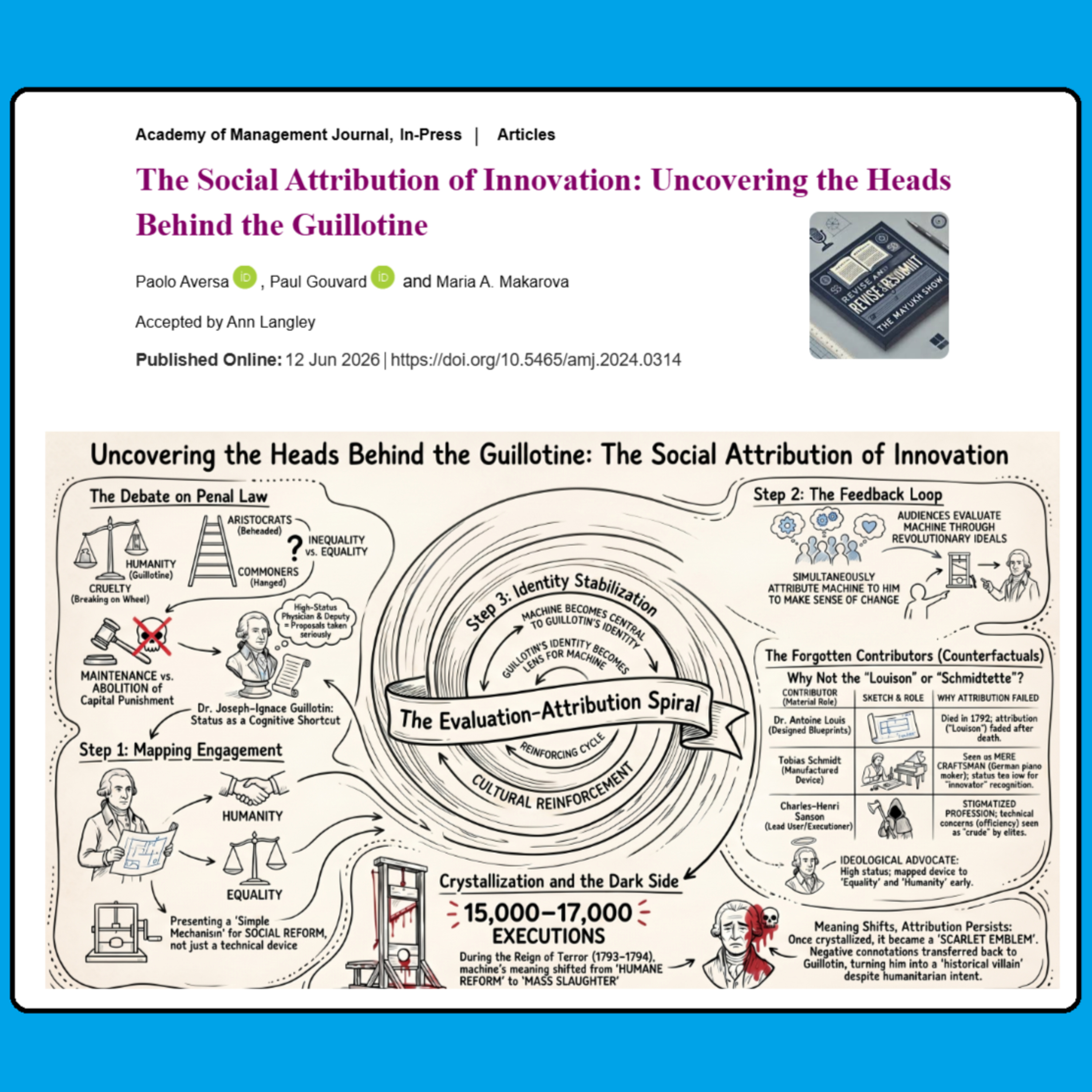
English Podcast Starts at 00:00:00Bengali Podcast Starts at 00:47:06Hindi Podcast Starts at 01:06:28Danish Podcast Starts at 01:21:43ReferenceAversa, P., Gouvard, P., & Makarova, M. A. (2026). The Social Attribution of Innovation: Uncovering the Heads Behind the Guillotine. Academy of Management Journal. https://doi.org/10.5465/amj.2024.0314Youtube Channelhttps://www.youtube.com/@weekendresearcherPodcast Websitehttps://mayukhmukhopadhyay.com/reviseandresubmitAcademy of Management PDW on Space Economy Registration Flyerhttps://cto.aom.org/discussion/flagship-aom-2026-pdw-space-economy-consolidating-a-research-agenda-8AOM SIM Curriculum Committeehttps://sim.aom.org/curriculum/curriculum-committeeAOM SIM-Bytes Episode 1 - Dr Ed Freemanhttps://www.youtube.com/shorts/EBSA7WvQNSILinkedin Post By Professor Erica Stecklerhttps://www.linkedin.com/posts/erica-steckler-ph-d-427272_simbyte-episode-1-ed-freeman-activity-7469092002098225152-PbHM🎙️✨ Welcome to Revise and Resubmit. I’m so glad you’re here. There are some research articles that do more than present an argument. They quietly unsettle the habits of thought we have carried for years, and ask us to look again at something we believed we already understood. Today, I want to sit for a while with one such piece: The Social Attribution of Innovation: Uncovering the Heads Behind the Guillotine by Paolo Aversa, Paul Gouvard, and Maria A. Makarova, published online on 12 June 2026 in the Academy of Management Journal 📚This is, of course, no ordinary journal. Academy of Management Journal is one of the most prestigious outlets in management research and belongs to the FT50 journal list 🏛️✨ So when a paper appears here, it often arrives carrying both rigor and consequence. And this one does exactly that.What I find especially moving is the paper’s refusal to accept the familiar comfort of the “hero innovator” story. Instead, the authors lead us into a subtler and more human terrain, where inventions and inventors are not simply paired by fact, but bound together through public memory, social judgment, and repeated acts of attribution. Through the strange and enduring case of the guillotine, they show us how Dr. Joseph-Ignace Guillotin, who did not invent the machine, nevertheless became inseparable from it in the historical imagination. ⚙️🩸🧠Paolo Aversa, Paul Gouvard, and Maria A. Makarova write with a precision that feels, to me, almost forensic, yet the implications are deeply human. They remind us that recognition is rarely innocent. It gathers around those who seem to embody a problem, a value, or a public mood. Their idea of an evaluation-attribution spiral is especially compelling, because it captures how society slowly fastens a name to an innovation until the bond feels inevitable, even when it is not. 🔍💭In a way, this is a paper about invention, but also about memory, reputation, and the quiet machinery by which history decides who will stand at the center of the story.My thanks to Paolo Aversa, Paul Gouvard, and Maria A. Makarova, and to the Academy of Management, for publishing this fascinating article in such a prestigious FT50 journal 🙏📖 If you enjoy these reflective research conversations, please subscribe to Revise and Resubmit on Spotify, and also follow the Weekend Researcher YouTube channel 🎧📺 The podcast is also available on Amazon Prime and Apple Podcast 🍎✨And as we begin, I want to leave you with a question 🤔 If history remembers the wrong inventor for the right reasons, what does that reveal about innovation, and what does it reveal about us?
Embed this episode
Ready to play
The Social Attribution of Innovation (Aversa et al., 2026) | FT50 AMJ
No transcript for this episode yet
Similar Episodes
No similar episodes found.
Similar Podcasts
No similar podcasts found.