
EPISODE · Jun 28, 2026 · 1H 46M
The unintended (negative) consequence of training (Gyensare et al., 2025) | ABDC-A* JOOP
from Revise and Resubmit - The Mayukh Show · host Mayukh Mukhopadhyay
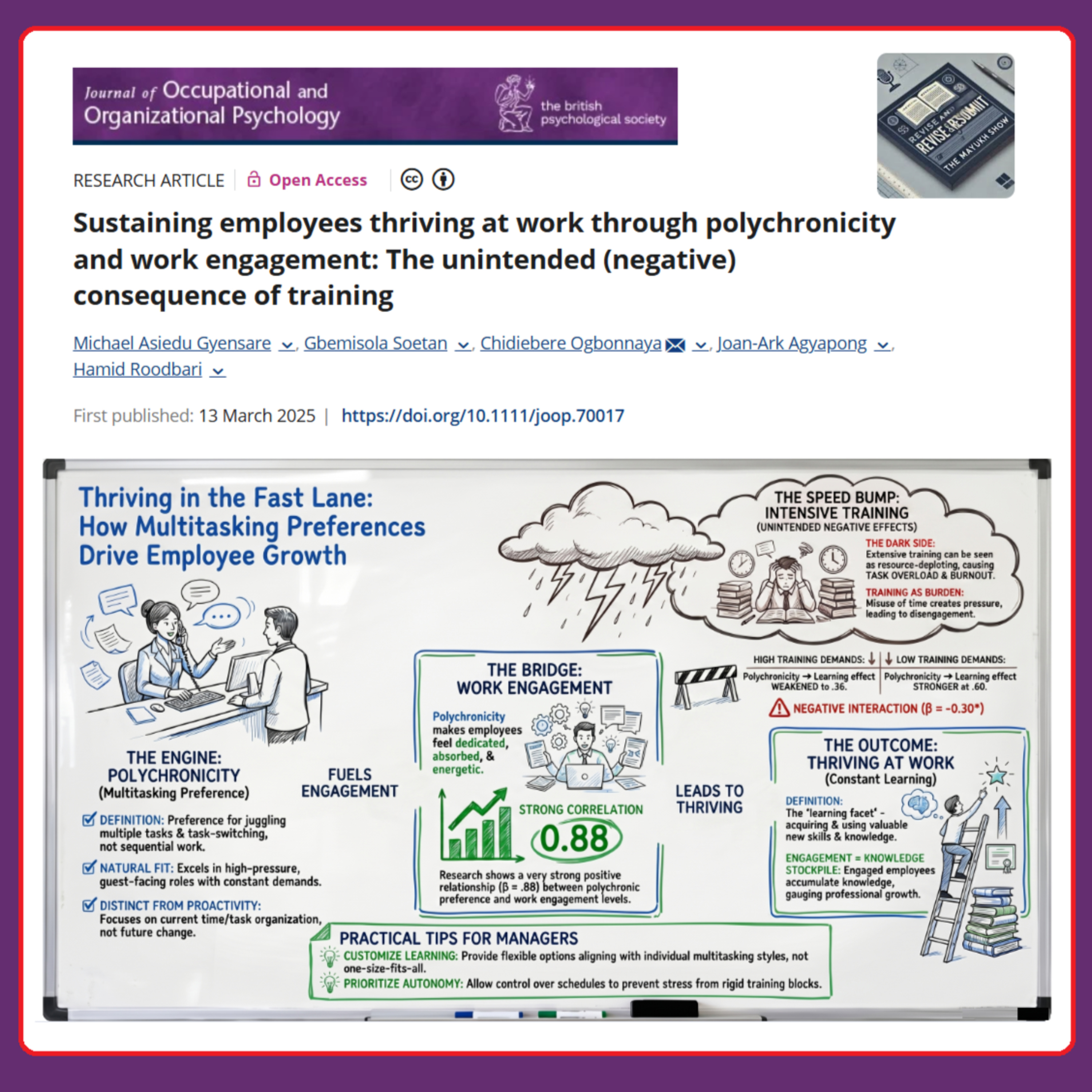
English Podcast Starts at 00:00:00Bengali Podcast Starts at 00:49:49Hindi Podcast Starts at 01:10:05Danish Podcast Starts at 01:27:44ReferenceGyensare, M. A., Soetan, G., Ogbonnaya, C., Agyapong, J.-A., & Roodbari, H. (2025). Sustaining employees thriving at work through polychronicity and work engagement: The unintended (negative) consequence of training. Journal of Occupational and Organizational Psychology, 98, e70017. https://doi.org/10.1111/joop.70017Youtube Channelhttps://www.youtube.com/@weekendresearcherPodcast Websitehttps://mayukhmukhopadhyay.com/reviseandresubmitAOM SIM Curriculum Committeehttps://sim.aom.org/curriculum/curriculum-committeeAOM SIM-Bytes Episode 1 - Dr Ed Freemanhttps://www.youtube.com/shorts/EBSA7WvQNSILinkedin Post By Professor Erica Stecklerhttps://www.linkedin.com/posts/erica-steckler-ph-d-427272_simbyte-episode-1-ed-freeman-activity-7469092002098225152-PbHMWelcome to 🎙️✨ Revise and Resubmit ✨🎙️, the podcast where academic research meets human stories, where journal articles become conversations, and where every paper invites us to see familiar workplaces in a slightly different light.📚 Today, we turn our attention to an intriguing article published in the prestigious Journal of Occupational and Organizational Psychology, an ABDC-A* ranked journal that has long served as a home for rigorous scholarship on work, people, and organizations.The paper, "Sustaining Employees Thriving at Work Through Polychronicity and Work Engagement: The Unintended (Negative) Consequence of Training", by Michael Asiedu Gyensare, Gbemisola Soetan, Chidiebere Ogbonnaya, Joan-Ark Agyapong, and Hamid Roodbari, asks a deceptively simple question. 🌱Why do some employees continue to learn, grow, and flourish even when their workdays seem crowded with competing demands?Imagine a hotel lobby on a busy afternoon. A frontline employee welcomes guests, answers calls, resolves complaints, coordinates with colleagues, and somehow still finds room to learn something new. We often celebrate this ability as efficiency. Yet beneath that surface lies a deeper story about attention, energy, and the quiet ways people sustain themselves at work.🧩 The authors explore the idea of polychronicity, a person's preference for handling multiple activities at once. Their findings suggest that people comfortable with juggling tasks often become more engaged in their work, and that engagement fuels learning, one of the key dimensions of thriving at work.But here the story takes an unexpected turn.🎭 Training, something organizations usually view as unquestionably beneficial, can sometimes become a burden. When training demands too much time, effort, or emotional energy, it begins to erode the very engagement it seeks to create. What appears to be nourishment can, under certain circumstances, become exhaustion.There is something quietly profound about that insight. The path to growth is not always blocked by a lack of opportunities. Sometimes it is crowded by too many of them.🌟 As we explore this study, conducted with 261 frontline hotel employees and their colleagues across ten four-star hotels in Ghana, we will reflect on a timeless organizational dilemma. How do we help people become better without overwhelming them in the process?🤔 And perhaps the deeper question is this: when organizations offer us more opportunities to learn, how do we know whether those opportunities are helping us thrive, or merely teaching us new ways to become tired?🙏 Our sincere thanks to the authors for their thoughtful contribution and to John Wiley & Sons Ltd and the British Psychological Society for publishing this important work.📖 If you enjoy conversations about cutting-edge academic research, please subscribe to Revise and Resubmit on Spotify, YouTube channel Weekend Researcher, Amazon Prime, and Apple Podcasts. 🔔🎧Until next time, keep reading, keep questioning, and keep revising. 📚✨
Embed this episode
Ready to play
The unintended (negative) consequence of training (Gyensare et al., 2025) | ABDC-A* JOOP
No transcript for this episode yet
Similar Episodes
No similar episodes found.
Similar Podcasts
No similar podcasts found.