
EPISODE · Apr 11, 2026 · 14 MIN
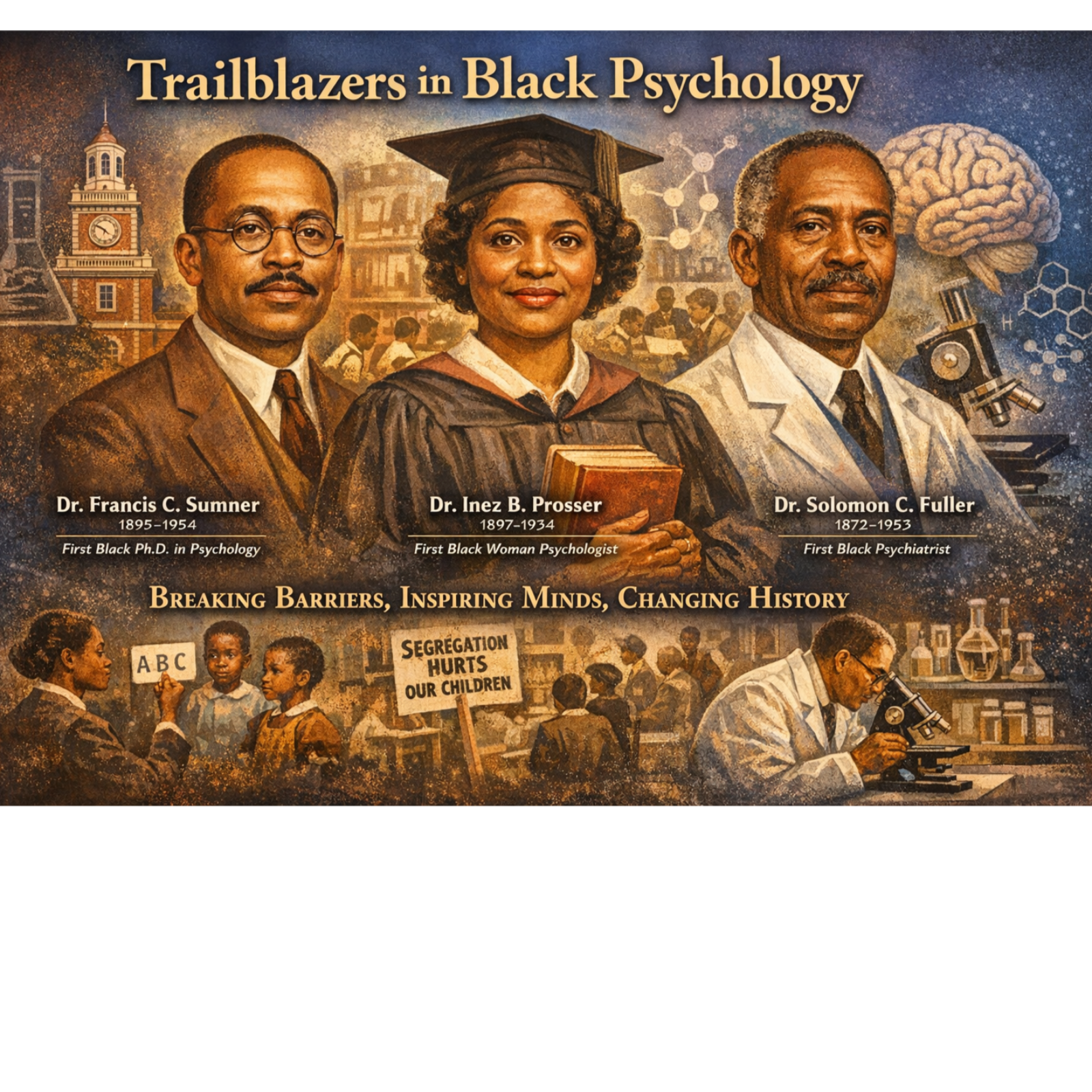
Trailblazers in Black Psychology
from Metro State BLACK Student Achievers Podcast
Order My Book: www.weusoursluckybooks.com-Psychology students stand on the shoulders of pioneers who proved that brilliance and perseverance can break every barrier. The stories of Francis Cecil Sumner, Inez Beverly Prosser, and Solomon Carter Fuller remind us that knowledge is not confined by race or circumstance—it is expanded by courage. Their legacy calls today’s students to study with purpose, lead with integrity, and use psychology to heal, uplift, and transform communities.The history of Black psychology in America begins with extraordinary determination against systemic barriers. Dr. Francis Cecil Sumner, known as the Father of Black Psychology, became the first African American to earn a Ph.D. in psychology in 1920 from Clark University. Largely self‑taught due to segregated schooling, Sumner passed special entrance exams, graduated valedictorian from Lincoln University, and later founded the psychology department at Howard University. His work on race, bias, and educational inequality shaped the discipline and mentored scholars like Dr. Kenneth Clark, whose research influenced Brown v. Board of Education.Dr. Inez Beverly Prosser, the first Black woman psychologist, earned her Ph.D. in 1933 from the University of Cincinnati. Her research examined the emotional well‑being of Black children in segregated and integrated schools. Prosser found that Black students often experienced stronger self‑esteem and academic support in all‑Black schools with Black teachers. Her findings informed early civil rights debates about education and remain foundational in educational psychology.Dr. Solomon Carter Fuller, the first Black psychiatrist in the United States, worked directly with Alois Alzheimer in Germany. Fuller’s research advanced understanding of neurodegenerative disease and challenged racist pseudoscience with empirical evidence. Together, these pioneers built the intellectual foundation for Black psychology, opened pathways for future scholars, and reshaped national conversations about race, education, and mental health.Lesson Plan: Trailblazers in Black PsychologyLearning Objectives Students explain who Sumner, Prosser, and Fuller were, using examples of their contributions. Students analyze how their work challenged racial barriers and advanced psychology.Learning Outcomes Students summarize each pioneer’s achievements clearly and accurately. Students connect each figure’s work to civil rights and educational reform.Assessment Students write a short reflection explaining how one pioneer’s work influences modern psychology or education. Responses demonstrate comprehension, historical reasoning, and application.5E Learning ModelEngage Begin with a discussion: “What barriers might early Black scholars have faced in higher education?” Show portraits of Sumner, Prosser, and Fuller to spark curiosity.Explore Students read short biographical excerpts and identify common themes of resilience and innovation.Explain Facilitate a class conversation linking each pioneer’s work to broader social change and civil rights history.Elaborate Students create a mini‑poster or digital slide highlighting one pioneer’s legacy and its relevance today.Evaluate Use the written reflection and group discussion to assess understanding and connection to modern psychology.Help with my audience research. Call and let me know where you are listening from: 773-809-8594
Embed this episode
Ready to play
Trailblazers in Black Psychology
No transcript for this episode yet
Similar Episodes
No similar episodes found.
Similar Podcasts
No similar podcasts found.