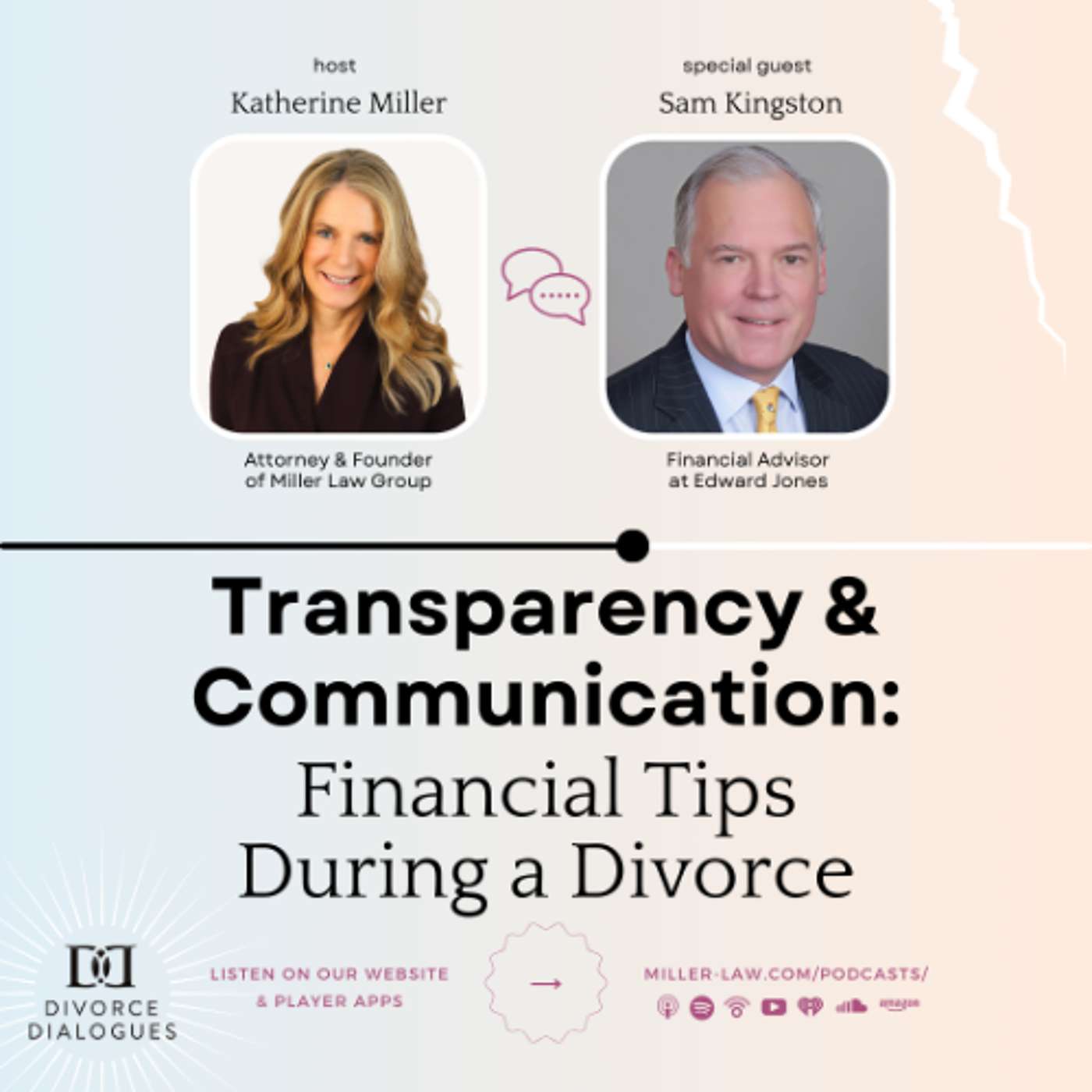
Welcome to Divorce Dialogues on Catherine Miller. DeWorse Dialogues brings expert guests to the airway to talk through your divorce questions and fill in the gray areas about separating. From thinking about divorce, to how to behave during divorce, what to do after, this is divorce Dialogues. Welcome to Divorce Dialogues.
I'm Catherine Miller. I'm the founder of the Miller Law Group and a trainer at the Center for Understanding in Conflict and I am on a mission to change how people divorce and help them divorce with dignity. And I guess it is Sam Kingston. He's a financial professional with over 20 years of experience in financial analysis and portfolio management.
He specializes in family and small to mid-sized businesses. His background, spanning global firms, a family office and a fifth generation family business in Chile, gives him a unique perspective in guiding business owners on retirement plans and personalized financial planning. Welcome Sam Kingston to the show. Thanks Catherine.
Appreciate you having me. Looking forward to talking with you and your audience. Great. You know, your career has spanned global business, portfolio management, the Chile family business and now financial advising.
How do you think that those diverse experiences have helped you shape the way that you've helped families navigate transition? Well, like divorce. So I lost my father at a pretty young age and was raised by a single mother. Like you said, my family does have a fifth generation business in Chile and we primarily do dairy, beef cattle and forestry activities.
And since I turned 21, I was actively involved in that business. My mom remarried when I was in elementary school and divorced when I was in college. So that's an experience. I was a bystander during that period of her life, but obviously my loyalty was to her.
And I also realized through that experience that the separation of assets can be a highly charged period in someone's life, very emotional and being empathetic, understanding, supportive as of utmost importance. It can also be a financially stressful period for people. So I think a lot of people view that the path of least resistance to be quick one, perhaps to rip the bandaid off. But I think that this period also can be one there that folks can make mistakes and really leaning on a team of professionals that can help them through the period is of utmost importance.
And namely those people being a divorced attorney, a financial advisor, a tax professional in perhaps an estate planning professional attorney. Yeah. I think what you're saying is that one thing that you're saying, Sam Kingston, is that rushing through these decisions and through this negotiation without an effort to get it over with because it's uncomfortable, without getting a fully really robust set of advice on every aspect and everything that it means to really be a mistake. Am I right about that?
Absolutely. Yep. I see that happen. And it's not, like you said, it's not a comfortable period.
And a lot of times taking your time is not the ideal route that people think about when going through this process. But ultimately, I believe is the most awful way to go about it. Yeah. And my clients are there pushing, pushing, pushing toward the end because it's so uncomfortable to get through this.
We need to get this done. You know, in the end, if it took you two weeks or two months longer to get to the right result, it's really worth it, even though it's really unpleasant in the going through. So I know that you have described your advice as am I putting air quotes around this for our listeners, robust and un-barnished? What does that mean in the context of divorce, especially where the emotions and the financial realities might be, um, in collision with each other?
Sure. So I think divorce can be, sometimes can be where one or both spouses really need to adjust their lifestyle. Sometimes the, it can be a deleterious financial experience for a couple, but it's a fine line to navigate. And so, you know, being there for emotional support is important.
Family professionals as well. But you know, at the end of the day, I think that there can be some new, I'll put air quotes around that new financial realities that set in for couples that are going through a divorce and don't really just help clients with their investments. But I also take a deep look at their financial picture and I'm not going to tell them that everything is perfect the way they're living their life if it isn't. And if adjustments need to be made in order for the client to reach those goals that they have for saving for college for a child or for their own retirement, they might need to make adjustments to get to reach those goals.
And so I think there's a fine line like I was saying between being supportive, but then also giving them good advice as to how to handle the current situation. You know, I think that knowledge is power and that's what I'm sort of hearing you say that I think money is a very complicated, emotionally complicated topic. It's less complicated when it's just the numbers, but it's emotionally complicated in a feeling of loss or a feeling of being less than or not equal to or all of that comes into it. And so many times when I give our clients homework to look at the cost of their lifestyle, they'll come back to me and apologize for some of their expenses.
Oh, I'm sorry I spent so much money on clothes or on vacations or whatever. And it's like, listen, this is not a judgment. This is a way to allocate the resources that you have in the way that's going to get you what you really want. And I think that's kind of what you're talking about.
It's like really taking a hard look at the spending plan and making sure that it's set up in a way that you're going to reach your goals and not just for it. Yeah, I mean, ultimately, it's the client's decision as to whether they take advice or not. I mean, I feel that it's my duty to provide the best advice that I can for the client to accomplish their goals and be supportive. I mean, like you said, not how to give them disappointment or whatnot, or if they're not able to attain certain budgetary goals in a given six month period, say, but let's try to let's still try to get to what we want to where we want to be just but ultimately the client does take responsibility for their actions and we try our best just to keep them on course.
Along those lines, what do you think are some of the major financial mistakes that people make with money during their divorce or right after? So I think that some of the kind of most important things that need to be done that sometimes are not done or to be construed as a mistake was to establish their own financial footprint separate from their spouse. So that's important to do almost immediately. Also very important is to create a new budget.
So what's your budget going to look like now that you're separate, you know, separate from your spouse's life, you're on your own. And what are your, what are your, what are your expenses look like? What kind of, what's your cash flow look like? And then understanding liabilities and assets.
So that's really gathering information and kind of putting it all together and having discussion about it. I think retirement benefits, you know, understanding those are important, how the divorce impacts those assets thinking down the road when we get to retirement, what are we going to have in place? And then also like very important updating beneficiaries and in a state plan. I think a lot of times people forget that and I actually personally had an experience along those lines where my in-laws acquired a house that was the, is part of the estate of a deceased individual who was going through a divorce at the time.
They had started a new relationship with a new partner and they passed away in a plane accident. And the house ended up being in the part of their state, but since the divorce was not final, it ended up with the, the, the, the spouse that they were divorcing. And that probably wasn't what they ideally wanted. So, so even if the divorce isn't final, it's important to update those when you're going through the divorce because you just really don't know what can happen.
And then also if you don't have a credit history, starting one of those is important because if you want to take, you know, that could be just hard, hard, hard process to get through. You said a lot there. So I just want to comment on the estate plan, you know, it can be really hard for clients and it's not always a conversation that they really want to have with us. Divorce lawyers at the end is to say, now that you spent all this money on legal fees for your divorce, you should whip out your checkbook and write a check either to ask or to another attorney to revise your estate plan.
And it is the end, is the tail and of the divorce process. So it's something you really need to do in order to accomplish the goals that you have worked so hard to reach during the divorce negotiations. So I think that's, and you're right, life happens, right? And you just never know.
And another thing that I really want to talk about is the word budget. You know, Sam, I think that people hear the word budget, like the word diet, it means restriction. But it doesn't necessarily mean restriction. It's really a way to allocate your resources to get what you want.
Could you talk a little bit about that? Sure. So going through a budget, a lot of times people don't, there are certain synergies say when you're living with a spouse partner under under one roof. And then when you're suddenly separating going to two separate lives, a bunch of changes.
And so I use a budgetary tool to sit down with my clients and go through how exactly they're spending money and have it clearly illustrated so that they can see it. And believe it or not, oftentimes more often than I should say, clients are spending way more money than they think. And it's just, that's just the way it is. And until you put it down on paper, you don't really know, but it's an important exercise to really understand where money that you have is going.
And then also to have a discussion about, okay, do we really need this, do we need that? Like in a manner that's given the situation of a divorce that's supportive and look, let's stay at home all the time and eat frozen food and whatnot. We're not trying to do that, but we want to be thoughtful about how we're spending our money at the end of the day. Absolutely.
I'm Catherine Miller and you're listening to divorce dialogues, a podcast dedicated to educating people about divorce related topics, how everyone can divorce with dignity. Subscribe to the podcast wherever you listen to podcasts to be sure that you don't miss an episode. And I'm talking today with Sam Kingston about divorce related finances. And I know that it can get really complicated, Sam.
When people have family businesses or shared investments, what do you think are some of the toughest financial questions that they need to address early in the process might be? So I think with a family business, it can be very complicated. I mean, we could talk for a long time about it. So I think especially when spouses work together in a business that can be particularly complicated.
So I have experience in that area. I certainly can speak to it, but what I focus on is really the financial side. So when a couple's investment assets, financial assets are involved, I tend to focus on those. And it's a bit more conventional to handle those types of assets.
And so I think that that's really what I tend to have the most experience with. You know, that being said, I do certainly understand how a business can be something that's probably more in your wheelhouse than it is in mine. But just from my personal experience, I certainly can speak to it. Yeah, I find that when families, when a couple is both has a family business and they're both involved, especially if they started that usually the underlying business documents are pretty weak, as opposed to like Sam, you and I not being related to each other or going to business, we would negotiate all kinds of things about shares and votes and all that sort of stuff.
When a couple is getting divorced, they generally don't do that. They just launch right into it. And I'm not criticizing. It's just I'm just stating that often.
So when you have a family owned business and both people want to continue to work in it, or at least to continue to own it, how we're going to structure that is part of the really interesting complex part of that negotiation. But not certainly not every family has that going on. But a lot of times people do have generational wealth. A one or both parties have a member of a family that has generational wealth, meaning they're inheriting assets and their families of origin hope that they will also pass those assets on to the children.
And so how do you think about the impact of divorce on that generational wealth planning and how can couples prepare for that possibility? The word prenatural comes into my mind. So what are your thoughts? Yeah, I mean, I think certainly when you have a family business going into a marriage, certainly that's something that falls into your purview.
I think in terms of generational wealth, that also could be a prenup like you mentioned. But I think that a lot of folks, like I was saying earlier, they don't necessarily change or focus on the beneficiaries or the estate planning aspect when they're going through the divorce, perhaps thinking about it, but I'll deal with it once it's over or get when I can get around to it. And it's really important to figure that out because it happens more often than you think where someone thinks they're going to live a lot longer than they actually do and things happen and as a result, then money moves in places that they hadn't originally intended, shall we say. And so that's important to work with professionals to kind of make sure that your wishes are carried out.
And I think it's extremely important. So Sam, you know, from a financial perspective, if someone's listening to this, considering divorce and that person is a business owner, either him or herself, well, that's really what I'm thinking about. A person who owns a business that their spouse is not involved in or at least not involved in directly. What do you think are some of the things that person should be concerned about and start preparing for in order to enter the divorce process?
I mean, honestly, I don't get too involved in businesses like that. In my role, again, it's mostly investments and financial instruments that I'm involved with businesses. They can vary. I mean, it's really, it depends on how they're set up.
And so I think that would be something I would really lean on your expertise to talk to a client with about how to handle those types of situations because it does require a real professional hand in the matter. And there can be lots of implications if not done the right way. Yeah. Absolutely true.
There are a lot of things to know ahead of time. But I know you have a sort of entrepreneurial history in starting your own businesses. So just from that perspective, leaving aside the financial planning, how do you think that entrepreneurial perspective helps you, help your clients and advise them while they're thinking about dividing their assets or valuing a business asset in a divorce? Because a lot of times people are like, oh, my business isn't worth anything.
It's just me. Right. That's not necessarily true. No, no, it isn't.
And so I view my role as being a coach and financial coach and also providing support and also advice around people that they should be potentially reaching out to beyond the scope that I can help them with. And so with business owners, yes, my firm can provide some help, but generally we're not a law firm. And we have folks that we look to to help our clients in ways of handling, evaluating a business, ways of potentially acquiring a spouse's interest in a business, if they're partners or handling kind of liquidation, shall we say, of a business, there are professionals that we work with that can handle those. But it's not specifically something that we provide on a day to day basis.
You're listening to the divorce dialogues podcast and I'm Katherine Miller. Divorce dialogues has been educating people about divorce related issues for over 10. Please subscribe to the podcast and don't forget to check out our previous episodes on the podcast website, divorce dialogues.com. And I'm talking today with Sam Kingston about divorce and financial issues.
So Sam, if people want to learn more about you or your firm, how can they do that? Sorry, the best way to get in touch with me is so my firm is Edward Jones and my email is sam.kinksdenkimgston at edwardjones.com. The phone number to reach me at is 203-426-7826. And I'm always happy to help and talk with anyone who might have issues that they'd like to explore.
That's great. Sam, as people go through divorce, there's always this sort of tension in their head. It turns out that in our brains were hardwired for fairness, meaning that we want to be treated fairly, but we also want to be like we treated the other person fairly. The thumb is always on the scale a little bit towards ourselves as a general rule, right?
But then there's also a sort of real protective perspective of wanting to protect what's yours and protect your assets, protect your security. And there's a tension there. So how do you think about finding the right balance between those two things, protection and staying fair-minded? So it's pretty crystal clear in my industry in that, and I encounter this quite a bit, where you have spouses that are going through a divorce and they have several accounts with me.
And one might be in the name of one spouse, one might be a joint account, one might be named the other spouse. And so when going through the process, it really has to be emphasized that the information about the account can only be discussed with the account holder. And if the husband calls and asks a question about his wife's account, I can't talk to him about it. It's just not something that's allowable.
That being said, it's also important, I think, for clients to understand that, and I think you would relate to this, is that they shouldn't be doing anything that would construe misallocation of assets or that they're trying to hide assets or anything along those lines because that can be really a poor result for them in the divorce process. So I think being very transparent about what's happening. If it's a joint account between the two spouses, then I have to speak with both spouses whenever there's any money moving. So it creates an additional step for me, but it should provide some confidence to the couple that things are being handled in a very judicious and fair manner for both.
And what I was hearing saying, Sam, is that the boundaries are there. So they don't have to, they can trust that the boundaries are there and you're not going to slip outside of them just to be nice. Absolutely. I know we have to be independent and judicious and certainly a fiduciary for the best interest of the clients equally.
Well, we're now in the end of the show, but I know that you've worked internationally, obviously Chile, New York and etiquette. What have you noticed about cultural differences and how people relate to money, family, separation and divorce? Yeah, I mean, that's a really interesting question. I did.
I've lived in Chile for a year and still travel there frequently, but culturally, it's say marriage is very much an institution there where it's divorce is much more complicated. So there's a strong sense of religion in Chile. And so in order to get a divorce, it must be annulled by the church. It's a very complicated process.
And so what's interesting is that you see younger people these days in Chile, more of them are not getting married because of that. So they just become a couple. And so it's a different, very different dynamic than what we see here in the States and particularly in the Northeast. And people are getting married a little bit later in life these days, for sure.
And some of that's having to do with the different cost of living, housing being expensive. People might be a little bit more concerned about the economic future. But yeah, that's kind of some of the differences between kind of South American culture, perhaps, and North American. In our last few seconds, Sam Kingston, what advice do you have to someone who's listening to this who might be just starting or just thinking about starting the divorce process?
I would just say, like we were saying in the beginning, really don't rush yourself. That might be your initial inclination is to rush through the process and try to move on with your life to what is perceived to be the next chapter. But really rely on your advisors to help you through the process to make sure that ultimately you end up in a place that's going to be more likely to be favorable than if you rush through the process. So just like I said, the inclination is to rush.
But I'd say try to be more thoughtful about it and patient. I think that's great advice. Sam Kingston, thank you so much for being my guest under divorce dialogues. Thank you, Catherine.
I appreciate it.