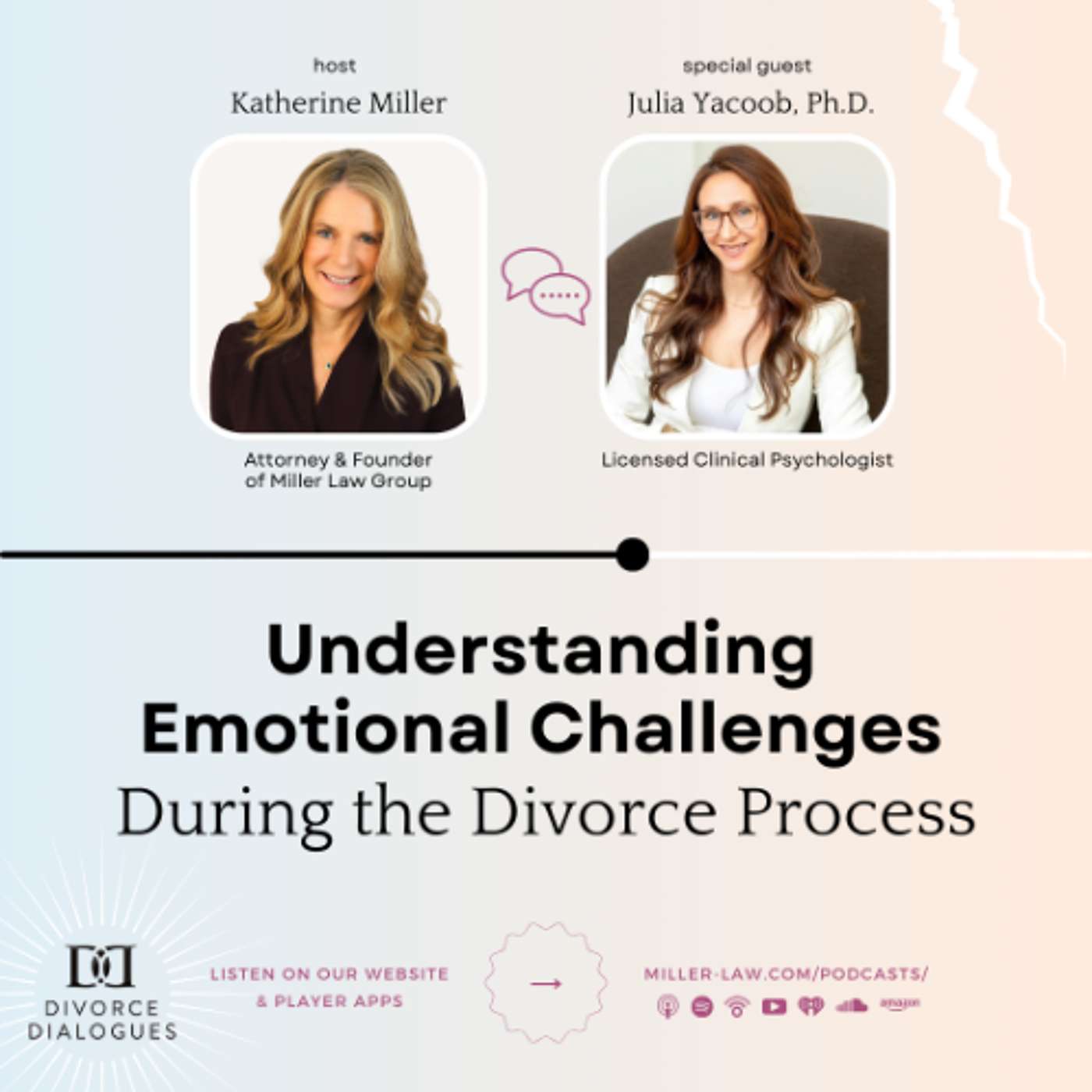
Welcome to Divorce Dialogues on Katherine Miller. The Horse Dialogues brings expert guests to the airwaves to talk through your divorce questions and fill in the gray areas about separating. From thinking about divorce, to having a behavior and divorce, to what to do after, this is Divorce Dialogues. Welcome to Divorce Dialogues.
I'm Katherine Miller, I'm the founder of the Miller Law Group and a trainer at the Center for Understanding in conflict and I am on a mission to change our people divorce and help them divorce with dignity. My guest today is Dr. Julia Yaku, which is a clinical psychologist with over 15 years of experience helping high achieving professionals, young adults, and parents navigate emotional challenges using evidence-based and insight-oriented therapies. She's based in Manhattan and is known for her thoughtful, individualized approach to treating stress, relationship struggles, and life transitions with the goal of deepening self-understanding and improving overall well-being.
Welcome Dr. Julia Yaku, to Divorce Dialogues. Thank you, Katherine. I know a lot of the people that you work with feel stuck and certainly in divorce, people feel stuck.
They're stuck in their marriages, they're stuck in the divorce process, they're stuck entwined with this person, they don't want to be entwined with anymore, stuck with a lot of expectation, responsibility. And how does that sense of stuckness impact their thinking about the divorce or any life transition really? Right, right. So, yeah, people often consider themselves stuck when they're in a position of challenge and struggle and they don't know when it's going to end and how long it's going to go on for, how it's going to affect them.
Sometimes those thoughts about what it's going to look like start to feel really all-consuming. So, outside of kind of like the day-to-day involvement in conversations and decisions is really their thought patterns and the way in which people think and the types of errors that come up in their cognitions during these times of challenges tend to be more pronounced. So, I think it's really helpful to learn about like the thought patterns that people get stuck in and these types of cycles of thinking and emotional challenges. So, you said something there about errors in cognition.
Tell us more about that. Yes, so, as a cognitive behavioral therapist, you know, we learn all about the ways in which humans try to take shortcuts in their thinking. And we all do this, but it's more present when we're feeling emotionally charged. So, some of the common errors that we make are things like all or nothing thinking, you know, either I have to win or I have to lose or I'm either, you know, right or I'm wrong.
These types of thoughts as well as things like emotional reasoning. So, because we feel a certain way, we assume that it's true, even if there's no evidence to support that. Another example would be personalizing. So, thinking that somebody else's decision or behavior reflects on how they feel about us or something that we have done, I can list a couple more, but I can stop there.
I've had enough for us to talk for a couple of hours already. So, one of the things that I think is really a common error in divorce in the work that we do, that I do personally and that we do in the firm, is this mistake on right wrong thinking, right? You're either right or you're wrong. It's win versus lose.
And that relationships, marriage, divorce are so much more nuanced than complex than that binary kind of right wrong, black, white thinking. So, what can people do if they're thinking, you know, I'm either right or I'm wrong. Like, if I'm wrong, the cost of being wrong is a lot of shame, right? And so, you can't be wrong because that's a huge price of hey, if you're going to feel like a bad person.
If you're wrong. So, how can people, Dr. Yakuab, think through that more nuanced approach to a particular decision, a particular situation? And if you have an example, that would be great too.
Yeah. And if you want to provide an example too, and when it gets in the way, I'm happy to respond to that. You know, there's more than just the cost of shame. There's also like the financial repercussions.
Like think about somebody that is so rigid in thinking that they have to keep custody XY and Z way or it has to be that they keep their family home. That's going to create a huge barrier to any kind of negotiation, any kind of mediation. I'm sure you could describe all the ways in which that ultimately leads to a lack of reconciliation and agreement and like more and more and more work and more strides, more cost and so forth. So, what we try to do, you know, what I do in my practice is really work through the shades of gray, you know, nothing is really that simple, that it has to be this way or another way.
The idea is to introduce more flexibility. And if we can try to talk about values, for example, you can start to look at like, well, what's really important to you? What's most important to you? Okay, how do we think about that?
What would a new home look like? What would this type of arrangement be like? And can you imagine what matters most to you so that we can kind of stick with that and maybe the other pieces fall lower on the priority list? Yeah, I find sometimes people asking people are like, why is this so important?
Now, why can sound like, why do you want that? Like obnoxious? So like a genuine curiosity is to what makes in your example the family home so important, right? What is that that you're trying to preserve?
And what does it give you besides just saying, what does it give you and trying to sort through some of those elements just so they can see what that shortcut is that they're thinking, well, if I have the family home, then I'll be okay, right? Exactly. Exactly. What does it represent to them?
That family home doesn't represent like stability for their children. Does it represent a certain image that they want to have in the community? Does it represent like a certain identity? Or are they just holding on to the past and are unable to kind of grieve the loss of this thing that represents in a really important phase of their life?
Yeah. So I think that, you know, I think this personally and I think this professionally that grieving, you know, sinks, right? It's hard to do. It's painful and that maybe one of the shortcuts you talked about at the top of the show is a shortcut in hoping not to have to do that.
What do you think about that? Right. Right. Like really not wanting to move on.
You mean? Yeah. I'm not wanting to feel the pain. You could be stuck in sort of saying, I'm just going to, you know, that person's and jerk or rise around on a broomstick.
I did nothing wrong. You know, I'm not to have to sort of go through the pain of not of those feelings, right? Up in the heat or the sadness or fear, right? Or like comes up in having to face redefining your life, redefining yourself, maybe restructuring your parenting and the loss that goes with kids times.
I mean, so much, right? It goes into it. Well, I think the way that manifests and you would probably see it as well is in anger, you know, like if we're not talking about what we have lost and the future of what we expected and the loss of our hoped for future, then we're really just more angry. Like it should have been this way.
I should have done this. This is another cognitive error. He should have done this or she should have done this. You know, the more we are angry, the more that clouds our judgment and then the more our judgment is clouded, the more we are unable and crippled to make these types of decisions.
So this is like, again, coming back to the cycle in this rut, you know, it starts with the thinking he should, she should. We start to feel more and more angry or more and more guilty. The more guilty we feel, the more angry we feel, the more our judgment is impaired. The more impulsive our decisions are the less clear we are in thinking about what our long term goals actually are and then the more impaired we are in our decision making, the more anxious we are, the more catastrophic we start thinking.
So you can see how people just get caught up in this and really it helps to speak with a professional. Yeah. I'm Katherine Miller and you're listening to divorce dialogues, a podcast dedicated to educating people about divorce related topics. How everyone can divorce with thingity.
Subscribe to the podcast wherever you listen to podcasts. Be sure that you don't miss an episode. And I'm talking today with Dr. Julia Jakub about while the divorce transition and working with people who are right now, we're talking about stock in their feelings and having difficulty moving through the process of divorce and the emotional journey that takes.
And Dr. Jakub, I know that you've worked with a lot of high functioning people at some high pressure institutions in New York who are very successful. And how do they balance the time and effort it takes to go through the processing the divorce, whether or not they're the person choosing it or the not the person choosing it and also maintaining that level of functioning at work or professionally. What is your advice?
Yeah. Yeah. I would say pain and grief does not discriminate. So whether you are an executive in a bank or an assistant at a tech firm or a stay at home, mom or any one of these things, it really comes down to how you can focus, whether or not your concentration is affected by all these lingering feelings and thoughts and big decisions that need to be made.
How well you can compartmentalize. Can you balance your work and self care? These types of things, you know, how anybody really manages stress because whether it's divorce or something else, you know, everybody has lives outside of their work. You know, I just want to go back to some of the language in your in the introduction of you and your bio about helping people on the journey of self discovery and deepening self understanding.
You know, I want to tell you something about myself and that is it. When I was younger, I really thought anxiety might kill me. I'm really not kidding. You know, like I would feel anxious about something on my heart would pound.
I get sweaty, you know, whatever. I would do anything to make that stop and the anything that I would do is usually a mistake, right? Like I just flail around for something to make that feeling go away. Later on the 2020 hindsight and see that the thing I did might not have been the best thing to do in the moment because I was acting from a place of just make it stop when I realized that if I just tolerated that anxiety for a little bit of time, right, and waited for the message, but for to learn the thing that was making me so anxious that from that place of understanding what was it was that was making me so anxious, I could make a much better choice.
And even though it was uncomfortable for a little bit longer, maybe another hour, maybe another few days, right, that that that realization at the end of the road was an important realization. And I'm just wondering what you think about my experience and how that might apply to people who are listening to this program. And can I ask you, Catherine, how did you come to that realization that instead of trying to suppress and push away that you had to kind of glide through it and ride the wave? Well, a lot of therapy.
And I think that ultimately through that process, just realizing I just wasn't making smart decision being forced in some cases to just to sit with the anxiety because there wasn't anything I couldn't come up with any I was in a box and I couldn't come up with something and just realizing that ultimately, if I waited it out, the answer was going to reveal itself to me. Yeah. And having that experience a few times and also really regretting some of the things I had done terrible, terrible things. But regretting some of the choices I made and realized that if I just had a little bit more patience with the feeling, it wasn't going to kill me.
And I was going to be in a better place. Yeah, that's remarkable. I mean, you kind of nailed the therapy for panic attacks. I think that's what you're describing.
Like when somebody experiences a wave of physical sensation and it's really alarming and that creates its own anxiety to the point where the anxiety then fuels the physical sensations and worsens it. And then you can start to feel like either a you're dying, you're losing control or you're going insane. It's deeply distressing for people. And like you said, you know, people imagine it being extremely dangerous.
They think that they're going to faint or they think that they're going to collapse or have a heart attack that show up in the ER therapy is extremely effective for panic attacks. It's kind of like the one type of anxiety disorder along with phobias that we really know how to treat. And so I would say like if anybody was listening and they're experiencing panic attacks, there is a reasonable solution. It's short term and it does mean riding through that anxiety.
I'm not trying to tamper with it too much because like the more you try to deal with it and suppress it, the more it presents itself. And so just really kind of learning to be learning to be comfortable with discomfort and building the confidence over time that you can go through this is actually the very thing that prevents it and curtails it. Yeah, it's kind of intuitive, right? You don't you know, just like, no, no, no, no, I don't know.
I'll take an aspirin. Right. People have all sorts of coping techniques for this and they're actually considered safety behaviors because A, most of the time they may not work. B, it's more like a superstition than anything.
And C, then when you do feel better at the end of it, you can attribute to feeling better to the safety object like the aspirin or like the water or like leaving the door unlocked because you think somebody can enter and save you if you collapse. These are the things that we need to let go of in order for us to realize that like our bodies are designed to bring ourselves down from that fight or flight response. So making decisions in a mode like that couldn't be more out of line with the rational thinking because you're operating from an emotionally hijacked place. You know, you're operating from a sense of like there's a bear in the woods and I need to flee.
I need to freeze people sent texts and things in those moments that they later regret. You know, I'm sure during all of this communication with X is Ken Worson in States of Things. I do like that. Absolutely.
I think that though that's the kind of state in which people do things that their lawyers wish they wouldn't do. Exactly. Exactly. In your experience, what do you think some of the common psychological blind spots people going through divorce or custody dispute have about themselves or about the situation?
Yeah. So I think a blind spot as those cognitive errors like the ways in which our mind tends to work against us moments in which we use our emotions as information to fuel our behaviors. So I would say like the more aware you are of the type of thinking that you have and the more psychologically minded and reflective you are the less blinded you will be to these types of distortions and thinking. Yeah, you know, I think it's interesting.
Sometimes I observe that either our clients or our client spouses have a real emotional response and it's as if the way they their perception of reality is based on the way they feel about it. So they'll change the facts that are facts to accommodate the feelings that they have, which is crazy making for everybody involved in their lives. Like that didn't happen that way. It did because it must have happened that way because I wouldn't be so hurt.
I wouldn't be so sad. I wouldn't be so angry. Yes. It happened that way.
So it must have happened that way. So what do you think is happening with that? Yeah. It's pretty common actually.
Well, this is like deductive reasoning or confirmation bias. We're all looking to feel consistent with how it is that we feel and our memories are fallible. So we can recreate experiences and create all sorts of ways of interpreting something if we are, you know, kind of biased by those types of feelings and there's no way in which that's in line with like productive thinking and conversations with attorneys and it's less about like, are you right and more about like, what are the facts and where do you want to go? Like, is this worth harping on or do we need to just like figure out what you would like to see happen?
You're listening to the divorce dialogues podcast and I'm Catherine Miller. Divorce dialogues has been educating people about divorce and relationship issues for over 10 years. Subscribe to the podcast and don't forget to check out our previous episodes on the podcast website, divorce dialogues.com. And I'm talking today with Dr.
Julia Jakub about the emotional process of divorce and how people can sometimes get stuck and work through those stucknesses in order to process the divorce. And, you know, I think a lot of people feel come into the divorce situation or into a marriage or any kind of relationship issue with the background of their family of origin, right? And that they're either recreating or reacting against or something like that. So how are some of the ways that unresolved family of origin issues can resurface during or after divorce or invading new people, parenting, all that kind of thing?
Yeah, I'm so glad you brought this up. Anytime there is some kind of crisis or massive life stressor, you know, we're in our most vulnerable state. And so that is an opportunity for anything from the past that's been unprocessed or unresolved to kind of peak its head again. And so not only are you necessarily experiencing like the loss of the marriage, for example, you can experience the loss of, you know, a dream's future or previous losses might come back up trauma, for example, you know, depending on what the relationship was like, whether there was emotional abuse or physical abuse or who knows what else that can bring back up earlier traumas that were never dealt with.
Panic attacks are a good example too. You know, sometimes people have panic when they're younger and it kind of like dissipates over time or they were treated for it. This would be really fertile ground for those types of feelings to resurface and have to kind of look at them again. And so hopefully if you are working with some kind of mental health professional, you're not just talking about like how to deal with everything that's happening on the day to day basis, but more awareness of kind of earlier experiences can help you to have a better handle on how to understand what's happening for you now.
So you feel a little bit more in control and a little bit more empowered for how to work through all of this. It's an opportunity for healing, not just in the present moment, but also for previous wounds. That is a lot that you said there. You know, I realize I forgot to give you a chance to give your contact information your website, Dr.
Julia Yacob. So could you share with our listeners how they can reach you or find out more about your practice? Sure. You know, I'm located in person at Union Square West in Manhattan and I also work with people virtually all across New York state.
I have a website. It's JYPHD.com. So you're welcome to look there and contact me, you know, either through email or by phone. And Dr.
Yacob's contact information will be in the show notes as well. You know, another thing that happens for people who have kids while they're going through divorce is how to help those kids through the divorce. And you know, there are a bunch of mistakes that people can make and certainly you would be helpful if you would mention some of those things, but staying away from the mistakes. What are some really positive things that people can do to help their kids feel with their divorce?
I would say being honest as best as you can and meeting the child at the level that which they are concealing things or miscommunicating or creating inconsistencies with what it is that they're observing. Children are pretty sharp, sharper than you imagine. They hear things. They remember things.
The best thing that you can do for them is to name what it is that they have witnessed so that they really don't feel alone in whatever it is that they're feeling and whatever it is that they're seeing and, you know, to give them whatever kind of support and reassurance that they need. Let's give an example of what you mean by naming. Say they see their parents have a big fight, right? Or a bunch of big fights or somebody storms out of the house after dinner after a fight.
Like how much to say to a kid about that, you know, other than your dad as an ass or your mother's a bitch, you know, what could you say to a child in the, especially in the face of your own upset, right? I mean, that is one of the biggest challenges of parenting period. How do you regulate yourself in order to provide a neutral and regulated space for your child who is dysregulated from whatever it is that just happened and that is our job as parents to kind of just create this field to hold them in. Well, you know that name calling is probably not going to be productive and speaking from that place, you might have to take a few moments, you know, to kind of come down yourself until you are able to talk with your child about whatever it is that they saw.
You can ask them, what is it that you just witnessed? Like that was a really difficult situation. And you saw that dad was really angry. You saw that I was too.
That's the naming, right? You're repeating what it is that they witnessed, but in like contained words and sentences. And you're saying that like, what was that like for you? What do you need right now?
How can I comfort you right now? You know, you didn't, it wasn't your responsibility. It's not your fault. And I'm here to support you while you witnessed these types of moments and also even when there is conflict between us, you never need to worry about us taking care of you.
That I am a grown up, that I know how to manage these emotions. Whether you see me that or angry, I will always meet your needs in the way that you need to be taken care of. And then figure out how to do that. And then figure out to do that.
I've been giving them the confidence and preventing us three fronts. Whether or not you feel it, sometimes it's a fake or make it kind of situation, you know. Yeah, that's why I said that because I think you could be saying that in the moment and thinking, I haven't got a clue how I'm going to do this, but my commitment is to do it and figure it out later. I am exact.
I like that word. I am committed to making this manageable for us and providing, you know, a secure home for all of us to do what we need to do. And everybody will be okay. All right.
It isn't our last minute or two of the show. What do you wish more people understood about emotional healing, particularly in the context of divorces? They just, you know, try to move forward with their lives. That's a big question.
I would say like lean on your social support and create time to take care of yourself, but also I can't imagine going through any of this without a therapist. And you don't want to divulge all of this to your friends. B, they might have their own opinions and might actually fuel the fire. C, to have an open safe space free of judgment where you can just talk openly about anything that you need to process from that day from that week.
Give yourself the opportunity to have a place to talk outside of your lawyer's office. Yeah, because lawyers and it can be useful to some extent, but they're not trying therapists and they're costly, you know, it's a costly place to do it. Have a team, you know, have a team. That's great advice.
Dr. Julie Ayaku. Thank you so much for being my guest on divorce dialogues. Thank you for having me, Catherine.