Understanding Shopkeeper Behavior at the Bottom of the Pyramid (Villa et al., 2024) episode artwork

EPISODE · Dec 12, 2024 · 12 MIN

Understanding Shopkeeper Behavior at the Bottom of the Pyramid (Villa et al., 2024)

from Revise and Resubmit - The Mayukh Show · host Mayukh Mukhopadhyay

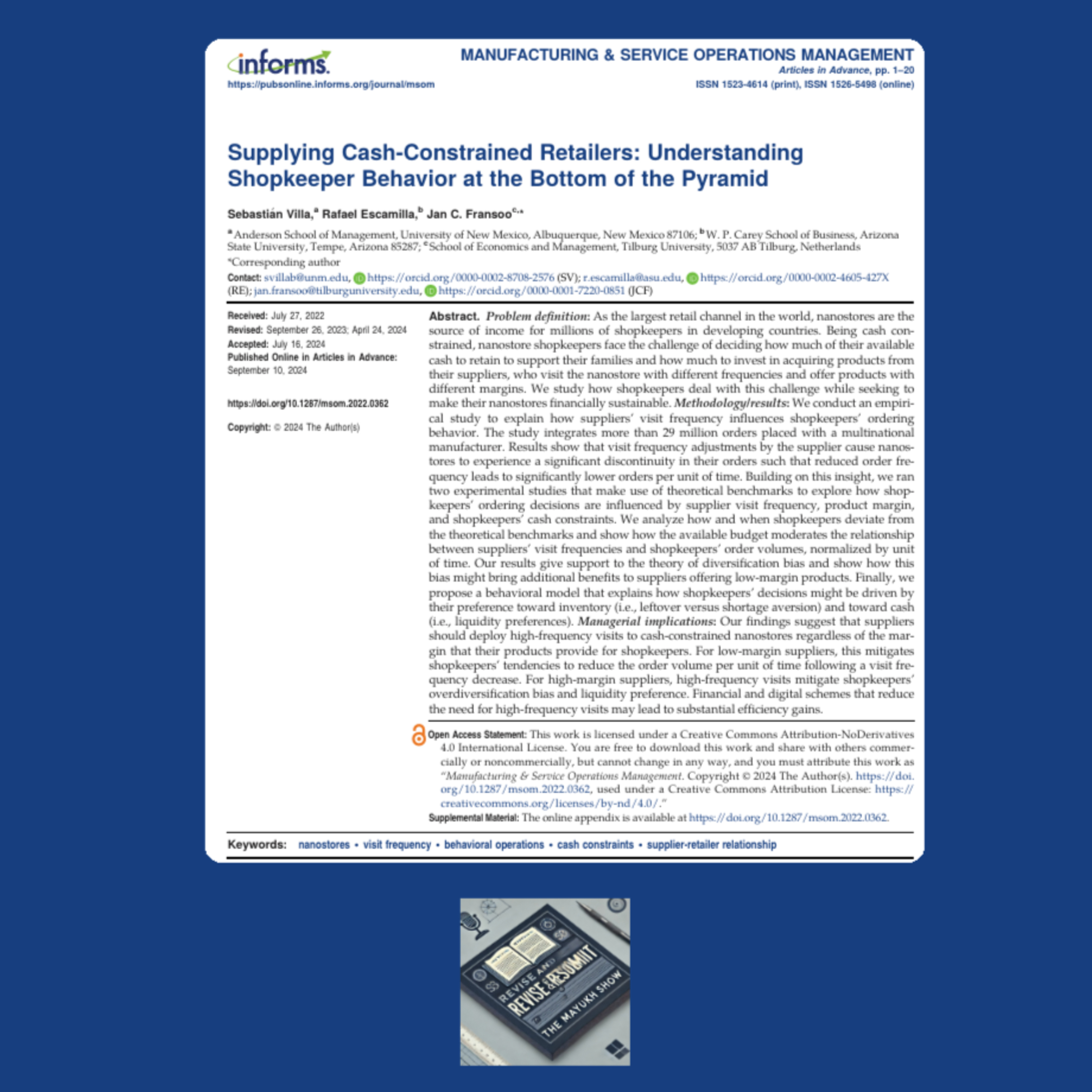
Welcome to Revise and Resubmit, the podcast that dives deep into the mechanics of research shaping our world. Today, we explore a story that unfolds in small neighborhood shops and back-alley markets across developing countries—spaces known as nanostores. These tiny stores, often run by cash-strapped shopkeepers, serve as lifelines for communities while juggling a delicate balance: how much cash to keep for family needs and how much to invest in products to keep their businesses afloat. Our episode covers “Supplying Cash-Constrained Retailers: Understanding Shopkeeper Behavior at the Bottom of the Pyramid,” a research paper by Sebastián Villa, Rafael Escamilla, and Jan C. Fransoo, published in Manufacturing & Service Operations Management, one of the elite FT50 journals. The authors take us behind the scenes of supply chains in Latin America, revealing fascinating insights. Using over 29 million orders from nanostores, they show that supplier visit frequency profoundly impacts shopkeepers’ behavior. Less frequent visits shrink order volumes, while more frequent visits encourage shopkeepers to stock up—even on low-margin products. Villa, an Assistant Professor at The University of New Mexico, has spent his career focusing on operations in small businesses and humanitarian contexts. Escamilla teaches supply chain management at Arizona State University, while Fransoo, a professor at Tilburg University, explores logistics at a global level. Together, their research uncovers behavioral quirks like diversification bias and liquidity preferences—psychological tendencies that shape these micro-retailers’ decisions. The takeaway is clear: suppliers shouldn’t just focus on margins but increase visit frequency to help shopkeepers overcome biases and maintain sustainable operations. But here’s the big question: If small shops depend on frequent supplier visits to survive, can digital innovations ever replace this human touch? We’d like to thank the authors and INFORMS PubsOnline for making this fascinating research open access. Stay tuned as we dive into the hidden dynamics driving the world’s largest retail channel—one nanostore at a time. Reference Sebastián Villa, Rafael Escamilla, Jan C. Fransoo (2024) Supplying Cash-Constrained Retailers: Understanding Shopkeeper Behavior at the Bottom of the Pyramid. Manufacturing & Service Operations Management 0(0). https://doi.org/10.1287/msom.2022.0362

Welcome to Revise and Resubmit, the podcast that dives deep into the mechanics of research shaping our world. Today, we explore a story that unfolds in small neighborhood shops and back-alley markets across developing countries—spaces known as nanostores. These tiny stores, often run by cash-strapped shopkeepers, serve as lifelines for communities while juggling a delicate balance: how much cash to keep for family needs and how much to invest in products to keep their businesses afloat. Our episode covers “Supplying Cash-Constrained Retailers: Understanding Shopkeeper Behavior at the Bottom of the Pyramid,” a research paper by Sebastián Villa, Rafael Escamilla, and Jan C. Fransoo, published in Manufacturing & Service Operations Management, one of the elite FT50 journals. The authors take us behind the scenes of supply chains in Latin America, revealing fascinating insights. Using over 29 million orders from nanostores, they show that supplier visit frequency profoundly impacts shopkeepers’ behavior. Less frequent visits shrink order volumes, while more frequent visits encourage shopkeepers to stock up—even on low-margin products. Villa, an Assistant Professor at The University of New Mexico, has spent his career focusing on operations in small businesses and humanitarian contexts. Escamilla teaches supply chain management at Arizona State University, while Fransoo, a professor at Tilburg University, explores logistics at a global level. Together, their research uncovers behavioral quirks like diversification bias and liquidity preferences—psychological tendencies that shape these micro-retailers’ decisions. The takeaway is clear: suppliers shouldn’t just focus on margins but increase visit frequency to help shopkeepers overcome biases and maintain sustainable operations. But here’s the big question: If small shops depend on frequent supplier visits to survive, can digital innovations ever replace this human touch? We’d like to thank the authors and INFORMS PubsOnline for making this fascinating research open access. Stay tuned as we dive into the hidden dynamics driving the world’s largest retail channel—one nanostore at a time. Reference Sebastián Villa, Rafael Escamilla, Jan C. Fransoo (2024) Supplying Cash-Constrained Retailers: Understanding Shopkeeper Behavior at the Bottom of the Pyramid. Manufacturing & Service Operations Management 0(0). https://doi.org/10.1287/msom.2022.0362

NOW PLAYING

Understanding Shopkeeper Behavior at the Bottom of the Pyramid (Villa et al., 2024)

0:00 12:55

No transcript for this episode yet

We transcribe on demand. Request one and we'll notify you when it's ready — usually under 10 minutes.

Frequently Asked Questions

How long is this episode of Revise and Resubmit - The Mayukh Show?

This episode is 12 minutes long.

When was this Revise and Resubmit - The Mayukh Show episode published?

This episode was published on December 12, 2024.

What is this episode about?

Welcome to Revise and Resubmit, the podcast that dives deep into the mechanics of research shaping our world. Today, we explore a story that unfolds in small neighborhood shops and back-alley markets across developing countries—spaces known as...

Can I download this Revise and Resubmit - The Mayukh Show episode?

Yes, you can download this episode by clicking the download button on the episode player, or subscribe to the podcast in your preferred podcast app for automatic downloads.
URL copied to clipboard!