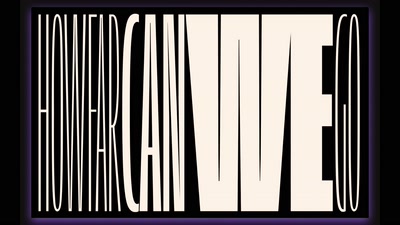
Variable Fonts — It Was Never About File Size (39c3) episode artwork

EPISODE · Dec 28, 2025 · 43 MIN

Variable Fonts — It Was Never About File Size (39c3)

from Chaos Computer Club - recent events feed · host Bernd

A brief history of typographic misbehavior or intended and unintended uses of variable fonts. Nine years after the introduction of variable fonts, their most exciting uses have little to do with what variable fonts originally were intended for and their original promise of smaller file sizes. The talk looks at how designers turned a pragmatic font format into a field for experimentation — from animated typography and uniwidth button text to pattern fonts and typographic side effects with unintended aesthetics. Using examples from projects such as TypoLabs, Marjoree, Kario (the variable font that’s used as part of the 39C3 visual identity), and Bronco, we’ll explore how variable fonts evolved from efficiency tools into creative systems — and why the most interesting ideas often emerge when technology is used in unintended ways. When the OpenType 1.8 specification introduced variable fonts in 2016, the idea was simple: combine all weights and styles of a font family into one file and save file size and therefore bandwidth. Yet in 2025, variable fonts have become a platform for artistic and technical exploration far beyond their initial goal. This talk follows that transformation from the inside. It starts with a short history of flexible font technologies — Adobe’s Multiple Master and Apple’s TrueType GX formats of the 1990s (I am just mentioning the company names as they were the publishers of these technologies) — and how they failed to become standards. It then shows why variable fonts succeeded: many designers today are more tech savvy and know some basic HTML, CSS and maybe even some JavaScript. And at the same time all major browsers and almost all design apps support variable fonts by now. From there, I present a series of first-hand projects where typography met code: – TypoLabs (2017), whose identity used a custom variable font animating between extremes of weight and width → the variable font family became the (probably forever) unpublished variable font family Denman; – Marjoree (2024), a pair of variable pattern fonts based on hexagonal and pentagonal tilings that explore legibility and repetition; – Kario (2025), a duplex variable font powering the 39C3 identity, with uniwidth weights, optical-size adjustments, and typographic Easter eggs; – and Bronco (2017?), an experiment using the arbitrary-axis model for interpolation to escape the cube-shaped multiple master design space of traditional variable fonts. The talk then moves from history to speculation. Early head-tracking experiments once tried to adjust a variable font’s optical size based on reader position — producing total chaos as text reshaped itself while being read. On the other hand this playful chaos marks the moment when things become truly interesting: connecting a font axis to live data, to mouse movement, to sound, to network input — anything that makes type responsive and alive. That’s the kind of misbehavior I want to talk about — not breaking for the sake of breaking, but using technology the “wrong” way to see what happens. The talk will mix images, a lot of short videos, and a bit of behind-the-scenes insight into font development. It’s about what happens when design tools meet code, and how that intersection keeps typography alive and unpredictable. Link list of variable font experiments: https://www.bronco.varfont.com/ https://www.denman.varfont.com/ https://www.seraphs.varfont.com/ https://marjoree.showmefonts.com/ + 39C3 visual identity Licensed to the public under http://creativecommons.org/licenses/by/4.0 about this event: https://events.ccc.de/congress/2025/hub/event/detail/variable-fonts-it-was-never-about-file-size

A brief history of typographic misbehavior or intended and unintended uses of variable fonts. Nine years after the introduction of variable fonts, their most exciting uses have little to do with what variable fonts originally were intended for and their original promise of smaller file sizes. The talk looks at how designers turned a pragmatic font format into a field for experimentation — from animated typography and uniwidth button text to pattern fonts and typographic side effects with unintended aesthetics. Using examples from projects such as TypoLabs, Marjoree, Kario (the variable font that’s used as part of the 39C3 visual identity), and Bronco, we’ll explore how variable fonts evolved from efficiency tools into creative systems — and why the most interesting ideas often emerge when technology is used in unintended ways. When the OpenType 1.8 specification introduced variable fonts in 2016, the idea was simple: combine all weights and styles of a font family into one file and save file size and therefore bandwidth. Yet in 2025, variable fonts have become a platform for artistic and technical exploration far beyond their initial goal. This talk follows that transformation from the inside. It starts with a short history of flexible font technologies — Adobe’s Multiple Master and Apple’s TrueType GX formats of the 1990s (I am just mentioning the company names as they were the publishers of these technologies) — and how they failed to become standards. It then shows why variable fonts succeeded: many designers today are more tech savvy and know some basic HTML, CSS and maybe even some JavaScript. And at the same time all major browsers and almost all design apps support variable fonts by now. From there, I present a series of first-hand projects where typography met code: – TypoLabs (2017), whose identity used a custom variable font animating between extremes of weight and width → the variable font family became the (probably forever) unpublished variable font family Denman; – Marjoree (2024), a pair of variable pattern fonts based on hexagonal and pentagonal tilings that explore legibility and repetition; – Kario (2025), a duplex variable font powering the 39C3 identity, with uniwidth weights, optical-size adjustments, and typographic Easter eggs; – and Bronco (2017?), an experiment using the arbitrary-axis model for interpolation to escape the cube-shaped multiple master design space of traditional variable fonts. The talk then moves from history to speculation. Early head-tracking experiments once tried to adjust a variable font’s optical size based on reader position — producing total chaos as text reshaped itself while being read. On the other hand this playful chaos marks the moment when things become truly interesting: connecting a font axis to live data, to mouse movement, to sound, to network input — anything that makes type responsive and alive. That’s the kind of misbehavior I want to talk about — not breaking for the sake of breaking, but using technology the “wrong” way to see what happens. The talk will mix images, a lot of short videos, and a bit of behind-the-scenes insight into font development. It’s about what happens when design tools meet code, and how that intersection keeps typography alive and unpredictable. Link list of variable font experiments: https://www.bronco.varfont.com/ https://www.denman.varfont.com/ https://www.seraphs.varfont.com/ https://marjoree.showmefonts.com/ + 39C3 visual identity Licensed to the public under http://creativecommons.org/licenses/by/4.0 about this event: https://events.ccc.de/congress/2025/hub/event/detail/variable-fonts-it-was-never-about-file-size

NOW PLAYING

Variable Fonts — It Was Never About File Size (39c3)

0:00 43:33

No transcript for this episode yet

We transcribe on demand. Request one and we'll notify you when it's ready — usually under 10 minutes.

LIGHTS, CAMERA, SMILE! Creatives Club Media Lights, Camera, Smile, is a podcast for anyone with a dream to share something with the world, out of the overflow of themselves - be it their mind, their heart, their personalities, and much more. Each of us are alive in this moment in time, with an innate ability to have ideas and create various things to benefit both ourselves and the people around us for a reason, and here, you will find the encouragement, the inspiration, and the motivation to do just that. Hosted by Cicily, founder of Creatives Club, she dives into various topics surrounding creativity and business. Exploring entrepreneurship for creatives in a corporate reality, sharing tips and tricks in a media centered company, answering questions regarding what a creative actually is are just a few of the things discussed on this podcast. Be encouraged to create for yourself as Cicily gets vulnerable by pivoting the camera to herself for the first time.To submit questions for Cicily to answer, or have her address certain t The PFN Cincinnati Bengals Podcast Pro Football Network The PFN Cincinnati Bengals Podcast is where you can stay up-to-date with the latest news and analysis on the Cincinnati Bengals! Our hosts, industry experts Jay Morrison and Dallas Robinson, provide weekly coverage of all the latest rumors and updates about the Bengals. Don’t forget to follow the show to receive new episodes directly in your podcast feed and leave a rating and review to let us know your thoughts. Piramidi Club The Bitcoin Butcher La Migliore Pizza di Firenze IT IS WHAT IT IS with SHALLZ - SHALLY ZOMORODI Shally Zomorodi What?  "It is what it is" with ShallZ – Shally ZomorodiWhen? WeeklyHow long? 35 minutesEvery week, Mother of 4, wife, morning TV news anchor and ultimate hostess, Shally Zomorodi talks about life - its up's and downs and how to stay on track in her weekly podcast, ‘It is what it is.’  Known for her high energy, infectious smile and ability to see the cup as half full Shally talks about all things in life and how to work through its challenges. From parenting, marriage, friendships, current events to how to smile when it just seems impossible ‘It is what it is’ is the perfect podcast to help inspire you to dance through the rain.

Frequently Asked Questions

How long is this episode of Chaos Computer Club - recent events feed?

This episode is 43 minutes long.

When was this Chaos Computer Club - recent events feed episode published?

This episode was published on December 28, 2025.

What is this episode about?

A brief history of typographic misbehavior or intended and unintended uses of variable fonts. Nine years after the introduction of variable fonts, their most exciting uses have little to do with what variable fonts originally were intended for and...

Can I download this Chaos Computer Club - recent events feed episode?

Yes, you can download this episode by clicking the download button on the episode player, or subscribe to the podcast in your preferred podcast app for automatic downloads.
URL copied to clipboard!