
EPISODE · Mar 29, 2025
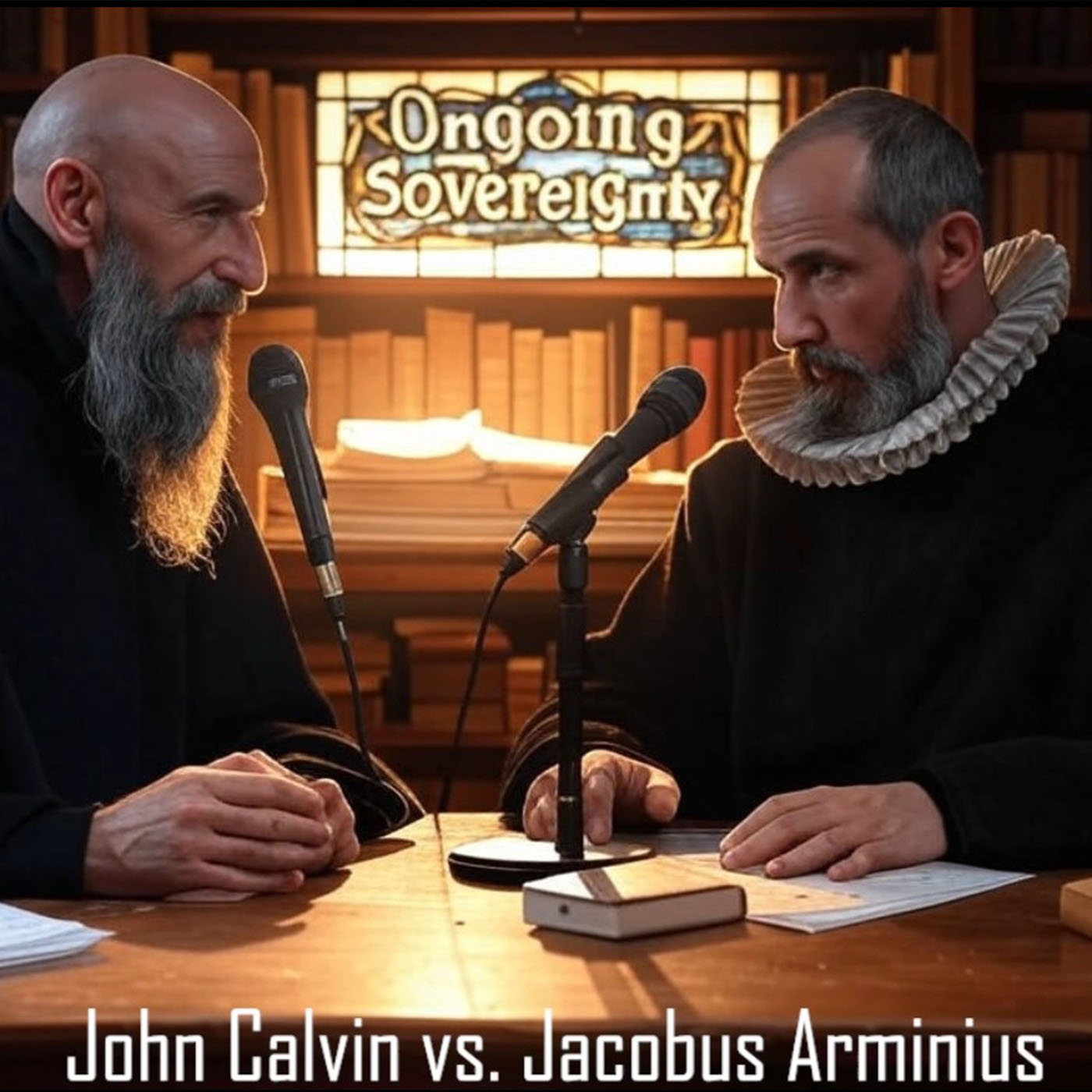
Virtual Debate, John Calvin vs. Jacobus Arminius
from Ongoing Sovereignty Theology Podcast · host Michael Mathis
Welcome, everyone, to this special episode of our theological podcast, brought to you by Ongoing Sovereignty Theology at ongoingsovereignty.org. Today, we’re plunging into a virtual debate featuring two towering figures of Christian history: John Calvin and Jacobus Arminius. No, we haven’t invented a time machine these men aren’t joining us from the 16th and 17th centuries but through the power of AI and text-to-speech technology, we’re reviving their voices and ideas as faithfully as we can. Their clash over predestination, free will, and God’s sovereignty ignited a firestorm that still burns in churches, seminaries, and late-night faith talks. And today, we’re not just replaying that showdown; we’re pushing it into uncharted territory. Let’s meet our debaters. First, John Calvin, the French theologian and pastor whose work in the Protestant Reformation birthed Calvinism. His masterpiece, the Institutes of the Christian Religion, champions God’s absolute sovereignty, predestination, and a view of grace that leaves no room for human boasting. On the other side, Jacobus Arminius, the Dutch theologian who dared to challenge Calvin’s framework. His Declaration of Sentiments argues for human free will and a grace that reaches all, laying the groundwork for Arminianism. Their ideas collided most famously at the Synod of Dort in 1618-1619, long after they’d left the stage, shaping Protestant theology for centuries. Here’s how this will unfold. We’ll kick off with their historical positions Calvin defending unconditional election, irresistible grace, and a limited atonement for the totally depraved; Arminius countering with conditional election, resistible grace, and a universal atonement that respects human choice. Each will deliver a compelling opening statement, followed by two rounds of rebuttals where they’ll dig deeper into their differences, from depravity to the scope of Christ’s sacrifice. I’ll step in with a cross-examination, asking the tough questions to stoke the tension. Then, we’ll pivot. Both will wrestle with their views through the lens of Ongoing Sovereignty Theology a perspective where God exists as the Great ‘I AM,’ ever-present, knowing all possibilities yet leaving the future open through human autonomy, with some decrees set but not every detail fixed. We hope for our virtual guests and the audience listening to begin a dialog that might resolve tensions as these men grapple with a different presupposition of time (that it is simply a measure), possibly finding unity where division once reigned. The rules are straightforward: bring the passion, honor your core convictions, and be ready to stretch your thinking when we explore this fresh perspective on Time. We’re aiming for deep conversation packed with insight that uncovers the tension. Listeners, buckle up this isn’t just a debate; it’s history meeting the presupposition of God as the very definition of the present “I AM.” rather than some distant “I WAS” John Calvin, the floor is yours for your opening statement. John Calvin Greetings, all who seek the truth of God’s Word! I, John Calvin, stand before you not by my own merit but by the sovereign decree of the Almighty, whose glory alone reigns supreme. My opponent, Jacobus Arminius, dares to challenge the clear testimony of Scripture with notions that exalt man’s feeble will above God’s eternal purpose. I shall proclaim what God has revealed: His sovereignty is absolute, His grace irresistible, His atonement limited to the elect, and man’s depravity total. Let no one mistake this salvation is God’s work, not ours, and I will defend this truth with the fire of His Word! First, consider the majesty of God’s unconditional election. Before the foundations of the earth were laid, He chose a people for Himself, not because of their works for what could sinful man offer? but according to His own good pleasure. Ephesians 1:4-5 declares, “He chose us in Him before the foundation of the world, that we should be holy and blameless before Him. In love He predestined us for adoption.” Who are we to question this decree? Romans 9:15-16 thunders, “I will have mercy on whom I have mercy, and I will have compassion on whom I have compassion. So then it depends not on human will or exertion, but on God, who has mercy.” Look to Jacob and Esau before they were born, before they had done good or evil, God loved one and hated the other, that His purpose of election might stand (Romans 9:11-13). Arminius would have you believe God waits on man’s choice, but Scripture cries out: God elects, and His will is sure! Next, the irresistibility of His grace. When God calls His chosen, they come not by their own power, but by His. John 6:44 is unmistakable: “No one can come to me unless the Father who sent me draws him.” This drawing is no mere invitation it is the sovereign act of God Almighty, pulling dead sinners from the grave of sin into the light of life. Ephesians 2:4-5 proclaims, “But God, being rich in mercy, because of the great love with which He loved us, even when we were dead in our trespasses, made us alive together with Christ by grace you have been saved.” Dead men do not choose; they are raised! Arminius’s resistible grace turns God into a beggar, pleading at the door of man’s stony heart. I say nay when God wills to save, no power in heaven or earth can thwart Him! Now, the atonement limited, precious, and effectual. Christ did not die to make salvation possible for all, leaving its outcome to human whim; He died to secure it for His elect. John 10:11, “I am the good shepherd. The good shepherd lays down his life for the sheep,” not for the goats, not for the world at large, but for His own. Again, John 17:9 Christ prays, “I am praying for them. I am not praying for the world but for those whom you have given me, for they are yours.” If He died for all, why pray only for some? Because His blood was shed with purpose, redeeming a definite people. Arminius’s universal atonement robs the cross of its power, making it a gamble rather than a triumph. I stand with Scripture: Christ’s death saves, not merely offers! Finally, total depravity the root of all. Man is not merely wounded; he is dead in sin, incapable of seeking God apart from divine intervention. Romans 3:10-11 states, “None is righteous, no, not one; no one understands; no one seeks for God.” Genesis 6:5 echoes, “The Lord saw that the wickedness of man was great in the earth, and that every intention of the thoughts of his heart was only evil continually.” Arminius would paint man as a noble creature, reaching for God with a spark of good. I say, look to the flood, to Sodom, to our own hearts apart from God’s grace, we are lost, enslaved to sin, utterly undone. Only His sovereign hand can lift us from this mire! Let me close with this: God’s sovereignty is no cold doctrine it is the comfort of the saints! To know that our salvation rests not on our frail wills but on His unchanging decree is peace beyond measure. Psalm 115:3 declares, “Our God is in the heavens; He does all that He pleases.” Arminius would strip this assurance, leaving us to teeter on the edge of our own efforts. I will not yield God reigns, elects, saves, and keeps His own, from eternity past to eternity future. His glory demands it, His Word confirms it, and I proclaim it with all my strength. Let the debate begin! MichaelThanks John, now we move to Jacobus to hear his opening statement. Jacobus the floor is yours for your opening statement. Jacobus Arminius Greetings, seekers of God’s truth! I, Jacobus Arminius, stand before you not to diminish the Almighty’s glory, but to proclaim His boundless love and the dignity He bestows upon His creatures. John Calvin has thundered his doctrine of a sovereign decree that binds man in chains, stripping him of choice and painting God as a distant tyrant. I reject this grim vision! Scripture reveals a God who desires all to be saved, who offers grace that can be embraced or refused, whose Son died for every soul, and who calls us, though fallen, to respond in faith. I will defend these truths with the fervor they deserve, for they honor both God’s mercy and man’s responsibility! First, let us speak of election conditional, not arbitrary. God’s choice is not a blind decree etched before time, but a gracious act rooted in His foreknowledge of faith. 1 Peter 1:1-2 declares we are “elect according to the foreknowledge of God the Father,” and Romans 8:29 affirms, “For those whom He foreknew He also predestined to be conformed to the image of His Son.” God sees who will believe and elects them not by their merit, but their response to His call! Calvin’s unconditional election shuts the door on God’s universal love, as if He delights in damning most. I say nay 2 Peter 3:9 cries out, “The Lord is not slow to fulfill His promise as some count slowness, but is patient toward you, not wishing that any should perish, but that all should reach repentance.” Election flows from love, not caprice! Next, the grace of God resistible, yet wondrous. Calvin claims it forces the elect, as if God drags men kicking and screaming into His kingdom. Scripture tells a different tale! Acts 7:51 Stephen rebukes, “You stiff-necked people… you always resist the Holy Spirit.” Men can refuse, for God woos, not coerces. Revelation 3:20 paints the picture: “Behold, I stand at the door and knock. If anyone hears my voice and opens the door, I will come in.” The door has a handle on our side grace invites, but we must answer! Calvin’s irresistible force turns God into a puppet master, stripping love of its meaning. I proclaim a grace that respects our will, a gift offered freely to all who turn! Now, the atonement universal in scope, infinite in love. Christ did not die for a scant few, leaving the rest to perish by design; He died for all, that all might live! John 3:16 sings, “For God so loved the world, that He gave His only Son, that whoever believes in Him should not perish but have eternal life.” The “world” not some elect clique! 1 Timothy 2:4-6 doubles down: God “desires all people to be saved and to come to the knowledge of the truth… [Christ] gave Himself as a ransom for all.” Calvin’s limited atonement shrinks the cross, making it a private transaction rather than a cosmic triumph. I say Christ’s blood flows for every sinner effectual for those who believe, yet offered to all! Finally, man’s state not utterly dead, but wounded and needy. Calvin’s total depravity casts us as corpses, incapable of even a flicker toward God. Scripture paints a fuller picture. Yes, we are fallen Romans 3:23, “all have sinned and fall short of the glory of God” but Genesis 1:27 endures: we bear God’s image, marred yet not erased. Psalm 51:5 confesses our sin from birth, but Joshua 24:15 commands, “Choose this day whom you will serve.” A corpse cannot choose yet we can, by God’s prevenient grace! This grace precedes, awakens, and enables us to seek Him, as Titus 2:11 promises, “For the grace of God has appeared, bringing salvation for all people.” Calvin’s gloom denies this hope I affirm man’s ruin, but not his annihilation! Hear me, listeners: God’s sovereignty shines brightest in His love! He calls all to repentance, offers grace to every heart, and sent His Son for the world’s salvation. Calvin would lock God in a prison of His own decrees, leaving us no part but to tremble. I say, tremble indeed at His mercy, His patience, His invitation! 1 John 4:10 seals it: “In this is love, not that we have loved God but that He loved us and sent His Son to be the propitiation for our sins.” This is no cold election, but a warm embrace an embrace we may accept or spurn. I stand for a God who loves, who waits, who saves through faith. Let Calvin answer this if he can I yield to the debate, trusting Scripture’s light over man’s system! MichaelWe are now moving into the First Rebuttal: John Calvin, you now have the opportunity to respond to Jacobus John Calvin Arminius, your words drip with sentiment, but they crumble under the weight of Scripture! You paint a God who waits on man’s whims, a feeble sovereign shackled by human choice this is no God at all, but a phantom of your own making! I stand unmoved, for the truth of God’s Word thunders against your errors with a clarity you cannot escape. You claim election is conditional, tied to foreseen faith as if God peers into the future like a fortune-teller, bending His will to ours! Romans 9:11-13 shatters this: “Though they were not yet born and had done nothing either good or bad in order that God’s purpose of election might stand, not because of works but because of Him who calls [Esau] was hated and [Jacob] loved.” Where is your foreknowledge here? It is God’s purpose, not man’s faith, that reigns! Your 2 Peter 3:9 twists in the wind ‘not wishing any should perish’ speaks to the elect, not all, as the context of His patience with His people reveals. You rob God of His freedom, making Him a servant to our fickle hearts! Your resistible grace fares no better. You cite Revelation 3:20, ‘I knock,’ as if God pleads helplessly. Hear John 6:37 instead: “All that the Father gives me will come to me.” Will come not might, not may! Grace is no weak offer; it is power that raises the dead! Ephesians 2:1 ‘dead in trespasses’ means we cannot open your imagined door unless God first breathes life. Acts 7:51’s resistance proves only the hardness of unregenerate hearts, not the failure of His grace. You turn the Almighty into a suitor, begging at man’s gate I say He storms it with sovereign love! Universal atonement? A fantasy! If Christ died for all, why does He pray in John 17:9, “I am not praying for the world, but for those whom you have given me”? If His blood covers every soul, why are not all saved? Your 1 Timothy 2:4 ‘desires all to be saved’ is God’s will of command, not decree, as Romans 9:19 asks, “Why does He still find fault? For who can resist His will?” The atonement secures, not suggests Calvin stands with Christ’s own words! And your half-hearted depravity claiming man wounded, not dead is a lie against God’s verdict. Romans 3:11, “No one seeks God,” is absolute. Your Joshua 24:15, ‘choose this day,’ follows God’s prior grace to Israel, not some innate spark! Genesis 6:5 ‘every intention only evil continually’ leaves no room for your noble sinner. You exalt man to steal God’s glory, but Scripture binds us all in sin’s chains, broken only by His hand! Arminius, your theology is a house of sand built on man’s pride, not God’s truth. I call you to repent of this error and bow to the Sovereign who elects, saves, and keeps His own! MichaelJacobus, you now have the opportunity to give your first rebuttal. Jacobus Arminius Calvin, your thunder roars, but it drowns in a sea of misread Scripture and a God too small for His own love! You craft a deity who delights in damning most, a cold sovereign who tramples the very freedom He gave us this is not the God of the Bible, but a shadow of your own rigid system! I stand firm, wielding the Word to expose your folly! Unconditional election, you say? Your Romans 9 rips Jacob and Esau from context God’s choice there is for service, not salvation, as Genesis 25 unfolds their nations’ roles. Election is grounded in faith Romans 8:29, “whom He foreknew, He predestined.” God knows who will answer! Your Ephesians 1:4 ignores 1:13 “you were sealed when you believed.” Faith precedes, not follows! 2 Peter 3:9’s ‘all’ is plain God’s heart yearns for every soul, not your narrow elect. You shrink His love to fit your decree I proclaim it vast and free! Irresistible grace? A tyrant’s tool! John 6:37’s ‘will come’ pairs with 6:40 ‘everyone who looks and believes.’ Belief is our act, enabled by grace! Acts 7:51 ‘you resist the Spirit’ proves grace can be spurned. Your Ephesians 2:1 ‘dead’ is real, but Titus 2:11 counters “grace has appeared to all” awakening us to choose! You make God a dictator, forcing love I say He offers it, knocking as in Revelation 3:20, trusting us to open! Limited atonement mocks the cross! John 3:16 ‘the world’ means all, not some. 1 John 2:2 seals it: “He is the propitiation for our sins, and not for ours only but also for the sins of the whole world.” Your John 17:9 is Christ’s prayer for disciples, not a limit on His death! If atonement’s restricted, why command all to repent in Acts 17:30? You diminish Christ’s sacrifice I lift it as the hope of every sinner! Total depravity overreaches! Romans 3:11 is sin’s stain, but Genesis 1:27’s image endures marred, yet alive. Joshua 24:15’s ‘choose’ is no empty echo grace empowers it! Your Genesis 6:5 forgets God’s mercy post-flood. I grant our fall, but not annihilation Calvin’s chains bind too tight, ignoring God’s call to all! Your God is a judge alone mine is a Father, loving, pleading, saving through faith. Repent of your gloom, Calvin, and see His grace for all! MichaelTime for your Second Rebuttal: John Calvin John Calvin Arminius, your defiance grows shrill, but it cannot silence the roar of God’s truth! You twist Scripture into a knot of human pride, and I will unravel it with the sword of His Word. Your errors on atonement and depravity stand exposed listen, and tremble at your folly! Your universal atonement is a hollow dream! You wield 1 John 2:2 ‘propitiation for the whole world’ as if it promises salvation for all. Yet Christ Himself says in John 10:15, “I lay down my life for the sheep,” not the goats who reject Him! If He died for every soul, why does Hebrews 9:28 say He “offered once to bear the sins of many” not all? Your Acts 17:30 call to repent proves nothing God commands all, but saves only His elect, as Romans 9:22-23 reveals: vessels of mercy prepared for glory, not wrath! You make the cross a gamble; I declare it a triumph for the chosen alone! And your half-baked depravity claiming man wounded, not dead is a delusion! You cling to Genesis 1:27’s image as if sin spares it. Romans 5:12 strikes harder: “Sin came into the world through one man, and death through sin, and so death spread to all men because all sinned.” Death, Arminius not a mere bruise! Your Joshua 24:15 ‘choose’ rings empty without God’s prior grace Isaiah 64:6, “all our righteous deeds are like a polluted garment.” You paint man noble; Scripture calls him a corpse, revived only by God’s will! Election you bind to faith Romans 8:29’s ‘foreknew’ but ignore Romans 9:16: “It depends not on human will or exertion, but on God.” Grace you call resistible, yet Philippians 2:13 proves, “It is God who works in you, both to will and to work.” Your house totters I stand on rock! MichaelAnd your Second Rebuttal: Jacobus Arminius Jacobus Arminius Calvin, your roar deafens, but it cannot drown the cry of God’s love! You wield Scripture like a club, battering mercy into submission yet it rises to rebuke you. Your atonement and depravity doctrines choke the Gospel; I will free it with truth! Limited atonement? A cruel jest! You lean on John 10:15’s ‘sheep,’ but 1 Timothy 2:6 trumps it: “[Christ] gave Himself as a ransom for all.” Hebrews 2:9 doubles down “He might taste death for everyone.” Your Romans 9:22-23 twists election into exclusion yet John 12:32 sings, “I, when I am lifted up, will draw all people to myself.” Not force, but invitation! You cage Christ’s blood for a few; I loose it for the world, effective for those who believe! Total depravity you overstretch! Romans 5:12 marks our fall, true but Acts 17:26-27 counters, “He made from one man every nation… that they might seek Him.” Seek Him, Calvin not lie dead! Psalm 139:14 “fearfully and wonderfully made” holds even in sin. Your Isaiah 64:6 rags are real, but grace lifts us to choose, as Deuteronomy 30:19 pleads, “Choose life!” You bury man in a tomb; I see him wounded, yet called! Your election ignores faith’s role 1 Peter 1:2, “elect according to foreknowledge.” Grace you chain to force, but Matthew 23:37 mourns, “How often would I have gathered you… and you would not!” Your rock is sand I build on God’s wide mercy! Michael Gentlemen, hold a moment John, Jacobus, the fire in your words has lit up this debate, and rightly so! Your passion for Scripture and God’s truth is a gift to us all, echoing through centuries to this very discussion. But before we press deeper, let me remind you and our listeners that we are one in Christ. As Paul writes in Ephesians 4:4-5, “There is one body and one Spirit… one Lord, one faith, one baptism.” Despite our well-founded zeal, the fruit of that Spirit is love, joy, peace, patience, kindness, and self-control (Galatians 5:22-23). We’re limbs of the same body, seeking unity in Scripture, even as we wrestle with these weighty matters. So, let’s take care to honor who we are in Him as we proceed sharp in mind, gentle in spirit. John, I’ll start with you let’s talk this through. Michael John, your theology rests on God’s absolute sovereignty. If His decree governs all, why does evil thrive under His rule? Romans 9:19 asks, “Why does He still find fault?” how do you answer that? John Calvin Evil exists not against God’s will, Mike, but within it Romans 9:22-23 explains: “vessels of wrath prepared for destruction” highlight His justice, making His mercy to the elect shine brighter. Man’s fault is his own sin; God ordains all for His glory. Michael Fair enough, but if atonement is only for the elect, why does Acts 17:30 command all to repent? Doesn’t that hint at a broader grace? John Calvin Acts 17:30 is a command, not a promise God calls all, but John 6:44 ensures only the drawn come. Grace isn’t broader; it’s precise, securing the elect alone. Michael One last push, John Jacobus insists Scripture demands God loves all. Does your sovereign God do that, or is His love as limited as His atonement? John Calvin God loves all in benevolence Psalm 145:9, “The Lord is good to all.” But saving love is for the elect Ephesians 1:4 else all would be saved, and Scripture would falter. My God’s love is purposeful, not universal in effect. Michael Thank you, John sharp answers, rooted in your view. We’ll hold there for now and turn to Jacobus next. Listeners, stay with us this is getting good! Jacobus, you stake your ground on human freedom. If grace can be refused, how can salvation be secure for anyone? Doesn’t that leave it shaky? Jacobus Arminius Salvation’s secure for those who believe, Mike John 10:28, “They will never perish.” Grace invites, not compels Revelation 3:20, “I knock… if anyone opens.” It’s firm for the faithful, not forced on all. Michael You lean on 1 Timothy 2:4 God “desires all to be saved.” If He’s sovereign, why isn’t that desire fulfilled? What holds Him back? Jacobus Arminius His love, Mike He grants freedom. Matthew 23:37 mourns, “How often would I have gathered you… and you would not!” Sovereignty yields to choice, not weakness His desire meets our will. Michael Last one, Jacobus if atonement covers all, as you say with John 3:16, why does Christ pray only for some in John 17:9, not the world? How do you reconcile that? Jacobus Arminius John 17:9 is for His disciples then, not a limit on His death 1 John 2:2 says, “propitiation… for the sins of the whole world.” Christ’s prayer targets a moment; His blood flows for all who’ll come. Michael Thank you, Jacobus clear and spirited, true to your stance. Listeners, we’ve heard both sides now tension’s high, but unity’s in sight. Stay tuned for what’s next! Well, listeners, we’ve felt the heat John Calvin and Jacobus Arminius have clashed with the fury of their convictions, from unconditional election to resistible grace, limited atonement to human freedom. Their passion has illuminated Scripture’s depths, and we’re richer for it. But now, let’s catch our breath and turn a corner. We’ve tested their historical ground; it’s time to explore a fresh lens Ongoing Sovereignty Theology. This isn’t about erasing their views but seeing them anew, and I’m eager to hear how they wrestle with it. Here’s the heart of it: What if God exists as the Great “I AM” of Exodus 3:14 not a distant “I Was” or a fixed “I Will Be,” but ever-present, defining the now? Picture time as a measure, and our God who knows all possibilities, every path we might take, yet He leaves the future open through the autonomy He grants us. Some decrees stand firm Christ’s victory, the elect’s calling but not every detail is set. His sovereignty unfolds moment by moment, like a master artist painting a canvas where elements of the final image is certain, yet the strokes adapt to our choices. John, you’ve leaned on God’s eternal decree; Jacobus, you’ve championed our response. This view might bridge that gap election spanning time, grace meeting will. Scripture hints at this. Jeremiah 18:7-10 says, “If at any time I declare concerning a nation… that I will pluck up… and it does evil… I will relent of the good.” God adjusts, present with us. Revelation 1:8 echoes, “I am the Alpha and the Omega… who is and who was and who is to come.” He’s not locked in the past He’s here, now. John, Jacobus, I ask you to step into this: How does your theology hold or shift if God’s sovereignty is ongoing, alive in the present? Take your opening reactions keep it passionate, but let’s seek that unity we’re one body for. John, you’re first again. Give us your Opening Reactions JohnJohn Calvin Mike, this “Ongoing Sovereignty” stirs my soul yet I approach with caution, for God’s truth bends not to new winds. If He is the “I AM,” ever-present, I see no fracture in my stance, but perhaps a richer hue. Election remains Ephesians 1:4, “He chose us in Him before the foundation of the world.” That decree stands before time, yet if God acts now, might He elect today as well? Jeremiah 18:7-10 you cite He relents, yes, but within His purpose, not man’s whim. Romans 8:30 chains it: “Those He predestined He also called… justified… glorified.” The chain holds, past to present! Grace, irresistible still John 6:37, “All that the Father gives me will come.” But an open future? Perhaps He draws in the now, as Philippians 2:13 whispers, “God works in you to will and to work.” Atonement’s limit I guard John 10:15, “I lay down my life for the sheep” yet if He’s present, might more sheep be called? Depravity endures Romans 3:11, “No one seeks” but His present hand lifts us. This lens shifts little God’s decree reigns, yet I ponder: an ongoing call within His will? I’ll not yield election’s root, but His now intrigues me. Jacobus, how does this lens of God in the present sit with you?Jacobus Arminius Mike, this theology sings to my heart God as “I AM,” present, alive! It fits my soul’s cry like a glove. Election through foreknowledge 1 Peter 1:2 shines brighter now. If time’s a measure, God sees all paths and chooses in the now, as Romans 8:29, “whom He foreknew, He predestined,” meets His present will. Not fixed before, but unfolding 2 Peter 3:9, “not wishing any perish,” pulses with life here! Grace I’ve called resistible Acts 7:51, “You resist the Spirit” but if He’s with us, might it secure more than I thought? John 10:28, “They will never perish,” hints at a present grip. Atonement for all 1 John 2:2, “the whole world” grows vivid: He offers it now, daily. Depravity’s real Romans 3:23 but Titus 2:11, “grace bringing salvation for all,” awakens us in His presence. This isn’t Calvin’s cage it’s freedom under a living God! I shift, pondering: can grace be both free and sure? RebuttalsJohn Calvin Jacobus, your glee blinds you! This “present” God doesn’t bend election to your will Romans 9:16, “Not of human exertion, but God’s mercy,” anchors it beyond time. Your 2 Peter 3:9 twists again His patience is for the elect, not a universal plea. Grace secure? Only if irresistible Philippians 1:6, “He who began a good work will complete it.” Atonement for all falters Hebrews 9:28, “to bear the sins of many.” Depravity you soften, but Ecclesiastes 7:20, “No one does good,” binds us. This lens refines my view God acts now, yes but your freedom’s a mirage! Jacobus Arminius John, your chains still rattle! Election in the now 1 Timothy 2:4, “desires all saved” frees it from your vault. Romans 9:16’s mercy meets choice Matthew 23:37, “You would not!” Grace sure? Yes, if we open Revelation 3:20. Your Hebrews 9:28 serves “many” who believe John 12:32, “draw all,” broadens it! Depravity’s deep, but Acts 17:27, “seek Him,” lives in His presence. Your decree’s too rigid this God woos in time, blending our truths! DialogueJohn Calvin Jacobus, if God’s “I AM” acts now, my election might stretch Psalm 46:1, “a present help.” Grace unfolds, yet holds firm. Jacobus Arminius John, that present help lifts my will John 3:16’s love spans time. Could election and choice dance together? John Calvin Perhaps a decree alive, not dead. Philippians 2:13 stirs me. Jacobus Arminius And John 10:28 steadies me His now unites us, slowly. Michael Well, I am glad to see you both working though this… Let’s take it a step further: Here’s a final thought, if God created us to have a genuine relationship with Him, and we see examples of that relationship throughout the Bible where he is responding to prayer, responding to repentance, responding to praise, responding to sin… And if we are to truly enjoy Him, and He us. The Idea of a God who can never experience a single choice He didn’t already determine is not a relationship. I would agree with Calvin on the Doctrines of Grace… All three persons of the Trinity must act on our behalf in order to have any hope of Salvation. And I agree with Jacobus that God did not make us into puppets incapable of choice. Perhaps, after setting down the false Greek Philosophies about God’s existence outside the present, we can find ourselves in a much greater position for unity. John Calvin Mike, your words pierce relationship with God is indeed His gift. If He’s “I AM,” present, I hold Ephesians 1:4 election before time yet see Jeremiah 18:7-10: He responds, relents, within His will. The Doctrines of Grace stand Romans 8:30, “predestined, called, justified, glorified” the Trinity’s work, sure! But puppets? No Philippians 2:13, “God works in you to will,” suggests a living decree, not a dead script. Greek timelessness I’ll ponder if He’s now, my election might pulse with His responses, not just pre-set. Unity beckons, though I guard sovereignty’s root. Jacobus Arminius Mike, this rings true relationship thrives in freedom! God as “I AM” lifts 1 Timothy 2:4 “desires all saved” into the now, answering prayer as Psalm 34:17, “The Lord hears.” Choice isn’t puppetry Matthew 23:37, “You would not,” proves it. I nod to grace’s depth John 10:28, “never perish” yet see it offered, not forced, per Revelation 3:20. Shedding Greek shackles, I find His present love John 3:16 unites us. My will and His grace might meld closer than I thought, John’s firmness softening my edge. John Calvin Mike, your lens of Ongoing Sovereignty stirs us both yet your claim that God exists only in the present pricks my mind. Salvation’s work we’ve debated, but relationship with Him you now lift higher. I request Jacobus and I cross-examine you on this. If He’s “I AM” alone, how does this shape our eternal bond and relationship with Him? Michael Fair request, John I’ll welcome it. Listeners, we’ve wrestled with salvation’s mechanics election, grace, atonement but John’s right to pivot us. Salvation’s not the end; it’s the door to eternity with God. Ongoing Sovereignty Theology sees Him as the “I AM,” present, not a timeless statue of Greek thought. Exodus 3:14, “I AM WHO I AM,” roots Him here Revelation 1:8, “who is and was and is to come,” dances across time, yet His now is where we meet Him. Consider this: God created us for relationship Genesis 3:8, walking with Adam; Exodus 33:11, speaking to Moses “face to face, as a man speaks to his friend.” He responds prayer in Psalm 34:17, “The Lord hears”; repentance in Jonah 3:10, relenting; praise in Psalm 22:3, enthroned on it; defiance in Isaiah 1:18, “Come, let us reason.” A God who predetermined every choice, knowing no surprise, feels less relational more puppeteer than Father. I agree with you: the Trinity’s grace saves us Romans 5:8, Christ’s death; John 6:44, Father’s draw; John 16:13, Spirit’s guide. But if God’s only present, not outside time, He experiences our yes, our no, our love anew. Salvation’s vital, but eternity with Him Revelation 21:3, “Behold, the dwelling place of God is with man” is the prize. Not just saved from, but saved for relationship, growing forever. Test me, John. John Calvin Mike, your “present only” God intrigues, yet stumbles. Relationship I crave Psalm 16:11, “In your presence is fullness of joy” but if He’s not beyond time, how does Ephesians 1:4, “chose us before the foundation,” stand? Election’s past root secures my bond does God in your view rewrite it daily? And Psalm 139:16, “Your eyes saw my unformed substance; in your book were written… the days,” suggests He knows all ends. A present God responding Jeremiah 18:8, relenting warms me, but loses eternity’s anchor. Salvation’s start, yes yet relationship demands His timeless gaze, else our joy wavers with each moment’s choice. Michael No, John, God does not need to rewrite anything; all that He decrees will absolutely come to be because His power and authority over all things is total. However, you seem to be making an assumption the Bible does not make that God makes a decree about every action that will ever be. That would contradict the clear teaching in James 1:13, “God does not tempt anyone, but each one is tempted when he is drawn away by his own desires.” No! Our God has clearly left a vast number of things open and undecided, yet He intervenes directly, through Christ, and through the work of the Holy Spirit to work all things together for the good of those who love Him, as Romans 8:28 promises. His decrees, like salvation, stand firm, but our walk with Him, our relationship, unfolds in the present dynamic, alive, not a script. John Calvin Fair but if He’s surprised, is He sovereign? Isaiah 46:10, “Declaring the end from the beginning.” I see unity here, yet guard His all-knowing heart. Michael John! Have you forgotten all the places where Scripture speaks of God’s emotion? Genesis 6:6, “The Lord regretted that He had made man on the earth, and it grieved Him to His heart.” He was angry with His people Exodus 32:10 yet Moses persuaded Him to have mercy, appealing to His character (32:13-14). Zephaniah 3:17, “He will exult over you with loud singing.” God’s sovereignty isn’t a mandate that He must exercise total control; it’s His holding all authority and choosing when to use it as He pleases. A surprised God isn’t weak He’s relational, alive with us! John Calvin Mike, your words strike a chord I cannot dismiss Scripture’s witness to God’s heart indeed resounds. Genesis 6:6, “He regretted and was grieved,” unveils a Sovereign moved by His creation’s waywardness, not a stoic tyrant. Exodus 32:14, where Moses sways Him to mercy, reveals a will responsive yet supreme His character, not ours, prevails. Zephaniah 3:17’s song of joy over us paints a Lord delighting in relationship, not merely decree. I concede: these are no mere metaphors, but glimpses of His living nature. Yet, I hold fast Isaiah 46:10, “Declaring the end from the beginning,” guards His omniscience; Ephesians 1:4, “chose us before the foundation,” anchors His purpose. Sovereignty, you say, is authority wielded as He pleases this I affirm! He need not dictate every step, as James 1:13 attests, sparing Him the authorship of sin. Perhaps His “I AM” presence weaves election and response together a tapestry fixed in aim, yet fluid in thread. My doctrines stand, but your lens illumines a God who reigns not as a cold architect, but as a Father engaging His own. Unity dawns if His now embraces both my decree and our walk. Michael Listeners, John’s given us much to chew on his sovereignty bending toward a present, relational God. Now, Jacobus, it’s your turn to step up. We’ve explored salvation’s mechanics, but eternity in relationship with Him shines brighter still. Jacobus, test me on this Ongoing Sovereignty view God as the “I AM,” present with us. Go ahead. Jacobus Arminius Mike, your relational God lifts my spirit John 15:15, “I have called you friends,” thrives in the now! Choice Matthew 23:37, “You would not” sings with a present “I AM,” free from Greek chains. Salvation’s gate opens to eternity Revelation 3:20, “I will come in and eat with him” not just rescue, but fellowship! Yet, if He’s only present, how does 1 Timothy 2:4, “desires all saved,” hold if He’s blind to the future? How does He plan our bond without knowing its end? Michael God desires we would all obey Him all the time, Jacobus but we do not. In the same sense, 1 Timothy 2:4, “desires all saved,” reflects His heart that all turn, repent, and trust in Christ’s finished work. Yet we who are saved are His “beautiful feet” (Romans 10:15), called to pray, share, and preach as we make disciples (Matthew 28:19). God can elect to save, as with Paul in Acts 9:15 exception, not rule. He’s chosen to include us in His design 2 Peter 3:9, patient, waiting. Our faithfulness varies, but we’ll all give account (Romans 14:12). His plan unfolds through us, in the now. Jacobus Arminius Alive, yes Psalm 33:11, “The counsel of the Lord stands forever,” steadies me. But if He doesn’t know tomorrow, can He secure eternity? John 10:28, “They will never perish,” promises safety does a present-only God keep that without foreseeing? Michael Jacobus, you are seeing God far too small. Imagine God knowing every possible combination of events, every personality of every person who will or could ever exist then compound that with the ability to accomplish in a single day what we couldn’t in a thousand years with each person, animal, plant, and bug. No one knows you as intimately as God does not even yourself (Psalm 139:1-4). For Him to be “God with us” is an infinitely deep and powerful task. Your “if He doesn’t know tomorrow” is false He knows more about tomorrow than all of us combined times infinity! And with absolute authority Colossians 1:17, “In Him all things hold together” yes, He keeps His promises, like John 10:28, effortlessly. Jacobus Arminius Trust warms me John 3:16’s love in the now unites us! Yet, if He’s surprised, is He less? Isaiah 55 :8, “My thoughts are not your thoughts,” suggests depth beyond time. I lean to this, pondering His scope. Michael Surprise doesn’t lessen Him, Jacobus His depth embraces it. Genesis 22:12, “Now I know,” after Abraham’s faith, shows Him engaging our choices. His “I AM” is sovereign love, not static omniscience eternity’s joy grows as we walk with Him! Jacobus Arminius A love that grows Revelation 3:20’s fellowship I see unity here, Mike, if His now holds both will and grace. Michael Gentlemen, we’ve sparred fiercely salvation, sovereignty, relationship and I’m grateful for it. But let’s ease up a bit, take a breath, and just… marvel together. God’s bigger than our systems, isn’t He? We grasp at His edges me with my “present only” push, John with your decrees, Jacobus with your freedoms. What if our limits are the real story here? Scripture’s pulled us this far can it draw us closer still? John, what do you think how do we stand before a God so vast? John Calvin Mike, I’ll confess His vastness humbles me. Psalm 145:3, “Great is the Lord, and greatly to be praised, and His greatness is unsearchable.” I’ve clung to Ephesians 1:4’s election, tracing His will before time, yet your “I AM” stirs me Exodus 3:14, a mystery beyond my grasp. We’re but children, squinting at the sun. Scripture’s my rock Romans 11:33, “Oh, the depth of the riches and wisdom of God!” and if it bridges us, I’d rejoice. Jacobus, does His word not mock our smallness? Jacobus Arminius Oh, it does, John! Isaiah 55:9, “As the heavens are higher than the earth, so are My ways higher than your ways.” I’ve fought for Matthew 23:37’s choice, but Mike’s present God Revelation 3:20’s knock widens my view. We’re like sailors charting a sea too deep our maps falter. Yet scripture sings unity John 17:21, Christ praying “that they may all be one.” Our limits bind us, if we let His word lead. Michael That’s it, isn’t it? We’re bound by what we can’t know Job 11:7, “Can you find out the deep things of God?” I push His now, you both wrestle past and future, but we’re all reaching. Ephesians 4:13 till we “attain to the unity of the faith” feels close here. His word’s the thread can we laugh at ourselves a little and trust it more? John Calvin A laugh, Mike? Perhaps Psalm 2:4, “He who sits in the heavens laughs.” My pride’s taken blows, yet 1 Corinthians 13:12, “Now we see in a mirror dimly,” softens me. Unity through His word? I’d clasp hands on that. Jacobus Arminius And I’d join Proverbs 3:5, “Trust in the Lord… not your own understanding.” Our dim mirrors reflect one Lord. Let’s lean on scripture’s light together. Michael Beautiful His mystery humbles, His word unites. We’re never done learning, are we? And there you have it listeners, a debate centuries in the making, brought to life today. We began with John Calvin and Jacobus Arminius locked in their historic struggle: Calvin championing God’s sovereign election, unyielding and eternal, rooted in passages like Romans 9; Arminius defending human free will and God’s universal grace, drawing from verses like 1 Timothy 2. Their opening statements and rebuttals sparked fire predestination versus choice, irresistible grace versus resistible love. The cross-examination sharpened those edges, probing responsibility, the cross’s power, and perseverance. Then came Ongoing Sovereignty Theology a twist where God, the Great “I AM” of Exodus 3, knows all possibilities but leaves the future open, even to Himself, due to creaturely autonomy. His decrees are certain, yet not all is decreed; the rest unfolds in time. Calvin saw election as dynamic, still sure within God’s will. Arminius found room for freedom, grace adapting moment by moment. Where once they stood worlds apart, this lens brought them closer Calvin’s sovereignty and Arminius’s love meeting in a God who acts now, not just then. We’re not saying the debate’s settled far from it but today, these two giants found a thread of harmony. What do you think? Does this view reshape your understanding of God’s will or human choice? Share your thoughts on X, our website at ongoingsovereignty.org, or wherever you connect. If this stirred you, spread the word share this episode, subscribe for more. John Calvin, Jacobus Arminius, thank you for this journey through history and theology. Until next time, keep wrestling with the big questions.
NOW PLAYING
Virtual Debate, John Calvin vs. Jacobus Arminius
No transcript for this episode yet
Similar Episodes
Mar 26, 2026 ·1m
Jan 2, 2026 ·47m
Dec 21, 2025 ·46m