
This podcast is brought to you by Squarespace. I talk to entrepreneurs all the time who are looking for a way to upgrade their digital footprint. Well, whether you're just starting out or you're scaling your business, Squarespace is the easiest way to build a great website that stands out. It's an all-in-one website platform that gives you everything you need to claim your domain, showcase your products, and get paid.
Anyone can use Squarespace's cutting-edge design tools to build an online presence that truly reflects what makes your business special. There are templates, intuitive drag-and-drop editing, and even an AI-enhanced website builder. Then, Squarespace's built-in analytics tools help you make smarter business decisions, review website traffic, learn where to focus engagement, and track revenue all in one place. Looking to grow your business?
Squarespace even offers fast, easy business financing through Squarespace Capital. Go to squarespace.com.com.com for a free trial. And when you're ready to launch, use offer code BUILT to save 10% off your first purchase of a website or domain. Loans issued by Celtic Bank and Service by Stripe, all loan subject to credit approval.
This episode is brought to you in partnership with Airbnb. This past summer, I took my family to Athens, and it was truly an incredible trip. We ate amazing food, we saw the Parthenon and the Agora, and all the incredible things that you can see in one of the most amazing cities in the world. And one of the things that made it special was the home we booked on Airbnb.
We could see the Parthenon from our bedrooms. It even had a small jacuzzi on the roof, and we were walking distance from everything you'd want to see. We had such an amazing time cooking and just spending time together as a family in that home on Airbnb. If you've ever had a chance to visit Athens, I cannot recommend it enough.
That's the thing about Airbnb. You're not just getting a place to sleep, you're getting a home base that fits your trip. And while you're away, your own home doesn't have to sit empty. Hosting on Airbnb can help you earn extra money on your schedule with full control.
Your home might be worth more than you think. Find out how much at Airbnb.ca. Host. Hey, really quick before we start the show.
How I built this is now a book, and it's coming out in a few weeks. It's full of insights, advice, wisdom, and guidance all told through the stories of some of the most amazing entrepreneurs on Earth. And if you pre-order the book right now before September 30th, I will send you a signed book plate to put inside the book for free. To order the book and to get your free book plate, visit gyraws.com.
Just a quick heads up before we start the show. There are a couple of swear words in this episode, so you may want to keep in mind if you're listening with kids. OK, now on to the show. I would go in on my rollerblades, because I could hit 50 stores in a day on my rollerblades, whereas if I was walking it'd be a lot less.
One of the early stores I went into, I found the store manager. First he's laughing at me because I'm on rollerblades and I'm a sales guy without a polo shirt and a briefcase. And he takes a sip and he said, this is never going to work. It tastes like sock water.
Ramen VR is how I built this. I show about innovators, entrepreneurs, idealists, and the stories behind the movements they built. I'm Guy Raza, and on the show today, how Michael Curban shipped thousands of cases of coconut water to New York, fought off a ram that looked just like his, and built by the cocoa, the top-selling coconut water in the country. You remember that kid in high school who was weirdly interested in business, who had almost no interest in going to college or starting a traditional career, but was determined to start something on their own?
You might have snikered about them, or even rolled your eyes, or maybe that kid was you. Well, that kid was also Michael Curban. Michael had the benefit of watching his dad pursue a bunch of different business ideas, including ideas that failed. But the specter of failure never worried him.
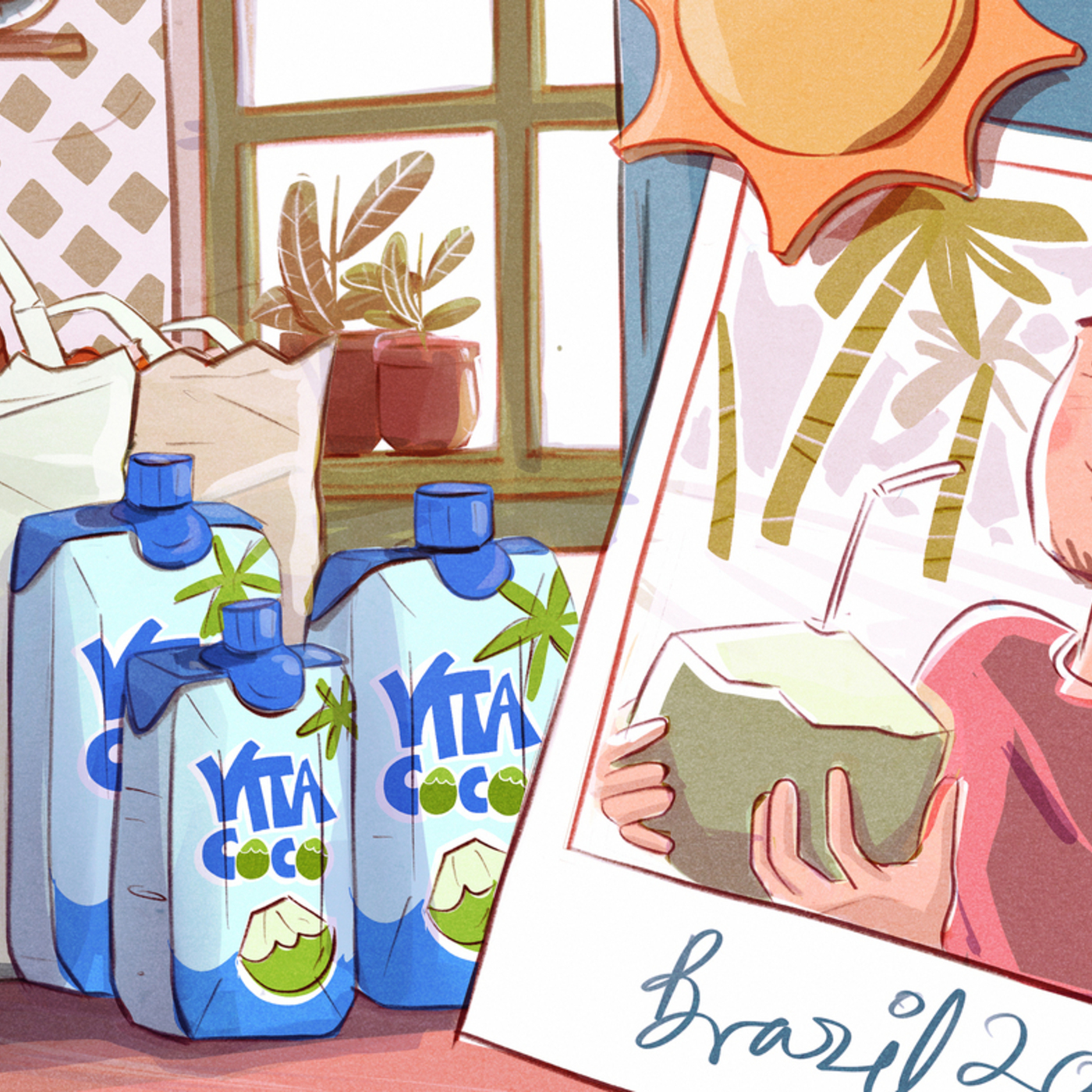
He knew from a very early age that it's part of the game, that you gotta take big swings, which means you will also strike out a lot. And the biggest swing Michael would take would be for Vitacoco. You've probably seen their familiar tetrapack boxes of coconut water in pretty much every convenience store. In the early 2000s, when Michael was trying to launch the brand in New York City, he was pretty confident that coconut water would take off.
At the time, most people who bought coconut water were immigrants from places like Vietnam, India, the Caribbean, and Latin America. But Michael had a hunch that coconut water could compete with sports drinks like Gatorade. Now, at the exact same moment, someone else had the same exact hunch. It would become a product known as Zico.
And so what happened and what you will hear is a story about a war. The coconut water wars of the early 2000s. A war with sabotage, subterfuge, dirty tricks, and eventually a pretty decent outcome for both parties. Today, Vitacoco is the biggest brand of coconut water in the US.
It has about 40% market share, but it would take a lot of time and a lot of obstacles to get there. Michael grew up in Connecticut and when he was nine, his parents split up. It was amicable, but while Michael's sister chose to live with their mom, Michael decided to stay with their dad. My mom got custody.
I think my dad gave my mom custody and my dad was actually packing his things and preparing to leave the house. And I packed my Snoopy suitcase, put it with all my dad's stuff. And I remember my mom coming home and saying, what's this? And I said, I'm moving with dad.
She said, okay. And that was it. Wow. That's amazing.
My mom ended up, a few years later ended up moving into New York City. So I'd spend weekends in city, and I'd still see her quite a bit, but I was super close with my dad. What did your parents do when you were a kid? As a kid, my dad was an entrepreneur.
My dad always had businesses before him. My grandfather always had different businesses. My great grandfather. Same thing.
So I come from a long line of entrepreneurs. I don't think there's a single male in my family who's graduated from college on both sides. And my dad, when I was young, had a roller skating rink, which was awesome. And those were the successful days.
And then he had other businesses that weren't so successful. And we went through periods of doing well, and then other periods of not doing so well. And were those like, I had a roller skating birthday party in Fortran. I remember birthday parties and church groups and youth group events and stuff like that happen there.
Yeah. Everybody I went to school with as a kid had their birthday party at the roller skating rink. So it was good. So I got to go to all the parties, whether I was invited or not.
Yeah. And then as roller skating kind of went out and wasn't a cool thing anymore, he turned the place into a rap concert hall. So I grew up at 12, 13 years old, hanging out with Beastie Boys, Elle Cool J, you know, as a kid, it was really, really cool experience. So he really pivoted because thinking about what happened at roller skating, it was great.
It was like one day was there and it was gone. Yeah. It was a real fad. I mean, it's just, you know, people stopped going and he pivoted very quickly.
And you know, that works for a little bit of time. And then just didn't work anymore. So in terms of school, how was it for you? Was it hard?
Was it easy? Were you a good student? Not a good student? School was really tough.
I had several learning disabilities from attention deficit up this order to form of dyslexia. And as I got into high school, they diagnosed me. And by diagnosing me, they put me in what we used to refer to as rompa room, which was half the day in normal classes and half the day in basically it was special that it was a room with me and other kids, many of which had more complicated issues than I had. I knew I was very late in reading, and math was really hard for me.
And I had a clear goal and that goal was to get seas and, you know, get as close to passing as possible. And that was always the objective. And I always knew that I would be successful in whatever I did. But why?
How did you know that? I don't know. I just felt, because even then, right, even though I was in these classrooms, I was still successful in things that I wanted to do. You know, I was not the best athlete, but I worked hard and I was able to play ball.
And it wasn't the best, you know, I definitely wasn't a good student, but I was able to get by. And I just, you know, I just had this confidence from an early age. Were you, were you, did you go to a big high school? No, I went to actually a really small high school in this small town.
And actually, so my junior year in high school, my dad started spending a lot of time in Florida because he was starting to build a business there, doing kind of vacation rental, property management stuff for tourists coming to Orlando and then corporate housing and things like that. And I was alone quite a bit my junior year and I would have big parties. I would charge admission. I turned into a business every weekend, making significant money.
You have parties at your dad's house? Yeah, with his permission, I'm assuming. Yeah, he knew. And you know, super responsible collecting keys and sure nobody went anywhere if they were drinking, nobody was driving, you know, really, really responsible, but they were big parties and I was charging admission and it was a nice, successful venture at the time.
So you were, and like, do you remember what you were charging like five bucks or 10 bucks to come in? Yeah, that's right. It's five bucks and 10 bucks for freshmen. Nice.
You know, dad, eventually, I guess, moved to Orlando and then you went to college to the University of Alabama, which, yeah, I don't know, being like a Northern kid at a Southern school, was that like, had you, did you enjoy it? I had a good time. I enjoyed it. But towards the end of the second semester, I realized I was actually sitting in an economics class and I was listening to a professor and I remember not understanding what he was speaking about.
And I remember thinking I'm not learning anything from him. I'm spending money to go here. I could very easily not be here and use that money or make money, right? And so there was this moment I remember exactly where I was sitting when I said I'm done, like, school's not my thing.
And about a week later, I was back in Orlando and then I was like, and did your dad ever say, hey, Mike, you know, I think you ought to get a degree college degree or not at all, never even. Wow. What do you want to do? Do you want to do that?
Do you need a college degree? Do you want a college degree? And it was more of a question to me. And that was kind of the way I was raised with everything, right?
Like, even in high school, like, what do you want to be when you get older? Do you want to be an academic? Then if you do, you need to start really studying. If you don't, you need to get through.
Like, it was just a special back then. It was different. It sounds like your relationship with your dad was almost like, like you guys were roommates like friends. Yep.
To this day. And we're business partners too, right? So for the past 25 years. So yeah, no, it's definitely more of a friendship and a partnership and a yeah, absolutely.
So you come back to Florida and Orlando and you like go back to your dad's house and live with them there. Yep. And what was your plan? I didn't have one.
And it was around that time that my grandfather on my mother's side, who I was also very close with, passed away up in Connecticut. And so I went to Connecticut and spent some time with my grandmother, helping my grandmother, who had all timers. I was helping with, you know, all sorts of family matters and stuff at 19 years old. And then I went back and forth to Orlando, which is I was actually in the process of starting a business at the time with my dad and my friend, this computer software company that we were developing to help run my dad's business.
This is a property management business. Yes. And who was your friend? He was a friend of a friend, actually, a member of Orlando.
He was a computer programmer and brought him in to help write this system for my dad's business. And what was that? Like, what did it do? So it does everything from marketing of the apartments, from booking and scheduling to housekeeping management, move in, move out, billing.
I mean, it's a pretty large system. This is like sales for specifically for property management. And so you started this kind of business with your dad and your friend or you really actually formally started business. Yeah.
So originally, it was just, let's build this for my dad's business. And then we started, you know, showing it to some of my dad's friendly competitors. And we had our first sale and then we created a business and I was going back and forth through Orlando at the time. But there wasn't much of a business there.
It was mostly development work that was being done. And I should mention that during some of this period, like you weren't even in the US, right? Like you, like you decide to spend some time in Italy. Yeah.
It's during that time period that I was in Italy. And I can remember back then being on pay phones on the street in Italy, having conversations about should we invest and go to this trade show to show the software? Is it ready? Is it, you know, and, and you know, that's before there were cell phones or anything else?
So why, sorry, so you, you decided you want to go to Italy for first of all, why did you want to go to Italy? What was it? Because I didn't know what I wanted to do. Right.
I didn't even know if one day, you know, if I would come back and go to work doing that business. At one point, I almost opened a bagel shop in Florence. You know, I had no real plan whatsoever. Yeah.
And just wanted to take some time and experience and, you know, to courses at the university in European politics, which I just found very interesting. I traveled by myself. I think it was during that time that I really found myself and I know everybody says this, but you know, it really was so impactful. It was a very impactful time in my life.
So, all right. So you, you're in Italy and do you do at some point, you decide, you know, I'm going to go back to Orlando and just kind of focus on that business. No, I actually went from Italy to New York, moved in with my sister in New York City and then eventually found my own place. And I was doing a few things.
I was doing some promoting. I actually invested in and helped open an event space in Manhattan. How did you have money by the way? Did you inherit some money from your grandfather when he died?
So my grandfather left me like $40,000. And that money was what I was to use for college. So that's part of the reason I decided not to go to college anymore because I felt I want to make this money last me a little longer. So you had that money to kind of keep you going.
That's right. I'm wondering when you got to New York, because this is your 21. So this must have been the late 90s. I mean, you wouldn't be able to get a job, a lot of jobs without a college degree at that point, right?
Yeah, I never would have like, wanted to look for that job. I never even thought that I would ever have a job. It just never crossed my mind. You thought I'm going to start something?
Yeah, but I was never really focused on looking for that thing either, right? I was just kind of doing and the software business was starting to, you know, we've got a couple of clients. There was no money to be made yet. Everything was going back into the business.
And then when the software was a little bit more stable and ready to actually sell, that's when I decided that, and I remember exactly where I was, I had bought an apartment. I took the remaining money that I had. I had like $20,000. I used it as a down payment on a one bedroom apartment in Greenwich Village.
And I remember being in that apartment and talking on the phone with my dad and having this conversation about, you know, let's start seeing if we could sell this thing. And that's when I went to work and took a small salary and started building that business together. And then there was the break was a trade show, right? It was a trade show that was formed specifically for the corporate housing industry.
And it was at that trade show where we started getting real leads. So you're doing that business and and it and did it start to grow pretty quickly. It was a slow burn. I mean, we, you know, it was it was a grind for many years.
It wasn't until 2005, 2006 that we had a couple of big breaks. We brought in Marriott at the time as a customer and another large multinational who was in the space and started to actually make money. Before that, it was really like paycheck to paycheck, you know, trying to pay the bills type of thing. So all right.
So you weren't doing that. It's the early 2000s. You're living in New York and you got your lucky apartment in the 90s in Greenwich Village. Because back then you have to put $20,000 down and get in the apartment.
So that you couldn't get parking space for $20,000. Not even close. It sounds like you were doing fine. You know, you had to sort of study income and you were traveling and you were selling this software.
And that was it. Yeah, I would say for anybody my age at the time, when most of my friends were graduating from college or starting their first year of work, I had a business that was up and running that was, you know, it wasn't printing money, but it was successful. And it was really balancing work and life, which I've always done. I've always taken very seriously.
What did that mean? You were doing what? So when I wasn't on the road and I wasn't traveling and I wasn't on one specific phone call, because I was working from home, I was down at the local cafe down the street where I used to go every day, having a very long lunch and talking to all my friends that were also there. And then I would probably sit in Washington Square if it was nice and sunny and read a book and start talking to people and meeting people and creating friendships and conversations.
And how would you do that? I'm curious. How would you just you just strike up conversations with people? Yeah, I guess.
Or people would strike up conversations with New York City. And I was always on my rollerblades and I was always outside. You know, it's actually funny. I think of myself almost as somewhat shy.
Yeah, my life has been the opposite. And I think it's strange. So you're living in New York and hanging out with friends. And I guess around 2003, you and a friend, is this Ira?
Ira Laurent. Yep. He goes by Ira. He goes by Ira.
He was a friend of yours from my school. So Ira was from New York, or from Israel originally, but grew up in New York City. And then went to study abroad in Florence. And I had just come back from Florence and a bartender, who I become friendly with in Florence, became friendly with Ira.
And Ira was going back to New York to visit his family for something. And the bartender gave Ira coffee, wine, a few other things to bring. And said, find my friend. He's in New York.
Bring this to him as a gift. Oh, wow. And Ira looked me up. I remember exactly where we met up.
We met up at that same cafe that I was talking about. It's on Thompson Street in Houston. And we hung out and we just hit it off. We became friends and we hung out all the time.
And what did you have in common? I think we're both very similar in that we're very social. We liked it. We were very driven in a way.
And we were always looking for business opportunities. I remember he wanted to start a power washing company. And I helped him. I bought a power washer and loaned it to him and created a little business there.
I helped him with something else he was working on. And so we were kind of always doing some sort of business in a weird way, even though we didn't have a real formal business at the time. And so we were just hung out quite a bit. All right.
So the two of you guys are hanging out. And this is important because from what I understand, there's a pretty significant event that happens. You didn't know it at the time. You guys are like, I guess at a bar and you meet two women from Brazil.
What's the story? Yeah. So we were at this party and we were there for a long time. It was like a February or something was cold.
It was late at night. And I remember Eira saw these two girls leaving and convinced them to come back into the bar, take the coats off and have a drink. They were from Brazil and we sat at the bar and we chatted and we talked for quite a while. So these these two young women from Brazil are just, you know, chatting.
But there's no, because obviously this is going to eventually lead to coconut water. But there's no conversations about coconut water at this point, right? So coconut water actually did come up at the bar. In a weird way, we were talking about food.
We were talking about Sao Paulo. We were talking about restaurants. And somehow it came up coconut water. We actually remembered afterward having a conversation about it.
But it wasn't like, you know, at that moment at the bar, you know, anything specific besides one of those things that are great about Brazil. Yeah, like you could go to the beach and you could not stop Hello, but in Rio. And there'd be people like with coconuts and they'd crack one open and get some coconut water. And that's something that they may have mentioned about what they miss about Brazil.
Well, it is it is a cultural thing in Brazil more than just a beverage. And in a lot of the tropical world, it's a cultural thing. It's coconut water is has all sorts of health properties. And in every country in the world, every tropical country in the world, your grandmother tells you a different reason why you should be drinking coconut water.
And it's an incredibly popular beverage that has a cultural connection beyond just being a juice or beverage. So what happened after you you met those women at the bar that night? So one of them era, he ended up, you know, seeing a couple days later. And then we started hanging out together for the next week or two while she was in a short period of time that she was in in New York.
And he ended up falling in love with her. And when she went back to Brazil, shortly thereafter, he went back with her. Wow. And he plans to go to Brazil for a long period of time or he doesn't know or just she just goes down to follow her.
At the time, he wanted to just, you know, go down, check it out. He wanted to be with her. And so he went, he found his own place. And he didn't really have much going on down there.
I went down to visit several months later. And he's like, I'm going to stay. And when you got there, what did you do? We hung out a couple of days in Sao Paulo, hung out with her and her friends and her family.
But while I was there, I mean, you know, he was talking about staying and he was talking about, you know, different business opportunities. I remember he was looking at leather from the Northeast, making women's shoes, which was, you know, becoming a business for export in Brazil at the time. And he was talking about coconut water. And in Brazil at the time, coconut water was, I think, within, you know, maybe a year or so prior to my visit, they'd started selling coconut water in a tetrapack and shelf stable.
So it was in grocery stores now. It wasn't only on the beach. And it was becoming incredibly popular in people's refrigerators all over the country, not just on the beach in Rio. And he showed it to me.
He took me to a couple grocery stores. We talked about it. He was in the early stages of developing what was somewhat of a business plan. What?
Let me just go back for a second. When you get, when you are hanging out with your there, does he say to you, Hey, Mike, people drink coconut water here. It's on, you can get in grocery stores, check this out. I think we should.
I think there's an opportunity in the U.S. Did he was he already saying that when you got there? Yeah. And it wasn't a we thing.
It was him, you know, like, I'm looking at different opportunities. This is one of them. This is one of them. This is one of them.
I was more intrigued by the coconut water thing than any of the others. Why? It's not much more fun and interesting. I had no interest in being in the shoe export import business.
And, you know, we started digging a little bit deeper while we were there. But then he said he's going to further develop the idea and so on and so forth. And then he came back to New York, I don't know, short period after with a more developed idea of creating a brand and selling it in the U.S. He didn't have the brand name or any of those things yet, but he was what he was really focused on.
And I remember we were back in that same bar on Thompson in Houston. And I said, okay, if you do this, I'll do it with you. I'll invest some money, invest some time. And let's do it together.
And I remember we wrote down what each of our responsibilities were going to be. He was going to kind of find the supply and do all these type of things. And I was going to figure out distribution and find customers to buy it. So he was going to deal with the Brazilian side.
You did not have to go like move to Brazil. No, that's right. And this is 2003, I guess. Yes.
And we were off. By the way, when you tried coconut water, were you blown away by it? Or you're like, oh my god, this is amazing. Or did you have a less excited reaction?
So I had tried it over the years, right? I'd bring to the tropics a bit. I tried coconut water. But the first time I tried it in a package without my feet in the sand and the whole bit, I wasn't blown away.
But when I started to see that it was outselling Gatorade and every sport drink in the grocery store in Brazil, I thought maybe there's a business here. And again, it wasn't about creating a big business. We never set out to create a big consumer goods business. Let's see if we can make a little bit of money.
Never expected it to go further than New York City. All right. So you go back to New York and then Eira comes back and he says, hey, I'm serious about this coconut water thing. And you say, I mean, I want to be involved.
How much money did you put in? Do you remember? I think it was actually, I put in, I think if I'm not mistaken, $75,000 and then later put in, I think the initial investment was $75,000. And by the way, did you guys like formally put down a partnership and set up an LLC and do all that stuff?
Or was it less formal? No, we pretty immediately formed a partnership. We created an LLC, put a little bit of money in the bank. I remember when we opened up the bank account.
So you were going to stay in New York, he was going to go down to South Hallo. And by the way, yes, he's still, he went to Brazil originally to date this woman that he met in New York, were they still together at that time? Yes. Yeah.
Yeah. They were still together and I think they were engaged at the time. Wow. So that was pretty quick.
Yeah. He got engaged. So he married to this woman in Brazil. And he's going to purchase coconut water and send it to you in New York.
And you're going to figure out how to sell it. But let me try to break this down. First of all, you were going to sell it the same way they were selling in Brazil in like a cardboard Tetra pack in New York. Yeah, which didn't really exist in any beverage, right?
Besides milk. There were cans or bottles. Yeah. For single serve beverage, there was no Tetra pack.
There was nothing like that. Yeah. So you were going to, so that was the first thing because you were inspired by the Tetra packs. The second thing is, what was the name?
How are you going to actually come up with a name for it? We had all sorts of ideas. I can remember phone calls back and forth. And one day I remember I was sitting at my dining table phone rings.
I picked it up. I'm like, what's up? He's like, fight a cocoa. I'm like, that sounds like a Ricky Martin song.
And he's like, nope, that's it. And I'm like, you know what, it sounds good. And that was it. So you're going to call it by the cocoa.
You were going to basically import it to the US in the Tetra packs. I'm assuming you would go to one of these companies that was already making a Brazilian version of it. And you would just have them kind of white label it. They would basically make it for you under your name by the cocoa.
That's exactly right. How did he do that? How did he find that company willing to do that? So if I recall he originally went through Tetra pack.
Where were they based or where were they based? So they're a Swedish company, Swedish family. They've been packing milk, think parmalot, things like that. And juices all over the tropical world for a very long time.
So he got in touch with the company and said, hey, I'm looking to sell to get coconut water on Tetra packs to the US. Who makes it? And they recommended a company in Brazil. Yep.
They recommended a company who had just was just getting started. And that turned out to be a disaster. They were getting up and running. They didn't know what they were doing.
Coconut water is a very complicated raw material to work with. And they didn't survive as a company. And then we quickly shifted to the company in Brazil who was making the most common brand in Brazil. But we had started with this other one.
And the other one was also in Brazil. Yes. Do you remember what your first order was for? Like how much coconut water are we going to buy?
So I think we had in the bank $75,000 in the bank. Right. And we spent pretty much all of it on the first production. So it was two containers of product, if I'm not mistaken.
Shipping containers. Yeah, shipping containers. Like the back of a truck like a big-rate 18-wheeler. Yeah, it's like those huge metal shipping containers that you'll see in a port.
So two of those were at $75,000 worth of coconut water. It was going to go on a ship in Brazil and go up the Atlantic Ocean to, I guess, New Jersey. And you would get it there. That's right.
That was the plan. Any part of you nervous about spending $75,000 on two shipping containers of coconut water? Yeah, but I had already started talking to some retailers and people seemed interested. I didn't think too much about it.
And I met a guy on the street right near my house. I was going to get my morning cappuccino. I see this guy pulling naked juice out of the back of the truck. I knew nothing about distribution or help ever just get to stores.
And I went up to him and said, are you a distributor? Are you a distributor? Or do you work for naked juice? Or what's the deal?
And he's like, kid, I don't time. I'm super busy. I said, sorry, I've got this coconut water project I'm working on. No, kid.
Not interested. So I went in the store, got my cappuccino, got my croissant, and the guy taps me on the shoulder and says, sorry, if I was a little rude, I like coconuts. Tell me what you're doing. I told him.
He told me he was a distributor for naked juice and other orange juice products. Yeah. So he wanted to learn more about it. We met a couple of times and then he became my first distributor.
But this is even before the coconut water arrived in the US. Yeah, it hadn't arrived. I didn't even got a sample like that. All right.
So this is now 2004, I believe. You've got the name of a business and you've got $75,000 worth of coconut water on its way to New York. By the way, what kind of market research did you have that gave you confidence that people in the US would want it? I mean, coconut water, as far as I understand, in 2004 was like, goya, sold coconut water.
You could find it in sort of the ethnic isles of supermarkets, but it was not in convenience stores mainly. Yeah. And to be honest, I did such little market research. I didn't even know anything about goya at the time either.
It was just stuff tastes pretty good. It's really good for you. It's working really well in Brazil. Vitamin water was taking off at the time.
There wasn't much else on the shelf that was healthy and functional and clean and better for you and just thought, it sounds like a good idea. And that was really the market research. And did you right off the bat see this as a sports beverage like a competitor to a Gatorade or did you just see this as a nice tasting natural beverage? Right off the bat, we saw it as a competitor to Gatorade.
Right. Because that's how it was drank in Brazil and that's how it's drank across the tropical world. Like a thirst quencher. It's a thirst quencher.
It's loaded with potassium and so it's all about this kind of natural sport drink. Right. And by the way, New York has such an incredibly diverse population. So there's a huge part of New York going from Puerto Rico and the Dominican Republic and other Caribbean countries knew what coconut water was.
It's not a thing. That was the beauty of what we were doing. We didn't really get into this business understanding that. But pretty quickly, we realized that we would have a real business where we could sell some volume without a ton of brand building and marketing right off the bat.
Got it. All right. So Ira is still in Brazil and he's procuring this coconut water and it's a white label. So now you've got two shipping containers.
I don't even know how many tetra packs that is. Like what? Something like closing in on 20,000 cases. 20,000 cases.
And so we were so excited for the product to land. And one day, I remember picking up the phone, it was the brokerage company. And the girl on the other end, she said, I need your registration number. It's a very specific type of number for low acid food products, which is what coconut water and tetra pack is.
And I said, I have no idea what you're talking about. And she said, well, then you can't import it. And she was in charge of importing it, right? So I would have expected she would have known what needed to be done.
She expected I had done my research and I knew what needed to be done. And it didn't happen. And so she basically told me that we can't import the product until we have this number. I said, great, let's get the number.
This was like a number, like a, like a, like a, a register from what agency, which gives you that number. The FDA. The FDA. Okay.
So I was, okay, let's get the number. What do we need to do? Sure. And she said, great, I need some information on the facility and so on.
But it's going to take like three months to get the number, like three months. What the hell am I going to do for three months? Wait, three months? This is just to get the registration number so you could then sell the product and you did not know you needed to do this.
You just thought you imported and then you sell it. Yeah, should be that easy, right? Yeah. But it wasn't.
I said, why do I do? I mean, the product is going to lose shelf life. I don't have the money. I need the money from the sales to, you know, to pay for things.
And she said, well, you can't sell it. You could either put it in a, an FDA warehouse and I said, okay, what's that cost? She said it's probably about $30,000 a month. I said, that's clearly not going to work.
And she said, the other options are you destroy it or you export it. I said, export it. She said, yeah, it just can't come into the country. And so I said, okay, I hung up the phone.
I was freaked out. I didn't know what to do. And then I remembered, I had been at this trade show in Chicago where I went maybe a month or so earlier and met a bunch of people from all over the world. And you know, people at trade shows, they're always interested, but you know, there's sometimes not so much follow up.
And I grabbed this card of this really nice guy that I met in the Bahamas who owned an alcohol distributor. And I called him up and I made a deal. I told him I'd send him the product and he wouldn't have to pay me unless he sold it, right? Because he wasn't just going to buy two containers worth of product on a new brand.
Right. So he said, if you want to come down and help me sell it, I'll pay you if we sell it. And that's exactly what I did. I went out of Bahamas, spent probably 10 days at least maybe two weeks.
I went door to door with him and his sales guys and we hit bars and restaurants and nightclubs and I was hitting grocery stores and hotels and just selling coconut water in the Bahamas out of a tetra-pack. And that's a lot of coconut water for the Bahamas. I imagine that's got to be, you know, what, two boxes per person or something? A lot of coconut water.
It's a lot, but luckily there was no education needed, right? People knew what coconut water was and people liked to drink their gin with coconut water. You know, and now they could do it without cracking open a coconut. And how long did it take you to sell all that?
I was there, I think just short of two weeks, but his guys kept on selling it for, you know, I would say another month or two thereafter. And I believe they sold just over half of the product we sent. And then together we paid to destroy the rest of it because it was at some point going bad. And he paid me for the product that he sold, which was enough to cover the majority of our costs for the initial product.
And that was it. So all right, so that's the first go around. Meantime, I'm assuming you've applied for the FDA registration. Yep, a couple months later, we got it.
So then now take two. Try again. Once again, do you order the same amount of coconut water? I think we did a little less the second time.
Right. All right. So this is, I think, around August of 2004. That's right.
And I remember the product was arriving like a week later and I went to a GNC store and I was talking with the manager and I showed him what we were doing. And he's like, that is incredible. It looks amazing. But it's so similar to this guy that was in her yesterday who's selling the same thing.
It's arriving next week. And I said, what do you mean? Is it coconut water? He said, yeah, it's called Zico.
And he showed it to me. He had a sample there. And he's like, this is, it's almost the same thing. It's also blue, you know, it's same packaging.
Wow. And I remembered my heart sinking. Wow. Like this is not happening.
When we come back in just a moment, the competition between Vidakoko and Zico got ugly. And when Michael started out as the underdog and made that work to his advantage, stay with us. I'm Guy Raz and you're listening to How I Built This from NPR. Hey, welcome back to How I Built This from NPR.
I'm Guy Raz. So it's 2004 and Michael has just launched Vidakoko in New York City, only to discover that a very similar brand, almost a dead ringer called Zico has launched in the same place at exactly the same time. That was the problem in the early days. We didn't know if there was space for both of us, right?
And so there were plenty of accounts that they would get first and we couldn't get in. And I should mention here, your competitor in all this, the guy who's running Zico is this guy named Mark Rumpola, who is like a peace core guy and tries to hook in a water and he's inspired to sell it in the US. And you never, you had no idea that this thing was launching and they probably had no idea you were launching. Yeah.
Because this is like still pre-social media. Yeah. No. Yeah.
Exactly. So we knew nothing about each other. We just started running into each other in the street. I remember one of the biggest distributors in New York.
I went and pitched him and Mark was in there the same week and he ended up choosing Mark. Wow. I said, but why? He said, because there's as much more sophisticated looking as a sleek blue bottle.
Yes. Yeah. And also being brought in from Brazil. Yep.
So it was a very similar product and similar price point. Same price point. But yeah, no. I mean, running into Zico everywhere, everywhere we would go.
Whether it was a yoga studio or a grocery store or whatever it was, people were like, oh, I love your product. It tastes great. But I just brought in the other one. Wow.
And did you know, this is 2004, 2005, did you, when you started finding out about Zico, did you find out that they were better capitalized than you? They had more money? Yeah. I knew they had a bunch of partners and they had real capital and they had, they just, they also, I think I found online somehow their business plan was published or their market, initial market research was published.
I remember thinking, holy crap, these guys actually did like market research and they actually had a business plan. Like they're for real. All right. So they get, they get a distribution deal with one of these big distribution companies.
And by the way, we should mention this is super important because you just going from Bodega to Bodega, you're not going to be able to scale. You've got to sign as a distributor. It's sort of like, it's not really the right term here, but it's kind of like a mafia system sort of. The distributor, you got to kind of go to distributors.
They, they, they bless it. You don't work with them. Good luck getting shelf space. That's right.
Meantime, you're kind of grinding away, trying to get your stuff on shelves. When you would go into stores that were not familiar with coconut water and you try to convince them to carry it, was that easy? I mean, did anybody say, I don't, I don't like the taste of this? Yeah, all the time.
I would go in on my roller blades because I could, I could hit 50 stores in a day on my roller blades. Whereas if I was walking, it'd be a lot less and I would go in and show it to, you know, the store manager, whatever it was. And half the time I get kicked out. Sometimes they would find it interesting.
They would say send me some, but find out later they weren't going to actually take it. And then other times people were just like, no way, this is ever going to work. I remember one of the early stores I went into, I roller bladed in there and found the store manager. And first he's laughing at me because I'm on roller blades and I'm a sales guy, you know, without a polo shirt and a briefcase.
And he takes a sip and he said, this is never going to work. It tastes like sock water. That's what he said. And, and I said, I promise you, I said, give me a chance.
I said, take two cases, put it in the store. And if it doesn't work, I'll buy it back from you. And he did. And pretty quickly it started working really well in his store.
And he was one of the early, really success stories. But how did people discover it? I mean, if it's just on the shelves, just randomly people saw it. I was this interesting.
I was every single evening. I was in stores, handing out samples, talking about all the health benefits and everything else and getting people to try it. And again, remember, I had this instant consumer in people from the Caribbean, people from Southeast Asia, people from Latin America. And, you know, in some cases, they would taste it and they would buy a case.
They weren't buying a case of anything else first time they're trying it in a store, right? So I had some early success. And then after I would do my demoing, my sampling, I'd go home into the bookkeeping. And that was kind of what the day looked like.
And meanwhile, you and Zico are totally at each other's throats. Like you guys would sabotage each other. It's like Uber and Lyft, you know, like they were stories about Vidakoko guys taking the price tag as off Zico products and stores and Zico calling up stores and saying, well, we'll sell you 50 cases and give you 25 cases for free. And they would inundate stores with Zico in order to prevent Vidakoko from being on the shelves.
Is all that true? That is true. And it goes even deeper. Okay, tell me what else.
I mean, they would literally just to piss us off. They would set up their sampling truck outside of our office every other day and sample people. So everybody around our office will be walking around with Zico. I mean, it was a constant battle.
And did you, were you obsessed with this guy, Mark? Obsessed. Obsessed. And did you ever meet him at this point?
Had you met him? We came across each other here and there at a trade show. We just, like, you know, remember in Seinfeld, they'd be like, hello, Newman. It was exactly that.
It was like, hello, Michael. Yeah. Hi, Mark. And that was it.
That's it. We became brutal entities for years. Because he was kind of crushing you guys. Yeah.
Yeah. In the early days. Yeah. And was that because he was running a better business than you were running?
Because it was the same product. I think getting distribution early was the key difference for the first couple of years. He had a huge leg up. How did you finally land?
Because I read that in 2006, you actually did land a deal with a distributor, a smaller one. Yeah. And that was kind of a turning point for you at that time because then you started to get, there was a distributor who would focus on getting you into more and more stores. The beauty about them is they were a bunch of guys that had left the distributor where Zico was sold.
Right. So not only were they a much smaller distributor, but they also had it out for that distributor and for Zico. So together, we had this. It was a war.
I have to win. It was a war. Yeah. And we were not going to lose.
And what kind of things did you do to Zico? A lot of that. I mean, literally buying their product out of stores, putting it in trash cans, taking their point of sale material down, hiding it in back rooms. Wow.
It's ugly. You think about it. I mean, they weren't huge businesses. They had two very passionate founders.
It was only in New York, mainly. It was really in New York. And we both built these small sales organizations that were also incredibly passionate and treated the brand like it was their own. And any move on it was a personal attack.
So aside from you handing out free samples at Little Shops in New York, what are their marketing? What are you able to do on the cheap? It was that. It was.