Weekend Update - W2629
from Telltales Hosted by Mike Nicoletti
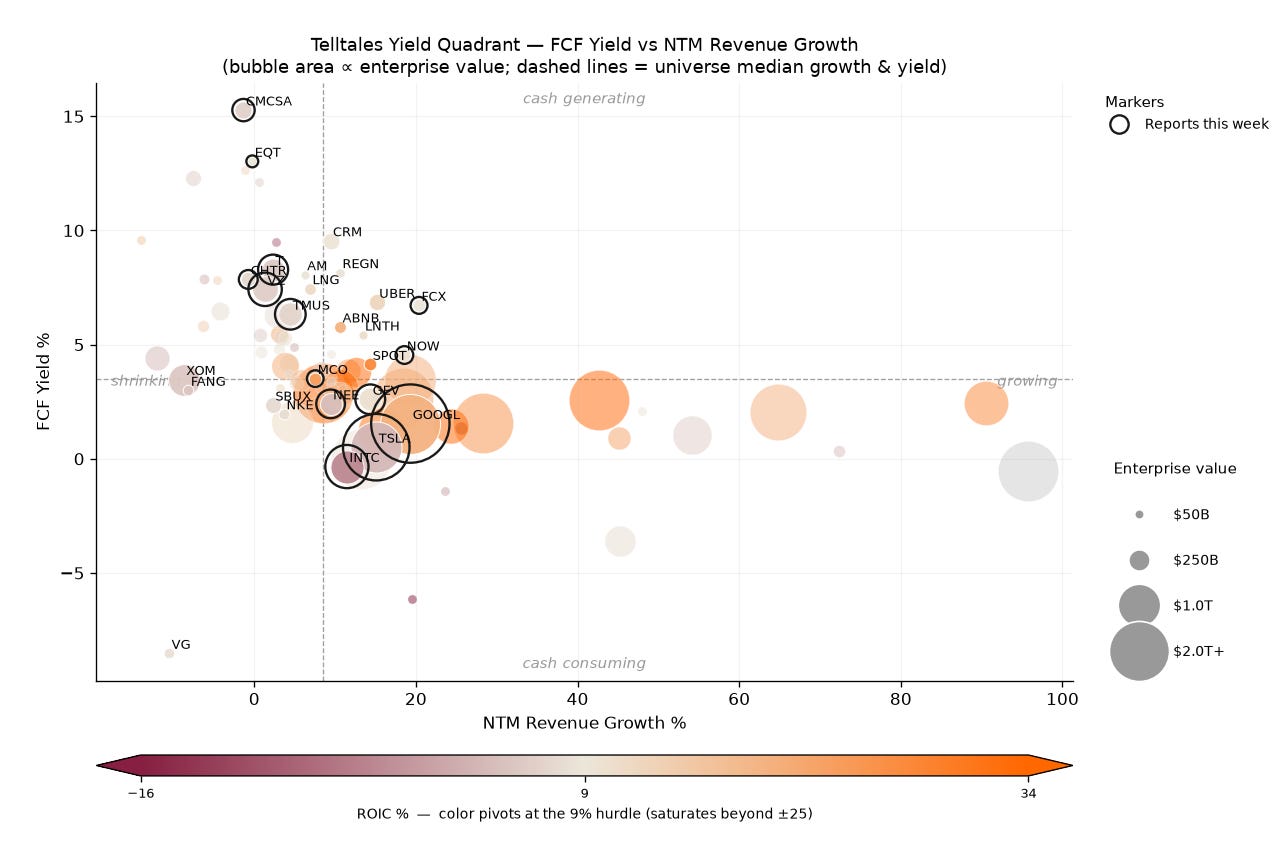
▶ Explore this week’s Tape — live, sortable, drill-down → Wall Street Called PayPal Dead Money for Two Years. This Week, Private Capital Sent a Term Sheet. Two markets looked at the same cash flows this week and reached opposite verdicts. The public market has spent two years pricing PayPal, Comcast, and half the telecom block as value traps — cheap for a reason, and the reason is they’re dying. Then Stripe and the private-equity firm Advent put fifty-three billion dollars on the table for PayPal at a twenty-eight percent premium, and PayPal’s own board came back and said the number was too low.¹² Only one of those two verdicts arrives with committed financing attached. The tell isn’t the premium. It’s what the premium is buying. Start with the balance sheet, because that’s where the buyer started. PayPal carries almost no debt and throws off something close to a sixteen percent free cash flow yield.³ To a public shareholder, that yield is a warning — the market’s way of saying the branded-checkout business is in slow decline and the multiple should stay buried. To a private buyer, the exact same yield is fuel. A clean balance sheet generating that much cash finances its own buyout: you borrow against the cash flow, cover the interest several times over, and fix the growth story out of the public eye on a five-to-seven-year clock instead of a ninety-day one. The public market marks PayPal to next quarter’s narrative. Advent underwrites it to the end of the decade. You could watch the plumbing for that trade get built in real time. Stripe and Advent lined up roughly fifty billion dollars in committed financing from JPMorgan and Morgan Stanley before the bid was even public, per Bloomberg.⁴ And in the same week, KKR started marketing bonds in Germany backed by PayPal’s buy-now-pay-later loans — the first securitization of its kind in Europe.⁵ That’s a second, entirely separate pool of lenders deciding PayPal’s receivables are money-good. When the assets underneath a company finance this easily, the buyout stops being speculative. The debt to do the deal is already there to be borrowed. Here’s the part the show didn’t have room for: this is not really a PayPal story. It’s a repricing of the entire boring half of the Cash Flow Memo. The same math that turns PayPal into a buyout candidate is sitting on page six under the telecom block — Comcast at a fifteen percent yield, Verizon at seven, every one of them a low-growth cash machine the public market has left for dead.⁶⁷ This is the take-private-of-the-cash-cow playbook, the one that ran hot in 2006 and 2007 — except this cycle the fuel isn’t syndicated bank loans and high yield, it’s private credit: direct-lending funds and asset-backed securitizations that did not exist at anything like this scale a decade ago. A financing system that large doesn’t just make one deal possible. It makes the list of takeable public cash machines far longer than the public market has priced in. The cashflow read is in Marcus’s column below; short version, the highest-yielding name in the whole memo is a telecom stock the tape is treating as a warning, not a gift. What changes the read is a term sheet, not a re-rating — and that’s the whole point. The catalyst for the cheap half of the memo was never going to be the public market waking up and paying more. It’s a buyer showing up and taking the company off the market entirely. On PayPal, the test isn’t the headline bid; it’s whether a second bidder appears before earnings on the twenty-eighth — a bank or a card network deciding it can’t let Stripe own these rails — because that’s what turns a negotiation into an auction.⁸ On telecom, the whole block reports Thursday and Friday next week, and the prints will tell the private buyers how fast the broadband base is actually eroding, which is the one number that decides whether these are melting ice cubes or the next names to get a term sheet.⁹ Wall Street’s consensus on the cheap half of the memo: value traps, cheap for a reason, and the reason is terminal decline. Private capital spent this week agreeing about the cash and disagreeing about the ending. The trap, it turns out, has bidders — and they brought their own financing. The Tape — W2629 Universe of 94 cashflow-memo names, snap dates 2026-07-10 → 2026-07-17. Composite is rank-sum percentile of FCF Yield + NTM Revenue Growth (higher = better balance). Banks and finance-book names shown separately. Telltales Yield — Top 10 From the Cashflow Desk — Marcus Graham Comcast is the highest-yielding cash machine in the memo, and the tape is treating that yield as a warning, not a gift. Going into Thursday’s print, the memo has Comcast at 6.5x EV/FCF and a 15.3% trailing FCF yield — a multiple that only pencils if the broadband base is melting. But consensus has next-twelve-month revenue down just 1.3%, so the whole read reduces to erosion speed: a base that leaks two or three points a year more than covers you here; one that loses faster to Starlink does not. I read the multiple as a bet on the pace of decline, not the fact of it. The test Thursday is broadband net adds and churn, not headline EPS — the same number the private buyers circling the cheap half of the memo are watching. Telltales Yield — Bottom 10 This Week’s Reporters Sector Medians Debt / FCF Watch (highest leverage on TTM FCF) Weekly Price Movement Top 5 (week-over-week price) Bottom 5 (week-over-week price) Banks (shown separately — FCF metric not meaningful) Finance-book — FCF not comparable Customer-float / captive-finance / reserve businesses (IBKR broker float, KMX CarMax Auto Finance, PYPL customer funds, CRCL stablecoin reserves). The memo’s operating-FCF method overstates their FCF, so they are held off the ranked leaderboard pending the P&L-waterfall rebuild. Data Gaps 91 of 91 ranked-eligible names ranked. 0 dropped for missing FCF yield or NTM revenue growth; 7 shown separately (banks + finance-book, FCF not comparable). Source: cashflow-memo master_2026-07-17.csv. NTM growth from analyst-estimates consensus. Composite is a percentile rank, not a recommendation. The Issue — This Week's Brief The Cashflow Memo The Trap Has Bidders While the market prices telecom and payments cash machines for the graveyard, the buyers keep writing billion-dollar checks. The Telltales Weekend Update. Ava Cabot and analyst Marcus Graham walk through what happened this week — and what’s coming next — across the 86 companies in the Cash Flow Memo. About 14 minutes. No filler. Download the memo at telltales.us. Hunt, Jason, and Mike are back Wednesday on episode 2630. Chapter markers * Time | Segment * 0:00 | Open * 0:45 | Theme — Telecom’s Squeeze * 4:45 | Deep dive — PayPal * 8:45 | Rapid-fire — the week’s checkbooks * 11:45 | Close + Consensus Watch Full transcript Opening disclaimer Ava: The following conversation is intended for informational purposes only. You should always do your own work to determine if an investment is suitable for you. Cold open Ava: You’re listening to the Telltales Weekend Update. I’m Ava Cabot. Marcus: And I’m Marcus Graham — the cashflow desk. Ava: Quick note before we start: the show is produced entirely with AI tools, and both voices you’re hearing are AI-generated. Send feedback through the Substack. Ava: Here’s the whole week in one sentence. The public market spent five days pricing its own cash machines for the graveyard — single-digit multiples, double-digit yields, telecom and payments left for dead. And the buyers spent the exact same five days writing billion-dollar checks for those companies. Both of those things happened. They can’t both be right. On Wednesday’s show — episode 2629 — Hunt, Jason, and Mike went value-hunting and found it hiding in plain sight on page 1, in the hyperscalers everyone already owns.[^ep-e2629] This weekend we go to the other end of the memo: to the names the market gave up on, and the people who just tried to buy them. Theme — Telecom’s Squeeze Ava: Start with the group nobody wants to own. On page 6 of the … This is a public episode. If you would like to discuss this with other subscribers or get access to bonus episodes, visit telltales.substack.com
Embed this episode
No transcript yet.