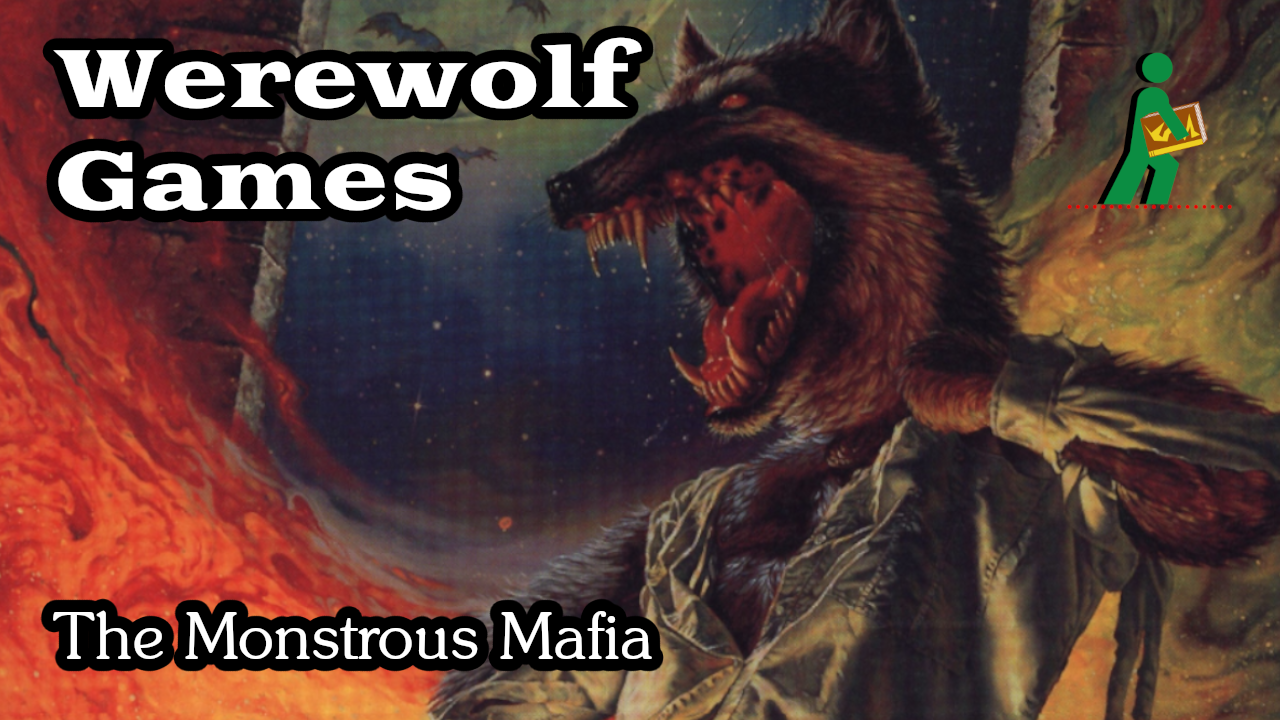
Werewolf Games | The Monstrous Mafia | Wandering DMs S05 E35 episode artwork

EPISODE · Nov 8, 2023 · 1H 2M

Werewolf Games | The Monstrous Mafia | Wandering DMs S05 E35

from Wandering DMs · host Wandering DMs

Paul & Dan discuss Werewolf and Mafia-style games -- party-style games with secret roles assigned, including a hidden evil faction, and a group of mostly-innocent civilians trying to survive and uncover the adversaries. What different variants of this game work the best? What psychological lessons can we take away? And what elements can be worked into your D&D and other role-playing games? Mafia, also known as Werewolf, is a Russian social deduction game created by Dimitry Davidoff in 1986. The game models a conflict between two groups: an informed minority (the mafiosi or the werewolves) and an uninformed majority (the villagers). At the start of the game, each player is secretly assigned a role affiliated with one of these teams. The game has two alternating phases: first, a night-phase, during which those with night-killing-powers may covertly kill other players, and second, a day-phase, in which all surviving players debate and vote to eliminate a suspect. The game continues until a faction achieves its win-condition; for the village, this usually means eliminating the evil minority, while for the minority, this usually means reaching numerical parity with the village and eliminating any rival evil groups. Andrew Plotkin gave the rules a werewolf theme in 1997, arguing that the mafia had less cultural resonance, and that the werewolf concept fit the idea of a hidden enemy who looked normal during the daytime. Mafia and a variant called Thing have been played at science fiction writers' workshops since 1998, and have become an integral part of the annual Clarion and Viable Paradise workshops. The Werewolf variant of Mafia became widespread at major tech events, including the Game Developers Conference, ETech, Foo Camps, and South By Southwest. In 1998 the Kaliningrad Higher school of the Internal Affairs Ministry published the methodical textbook Nonverbal communications. Developing role-playing games 'Mafia' and 'Murderer' for a course on Visual psychodiagnostics, to teach reading body language and nonverbal signals. In September 1998 Mafia was introduced to the Graduate College at Princeton University, where a number of variants were developed. The werewolf theme was also incorporated in the French adaption of Mafia, The Werewolves of Millers Hollow. Mafia is one of the 50 most historically and culturally significant tabletop games since 1800 according to about.com. This description uses material from the Wikipedia article "Mafia (party game)", which is released under the Creative Commons Attribution-Share-Alike License 3.0.

Paul & Dan discuss Werewolf and Mafia-style games -- party-style games with secret roles assigned, including a hidden evil faction, and a group of mostly-innocent civilians trying to survive and uncover the adversaries. What different variants of this game work the best? What psychological lessons can we take away? And what elements can be worked into your D&D and other role-playing games? Mafia, also known as Werewolf, is a Russian social deduction game created by Dimitry Davidoff in 1986. The game models a conflict between two groups: an informed minority (the mafiosi or the werewolves) and an uninformed majority (the villagers). At the start of the game, each player is secretly assigned a role affiliated with one of these teams. The game has two alternating phases: first, a night-phase, during which those with night-killing-powers may covertly kill other players, and second, a day-phase, in which all surviving players debate and vote to eliminate a suspect. The game continues until a faction achieves its win-condition; for the village, this usually means eliminating the evil minority, while for the minority, this usually means reaching numerical parity with the village and eliminating any rival evil groups. Andrew Plotkin gave the rules a werewolf theme in 1997, arguing that the mafia had less cultural resonance, and that the werewolf concept fit the idea of a hidden enemy who looked normal during the daytime. Mafia and a variant called Thing have been played at science fiction writers' workshops since 1998, and have become an integral part of the annual Clarion and Viable Paradise workshops. The Werewolf variant of Mafia became widespread at major tech events, including the Game Developers Conference, ETech, Foo Camps, and South By Southwest. In 1998 the Kaliningrad Higher school of the Internal Affairs Ministry published the methodical textbook Nonverbal communications. Developing role-playing games 'Mafia' and 'Murderer' for a course on Visual psychodiagnostics, to teach reading body language and nonverbal signals. In September 1998 Mafia was introduced to the Graduate College at Princeton University, where a number of variants were developed. The werewolf theme was also incorporated in the French adaption of Mafia, The Werewolves of Millers Hollow. Mafia is one of the 50 most historically and culturally significant tabletop games since 1800 according to about.com. This description uses material from the Wikipedia article "Mafia (party game)", which is released under the Creative Commons Attribution-Share-Alike License 3.0.

NOW PLAYING

Werewolf Games | The Monstrous Mafia | Wandering DMs S05 E35

0:00 1:02:56

No transcript for this episode yet

We transcribe on demand. Request one and we'll notify you when it's ready — usually under 10 minutes.

Novel to aid sleep shenank novels:"Boy" The Wandering Dog'Tilda Jane's OrphansThe Adventures of a Bear, and a Great Bear TooThe Adventures of a Cat, and a Fine Cat Too!The Adventures of a Dog, and a Good Dog TooThe Adventures of Bob WhiteThe Adventures of Bobby CoonThe Adventures of Buster BearThe Adventures of Danny Meadow Mouse (Dramatic Reading)The Adventures of Danny Meadow Mouse (Version 2)The Adventures of Danny Meadow Mouse (Version 3)The Adventures of Grandfather FrogThe Adventures of Jerry Muskrat (Dramatic Reading)The Adventures of Jerry Muskrat (Version 2)The Adventures of Jimmy SkunkThe Adventures of Johnny ChuckThe Adventures of Lightfoot the DeerThe Adventures of Lightfoot the Deer (Version 2)The Adventures of Maya the BeeThe Adventures of Mr. Mocker (Dramatic Reading)The Adventures of Old Man CoyoteThe Adventures of Old Mr. ToadThe Adventures of Old Mr. Toad (ve MemeLord Monday MemeLord Monday Ever seen a meme that made you laugh and also think deeply about a subject at the same time?  What if it was a Christian meme? I'm Matt, one of the creators for the first ever Christian social media meme pages on the internet, Memes for Jesus.  We have over 1m total followers I deal with a lot of online Christians.  Through comments and DMs, I discovered that a lot of people don't really know what Christians even believe, and a lot of people are deconstructing their faith. So, on this podcast I talk, or I interview my Christian creator friends, and use my MemeLord sense of humor to explore the many views within Christianity in an effort to reconstruct Jesus in a modern age.  Get ready for light-hearted conversations about deep, and sometimes controversial topics! World of Birds Kayla Fisk A look into the incredible diversity present in the 10000+ species found in the world of birds. From the tiniest bee hummingbird to the largest wandering albatross, there is so much to discover and learn about with these incredible species we share our planet with. For everyone who is into birdwatching, to ornithologists, I hope you enjoy this journey into the aspects of the bird world. Stories of Scotland Carrying Stream Stories of Scotland is an award-winning Scottish history podcast. Join hosts Jenny and Annie as they unravel the rich tapestry of Scotland’s culture, nature and heritage. Prepared to climb into caves, cairns and chaos, Jenny and Annie travel around Scotland and investigate how stories of the past can help us make sense of modern life.Stories of Scotland celebrates Scottish history through traditional storytelling, archival research, museum objects and wandering in nature. It is recorded in Inverness & hosted by Jenny, an environmental scientist & Annie, an archivist. Hosted on Acast. See acast.com/privacy for more information.

Frequently Asked Questions

How long is this episode of Wandering DMs?

This episode is 1 hour and 2 minutes long.

When was this Wandering DMs episode published?

This episode was published on November 8, 2023.

What is this episode about?

Paul & Dan discuss Werewolf and Mafia-style games -- party-style games with secret roles assigned, including a hidden evil faction, and a group of mostly-innocent civilians trying to survive and uncover the adversaries. What different variants of...

Can I download this Wandering DMs episode?

Yes, you can download this episode by clicking the download button on the episode player, or subscribe to the podcast in your preferred podcast app for automatic downloads.
URL copied to clipboard!