
EPISODE · Jul 4, 2026 · 22 MIN
What America Should Build Next
from Language Matters Podcast · host Elias Winter
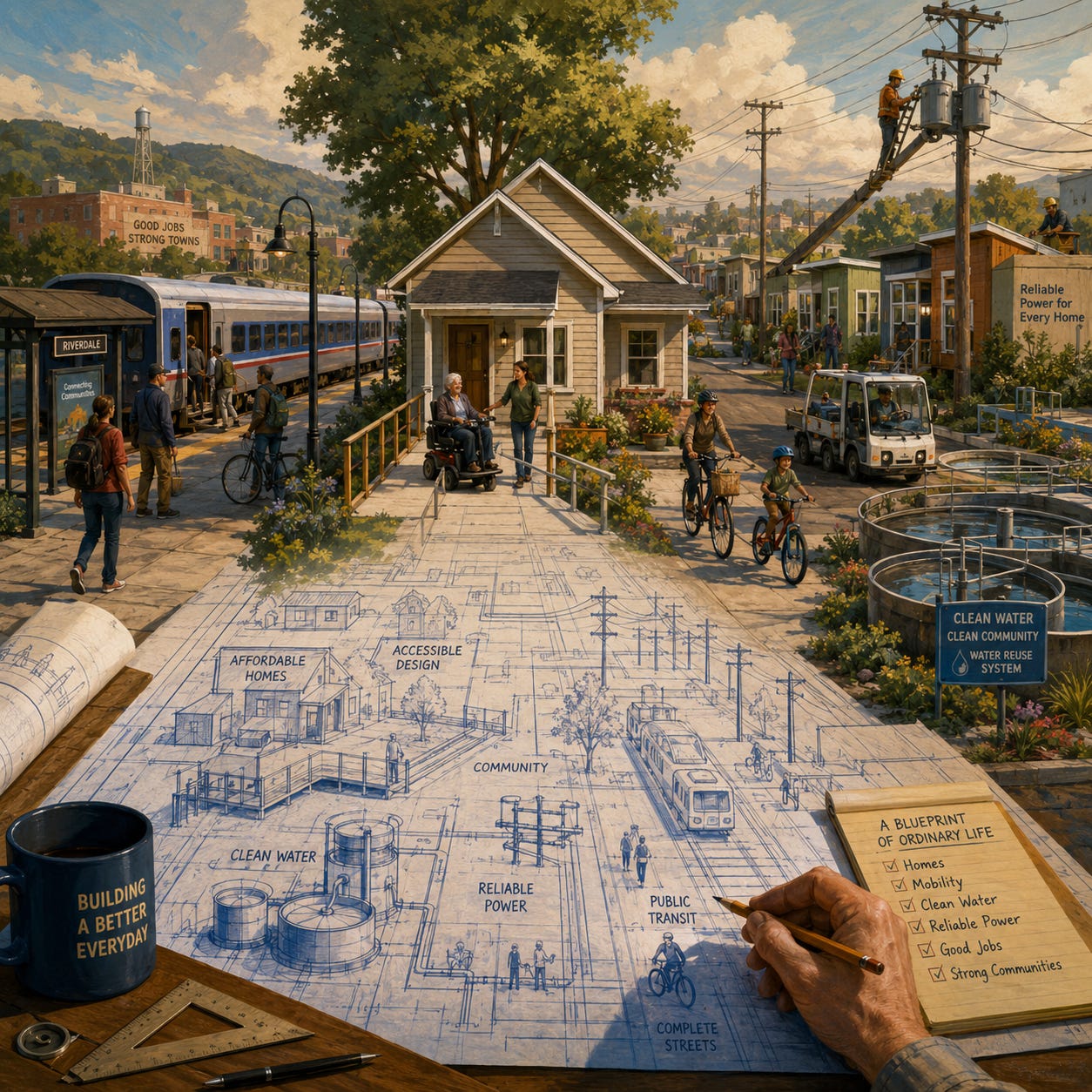
America has always been at its best when an invention stopped being a marvel and became part of ordinary life.Electricity was not important because a scientist could make a bulb glow in a laboratory. It became important when homes, factories, streets, hospitals, and schools could depend on power.Aviation mattered when it stopped being a stunt.Refrigeration mattered when food lasted longer.Antibiotics mattered when children survived infections that had once terrified every parent.America’s greatest technological achievements were not great merely because they were clever. They were great because they became common.That should be the standard again.The country is entering a period in which much of its technological ambition is directed toward artificial intelligence. There are good reasons for this. AI may advance medicine, science, engineering, and productivity. It may help researchers discover materials, doctors interpret difficult cases, and workers escape some of the administrative nonsense modern institutions produce in industrial quantities.But a nation can become so fascinated by one frontier that it stops noticing the others.The danger is not that America will create too much intelligence.The danger is that it will define the future too narrowly.A country does not become more advanced merely because its machines can answer increasingly difficult questions. It also becomes more advanced when its people can afford homes, move easily through cities, remain independent as they age, survive extreme heat, obtain clean water, and live without spending most of their energy fighting the physical conditions of daily life.America’s next great technological project should be to make ordinary life more livable.The Problems Are Also the FrontiersAmerica often describes its deepest material problems as crises.The housing crisis.The energy crisis.The water crisis.The transportation crisis.The caregiving crisis.The crisis of aging infrastructure.The word communicates urgency, but it can also make the problem sound like weather: something that arrived from elsewhere and must now be endured.Many of these crises are also frontiers of invention.Housing is not only a question of prices, zoning, land, and interest rates. It is also a frontier in construction methods, materials, prefabrication, financing, insulation, logistics, and design.Why should every building be treated like a custom expedition?Why should bathrooms, kitchens, wiring, plumbing, walls, and structural components be reinvented separately on every site by teams working through rain, delays, subcontractor disputes, and the ancient mystery of where the electrician has gone?A home will never be identical to an automobile. Land differs. Cities differ. Families differ. Local rules matter.But there is no law of nature requiring construction to remain as fragmented, slow, and expensive as it is.Factory-built components, modular systems, better materials, standardized designs, more predictable approvals, and more reliable financing could reduce the cost of shelter. Technology cannot manufacture permission to build, but better institutions and better construction systems can work together.The same is true of energy.America does not merely need more electricity. It needs better ways to generate, move, store, and use it.That means batteries, transformers, transmission lines, geothermal systems, heat pumps, thermal storage, improved insulation, efficient cooling, and materials that help buildings remain comfortable with less power.Some of these technologies already exist. Some need to become cheaper. Some need better manufacturing. Some need public investment. Some need trained installers who are willing to arrive sometime before the next presidential administration.The frontier is not one miraculous device.It is the whole physical system.Water is another frontier hiding inside a crisis.The United States has dry regions, aging municipal pipes, stressed farms, and industries that require enormous volumes of reliable water. Yet water is still often treated as a fixed inheritance rather than a field of continuous engineering.Better filtration, recycling, desalination, leak detection, irrigation, wastewater recovery, and local storage could make communities more resilient.Aging may be the largest overlooked frontier of all.People are living longer. Families are smaller. Caregiving is expensive, exhausting, and physically punishing.This is usually discussed as a healthcare or budget problem.It is also a design problem.Why are so many homes hostile to older bodies?Why do caregivers still injure themselves lifting people?Why are bathrooms, stairs, beds, sidewalks, vehicles, and public spaces designed as though every citizen will remain thirty-eight forever?Better mobility devices, safer lifting equipment, adaptable homes, improved hearing technology, lightweight prosthetics, home medical equipment, and accessible transportation could allow millions of people to remain independent longer.None of this is glamorous.That may be an advantage.A civilization should occasionally work on problems that do not improve anyone’s personal brand.The Future Is Already Being Built—Just Not in One PlaceThe useful future is not imaginary. Pieces of it already exist around the world.Japan has long treated housing, transportation, appliances, and technologies for an aging society as serious engineering disciplines. Its strength is not that it has solved every social problem. It has not. Its strength is a sustained cultural and industrial interest in making physical products dependable, compact, refined, and suitable for daily life.The lesson is not that America should become Japan.It is that an aging population can be approached not merely as a fiscal burden but as a frontier of housing design, mobility, medical equipment, and human independence.China offers a different lesson.Its advantage in batteries and electrical technologies did not emerge from one brilliant company or one government subsidy. It grew from a dense system of mineral processing, component suppliers, engineering expertise, factories, logistics, domestic demand, and financing. China produced more than four-fifths of the world’s battery cells in 2025 and has built tightly clustered supply chains around electric vehicles and storage. (IEA)That is what an industrial ecosystem looks like.America often announces a new factory and assumes an industry has returned. But a factory surrounded by imported materials, foreign machinery, missing suppliers, labor shortages, and uncertain demand is not yet an ecosystem.The lesson from China is not simply “build more factories.” It is:Industrial leadership belongs to the country capable of making the whole chain work repeatedly.The Netherlands demonstrates another form of leadership: integrating technology into the design of daily life.The bicycle is not a Dutch invention. What matters is the system around it—protected routes, parking, street design, rail connections, land use, safety rules, and public expectations. The country has around 35,000 kilometers of dedicated or fast bicycle tracks, and bicycles account for roughly 27 percent of trips. (Government.nl)The lesson is that the transformative technology is sometimes not the object.It is the environment that makes the object useful.Singapore offers a similar lesson in water.Its NEWater system takes treated wastewater and purifies it further through advanced membrane processes and ultraviolet disinfection. Recycled water has become one component of a larger national system that includes collection, treatment, conservation, desalination, and long-term planning. (PUB, Singapore’s National Water Agency)Singapore did not wait for a mythical machine that would abolish scarcity. It assembled existing technologies into a coherent system.These countries should not be romanticized.China’s speed can come with concentrated power, environmental costs, and limited public consent. Japan’s product excellence exists alongside economic and demographic stagnation. Singapore is a compact city-state, not a continent-sized federation. The Netherlands does not need to negotiate every project among fifty states, thousands of local governments, and a population trained from birth to regard parking as an ancestral right.Still, each country reveals a capability America could strengthen:China manufactures ecosystems.Japan refines useful physical products.The Netherlands integrates mobility into ordinary life.Singapore treats water as a permanent engineering mission.America’s task is not to copy any one of them. It is to combine those strengths with its own.What America Still Does Exceptionally WellThe United States is not technologically exhausted.It remains exceptionally strong in scientific research, biotechnology, aerospace, medical devices, advanced computing, semiconductor design, venture formation, university research, and the creation of new companies.Its research system continues to support fields including advanced manufacturing, materials, biotechnology, semiconductors, communications, and disaster resilience. American businesses also spend heavily on semiconductor-related research and development, even as much of the physical production chain has moved abroad. (NSF - U.S. National Science Foundation)The American advantage remains powerful:It can discover.It can finance.It can organize talent around a new idea.It can turn an obscure scientific possibility into a company with a logo, a legal department, and a valuation before most nations have found a room for the introductory meeting.The weakness appears later.Manufacturing.Permitting.Construction.Installation.Infrastructure.Maintenance.The unphotogenic middle.America often leads at the point of invention and loses strength as the idea moves toward mass production and ordinary access.That is not because Americans became less intelligent or less ambitious.It is because several incentives began pointing in the same direction.Capital increasingly favored businesses that could grow quickly without large factories, inventories, local approvals, or armies of installers. Software and finance offered extraordinary returns with less physical friction.Manufacturing ecosystems thinned as production moved abroad. Once suppliers, machine-tool expertise, technical workers, and local knowledge disappear, rebuilding them takes far more than opening a single plant.Government became fragmented across federal, state, regional, and local institutions, each with legitimate responsibilities but often no shared authority to finish a project.Construction and infrastructure accumulated procedural delays, legal risks, cost overruns, and veto points.Public agencies often retained funding responsibilities while losing engineering expertise and institutional memory.And prestige migrated.A talented graduate could earn more money, status, and freedom optimizing advertising, building financial products, or joining a software company than working on water treatment, construction equipment, mobility devices, or electrical infrastructure.No conspiracy was required.Millions of reasonable individual decisions produced an unreasonable national result.The Boring TechnologiesThe next revolution may arrive in objects that receive very little applause.Transformers.Pumps.Membranes.Compressors.Motors.Valves.Insulation.Cooling materials.Rail components.Medical devices.Agricultural machinery.A better sewer pipe, though unlikely to receive a standing ovation, can serve a city for generations.A more efficient compressor can reduce energy consumption across millions of homes.A safer wheelchair can change the geography of a human life.A cheaper building system can allow a teacher to live near the school where she works.A more durable battery can make electricity reliable when the grid is strained.A compact vehicle somewhere between a bicycle and a car could provide mobility without requiring every journey to involve two tons of metal, a monthly payment, and a private rectangle of land at every destination.These technologies appear boring only because we have forgotten how much civilization depends on things that quietly work.A functioning society is full of hidden competence.Water arrives.Power stays on.Buildings remain standing.Food remains cold.Brakes respond.Elevators stop at the floor rather than near it.The highest compliment we pay infrastructure is that we do not think about it.America needs to recover respect for useful obscurity.It should be honorable to build something durable, repairable, and necessary.It should be intellectually prestigious to work on housing, water, mobility, industrial materials, caregiving, cooling, manufacturing, and public infrastructure.The culture should make room for the inventor who does not claim to be reinventing humanity.Perhaps she is merely reinventing the heat exchanger.Humanity will survive the disappointment.A New American Industrial ImaginationAmerica already possesses much of what it needs.It has capital, universities, laboratories, engineers, entrepreneurs, manufacturers, skilled tradespeople, large markets, and a long history of organizing difficult projects.The goal is not to punish digital success or declare war on software.It is to widen the field of ambition.That means patient capital for physical technologies.It means rebuilding clusters of suppliers and expertise rather than celebrating isolated factories.It means using public procurement to help promising technologies reach scale.It means public agencies capable of evaluating complex systems, managing contractors, learning from failure, and completing projects.It means permitting housing where people need to live.It means training electricians, machinists, mechanics, nurses, technicians, installers, and construction workers with the same seriousness devoted to producing more people capable of attending meetings about innovation.And it means recognizing that different frontiers fail for different reasons.Some technologies still need invention.Others exist but remain difficult to manufacture and install.Still others are technically ready but blocked by law, governance, financing, or political opposition.A better battery may require science.A better grid requires manufacturing and public coordination.A better home may require construction innovation, but also land, infrastructure, permission, and political courage.A better mobility device may already exist but remain inaccessible because insurance will not pay for it.There is no single magic category called innovation.There is only the long work of carrying a useful idea through engineering, capital, production, installation, maintenance, and ordinary access.A country has not completed an invention when a prototype succeeds.It has completed it when ordinary people can rely on the result.A Useful American CenturyThe next American century should be measured not only by what the country discovers, but by what it makes common.Can a young family find a home without inheriting one?Can an older person remain independent without exhausting an adult child?Can a city keep people cool during extreme heat without bankrupting them?Can clean electricity move reliably across the country?Can water be reused rather than wasted?Can transportation provide freedom without requiring everyone to own the same expensive machine?Can medical treatment move closer to the home?Can workers use tools that protect their bodies rather than slowly destroy them?These are technological questions, economic questions, and political questions.They are also patriotic questions in the least theatrical sense of the word.A nation is not merely a flag, a market, an army, or a collection of arguments conducted at increasing volume.It is a shared material world.Roads, homes, hospitals, pipes, schools, machines, power systems, public spaces, and the rules governing who can use them.The health of a civilization is visible in what it makes easy.America should make dignity easier.It should make shelter easier.It should make mobility easier.It should make caregiving easier.It should make clean energy, water, cooling, healing, and physical independence easier.The next great American ambition need not arrive as one miraculous invention accompanied by dramatic music.It may come through hundreds of improvements working together.A better wall.A cheaper battery.A safer lift.A cooler roof.A more durable transformer.A smaller vehicle.A cleaner water system.A medical device that allows someone to sleep in her own bed rather than a hospital room.These things may not resemble the future as imagined by filmmakers.They may resemble hardware.That is fine.America does not lack intelligence.It does not lack capital.It does not lack people willing to build.What it needs is a broader idea of progress—and the confidence to learn from what other societies do well without surrendering the qualities that remain distinctly American: scientific daring, entrepreneurial energy, practical invention, and the belief that ordinary life does not have to remain as difficult as we found it.The next frontier is not somewhere beyond the human world.It is the human world, still unfinished.—Elias WinterAuthor of Language Matters, a space for reflection on language, power, and decline This is a public episode. If you would like to discuss this with other subscribers or get access to bonus episodes, visit eliaswinter.substack.com
Embed this episode
NOW PLAYING
What America Should Build Next
No transcript for this episode yet
Similar Episodes
No similar episodes found.
Similar Podcasts
No similar podcasts found.