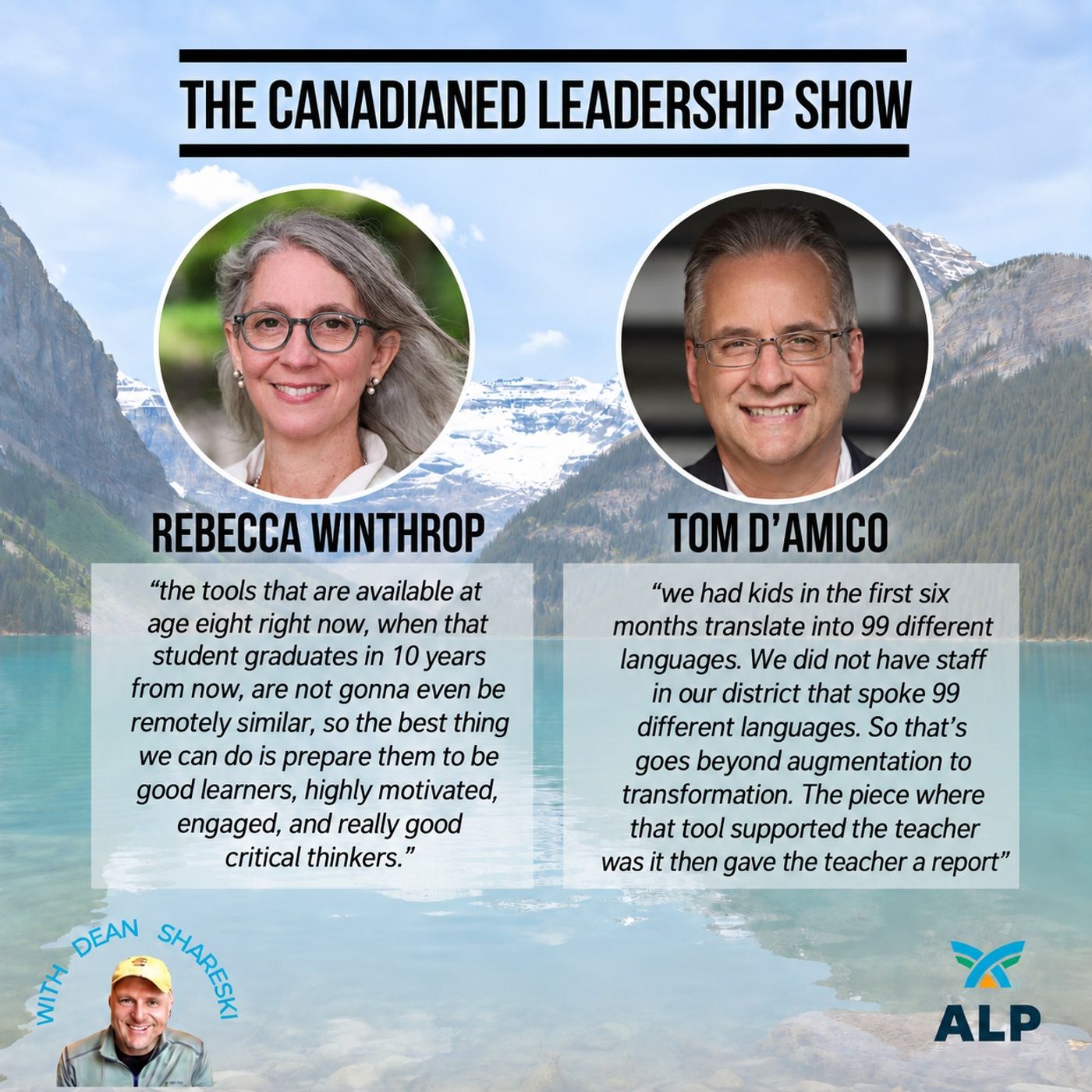
What Does the Research Say About Gen AI and Learning?
from The CanadianED Leadership Show Hosted by Dean Shareski
Dean interviews Rebecca Winthrop (Brookings Center for Universal Education) and Tom D’Amico about Brookings’ February 2026 Global Task Force report on generative AI in primary and secondary education. Based on an 18‑month process and a scan across 50 countries, the report’s debated headline conclusion is that current rollouts make risks overshadow benefits, especially with “wide” use where students directly interface with general-purpose chatbots and AI companions. They contrast this with “narrow” use—vetted content embedded in strong pedagogy that scaffolds learning—and discuss risks such as cognitive stunting, undermined critical and creative thinking, erosion of relational trust, desocialization, emotional manipulation, and dependence. They explore policy responses (including limits by age), the need for AI literacy for students and adults, and examples of beneficial uses like translation support, early detection tools, and career-focused virtual experiences. 00:00 Risks Versus Benefits 00:34 Welcome And Guests 00:58 Brookings Report Setup 04:52 Task Force Findings 07:59 Adults And AI Risks 12:30 Why The Headline Matters 16:40 Trust And Authenticity 19:11 Estonia LEAP AI Lessons 26:44 Companionship And Wellbeing 31:28 Do Nothing Approach 32:00 Where AI Still Helps 33:15 Student AI Boundaries 35:29 Tom on Bans and Balance 37:47 Moratoriums and Do No Harm 42:04 Narrow AI That Helps 45:44 Translation and Teacher Insights 48:16 Report Takeaways and Where to Start 50:31 AI Pedagogy Audit Mix 53:10 Rapid Fire and Wrap Up
Embed this episode
No transcript yet.