What is intergenerational trauma? And how do you heal it?
from The Healing Hype Hosted by Nisha Mody
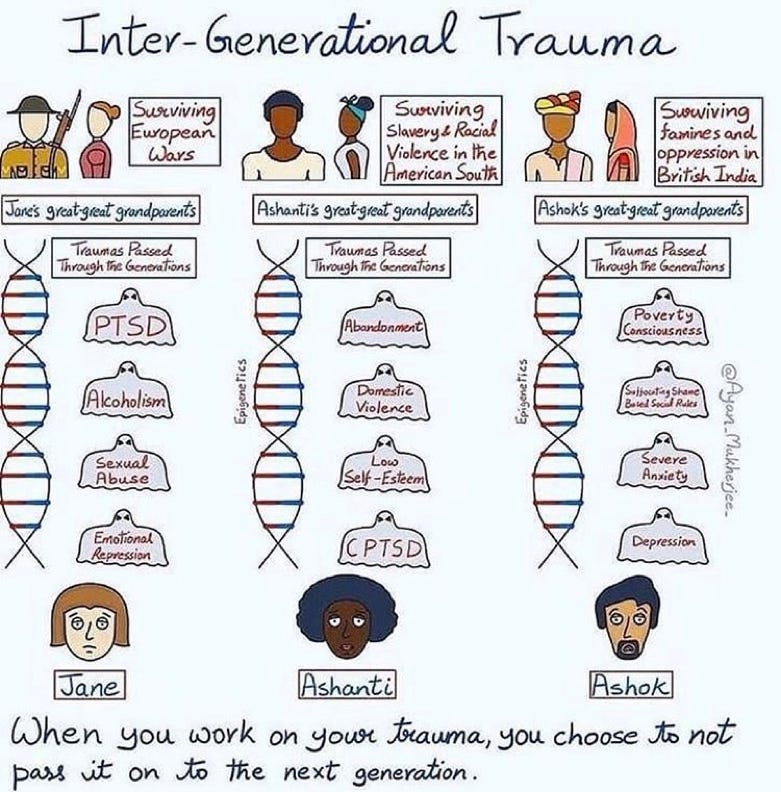
For those of you in the community, the Winter Healing Circle will be on Saturday, December 19 at 10am PST/1pm EST. Check out this post for the Zoom information! The theme of this healing circle is intergenerational trauma. There will be meditation and space for the community to share experiences. If you aren’t part of the community and would like to join, even if you just want to try it out this month, you can subscribe here: I first heard about intergenerational trauma through this illustration by therapist Ayan Mukherjee: When I saw this post, it was like 🤯🤯🤯!!! I was grateful for the South Asian example because, while I was aware that India was colonized, I hadn’t yet internalized what this meant for me. According to article “The legacy of trauma: An emerging line of research is exploring how historical and cultural traumas affect survivors’ children for generations to come” by Tori DeAngelis: One of the first articles to note the presence of intergenerational trauma appeared in 1966, when Canadian psychiatrist Vivian M. Rakoff, MD, and colleagues documented high rates of psychological distress among children of Holocaust survivors (Canada’s Mental Health, Vol. 14). Since then, researchers have been assessing anxiety, depression and PTSD in trauma survivors and their progeny, with Holocaust survivors and their children the most widely studied and over the longest period of time. This is also the topic of the text The Body Keeps the Score: Brain, Mind, and Body in the Healing of Trauma by Bessel van der Kolk M.D. When I imagined the impact of colonization, slavery, assimilation, and other types of disenfranchisement on humans generation after generation, as illustrated by Mukherjee, it recontextualized how we carry the wounds of our ancestors before us. And the DNA strand taught me that this trauma literally lives in the body through epigenetics. What is epigenetics? According to the CDC, “Epigenetics is the study of how your behaviors and environment can cause changes that affect the way your genes work. Unlike genetic changes, epigenetic changes are reversible and do not change your DNA sequence, but they can change how your body reads a DNA sequence.” I wouldn’t be a good librarian if I didn’t say that there is debate about intergenerational trauma, also referred to as transgenerational trauma and inherited trauma, and how its oversimplifications in popular media can be misleading. The article “The Public Reception of Putative Epigenetic Mechanisms in the Transgenerational Effects of Trauma” (2018) states (emphasis by me): Terms such as “inherited trauma” also obfuscate rather than clarify what is being transmitted and how—indeed, how can an experience be inherited? It is clearer to frame the discussion around how the impact of a trauma occurring to the parent can affect the offspring. Thus, the term “intergenerational trauma” is misleading because it is meant to refer to the intergenerational manifestation of the effects of parental trauma. It continues (emphasis by me): In some ways, the presence of epigenetic marks associated with preconception parental trauma seems to imply a kind of blameless and predestined legacy. Perhaps the widespread reception of this research speaks to a cultural fear of powerlessness and lack of agency, or reflects a cultural moment in which objective evidence of a trauma-induced alteration seems to validate suffering that has been dismissed or trivialized. Regardless of the explanations for popular interest in the research, the determination that epigenetic mechanisms provide a potential vehicle for the intergenerational transmission of parental trauma effects does contribute meaningfully to the social and cultural narrative. I appreciate the differentiation between predestined trauma and the effects of parental trauma on children because this shows that if we heal our traumas, we can reduce the chances of projecting the effects of trauma transmitted to ourselves upon others. The tricky thing about research is that all of it uses language that is invested in Western Eurocentric ways of language and thinking. It doesn’t consider collective ways of being and living, and so much medical research focuses on White men. It cannot measure what it means to feel connected to or disconnected from your ancestors. And then there is just general scientific variation. In the research article “Environmentally-Induced Transgenerational Epigenetic Inheritance: Implication of PIWI Interacting RNAs”, Casier, Boivin, Carré, and Teysset (2019) write (emphasis by me): One stress may cause multiple epigenetic changes. Among these changes, some of them are probably independent, whereas other modifications work together. Nature is a combination of numerous stressors including temperature, pressure variations, pollution, starvation, drought as well as competition for food, social stresses, and so on. It is unlikely that one stress can act only on one biological process, but even if this is the case, we can expect that the addition of all these stresses will impact several important pathways. A balance between transgenerational epigenetic inheritance and epigenetic reprogramming occurs at each generation, and these processes are tightly regulated during development. Several factors are capable of tipping this epigenetic balance toward transgenerational inheritance, notably after stress exposure. I think it’s hard to argue that if someone goes through serious trauma, it doesn’t affect the people around them. And if the people who raised you were on the receiving end of these effects and were not able to heal these effects, then wouldn’t that affect you? While genetic changes are not reversible, epigenetic changes are possible. So when I talk about intergenerational trauma, this is what I’m talking about. What about systemic trauma? Did I just make up the term “systemic trauma” without doing any research? Yes. Do I feel bad about it? No. I think it’s important to understand how current “-isms” and oppressions like racism, capitalism, sexism, ableism, classism, the gender binary, and heteronormativity can have traumatic effects, especially if you identify from a marginalized population. While ancestral and intergenerational wounds matter, we also have to acknowledge present effects. We still battle day-to-day global challenges of White supremacy, food insecurity, geopolitical conflict, climate disasters, lack of healthcare access, and, now, a pandemic. (Hot take: these are all related). And while we think these don’t all affect us directly, that isn’t true. Take the recent farmer protests in Punjab India. Maybe you think this doesn’t affect you, but India is also the largest producer of cotton in the world. Global movements have effects - you can read more about this here. And this is just one example. This systemic trauma, combined with the effects of historical oppression, puts us in positions to just SURVIVE on a daily basis. Unless you have expansive generational wealth (and even if you do) capitalism asks us to compete and it disconnects communities from each other and from their land. As a result, social and racial divisions emerge. This is a recipe for feeling burned out, unworthy, shameful, and powerless. So how do we heal intergenerational trauma? The first step is always awareness. And with awareness comes learning and unlearning. We are all unique individuals. If you have a sibling who was raised under the same parental figure(s) as you, I’m guessing they reacted in ways that were different than you. Yet, there are similarities to your experiences. So while this is a personal investigation, it’s also a collective one. Here are some ways to get started: Discover your ancestry You can do this formally through one of those DNA tests and/or informally by talking to family or recounting stories (verbally or written) about your family’s history. I also suggest doing some research about your ancestry through books, historical texts, oral histories (SAADA has som… This is a public episode. If you would like to discuss this with other subscribers or get access to bonus episodes, visit healinghype.substack.com
Embed this episode
No transcript yet.