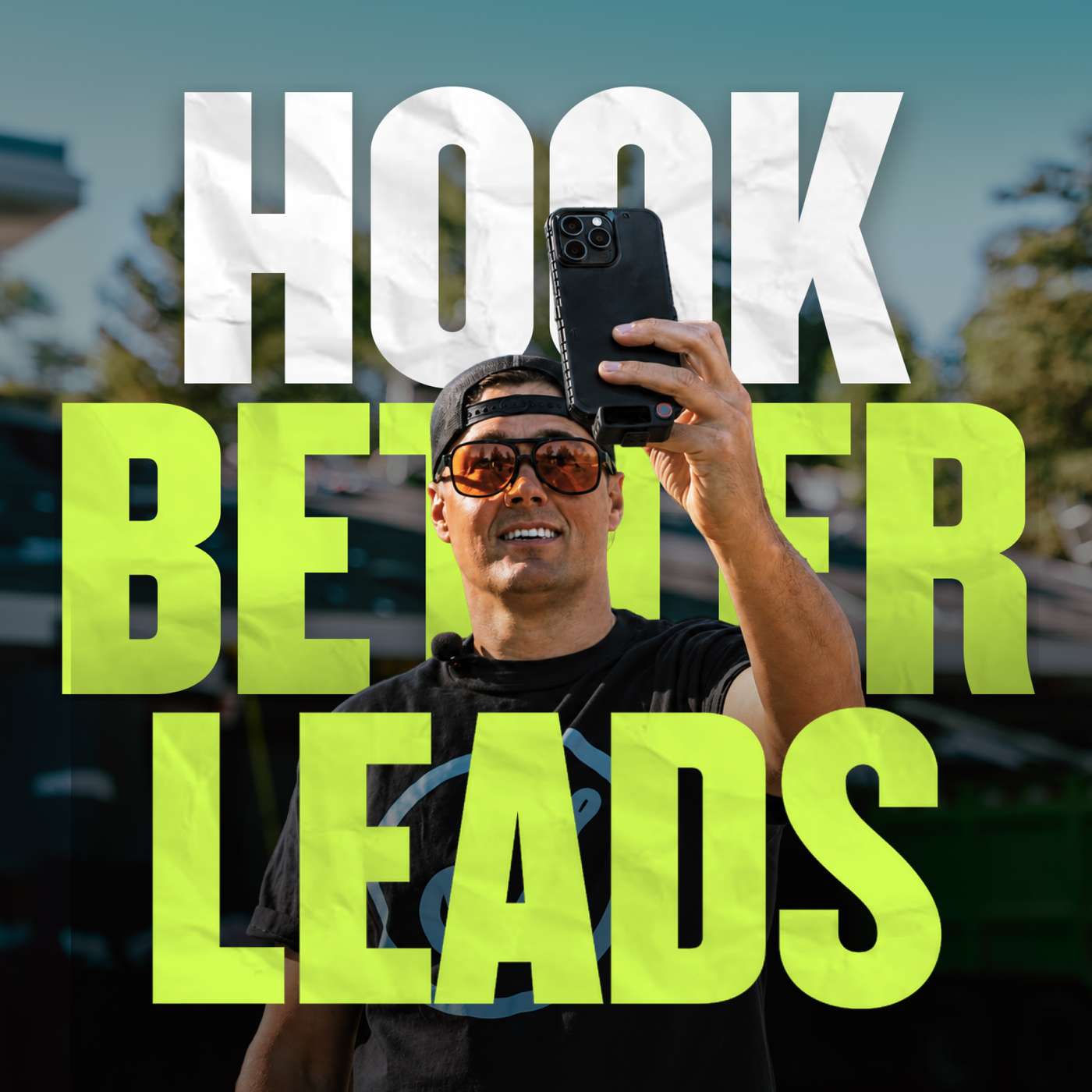
Hey, how's it going? It's Tim Brown and it's the Hook Better Leads Podcast. And today I'm Dylan Herman of Open Roofing, Hayward Roofing. How you doing, brother? I'm good. I'm hanging out in the place of sale on Facebook. Yeah, we love having you down here. We're having a little pitch back and forth and we're learning from each other, mainly me learning from him. But we're doing roofing sales role play today. We might even put a little bonus content out with that. But the question is, what do you have sales reps doing when they're slow? And sometimes we're talking about like up here in the north, the winter. And then sometimes you're talking about when there wasn't just a storm.
So from your point of view, though, we're going to get into that. Before we do that, I just want you to give a little bit of background of you, a little bit more about you than the company, but a little bit about your company, too, and why roofing sales? So my background is I've been doing this for about five to six years, five years, my fifth season. It's the only thing I've done in my professional career. I definitely didn't think I was going to roofing sales. I had a job lined up after college, kind of decided I didn't want to do that, so I called my old high school wrestling coach, actually, asked him, what do you think I should do? You're starting a roofing company?
We're here now. Wrestling was big for me. I wrestled all of high school. I wrestled collegially. I bring up quite a bit because I'd say it makes up most of our company. Almost all of our project managers and sales have wrestling in their background in some sort of element. And yeah, I mean, I definitely didn't go into college thinking I was going to give a degree to USL Rose, but I don't really see myself leaving it for a long time. What did you get your degree in? Business management. It's about the most generic degree you can get. I feel like that's a good degree, though. Is that like a generic one? It's an easy degree. Yeah. Oh, there you go. Both great things. That's how I say it. Hardly the Midwest. Just to shoot the shit for a second. I just feel like I didn't go to a traditional college. No.
But I think if I was like talking to my kid, I realized lately I'm like, yeah, I'd have him go to college. Yeah. Like I love roofing. I love roofing sales. And I would love for somebody to get into that or into the trades. However, I just like the experience. Like I want you to have the experience of going to college. Yeah. And I think a business degree, it's a little generic, but it's like, it's good because it's also okay if it's a little bit for the experience. Why are we making decisions about, it's crazy we're making decisions about what career we're going to have. I thought it was going to be a doctor. Yeah. Hey, thanks for watching this episode.
Please like, comment, and subscribe. It really helps other people see this content. We're back every Tuesday and Friday with the podcast, and we've got a ton of other videos. Thanks, guys. Nope. Great time at college. I'd pay money to go back. And suffice it to say, you've done well at roofing sales. Like, you've got a pretty good personal income going from roofing sales. Yeah. You sold over $2 million last year? Like $3.8, $3.9. $3.9, which is, you know, as you guys know, is well above average. I would say a roofing salesperson who is quite successful selling over $2 million, right? Yeah. Let's couple that. In our industry, everyone's kind of assessed with a million. When I got in the industry, everyone was like, wait, you got to be a million, you just got to do all that. I do think a million's a little bit lower than the threshold note just because of pricing and all this stuff. But yeah, $1 million.
still it's survival yeah yeah that being said like you know it's extraordinary to see somebody go to four or you know and like these numbers are crazy right this is a pretty the beautiful place to be to be able to be in roofing sales that being said it's stressful sometimes as a roofing sales person it's you know you've got a lot on your plate a lot like it's tiring i will say like for me if i had to go out on the truck like i get that the money helps like to just get out there and just like be doing getting on roofs climbing up all these different things it is tiring and then sometimes leads are down or leads are slow or you don't have as many roofs to get on That would be really stressful to me. What do you do personally with your stress when there's less roofs to get on at that moment? I'm fortunate enough to work for a company where our brand is pretty established wherever we go. So I would define a lot of our salesmen, including me, as a lead baby. I definitely have been one of those. But there's tools we use when you're experiencing a slow time. Like I said, I'm pretty obsessed with the idea of brand. And branding on a sense of what's on your hat and all those clothes you're wearing. But when people think of Hayward Roofing, who do they think of? What do they think of? And are they going to call you?
One thing we do as salesmen, referrals are obviously huge, but just little things like getting to your job sites, because yeah, there might be a slow time, there's never zero risk going on, but did you go to your job site that day? We really try not to be the salesman that, and we've all done it though, you sign the contract, you never talk to the homeowner again. We try our hardest not to be that, and it does happen because you're busy, but just getting back to that job site, instantly, that homeowner thinks you were just so a part of that process. And from there, just referrals are big for us, so I mean, just asking for a referral, and it doesn't mean you have this gift card and say, give me a name, please. It might just come up in conversation, something about their neighbor might have got hit by the hale, or whatever it is. So referrals are big.
I will say, I went out with Dan Walrack, and I was pretty impressed by how consistently he asked for referrals. It feels like a little bit of an extra move, like, I got the sale, what do I need? But he was just pretty diligent on that. He was like, by the way, and he did it very nicely right at the end, and he just was like, we would love if you referred your neighbors to us, your friends. I liked how consistent he was with that. I was very impressed with that. I don't think he can sell $18 million the way he does without doing something consistent. I mean, it doesn't surprise me that he has referrals. I've met the guy a couple times now, and you can see why he's a very nice guy to talk to. What would you attribute?
five years five six years at four million about just about four million that's incredible what would you like before we're gonna talk a little bit more about things to do with yourself but yeah talk to me about why do you think you're so successful no offense i like it yeah i'm just saying like how the fuck Don't have a good answer. A lot of things. I think luck has a lot to do with it, honestly. Years of learning. I mean, I was not a construction guy right away. I made a lot of dumb mistakes. My boss and everyone would oblige for that. Wrong shingles on the house. Unprofitable jobs. Unprofitable jobs. You barely know the difference between rake and eve of a house. You'd be so surprised how long that took me to get down. I still don't know. See, I didn't either. And what I mean, I think just putting myself out there. One thing I've never been scared of is like that inkling when you think you should reach out to someone like that insurance agent or that hotel owner or you drive by that building that's huge and everyone's going to do it. Like, I will go do that. Like, if there's a...
There's a hotel in town. And I know one day they might need a roof. And I have that little inkling feeling I should maybe go ask who the managers get to know them. I'll do that. So I think that's one thing I've always had for me is I'm not. So bigger jobs, you're not scared of them. No. I mean, I know it's not mine to be the next day, but I don't go at it from like the greedy point of wanting to get this home or to sell them a roof. It normally just turns into some type of relationship organically. But I think that's one thing. I don't know what narrowed down to what I saw. It's a lot of time. It was a great time where I was during a big storm and a brand that we built pretty successfully. So that's a large number why the number is what it was. But I think one thing that's benefiting me throughout that process is I'm not like afraid of that call or just walking up to that guy. How old are you?
27 was four million basically four million sales I think it's the same way I met you. That's pretty, like, that's almost more, like, no offense to Dan, but that's almost more incredible. Oh, I don't know. I would love to sell you $2 million. Well, dude, just stay at it 25 years. I guess, yeah. Like, if you were out, like, people are so confused and they don't even hear that. I can't imagine a lot of experience you've gained in 25 years. They don't want to hear that number. Like, people, like, get mad when I post something about it. Yeah. Because it's just, it's frustrating for people that, like, they're selling five or something and they think that's the most anyone's ever sold. No. And they, like, get mad. No. I know for how many homeowners I met to have sold what I sold last year. I can't imagine the amount of people he had to meet to do that. Yeah. It's incredible. Yeah.
And I would like to hear a little bit more about that too. Like in those busy times when you're going from house to house to house to house. How many houses are you hitting a day? Well, it depends. Like so when the big storm hit and when I did what I did last year, it was pretty crazy. We had to throw pretty much all of our rules out the windows. I was looking at anywhere from 8 to 12 homes a day. Were you going from like 7 a.m. to 8? 7 to 7. Yeah, maybe 8 to 7 a.m. It just was so constant. It was very fast. You just feel like you're just, I'm going to get this money because this, I mean. I mean, I'm not really thinking about the money, honestly. Oh, come on. Most of the time I'm thinking about it. I have to get to the next person I'm going to be nailed at. No, no, no, no, no, no, no. We're going well. Yeah.
And those are all leads coming from the company. But sometimes, I mean... But they also trusted you with a lot of those appointments. You probably got a lot of appointments. Yeah. Because they're like, he's going to do a good job. Yeah. For a standard. A normal standard for a salesman, we allow three appointments a day. And we're even leaning more towards two now. Just so you can give a homeowner a legitimate appointment and not rush through it. Maybe knock-around jobs. Yes. There's a lot more in roofing sales than people think where you just go sign a contract. Now I just say your job happens after the appointment. I have a couple of new salesmen right now, actually. It's nice to hear when they talk about the stress of the job. Because I feel them too. Because I'm a sales manager, but I also do the sales job. But most of our job is after the appointment. It's great to sign on the spot, but it doesn't happen that often.
You just touched on something I really like to dive in a little bit more deeply too. You talk about sales management and how that, an additional responsibility on your selling jobs. I know that's sometimes a point of frustration because I probably put management on people's plates who also do other jobs. I think that's a little, it's a tough part, but it's a little bit of small business shit. So how do you balance that? And like, do you have any time segmented off in your day for management? Or do you just do it on the weekend? Or how do you give them feedback? So last year, I'm going to say little to zero, last year is when I officially became sales manager of our company.
Little to zero sales management happened last year. It was running like wild through a storm. This year's been a lot better. I mean, we do it with a weekly Zoom call, and then just mostly mornings when I talk to my other guys, and they know kind of that's what I'm answering. Where I work right now is a pretty remote area, so you can't, a lot of times phone calls don't go through, but mostly it's phone calls. A lot of my salesmen are on locations. So Zoom phone calls and just... In the truck? Yeah, in the truck. It's like, all right, I got you. Yeah, when you're running like we did last year, not a lot of management happened. This year's a lot better, a lot more time towards other guys. The majority of my time is helping the other guys sell or doing what they need to do. When do you, you know, from your point of view, being a high performer that got elevated into management, when would you suggest a roofing...
company owner elevate somebody to sales manager or give them sales management? We started doing sales manager. We started in the conversation a while ago. Once we got to a team, about three to four salesmen, and our location started having different sales work. My boss, Marcus, he pretty much did everything right away. I mean, he was essentially the sales manager. He did all the roles with no labels. So eventually, it always fed off like, okay, Marcus can't do everything. We need to hire here. Marcus can't do everything on the schedule. We need to hire here. So that's kind of what we did. About three to four salesmen is what I think was kind of a sweet spot. Right now, I have five to six full-time and then a part-time guy.
And yeah, given that, it feels like a full-blown sales team. And anything past that would feel like a lot. So I think that three to four range, someone should start submerging up as a leader. Do you put the guy that's doing really good work into the sales management? There's a lot of arguments against that, that you shouldn't take the sales management. I don't know. They say it quite a bit, that you shouldn't take your top performer and make a sales manager. I knew I always wanted to be in a leadership role. I've always tried to put myself in a leadership role, so I know that's where I wanted to be. So yeah, so then they're looking at this is what he wanted. So anyway, it's a retention strategy. There's plenty of people that told my boss not to put me as sales manager because I'm selling it. Because I'm still selling a decent amount. And some people that sell a lot aren't good.
managers. I'm not a great manager yet, but I know that's the role I've always wanted to be in, is a leadership role. What do you think is going to make you into a great sales manager? I know that you're not speaking from a place of authority yet, but I can sense your curiosity towards the role. And what are you seeing as kind of the lane that will get you there? Just be able to shift your focus away from your own sales to your team sales. And I've slowly been able to do that, where it's kind of two parts of my brain work throughout the day. I have my individual sales and I have the team goals. Does that mean you're going to have to lower your number? There will be a big transitional point where I'm not selling as much and it'll be...
A little sacrifice thinking about your own sales, but if I focus my time on the team and as that builds, it'll work itself out. And we're in the process right now of building a sales team, hiring more guys to be on it. So yeah, there'll be a transitional period where I don't get to say I'm a $4 million sales rep anymore, but I'll know that I'm building a bigger team because of it. Because if I continue to sell $45 million a year, I'm more than likely not building my team anymore. Totally. All right, let's do a few more questions on what to do when it's slow. You know, for your company, does it occasionally get slow for the whole team? And what do you do then? We've never quite experienced a whole company slowdown because we're so geographically spread out. We're in southern Minnesota and then northern Wisconsin and then a little bit in the metro. So we've never experienced a full company slowdown, but we have experienced multiple branches slowdown.
I mean, things to do during that that we've done pretty successfully. I, my fiancee, Joe Samantha, run around doing a lot of stuff for me too, is like meeting that insurance agent, meeting those people in town. Our Hayward Branch were pretty big community events. So you almost, when you're slowing down, I think the obvious answer is just go knock doors and find leads. That almost like solves like a now issue, I think, where if you like don't panic and you look back, okay, I still need to make those relationships with those insurance agents. If you're a good company, every insurance agent should want to work with you because you actually can help their homeowner. So you still focus on the big picture things because then it might not help directly during the slowdown, but if you keep, like I said,
brand focused. So if you keep focused on your brand, hopefully those slowdowns happen less and less because you build a brand. 100%. I think people don't realize what brand means until you get a few years in and you're like, oh, brand, reputation. I like what reputation is a lot. Because people use the word branding and brand is the same thing. Kind of like branding is my hat, branding is the truck, branding is all that. That's not what a brand is to me. A brand is like what you think about when someone would say, hey, we're going to find whatever it is. And I think the positive of then focusing on brand and the slowdown moments, like you said, if you...
door knock during that moment, you're pushing in on a sales thing when sales are naturally not good. There's probably a reason why there's a slowdown. Yeah, exactly. It's like seasonal or there's something that's a bigger cycle. It's better from my point of view to push into those things when there's more sales happening because that's when there's more to be reaped. I think of it in the like sowing and reaping cycle. You know, like when sales are slow, it might be a sowing cycle, not a reaping cycle. So like you're actually working against nature when you're trying to like go and reap during the sowing season.
I think, too, and if you continue to have a brand-focused approach, because right now you don't want yourself to be doing nothing, obviously, not just talking to an agent for 10 minutes a day or whatever it is. They should be talking to those old homeowners and getting referrals from those old homeowners. But if you've been brand-focused before that, that brand's already built and those referrals are a lot easier because they actually had a good experience. So if you constantly think brand, like the next slowdown's undoubtedly coming, hopefully you've built a brand in those, oh, no, I need to go talk to the homeowner who maybe knows someone who needs a roof. It's easier because the experience they already had. So I think...
But there are always little tricks. Like what you said about Dan, you don't ask for referrals. People don't just give you their cousin's number. It's just a little conversation. So that's one of the things you successfully ask.
Like I said during slowdowns too, like I said, one thing I excelled at a little bit is I'm not really afraid to go meet someone. You drive by that big building, you wonder who owns it and how with me, I'd be more interested in how we got the money to own it. That's what I go ask him. So I like to dig into people's head about that type of stuff. That's sweet. I'm curious. Yeah. Oh, I ask. Ask any homeowner of mine, I'll find out what you do for them very quickly. I'll be real. Like going into that big building, that's kind of punk rock in a way. You're just, you're going and trying to look for the owner? Yeah, I'd say who's the manager's building or property manager of the building. And when you ask that, like to the front desk people, what do they say and how do you get past the gatekeeper? It all depends on the situation. I know.
If there's a big building there, a big hotel or whatnot, and you know at least a storm just hit, it's obvious. I'd probably go after a property manager at that point. I'd like to know who makes the decisions on maintenance. And then you're just getting to know them and you let them know you're in the area. And you don't need to pitch this whole thing to be like, hey, here's my card. If you guys ever do need something, we love helping local businesses. So any big businesses in our branches. I'd probably talk to a decent amount of homeowners who say, hey, if something pops up, you can call us. So maybe an approach like that. There's always ways to find out who owns things. Google's a hell of a tool.
RoofCon's amazing. Getting to see all the speakers like Nick and Eric and especially Tim Tebow. Very exciting, eye-opening. Amazing speakers and great knowledge. Keep it up. First RoofCon, been following Hunter and Revolt Clan for quite some time. And it's definitely been a lot more than what we expected. RoofCon 2023 returns to Orlando, Florida, November 9th through the 11th. Get your tickets at roofcon.com. So, yeah, you know, we were talking a little bit earlier, just a random topic. You were talking about how you recently tried to implement many tools at once in the sales process and kind of got a little bit of resistance. So what would you say, like...
how do you, it's like basically in corporate world, they call it change management. Like we're adopting new tools and there's resistance. Have you found any sweet spot about it? Cause we talked about like, you know, presentation tools and like sales tools and company cam and all these different things. How many things can you change a season? For us, my life works in season. There's roofing season and there's off season. I think off season is the best time to implement anything. It's obvious, it's slow. But yeah, for that example, what I gave you earlier was I was a kid from my brother. I go to conferences, I get excited, I see the newest gadget, tell my boss we need this, we need this, we need this. I try to implement about three to four changes at the same time. They're nothing crazy, but enough that when that salesman got to the appointment, their brain started going, oh, I got to turn this app on, oh, I got pictures in this app, oh, is my iPad ready? And it was all these things all at once, and I just got a pushback, and I was just kind of saying, hey, I'm finding myself thinking about all that instead of the appointment. And it clicked with me, I was like, oh, way too much.
I mean, one to two things during the season I think is fine. We introduced company camp. Not very easy to implement. But there's certain other things. If you're going to introduce, like, we're in the process of introducing something like project presentation, that takes time. Because all of a sudden, you need to sell roofs. And then if your salesman's only worried about presenting that new thing right, you're probably wasting the lead. And even from my experience, it's like, it's not, the presentation is not the point. Correct. The conversation and the relationship is the point. Yep. And getting the homeowner what they want and need. And then, and I think about it for our customers, our clients, like, getting the client what they want and need. And then the...
The presentation is just some visuals they call it. It makes it easier to paint a picture because here's some visuals. And I think a lot of the gadgets out there in the industry are awesome, but you definitely can't do them all. I mean, you would be just a walking guy on your phone and open up 20 different apps. Well, there's like a thousand. Yeah, so you'd just be on apps the whole point. But implementing a couple's fine. Like I said, Compicam's a really smooth transition. Shout out to Compicam. Yeah, shout out to any services. Yeah, Compicam's one that we just introduced to this year. Actually, I think we're a little behind the ball. I've heard about Compicam for years. Yeah, one of the best tools now in my arsenal, I guess. Just the ability to communicate with your team is pretty awesome. What else do you use? He's Rilla. He's Rilla. Hover's big for us. Okay.
Yeah, Rila's a big one. We just introduced that this year. That helps me being a salesman because I don't have to physically ride along with my salesman. I can do it remotely. So that's one major benefit of that. I love that. I don't know a lot of tools like that. That seems like a really good one. Yeah, so Rila allows you to listen to AI in your pocket. Listen to the appointment. It's pretty crazy. We could do it. It gives a script. It gives everything they said. It brings down some statistics for you. The one thing I think I like more than all the...
numbers it gives you and stuff like that, which are all good and whatnot. But what I like is ability to listen to your sales reps appointment with you not being there. Because I know me, I used to do all the time when I first did ride along with my boss, I would tell him right away, hey, I don't talk like that when you're at those appointments with me. I shut down. I started thinking about if I'm even saying things right, blah, blah, blah. So when you do ride alongs, I think they are good and there's a time and place for them. But a lot of times your salesman is showing you an appointment that they don't normally do. And they're more or less thinking about how to please you during the appointment. And I find myself as a sales manager when I'm doing a ride along with a guy and I'm trying to show the salesman I do stuff. I'm thinking about a lot how to impress them almost to show that I do the process. So I'm doing the same thing as a sales manager.
Where the Rilla offers a really, like, listen to a really organic appointment. You forget it's in your pocket. I mean, you don't. I mean, I don't even think about it. So it's a really interesting tool. And good for some of my position, where most of my salesmen are five hours away or four hours away. I have a couple in the branch I'm at, but even then, like I said, I like the organicness of it, what it sounds like. Yeah, totally, because if I was in the room with them, I'm thinking about, like, I'm kind of, my emotions are riding on their success. And so I'm kind of, like, going to affect what's happening. Or you find yourself, like, doing a ride-along, like, I struggle, and a salesman starts to slow down, maybe. Or maybe when you're doing objection handling, you would start stumbling, I would jump in. And I would find the need to, like, help them. Where you, when you're doing an appointment, you're not going to be there to help them like that. So I think it really allows you to, like, listen to that struggle. Like, hey, why'd you...
Why did you stumble there? What were you thinking about or what part made you stumble there? So it's just an interesting tool. If you're not using company can, you're in the old ways. You know, if you are taking pictures and going through extra steps of having to download them on a computer, having to email them out to people, show somebody, print them out, whatever it is. Company can has everything you want. Well, you know what we do have coming up soon? Pitchfest. Pitchfest, yeah. Pitchfest is Friday, October 13th. Spooky. It's very spooky. It's going to be a spooky time. You know what's spookier than pitching a multi-million dollar sales rep?
is sending your sales reps out into the wild unprepared. Great. Way spookier. Way spookier. Because you're wasting leads on people that don't know how to sell. So bring them to this event. Bring two or three people. Bring your best closers. Get some really good information. We've got, for us, the multi-million dollar reps, because we've got Dan Warwick, we've got Dylan Herman here, and then we've got Jacob Fuchs Fox? I still can't hear Fox. I see his name and my brain doesn't read anything. Yeah.
Those are the three. And then that's just the reps. And then we've got Chuck Toki, Becca Switzer, and Mark Goodere, all incredible teachers. I think it should be a good time. And when you get a ticket, you get a chance to choose one of the coaches and one of the reps to pitch directly. So you're going to get a chance to pitch them and get direct feedback. I think they're going to pick it down, honestly. Well, so far, the people that signed up, it's been basically one, two, three, one, two, three.
Well, we've only sold three, so it's actually just one, two, three. Only 57 left. Only 57 tickets left. It's almost sold out. That's what these events do. But what I will tell you, I mean, I think it is going to sell out. Oh, yeah, yeah. I think like with that group of people, I think it's just too good. I mean, it's 500 bucks, but if it's, if you, well, tell them your deal. Because you have, I'm not telling anyone, but you got the. I don't know my promo code off the top of my head, but it will be on Facebook. It's just Dylan. Dylan. Good promo code. If you choose Dylan, then you get 100 bucks off. Yep, $100 off your ticket. Yeah.
It should be a good time. I appreciate everyone for watching this. The podcast is put on by hookagency.com, hookagency all over social. And where's yourguys.com if they want to check you out? Local-roofing.com, then you have to have branches would be the names that coordinate. Paramountroofing.com, Haywardroofing.net, I think. Yeah. And where can they talk to you if they want to say what's up? Facebook, put yourself down there, post quite a bit, send me a message, anything of that nature. Awesome. Thank you so much for joining me, brother. Pleasure. Yes, sir.