
EPISODE · Feb 2, 2026 · 7 MIN
What’s it like being a raven or a crow?
from Walter Veit Podcast · host Walter Veit
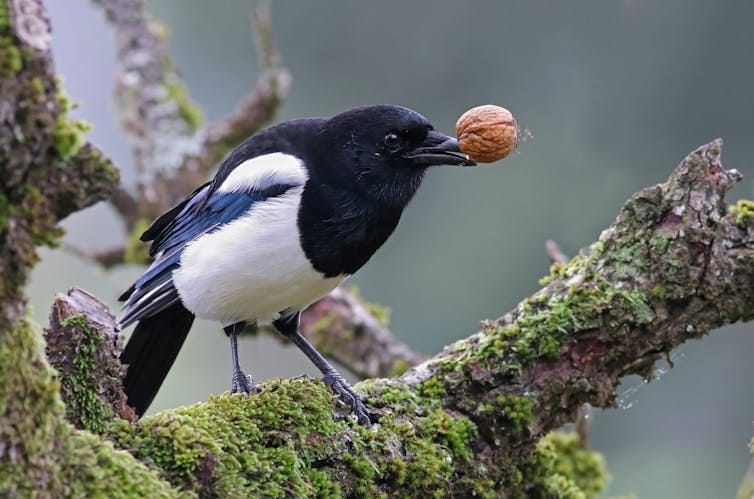
This recording is based on an article Heather and I published in The Conversation under a Creative Commons license. Read the original article here. I’ve copied the text here for convenience:Many of us as children may have wondered what’s going on inside the mind of an animal – what are they thinking and feeling? Most animal researchers study science because of their fascination with animals, but for a long time scientific norms made it impossible to even raise the question of animal consciousness without losing scientific credibility.Fortunately, those days have ended, thanks in large part to pioneering work by scientists such as Donald Griffin, who argued from the 1980s to his death in 2003 that animal minds should be a topic for scientific study.We are philosophers who study consciousness, and in our recent research we worked with other scientists to explore what the world might be like from the point of view of corvids, the family of birds that includes ravens, crows, jays and magpies.“Birdbrain” used to be a common insult but corvids have such surprising intelligence that they are sometimes described by scientists and journalists as “feathered apes”. But we wanted to go beyond intelligence. To do this we examined five dimensions of their experience by combing through studies on their behaviour, cognition, brains, emotions and consciousness.Corvids’ eyes have incredibly sharp resolution that allows them to navigate while flying at high speeds and to find potential sources of food. Their hearing is excellent, perhaps unsurprising for songbirds, allowing them to even distinguish reliable from unreliable group members by assessing and remembering their alert calls.They also have a good sense of smell, which they use to help them find nuts and other food they have hidden. Unfortunately, we do not know how their smell compares to a lot of other animals, because there are not enough studies on corvids’ sense of smell yet.Emotional livesCorvids show cognitive biases, similar to humans. They have negative moods and show signs of pessimism after observing similar states in others.But they also show positive moods after successfully using tools – just like humans. And they can also show neophobia – wariness of new objects.Even if you come with treats to give them, corvids are reluctant to fly close to someone they haven’t met before, but are confident with humans they know well – another common human trait.It is common for people to only attribute emotional lives to mammals, but corvids show that we should study the emotions of birds in more detail.Integrated experiencesWe humans have one stream of consciousness. But birds lack a corpus callosum, the structure that connects the two brain hemispheres in us and other mammals.Their brain halves show a lot of division of labour, such as using their different eyes to focus on different tasks. However, that doesn’t necessarily mean that their experience is split into two selves – it could suggest a kind of partial unity different from our own.Perhaps their consciousness is more like split-brain human patients who have had their corpus callosum cut to reduce the effects of seizures. When two pictures are presented in their respective left and right visual fields, these people will draw what they see on the left side with their left hand, whereas they will verbally describe what is on the right, giving the appearance of two selves in one body.Consciousness across timeCorvids show remarkable abilities in their sense of self across time. Because they often hide food (scientists call this caching), they can remember not just where they hid food, but also what kind of food it was and how long ago they hid it – which is relevant for more perishable foods such as insects, compared to longer-lasting nuts.Here their memory far outstrips our own or, for that matter, most other animals when it comes to hiding objects, with some corvids caching and remembering over a thousand food items in a month for later consumption. No human would be able to remember that many hiding spots.Corvids can even plan, collecting and storing a tool such as a spoon for future use.A rich sense of selfThey not only recognise themselves in mirrors, but also understand other minds. Research has shown corvids go back to remove cached food and hide it elsewhere if they know they have been observed – but only if they have stolen from others in the past.Male jays will watch the feeding behaviour of a female they want to court, so they can bring their preferred food. Even more solitary corvids, such as ravens, seem to have well-developed social skills, which scientists used to think were largely restricted to mammals.In all of this, there is still a great deal of uncertainty. Learning about the minds of other animals requires a great deal of inference from sparse and often ambiguous data. But we believe that there is scientific evidence for rich conscious experiences in corvids. For most species, it is a lack of research, not a lack of capacity, that keeps us silent on what their subjective experiences are like.This research also has implications for corvid welfare. Understanding what the world is like for an animal means understanding what feels good and bad for them. Their good memories may mean they suffer longer from a negative experience, neophobia will mean novel objects should be introduced slowly, their social abilities mean they should be housed in groups. Giving them tools could allow them enriching experiences.All this should be taken into account when deciding how to care for these birds when kept in cavity, and how to minimise welfare risks in other interactions with them.ReferencesVeit, W., et al. (2025). Dimensions of corvid consciousness. Animal Cognition. 28(35). https://doi.org/10.1007/s10071-025-01949-y [Download] Get full access to Walter Veit at walterveit.substack.com/subscribe
Embed this episode
NOW PLAYING
What’s it like being a raven or a crow?
No transcript for this episode yet
Similar Episodes
No similar episodes found.
Similar Podcasts
No similar podcasts found.