
EPISODE · Nov 29, 2024 · 16 MIN
When Arguments Merge (Newman, 2024) - Weekend Book Review
from Revise and Resubmit - The Mayukh Show · host Mayukh Mukhopadhyay
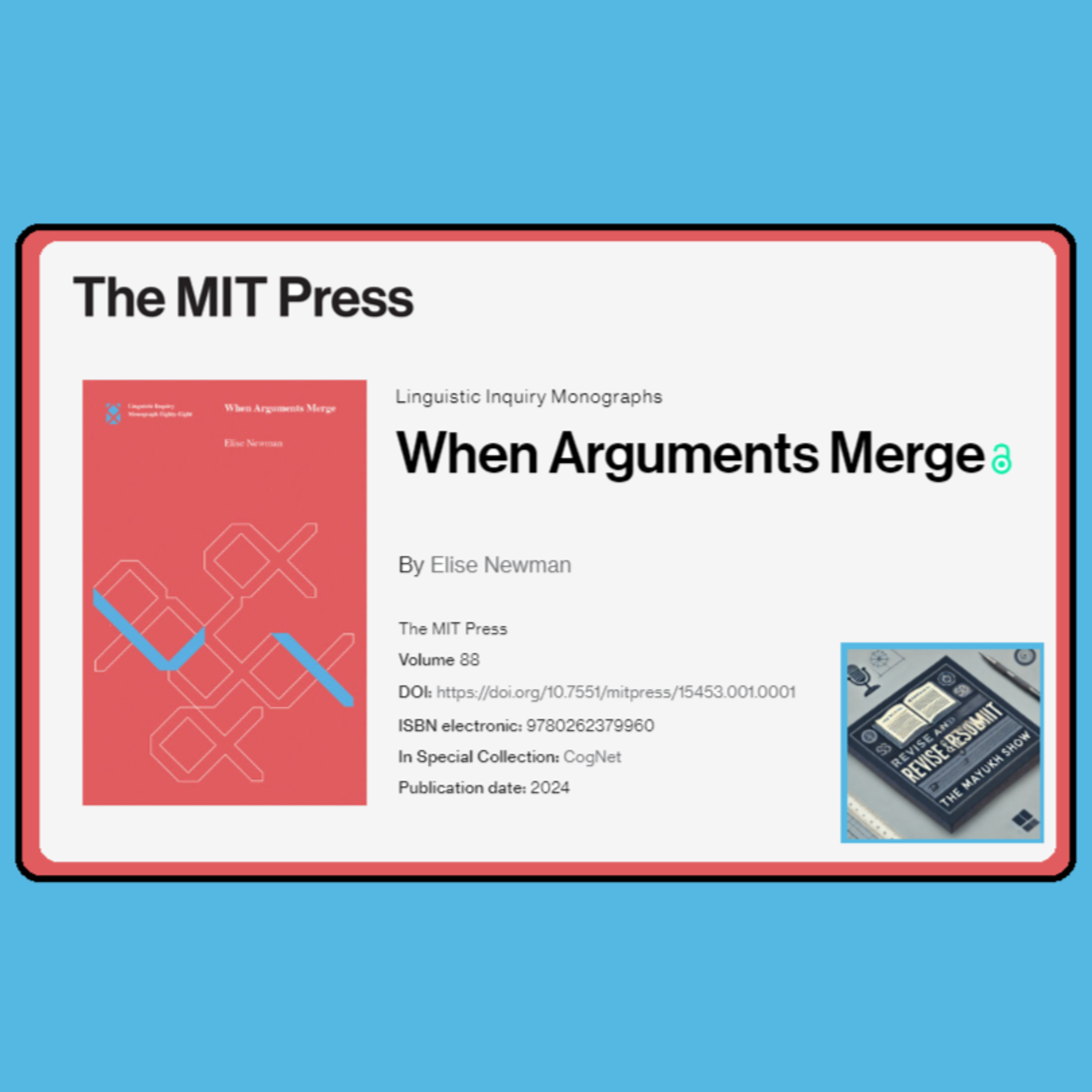
Welcome to Weekend Book Review in Revise and Resubmit, the podcast where we explore complex ideas with clarity and curiosity. Today, we delve into the intricate world of syntax with "When Arguments Merge" by Elise Newman. Newman, a Postdoctoral Associate at MIT, brings a fresh perspective to one of linguistics' most debated areas: argument structure. Her academic journey is rooted in the mechanics of language, where she unravels the hidden order behind how verbs and arguments come together across diverse languages—from Mayan to Bantu to Indo-European. With this book, part of the Linguistic Inquiry Monographs series, Newman challenges long-held assumptions about argument placement and proposes a novel theory inspired by Chomsky's Minimalist Program. The book dives into the role of Merge, the core operation that builds syntactic structures, and explores how the sequence in which arguments align affects case assignment, agreement, and even the voice of a clause. From Agent Focus in Mayan languages to double-object movement asymmetries in Norwegian, Newman’s work offers a unified analysis with a minimal set of features. We extend our gratitude to Elise Newman and The MIT Press for making this cutting-edge research accessible. Now, here’s our question: What happens to meaning when arguments take unexpected paths—can a subtle shift in syntax reshape the way we understand language itself? Reference Newman, E. (2024). When Arguments Merge (Vol. 88). MIT Press. https://doi.org/10.7551/mitpress/15453.001.0001
Embed this episode
Ready to play
When Arguments Merge (Newman, 2024) - Weekend Book Review
No transcript for this episode yet
Similar Episodes
No similar episodes found.
Similar Podcasts
No similar podcasts found.