
EPISODE · Aug 21, 2026 · 11 MIN
When Snowmelt Meets Frozen Ground: The Hidden Pores That Decide Flooding and Recharge
from Waterlines: How Water Shapes Our World · host jaywen
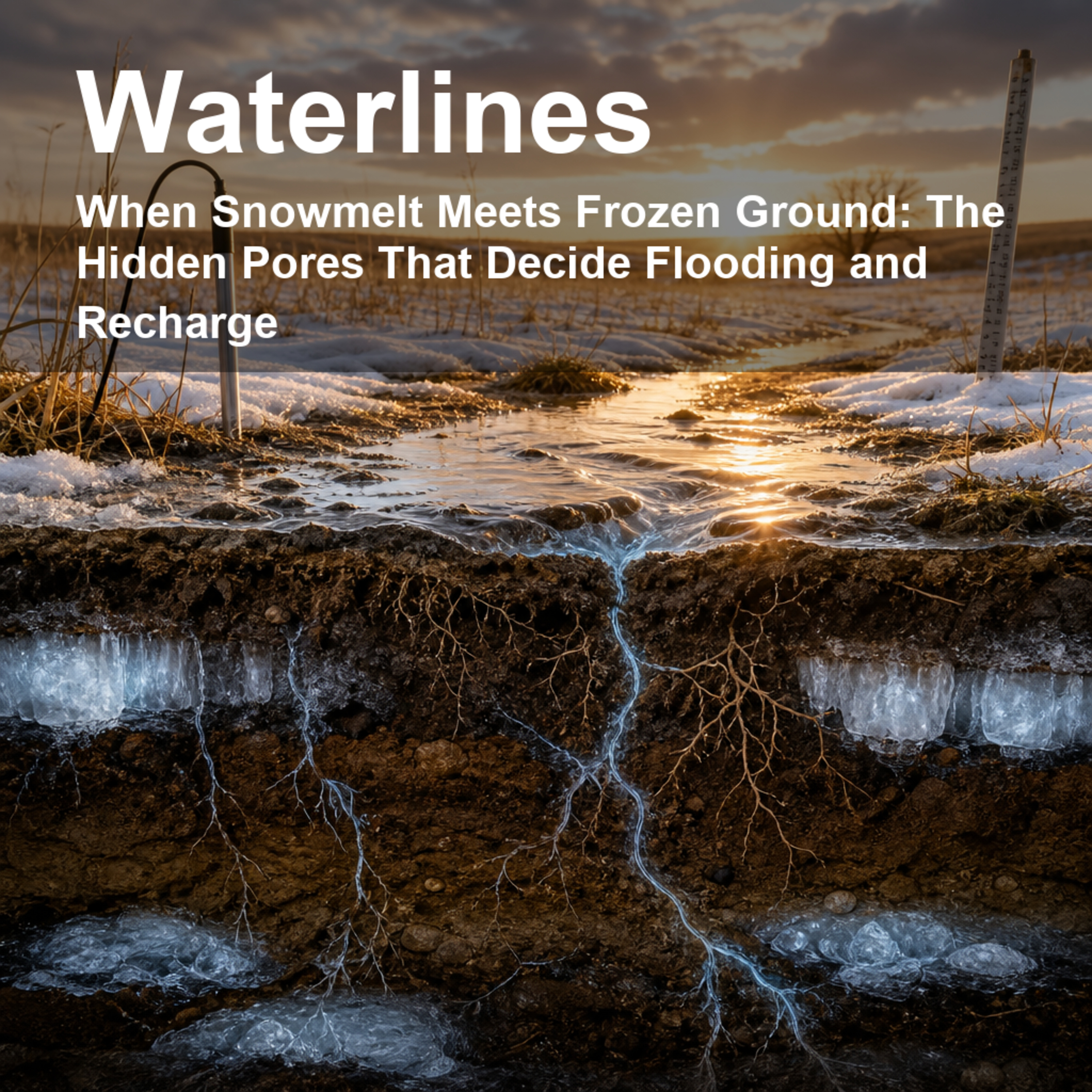
Takeaway: Frozen soil is not just a hard lid; if open pores stay clear, snowmelt can rush downward, but if those same pores ice up, the water is pushed across the surface.Spring melt can look simple from above: snow disappears, puddles form, streams rise. But just below our boots, frozen soil may either block meltwater like a lid or let it dive through hidden cracks and wormhole-like pores. This episode explores why that split matters for floods, groundwater recharge, farm nutrients, road salt, and water planning in cold regions as winters become more variable. We unpack a modeling study that gives frozen soil two “personalities”: the dense soil matrix and fast-flowing macropores. The researchers tested whether a physically based model could reproduce rapid infiltration and drainage through frozen structured soils, and how freezing inside those pathways can later plug them and turn meltwater into runoff. Along the way, we talk about what models can reveal, what they simplify, and why field observations are still essential. Citation: Mohammed, A. A., Cey, E. E., Hayashi, M., Callaghan, M. V., Park, Y.-J., Miller, K. L., & Frey, S. K. (2021). Dual-permeability modeling of preferential flow and snowmelt partitioning in frozen soils. Vadose Zone Journal, 20, e20101. https://doi.org/10.1002/vzj2.20101. This episode uses AI-generated voices.
Embed this episode
NOW PLAYING
When Snowmelt Meets Frozen Ground: The Hidden Pores That Decide Flooding and Recharge
No transcript for this episode yet
Similar Episodes
No similar episodes found.
Similar Podcasts
No similar podcasts found.