
EPISODE · Aug 10, 2026 · 11 MIN
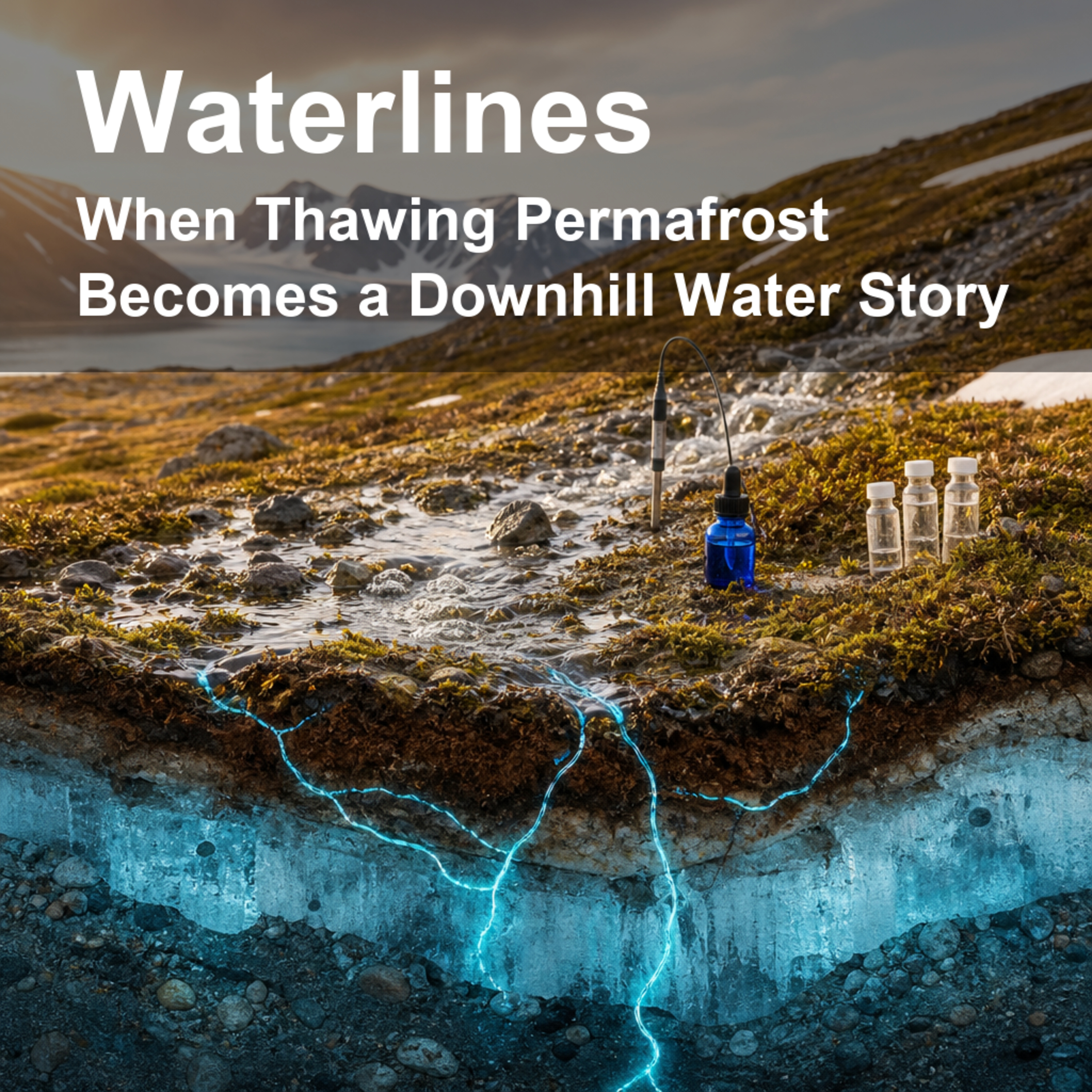
When Thawing Permafrost Becomes a Downhill Water Story
from Waterlines: How Water Shapes Our World · host jaywen
Takeaway: When permafrost thaws, the wetness and timing of the soil can decide whether old carbon sits long enough to become CO2 or is carried downhill in groundwater.Permafrost carbon is often described as a climate time bomb, but this episode looks at a quieter question with big consequences: once frozen ground thaws, where does that carbon actually go? On a high-Arctic hillslope in Svalbard, the answer depends on water. Does newly thawed carbon sit in damp soil long enough for microbes to turn it into carbon dioxide, or does groundwater carry it sideways toward streams, lakes, and the ocean? We unpack a modeling study that follows carbon-like tracers through the seasonally thawed “active layer,” showing how snowmelt, soil wetness, freeze-up, and sudden warm summers can change the path of old carbon. Along the way, we talk about why surface carbon and buried carbon move differently, why saturated ground can both speed transport and slow CO2 production, and why climate models still struggle to capture these hidden water routes.Citation: Hamm, A., Schytt Mannerfelt, E., Mohammed, A. A., Painter, S. L., Coon, E. T., and Frampton, A. (2025). Model-based analysis of solute transport and potential carbon mineralization in the active layer of a hillslope underlain by permafrost with seasonal variability and climate change. The Cryosphere, 19, 3693–3724. https://doi.org/10.5194/tc-19-3693-2025Disclosure: This Waterlines episode package is written for production with AI-generated host voices.
Embed this episode
NOW PLAYING
When Thawing Permafrost Becomes a Downhill Water Story
No transcript for this episode yet
Similar Episodes
No similar episodes found.
Similar Podcasts
No similar podcasts found.