📜When the Traditional Script Fails, Write Your Own📜
from The Middle Way Hosted by Christian Champ
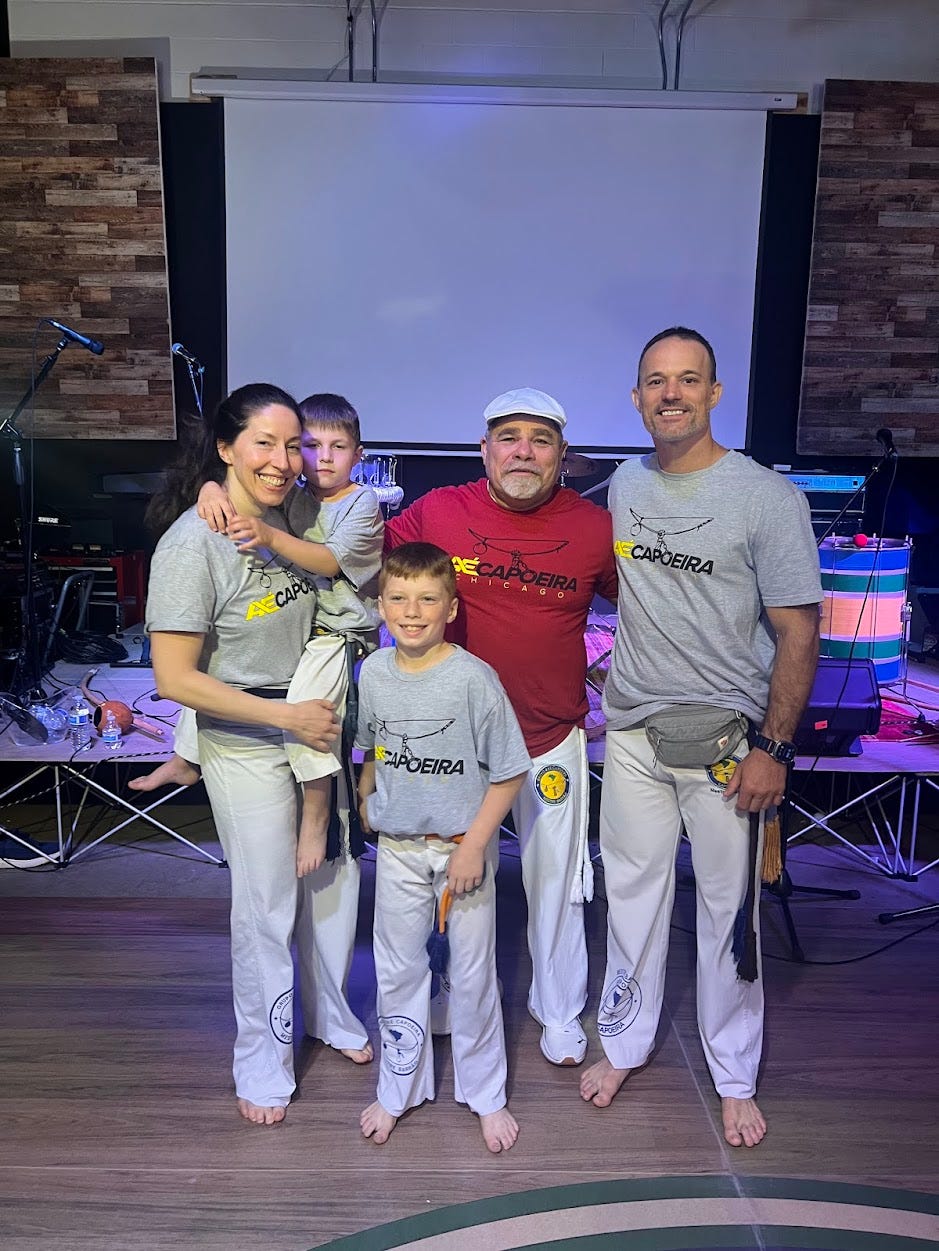
🔥Welcome to Volume #00121!🔥 I’m Christian Champ. This is ☯️The Middle Way Newsletter ☯️. It is a place where I write, explore, share, and invite you along for the journey. If you enjoy the newsletter, please share it with your friends. 📜When the Traditional Script Fails, Write Your Own📜 How We Launched the Largest Venture at Home “I’m bored and I don’t want to go to school.” The first time you hear it, you shrug it off. The second time, the same. When it becomes a daily occurrence, alarm bells ring. I always hated school. I loved seeing friends, playing sports, and reading books. I loved it when a topic was introduced, and then I could dive in on my own by exploring, experimenting, and figuring it out. What I hated was sitting around and being bored. School was too slow. Too passive. I wanted to be moving, questioning, trying things, learning by doing, not memorizing what someone wanted to feed the group, or worse, what I already knew. Even today, I can’t sit through boring lectures. I need to move while listening, or read instead of listening. I need to ask questions and engage in dialogue to stay engaged, but that doesn’t always work in a room full of people. When I read comparisons between school and prison, they resonate. I wanted to learn, but on my terms, not locked to a chair and told to be quiet. Years later, when my oldest hit second grade, he started echoing those exact words: “I’m bored. I don’t want to go to school.” Immediately, all my old feelings surfaced. He wanted harder math problems. He didn’t want to sit in Spanish when he already spoke the language. He wanted to choose projects, chase curiosity, and drop things when they lost their spark. His current teacher pushed back. Even in a Montessori classroom, the response was: sit still, follow along. His previous teacher already confirmed he wasn’t being challenged. Then came the breaking point. A school administrator pulled our son out of class to interrogate him about why he’d want to leave “the best school in the world” and then lied about having the conversation. That sealed it for us. We launched Champ Academy—our venture into personalized learning for our kids. The premise was simple: kids agreed to do the work, and in return, they earned the freedom of self-directed learning. The aim wasn’t to recreate school, but to raise lifelong learners by blending structure and freedom, mastery and curiosity. Every day needed to hit four anchors: reading, writing, math, and movement. Once those were in place, the rest became an open canvas. My role is to set conditions for growth, make adjustments as needed, coach, and provide guidance when necessary. Like any launch, there were many unknowns. The only way forward was to try, fail, adjust, and try again. Success meant they learned how to learn. Failure meant we’d course-correct and design a new path. And like all worthwhile endeavors, we found both. Some things came easier than expected, others harder—primarily for me, not them. Conventional learning accelerated. With no artificial pacing, progress was limited only by their ability and interest. Our six-year-old finished the year doing third-grade math and reading books his brother had read the year before. Our “third grader” advanced to fifth-grade math, which he wrapped up this week as we kicked off year two. We added storytelling, group discussions, and strategy games. History came from books, YouTube explainers, and podcasts. Movement meant capoeira, BJJ, wrestling, gymnastics, acrobatics, soccer, skateboarding, basketball, parkour, football and breakdancing. Daily practice in the home gym tied it together. The most common questions we hear are: How do they socialize? and Do you follow a curriculum? The answer to the first is obvious: they socialize constantly. They do everything we do. From the time they were four, they were training handstands, capoeira, wrestling, BJJ, and always learning alongside grown-ups. The second one is yes, but we stay flexible. If it works, we double down. If it doesn’t, we shelve it and move on. We don’t follow a fixed script beyond everyday essentials of movement, math, writing, and reading. The rest is micro-experiments fueled by curiosity. The questions we keep asking are simple: How do we keep learning, growing, and staying curious? How do we raise good humans who make things better? That’s the heart of it. That’s our startup. And when the traditional script fails, we don’t wait for someone else to fix it—we write our own. 🧠Things to Think About🧠 The Math Academy Way Working Draft Book Math Academy is one of the resources we use for structuring Champ Academy. Beyond liking and using their math product, this living book is an excellent resource for ideas around learning and talent development. A couple of my favorite ideas from the work: * In talent development, instruction is completely individualized, where to increase skill, you need a sufficient level of mastery to move on. * Accountability and incentives are necessary but absent in education (why grades can’t be trusted). * Our limits exist, but are higher than we think. * We always strive for active learning and deliberate practice, which require effort and discomfort. * Use gamification and effort to develop talent. KC writes about how The Best Coaches Know When to Stop Talking Here are some things I’ve learned to do when coaching: -Resist the urge to fill silence with explanation- Trust that struggle is part of the learning process -Ask guiding questions instead of giving ready-made answers -Step in only when correction is truly necessary -Instead of correcting step by step, give further context of the position and remind them of the priorities from there. This will guide them to make better decisions moving forward Review of Alpha School for Astral Codex Alpha School helps kids 2 to 4x+ their learning by setting no boundaries and allowing everyone to work at their own pace. We use some of their methods for Champ Academy. The piece breaks down what it is like for kids to attend Alpha and why they think it works. 2-Hour Learning’s flagship school is the “Alpha School” in Austin Texas. The Alpha homepage makes three claims: * Love School * Learn 2X in two-hours per day * Learn Life Skills Only the second claim seems to be controversial, which may be exactly why that is the claim the Alpha PR team focuses on. That PR campaign makes three more sub-claims on what the two-hour, 2x learning really means: * “Learn 2.6X faster.” (on average) * “Only two hours of academics per day.” * “Powered by AI (not teachers).” The author’s kids, according to her calculations, are learning at 3x speed, but view Alpha a bit more as… * It isn’t genuine two‑hour learning: most kids start school at 8:30am, start working on the “two-hour platform” sometime between 9am-930am and are occupied with academics until noon-1230pm. They also blend in “surges” from time to time to squeeze in more hours on the platform. * It isn’t AI in the way we have been thinking about it since the “Attention is all you need” paper. There is no “generative AI” powered by OpenAI, Gemini or Claude in the platform the kids use – it is closer to “turbocharged spreadsheet checklist with a spaced‑repetition algorithm” * It definitely isn’t teacher‑free: Teachers have been rebranded “guides”, and while their workload is different than a traditional school, they are very important – and both the quantity and quality are much higher than traditional schools. * The bundle matters: it’s not just the learning platform on its own. A big part of the product’s success is how the school has set up student incentives and the culture they have built to make everything work together The author believes it works (their kids are proof of work) and notes that it took roughly 3.5 hours to get in those 2 hours of learning. * 1:1 learning: It’s not really 1:1, but in practice every kids is working on stuff a… This is a public episode. If you would like to discuss this with other subscribers or get access to bonus episodes, visit themiddleway.substack.com
Embed this episode
No transcript yet.