
EPISODE · May 22, 2026 · 9 MIN
Why didn't my divorce feel real after the hearing?
from Divorced me Podcast · host Missy Rönsch
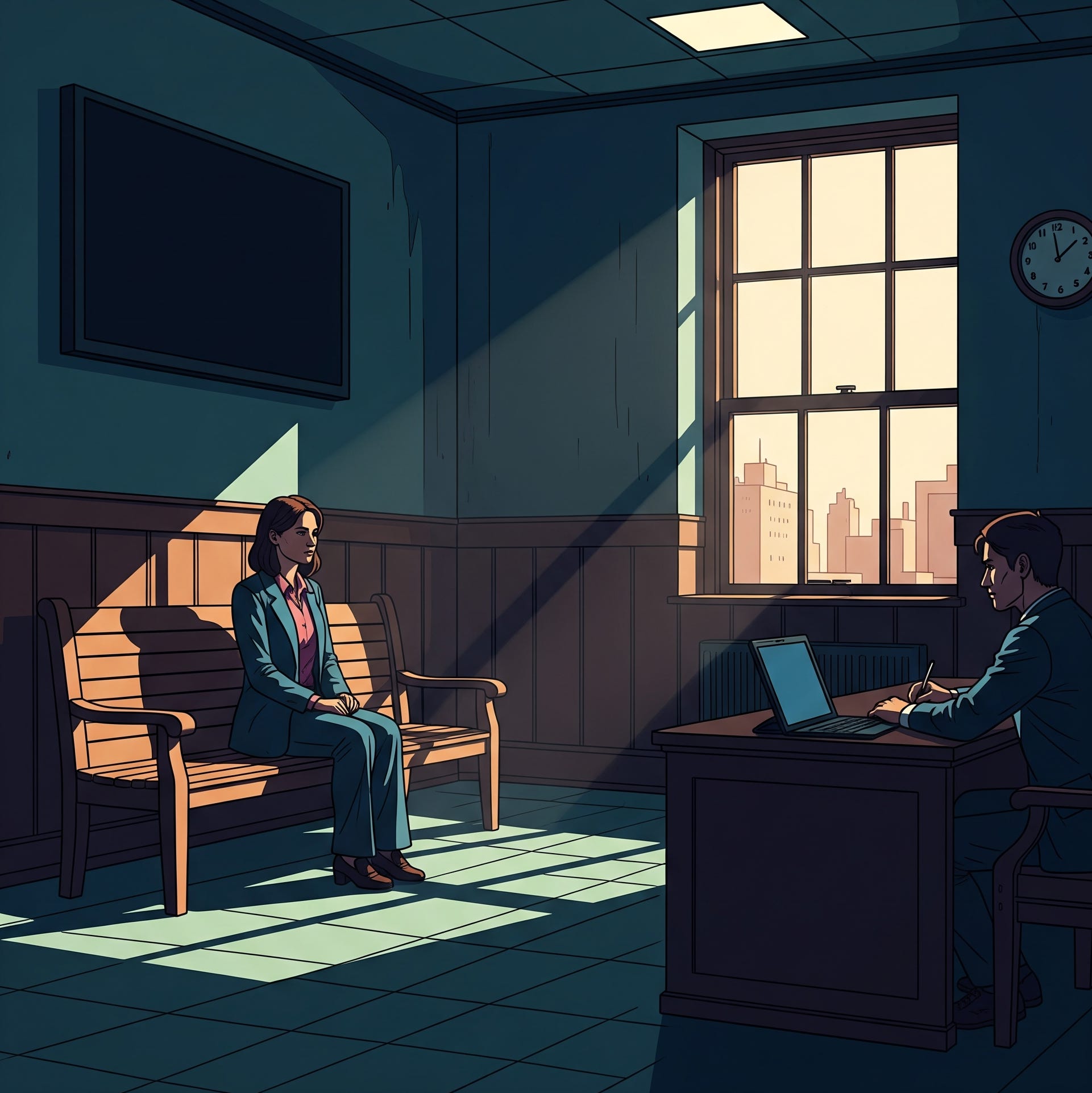
[From my diary]February, 26th 2026I got stuck in this divorce situation.We never met in the court. As an aftermath of the COVID time, live streaming replaced physical presence. If the couple did not live in the same city anymore, only one person had to come to the court. My ex-husband told me to consider it a convenience.I did come to the court.I saw him on a big, flat screen, in an encrypted live streaming session.Afterwards, it just did not feel real to be actually divorced. I asked him for a final personal conversation, but it never took place.Major life transitions usually require some form of ritual — a physical, witnessed moment that marks the change as real. When that moment is missing or stripped down, the mind often refuses to fully register what has happened, and the ending lingers as unfinished business. The growing tendency to handle separations through screens and paperwork has made this kind of unfinished ending more common, and the work of marking the change has shifted from public ceremony onto the individuals themselves.Why endings need ritualsAnthropologists and sociologists who study life transitions have a name for the moments that mark passage from one social state to another: rites of passage. Births, marriages, deaths, comings-of-age, and divorces have all been ritualized in nearly every human culture studied. The forms vary enormously, but the structure is remarkably consistent: a separation from the old state, a threshold period of being neither one thing nor the other, and a public reincorporation into the new state.The thing the ritual does, beyond its religious or legal meaning, is psychological. It tells the nervous system that the change has actually happened. Standing in front of witnesses, performing a specific act, saying specific words in a specific place — these elements give the mind something concrete to anchor the transition to. Without an anchor, the change can remain abstract, and the abstract change has a harder time becoming real.This is why most cultures have refused, for most of their history, to let major endings happen quietly. Funerals exist not because the dead person needs them, but because the living do. Weddings exist not because the marriage requires public confirmation to be valid, but because the new couple needs to be marked as a new couple by people who will continue to treat them as such. Divorce rituals, where they exist, do the same work in reverse: they mark, publicly, that what was joined is now separate.The hearing in a courtroom — a specific room, a specific judge, two people in the same physical space being addressed by a third — is one of the few remaining rituals modern Western culture has for the end of a marriage. It is sparse, but it is something. Both people are present. Words are spoken aloud. A formal act occurs. The room is left.What a screen takes awayThe shift to remote hearings, accelerated by the COVID years and then retained as a convenience, has quietly removed most of what the courtroom ritual was actually providing.On a screen, the other person is present as an image but not as a body. There is no shared room, no shared air, no possibility of meeting eyes in the way that happens when two people are in the same physical space. The encryption that protects the connection also distances it — the partner appears as data, mediated, slightly delayed, framed in pixels. The mind reads this differently than it reads a person standing across an actual courtroom. The encounter happens, but it does not quite land.There is also the absence of arrival and departure. In a physical courtroom, both people travel to the location, enter the building, sit in the same waiting area, see each other before and after the hearing, leave through the same doors. These small framing actions — the journey to the place, the entry, the exit — are part of what makes the event feel like an event. On a screen, the partner appears suddenly and disappears suddenly. There is no shared geography of the day.When one person comes in physically and the other appears only by stream, the asymmetry deepens the unreality. The partner who travels has a body in a room, a journey home, a clear before-and-after. The partner on the screen has none of these markers from the traveling partner’s perspective — and the screen partner, on their side, may not even have left their kitchen. The two endings happen in entirely different worlds. The shared moment that the courtroom was supposed to provide does not occur.Why the request for a final conversation came afterwardThe instinct expressed in my diary — asking for a final personal conversation after the legal divorce — is unusually clear about what was actually missing. The legal end had happened. The emotional end had not, because the legal end had not been embodied enough to count as one.Many people who divorce describe a version of this. The papers are signed, the hearing is concluded, the official status has changed, and yet something refuses to settle. They find themselves wanting one more conversation, one last meeting, a chance to say something — without quite being able to specify what would need to be said. The content of the desired conversation is often less important than the form: two people, in the same place, marking that this is the last time. Not to negotiate, not to fix, not to reconcile. Just to acknowledge, in each other’s physical presence, that what was is now finished.When that request goes unmet — as it often does, because the other partner has already moved on internally, or finds the prospect too painful, or simply does not understand what is being asked for — the ending stays unfinished in a particular way. The mind keeps returning to the missing meeting, looking for the moment that did not happen, trying to construct a closing scene out of imagined material. This can go on for years.What it doesn’t meanIt does not mean the divorce was not real, legally or factually. It was. It does not mean the ex-husband was withholding by treating the stream as a convenience — he may have genuinely experienced it that way, and the legal system increasingly encourages this framing. It does not mean a final conversation would have actually resolved anything, either. People who do get the meeting they were hoping for often find it less conclusive than they imagined. The unfinished feeling does not always come from a specific missing moment; sometimes it comes from the absence of any moment that could carry the weight of the change.What it does mean is that the work of marking the end of the marriage now has to be done privately, in the absence of an external ritual that did most of this work for previous generations. Some people do this through writing — journals, letters never sent, the slow construction of a personal account of what happened. Some do it through symbolic acts: returning to the apartment one last time, removing a ring with intention rather than absently, choosing a specific date as the personal anniversary of the ending. Some do it through ceremony — divorce rituals, formal or informal, are quietly becoming more common again precisely because people are recognizing that the legal process no longer provides what the soul of the ending requires.The “science” anchors, for your further-reading section:* Rites of passage: Arnold van Gennep’s Les Rites de Passage (1909) is the foundational source. Victor Turner’s later work on liminality developed the threshold-period concept significantly.* Ritual and psychological transition: more recent work by Michael Norton at Harvard Business School on the function of rituals after loss — short, accessible, well-cited.* Disenfranchised grief: Kenneth Doka’s term for grief that is not socially recognized or supported by ritual. Highly relevant for divorce, which often falls into this category.* Telepresence and emotional distance: a smaller and newer literature, but research on Zoom fatigue and the limits of video-mediated communication is now substantial. Jeremy Bailenson’s work at Stanford is a starting point.I write these reflections while building Supportive Stranger, a small iOS app for journaling through difficult moments. This is a public episode. If you would like to discuss this with other subscribers or get access to bonus episodes, visit divorcedme.substack.com
Embed this episode
Ready to play
Why didn't my divorce feel real after the hearing?
No transcript for this episode yet
Similar Episodes
No similar episodes found.
Similar Podcasts
No similar podcasts found.