
EPISODE · Apr 19, 2025
Why Does God Allow Evil? Augustine, Jonathan Edwards, and Michael Mathis Explore
from Ongoing Sovereignty Theology Podcast · host Michael Mathis
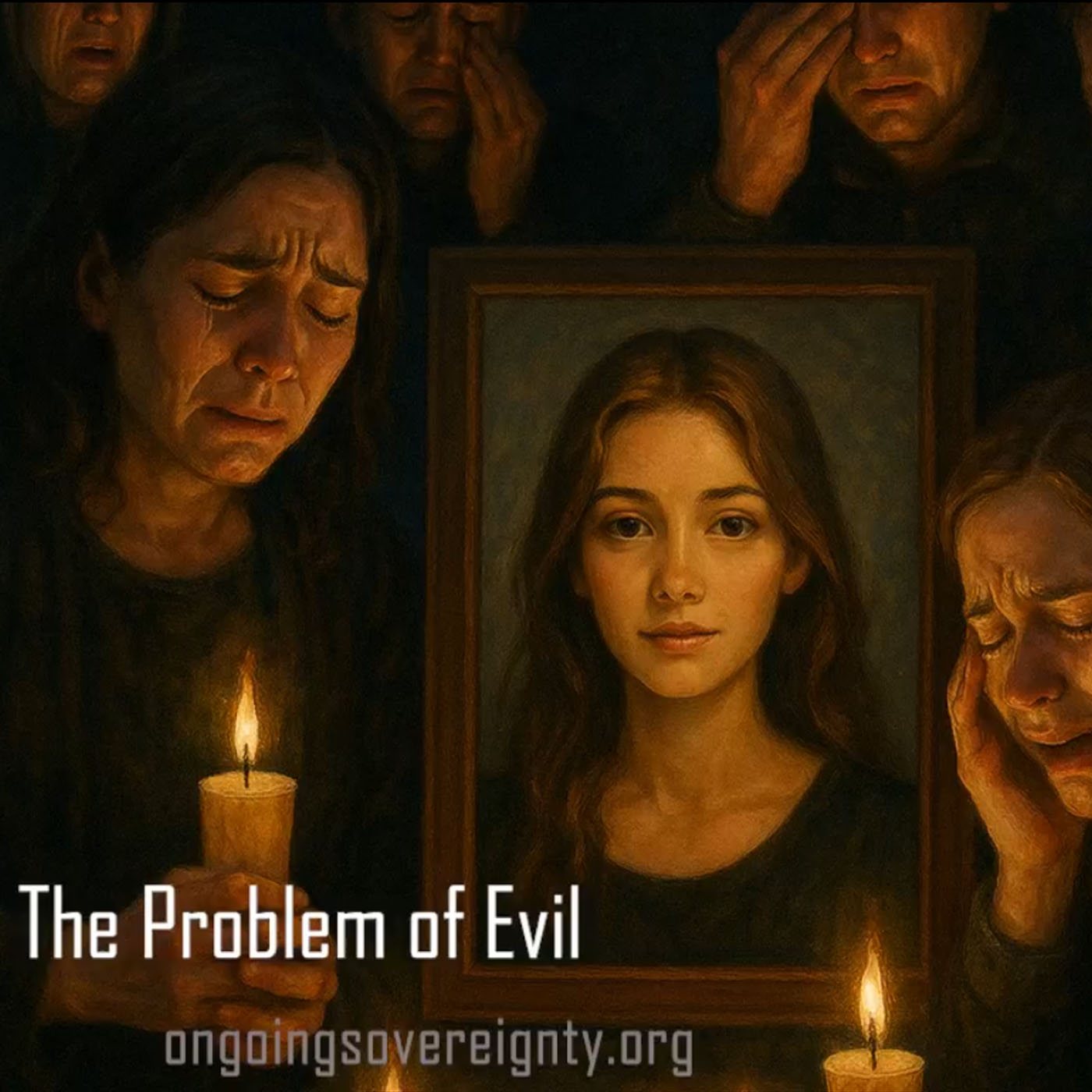
Michael MathisThe news hits like a gut punch: a teenage girl, full of life, raped and murdered, her body found in a desolate alley. Her family stands at a candlelit vigil, their faces etched with grief, voices cracking as they whisper, “Why, God? If You’re good, how could You let this happen?” This is the problem of evil, not a textbook debate but a raw, bleeding wound. Welcome to this week’s podcast, where we’re wrestling for hope in the face of such darkness. My theology, Ongoing Sovereignty Theology, sees God as the “I AM” of Exodus 3:14, alive in this moment alone. Time isn’t His chain; it’s His creation, a stream of moments measuring His eternal now. Before creation, He was; when He spoke in Genesis 1, time began. He knows every possible path every choice that murderer made, every tear that family sheds but doesn’t fix most outcomes, honoring our freedom. Evil, like this horror, isn’t His script; it’s the fracture of a free world, yet He weaves it toward good, shaping us into Christ’s image, as Romans 8:28–29 promises. I’m joined by Augustine of Hippo, whose insights on evil echo through history, and Jonathan Edwards, whose fire for God’s glory burns bright. Augustine, kick us off: how do you explain this family’s pain and God’s role in such evil? Augustine of HippoMike, the anguish of that family stirs my soul, as I mourned human brokenness in Confessions. Evil is not God’s creation, for Genesis 1:31 declares all He made was very good. It is a privation, a turning from the good, like a tear in a radiant tapestry. The murderer’s act, born of corrupted desire, echoes the fall in Genesis 3, where free will, God’s gift, was twisted. This freedom lets us love God truly, but its misuse births such atrocities. God’s eternal now sees all time at once, as Psalm 145:9 sings of His mercy over all. His foreknowledge of this crime didn’t cause it; He permitted it, weaving it into His redemptive plan. How do you account for this evil, Mike, if God is bound to the present? Michael MathisThat’s a fair question, Augustine. I see God as present, not bound, engaging each moment with perfect knowledge of possibilities, not a fixed future, so He can respond to human choices without scripting them. But let’s unpack your view first your tapestry image is vivid, and I want to hear more. How does God’s eternal perspective comfort that family, knowing their daughter’s death was foreseen? What do you think, Augustine? Augustine of HippoMike, your present God intrigues me, and I’ll return to it. For that family, God’s eternal now offers hope, not despair. In City of God, I teach that foreknowledge doesn’t cause evil God sees the murderer’s act as a poet knows a poem’s end, yet the words are ours. Psalm 139:4 says He knows our speech before we speak, yet we choose. Their daughter’s death, though foreseen, flows from human sin, not God’s will, as Romans 8:20–21 speaks of creation’s groan. God permits it, like Job’s trials (Job 42:12), for ends we can’t fully grasp perhaps refining faith or revealing justice. Their pain finds meaning in His eternal plan, where even evil serves redemption. Edwards, your view of God’s decree is bolder. How do you see this tragedy? Jonathan EdwardsAugustine, Mike, this murder kindles holy indignation, yet it serves God’s sovereign purpose. In Freedom of the Will, I teach that God’s absolute sovereignty ordains all for His glory, as Isaiah 46:10 declares He works all according to His purpose. This crime, though heinous, is within His decree, displaying His justice and mercy, as Romans 9:14–18 shows His power over vessels of wrath and honor. Human freedom exists, but it’s subordinate to God’s will, directing even sin to His ends. That family’s pain glorifies God, perhaps awakening souls to eternity. Mike, your present-only view seems to limit His dominion. Augustine, foreknowledge lacks decree’s certainty. How do you see God governing this evil? Michael MathisEdwards, your passion for God’s glory is powerful; Augustine, your poet analogy paints a picture. But let me clarify why my view doesn’t limit God, especially on time and freedom, since it’s central to this. When God created time in Genesis 1, He didn’t step into a future or fix a script. Time measures His eternal now, like a river of moments He flows in, not a road stretching forward. He’s the “I AM,” present alone, with authority to control all but choosing to decree only some like Christ’s cross or Israel’s call leaving vast possibilities open. This gives created beings, like that murderer or us, real autonomy, as Romans 3:23 shows we all sin freely, none deserving His goodness. Yet God rules dynamically, weaving our choices for Christlikeness, per Romans 8:29, not our wants. That murderer’s act wasn’t decreed or foreseen as fixed; it was a free fracture God grieves, as Psalm 34:18 vows He’s near the brokenhearted. Edwards, doesn’t your decree make God the author of this evil? Augustine, doesn’t foreknowledge make it inevitable? What do you both think? Augustine of HippoMike, your river of moments is a fresh lens, and I’m struck by God choosing to leave possibilities open it honors freedom in a way my eternal now might obscure. In On Free Choice, I argue the will chooses freely, though foreknown, as Psalm 139:1–4 shows God searches our hearts, yet we act. The murderer’s sin wasn’t inevitable; it was permitted, redeemed by God’s plan, as Christ’s cross (Hebrews 12:2) turned pain to joy. Edwards, your decree feels heavy does it not risk God’s goodness? Mike, your God responding in each moment fascinates me. How does He weave such evil for good without seeing all time? Jonathan EdwardsMike, Augustine, your present God challenges me. I hold in The End for Which God Created the World that all, including evil, is ordained for God’s glory, as Ephesians 1:11 states He works all after His will. This murder manifests His justice, per Romans 9:22–23, revealing mercy to the elect. But Mike, your view God ruling in the now, leaving autonomy open stirs curiosity. If He decrees only some, like the cross, and weaves free choices, His sovereignty shines in responsiveness. Augustine, your foreknowledge seems passive next to this. Mike, how does God’s present rule comfort that family, ensuring their pain serves Christlikeness? Michael MathisGreat question, Edwards, and I love your curiosity, both of you. God’s present rule means He’s with that family, hearing their prayers, as James 5:16 urges, working their grief for Christ’s image, not just relief, per Romans 8:29. Romans 9:22–23 shows He permits evil to reveal His attributes, so we worship fully, knowing mercy through wrath. His ongoing reign, unbound by a fixed future, lets Him shape every choice like theirs to pray or forgive toward Revelation 21:4’s new creation. Let’s turn to Scripture’s first murder, Cain and Abel in Genesis 4, to see this in action. Cain’s envy killed Abel, but God warned, “Sin is crouching at the door” (Genesis 4:6–7). Augustine, how does my view of God’s present response to Cain compare to your eternal perspective? Augustine of HippoMike, I’m drawn to your vision of God engaging Cain in real time. In City of God, I see God’s warning as eternal mercy, foreknown yet free, with Cain’s sin permitted, as Romans 8:20–21 speaks of creation’s groan. But your view God as the “I AM,” responding moment by moment, like Jonah 3:10’s relenting casts new light. In Genesis 4:9, when God asks, “Where is Abel?” it’s not ignorance but a present invitation to confess, as Psalm 34:18 shows His nearness to the broken. The curse and mark (Genesis 4:10–15) tailor justice and mercy to Cain’s heart. The knowledge to do this for every soul, as Psalm 139:1–4 describes, is vast. Edwards, doesn’t this magnify God’s care beyond a decreed plan? Jonathan EdwardsAugustine, Mike, I’m stirred. In Freedom of the Will, I see Cain’s act ordained for God’s glory, as Isaiah 46:10 states. But Mike’s God, present in each moment, knowing all possibilities, as Psalm 139:1–4 details, responds with care that humbles me. Genesis 4:15’s mark on Cain shows mercy tailored to his sin, aiming for redemption, like Romans 8:29’s Christlikeness. The vastness of God’s knowledge, seeing every creature’s path, surpasses my decrees. Augustine, how does this present care, clearer than our own sight per Isaiah 55:8–9, deepen our view of that family’s grief? Augustine of HippoEdwards, Mike, I’m in awe. My eternal now feels distant compared to this God, present in every cry, as Genesis 4:10’s blood and that family’s tears show. Psalm 34:18’s nearness, with Psalm 139’s knowledge, paints a God who sees each need far beyond our limits, as Isaiah 55:8–9 humbles us. Mike, for that family, how does God’s vast knowledge shape their pain, knowing their needs better than they? Michael MathisAugustine, your awe captures it. God’s knowledge is personal He sees that family’s grief, their prayers, as James 5:16 urges, and knows their need for Christlikeness, per Romans 8:29, beyond their wish for relief. In Genesis 4, He engages Cain’s heart, warning, questioning, protecting, each act precise. Romans 3:23–25 shows none deserve His grace, yet He weaves their pain, like Cain’s, for His glory, per Romans 9:22–23. Imagine the care to tend every soul, every moment, across creation! Edwards, how does this shift your view of God’s glory in suffering? Jonathan EdwardsMike, Augustine, this vision glorifies God beyond my decrees. His knowledge, searching every heart per Psalm 139, and care, near per Psalm 34:18, shine in each moment. That family’s pain, like Cain’s sin Chili, is woven for Christ’s image, revealing mercy, per Romans 9:22–23. His thoughts, per Isaiah 55:8–9, surpass ours He sees their true need. Augustine, doesn’t this unite us in worship? Augustine of HippoEdwards, Mike, it does. My poet pales beside this God, present in every wound, as Genesis 4 and that family’s grief attest. His knowledge and care, per Psalm 139 and 34:18, surpass our sight, as Isaiah 55:8–9 teaches. Mike, how do we live this truth today? Michael MathisAugustine, Edwards, we live by praying, trusting, acting, as James 5:16 urges, knowing God hears, shaping us for Christ, per Romans 8:29. That family’s vigil, our pain God’s near, per Psalm 34:18, seeing our needs, per Isaiah 55:8–9. Romans 3:23–25 shows none deserve grace; Romans 9:22–23 reveals mercy through evil. Listeners, marvel: is God conducting your moments, His knowledge vaster than yours? Keep wrestling.
NOW PLAYING
Why Does God Allow Evil? Augustine, Jonathan Edwards, and Michael Mathis Explore
No transcript for this episode yet
Similar Episodes
Mar 26, 2026 ·1m
Jan 2, 2026 ·47m
Dec 21, 2025 ·46m